The original Lexus LS 400 is a compelling choice for the best Lexus ever built—not because the available evidence proves it beats every later model, but because it gave Lexus its identity. Launched in 1989 after a six-year development program, it paired a new 4.0-liter V8 with a carefully defined luxury-car brief and helped establish a brand that Toyota intended to compete directly with Europe’s leading marques. Here are 10 reasons the first LS 400 still matters.
1. It made Lexus real
The LS 400 was one of two sedans—the other was the ES 250—with which Lexus launched in 1989. As the new brand’s flagship, it did more than add a model to Toyota’s lineup: it gave the Lexus name a clear point of origin. No later Lexus can occupy that founding role. Lexus’s history of the brand identifies both launch sedans.
2. Toyota set out to challenge established luxury marques
Toyota described the LS 400 as its first car designed to compete directly with European names such as BMW and Mercedes-Benz. That was the company’s stated ambition, not proof that the car outperformed those rivals in every respect. But it shows the scale of the challenge Toyota chose for its new flagship. Toyota’s May 15, 1989 production announcement set out that aim.
3. Its development was a long-term corporate bet
Toyota’s May 1989 announcement said the LS 400 had spent six years in development; the company’s history dates the project’s start to 1984. The car premiered publicly at the Detroit auto show in January 1989, production was announced in May, and the U.S. customer launch was scheduled for September 1. The Japanese-market Celsior followed in October. Those are separate milestones in a deliberately staged launch, not competing accounts of one date. Toyota’s corporate history of the development program and Lexus’s retrospective describe the project and premiere.
Recommended Free Tools
#1 Best Overall

- Authentic Replica: This Matchbox die-cast vehicle faithfully recreates the iconic 1994 Lexus LS 400 luxury sedan, capturing the elegant design and sophisticated styling of this classic Japanese luxury automobile in detailed miniature form
- Quality Construction: Manufactured in Thailand with durable die-cast metal body and precision engineering, ensuring long-lasting play value and collectible quality that withstands repeated handling and display
- Perfect Scale: Designed in classic Matchbox scale, this model vehicle features accurate proportions and realistic details that make it ideal for both imaginative play scenarios and display in any die-cast collection
- Collectible Appeal: A must-have addition for automotive enthusiasts and Matchbox collectors, representing a significant model from Lexus's flagship luxury sedan line during the mid-1990s era
- Versatile Play: Suitable for creative play, educational purposes about automotive history, or as a decorative piece, this non-riding toy vehicle offers entertainment value for children and collectors alike
4. The V8 was central to the flagship’s identity
The LS 400 arrived with a new 4.0-liter V8, rather than relying on an existing smaller-car engine. Toyota rated the U.S. launch car at 250 hp in its 1989 announcement. The UK launch pack identifies the engine as the 1UZ-FE: a 3,969 cc all-alloy V8 with dual overhead camshafts and four valves per cylinder. The UK document describes its market’s specification; Toyota’s announcement is the source for the U.S. horsepower rating. Toyota engineers also presented the engine in a 1989 technical paper. Toyota’s production announcement, the 1990 Lexus UK launch pack, and the SAE paper on the new V8 document these details.
5. The brief began with studying luxury-car buyers
Toyota says project members spent months in the United States studying the lives, expectations, and requirements of luxury-car owners. That is evidence of a customer-research-led brief, not a claim that every potential buyer was consulted or that research alone guaranteed success. The approach matters because Toyota was building a new luxury identity, not simply changing the badge on an existing model. Toyota’s account of the Lexus development program describes the research.
Rank #2
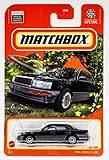
- COLLECTIBLE SERIES: Part of the 1994 Matchbox lineup, numbered 26 out of 100 in the collection series
- AUTHENTIC DESIGN: Precision-crafted miniature replica of the luxurious Lexus LS 400 in sleek black finish
- SCALE DETAILS: Expertly reproduced at 1:64 scale with authentic body styling and proportions
- DISPLAY QUALITY: Die-cast metal construction with detailed exterior features and classic Matchbox craftsmanship
- VEHICLE SPECS: Features rolling wheels, black paint scheme, and distinctive Lexus LS 400 luxury sedan body style
6. The team had five explicit goals
Toyota’s history lists the criteria identified in that buyer research: prestige, quality, resale value, performance, and safety. The list does not establish how the LS 400 compared with rivals on each measure. Instead, it gives readers a grounded way to understand what Toyota intended its flagship to deliver—and why the project was broader than designing a powerful engine or an elegant sedan.
7. The prototype program was substantial
Lexus’s retrospective reports that approximately 450 prototypes were built. That figure conveys the reported scale of the development effort, although it is Lexus’s retrospective account rather than an independent audit. It reinforces the picture of the LS 400 as a carefully developed flagship rather than a quick response to the luxury market. Lexus’s retrospective gives the estimate.
Crashes, No Sound, or Screen Glitches?
Random freezes, missing sound and display glitches usually trace back to one bad driver. Find and replace yours safely.Free scan · under a minuteWindows Errors? Fix Them Before They Spread
Repair common Windows errors and clear accumulated junk for a smoother, more stable PC - no reinstall needed.Free scan · no reinstallRank #3
![Matchbox 1994 Lexus LS 400 [Green], 1:64 Scale Diecast Toy Vehicle](https://m.media-amazon.com/images/I/51MePb+BkCL._SL160_.jpg)
- 1994 Lexus LS 400 in a Luxurious Green Finish!
- Number 36/125 in the Overall Series!
- 1:64 Scale Diecast Toy Car
8. The launch included testing before cars reached dealers
Toyota said new LS 400s would undergo high-speed testing on a factory track in Japan and receive a further inspection and test drive in the United States before dealer delivery. This describes the launch quality-control process Toyota announced in 1989; it does not establish the present condition of any surviving car. It does, however, show that Toyota made the delivery process part of its quality promise. The production announcement describes those checks.
9. Lexus earned an early quality accolade
Toyota’s corporate history reports that Lexus placed first in the 1990 J.D. Power Initial Quality Study. The scope matters: this is a dated, brand-level initial-quality result, not a lifetime reliability statistic for every LS 400. It is still a notable early signal for a new luxury marque. Toyota’s history of the launch and early recognition reports the result.
Rank #4

- Product size: 6.3*2.4*1.8 inches Weight: 0.5 pounds Outer packaging: exquisite color translucent packaging box.
- Material: Die-cast car model, made of zinc alloy, with plastic parts, rubber tires, detailed interior and exterior decoration.
- Function: Press the two wheels of the front car to trigger the sound of the engine and lights. The interior details are realistic. Put the car on the flat ground, press the body and pull it back, and the car will move forward. (Back pull function)
- This LS500H 1/32 car model pull back car is very suitable for children to play with. The paint is exquisite and feels good, and it is heavy to hold. It is also very suitable for car model enthusiasts as a decoration.
- Accessories and collections: This product is very suitable for static accessories and can be used as an accessory next to a computer. For those who are passionate about collecting model car models, this is a great art collection.
10. Its strongest claim is significance, not a universal ranking
“Best ever” depends on what a driver values: the original LS 400’s founding importance, a later model’s technology, or another Lexus’s performance and character. The historical case for the first LS is unusually strong because it was the flagship that introduced the brand and embodied Toyota’s ambition to enter the luxury-sedan market on its own terms. The available sources do not establish that it is objectively superior to every Lexus that followed, nor do they provide a comparative lifetime failure rate for surviving LS 400s. Its legacy rests most convincingly on what it set in motion.
Quick Recap
Best Value

- High-quality materials: Made from zinc alloy, the metal parts are electroplated and polished for a stylish, durable finish that resists fading.
- Fashionable appearance: The zinc-coated iron part of the keychain has a shiny finish, matches your keys while allowing 360-degree rotation.
- Wise Gift: Perfect for occasions like birthdays and Father's Day, suitable for car, motorcycle, and house keys.
- Wide Applications: This premium keychain ring can be used for your house keys, keychains, car keys, key finders, pendants, pet collars, wallet charms, etc.
- After-sales service: Contact us if you have any questions.
Product prices and availability are accurate as of the date/time indicated and are subject to change. Any price and availability information displayed on Amazon at the time of purchase will apply.