The most reliable six-cylinder engines ever made are not a scientifically ranked group, but this evidence-informed shortlist includes Toyota’s 1HZ, 1FZ-FE and 2JZ, Mercedes-Benz’s OM606, Cummins’ 6BT, Nissan’s RB26DETT, BMW’s M54 and M57, Jeep’s 4.0L, and GM’s LL8. Their architecture, serviceability, and applications support the case; condition still decides ownership reliability.
There is no apples-to-apples published dataset measuring failure rates, average lifespan, or survival mileage across all ten engines. The shortlist therefore uses documented specifications, duty-cycle evidence, architecture, parts support, service knowledge, and qualified ownership considerations rather than pretending to offer a precise statistical ranking.
Key takeaways
- There is no manufacturer-neutral dataset that ranks failure rates, average lifespan, or survival mileage across these ten engines, so this is an evidence-informed shortlist rather than a statistical league table.
- Toyota’s 1HZ, 1FZ-FE and 2JZ families, Mercedes-Benz’s OM606, and Cummins’ 6BT make the strongest broad reliability cases here, but each succeeds for a different combination of architecture, duty cycle, serviceability, and parts support.
- A naturally aspirated engine generally has fewer expensive systems to fail, but turbocharged engines such as the OM606, 6BT, 2JZ-GTE, RB26DETT and M57 can be exceptionally durable when correctly engineered, maintained, and left within a sensible tune.
- A durable long-block does not guarantee a cheap vehicle: cooling systems, transmissions, electronics, turbochargers, fuel systems, rust, and previous modifications can dominate ownership cost.
- A compression test can expose uneven cylinder sealing before purchase, but it cannot rule out every important defect; service history, leak checks, cooling-system inspection, oil-pressure testing where appropriate, and professional diagnosis still matter.
What are the 10 of the most reliable six-cylinder engines ever made?
The following ten engines stand out because their basic designs have earned extensive service knowledge, broad applications, strong parts support, or credible heavy-duty use. The order is editorial, not a measured ranking from first to tenth.
| Engine | Configuration and documented specification | Why it makes the shortlist | Main ownership caution |
|---|---|---|---|
| Toyota 1HZ | naturally aspirated, water-cooled 4,163 cc inline-six diesel; Toyota’s 1990 Land Cruiser 80 record lists 135 PS net in a representative application. | Conservative output, simple diesel architecture, and extensive commercial and remote-use history. | Age, cooling-system condition, injection wear, and vehicle rust can matter more than the basic long-block. |
| Toyota 1FZ-FE | 4,477 cc naturally aspirated gasoline inline-six with a 24-valve DOHC head and chain-and-gear drive; Toyota’s 2002 technical specification records 165 kW at 4,600 rpm and 387 Nm at 3,600 rpm. | Large displacement, strong low-speed torque, and a robust Land Cruiser application. | The complete four-wheel-drive vehicle can be expensive even when the engine itself is durable. |
| Mercedes-Benz OM606 | 2,996 cc indirect-injection inline-six diesel with turbocharging, intercooling, twin overhead camshafts, a Bosch six-plunger pump, and a double-roller chain; Mercedes-Benz Group’s official archive lists 130 kW/177 hp and 210 Nm for the cited E 300 Turbodiesel. | Robust diesel foundation, long-distance reputation, rebuildability, and tuning headroom. | Fuel-control systems, turbo hardware, electronics, and the age of the vehicle can be costly. |
| Cummins 6BT/6BTA 5.9 | 5.9-liter four-stroke, turbocharged, direct-injection inline-six diesel with a 102 mm bore, 119 mm stroke, and cast-iron six-cylinder block; Cummins’ 2024 specification identifies these core dimensions. | Commercial-duty design, simple mechanical variants, a large parts ecosystem, and severe-duty applications. | The installation, transmission, cooling system, or chassis may fail before the long-block. |
| Toyota 2JZ-GE/2JZ-GTE | Inline-six gasoline family used in the A80 Supra; Toyota’s 2024 heritage material describes the cited Supra output as 220 hp and 209 lb-ft for the naturally aspirated GE and 320 hp and 315 lb-ft for the twin-turbo GTE. | Strong architecture, deep replacement-parts and tuning support, and a large service knowledge base. | Modified boost, poor calibration, turbo upgrades, and neglected cooling systems change the reliability equation. |
| Nissan RB26DETT | 2,568 cc DOHC twin-turbo inline-six; Nissan’s 1989 R32 Skyline GT-R specification lists 280 PS and 353 Nm. | Motorsport validation, a strong aftermarket, and a capable bottom end when properly assembled and maintained. | Age, oiling, turbochargers, electronics, and modification history are central risks. |
| BMW M54 | Naturally aspirated gasoline inline-six family including the M54B25 and M54B30; BMW’s 2004 E60 technical training material documents the family and Siemens MS45.1 engine management. | Mature design, widespread installation, abundant service knowledge, and plentiful parts. | Cooling, crankcase ventilation, intake, gasket, and sensor systems require systematic renewal on older examples. |
| BMW M57 | 2,993 cc inline-six diesel with an 84 mm bore, 90 mm stroke, and 16.5:1 compression ratio; BMW’s 2015 powertrain reference gives 560 Nm for the cited X5 application. | Torque-rich diesel core with extensive use in passenger vehicles and SUVs. | Turbocharging, emissions equipment, electronics, intake components, and fuel-system repairs can be expensive. |
| Jeep/AMC 4.0L inline-six | 4.0-liter, 242-cubic-inch gasoline inline-six; 1995 Jeep service information lists a six-quart oil capacity. | Simple layout, broad production, accessible service, and abundant replacement parts. | Rear-main-seal leaks, oil leaks, cracked exhaust manifolds, cooling neglect, and vehicle age are common ownership concerns. |
| GM 4.2L LL8 | 4.2-liter naturally aspirated gasoline inline-six; General Motors’ 2010 performance-parts catalog lists 285 hp and 276 lb-ft. | Smooth operation, strong naturally aspirated performance, broad North American production, and a crate-engine option. | Vehicle-level age issues and application-specific electronics can outweigh the engine’s strengths. |
How were these engines selected?
Reliability here means a persuasive combination of durable architecture and realistic long-term ownership potential—not a promise that every surviving example is trouble-free. The most useful comparison axes are naturally aspirated versus turbocharged induction, gasoline versus diesel fuel, mechanical versus electronic injection, timing-drive design, specific output, cooling and lubrication requirements, parts availability, repair cost, modification history, and the condition of the entire vehicle.
#1 Best Overall
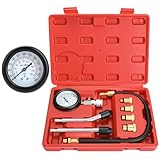
- Checking Compression On Petrol Engine Quickly And Accurately
- Easy Pressure Release Button On Side Of Tester
- 3" Gauge Features Dual Color Scale for easy reading. Pressure Range: 0-300psi, 0-20bar
- Kits Includes 2 Rubber Cones Ends for quick check. (no need to thread into head)
- Includes 17.7" extension hose with 4 sizes (10mm, 12mm, 14mm, 18mm) selectable adapters, suitable for petrol engines on motorcycles, cars, trucks, ATVs and more
The shortlist deliberately mixes engines built for very different jobs. A Toyota 1HZ in a remote-use Land Cruiser, a Cummins 6BT in a commercial installation, and a BMW M54 in an aging passenger car cannot be judged by the same ownership standard. A simple engine may be easier to repair, while a more complex engine may deliver greater performance or efficiency without being inherently fragile.
Neither manufacturer specifications nor heritage claims provide an apples-to-apples failure-rate study. The official documents below establish architecture, applications, and specifications; they do not prove that one engine survives more miles than another. No mileage claim is made because no reliable cross-engine survival dataset was found.
1. Why is the Toyota 1HZ one of the most reliable six-cylinder diesels?
The Toyota 1HZ earns its place through conservative naturally aspirated diesel design, extensive heavy-duty use, and a service reputation developed in Land Cruiser and Coaster applications. Toyota’s historical specification identifies the engine as a 4,163 cc water-cooled inline-six; the representative Land Cruiser 80 specification records 135 PS net, while the cited Coaster application is listed at 140 PS. Those figures indicate a deliberately modest output for the displacement rather than a highly stressed performance engine.
That low-stress character is the central argument for the 1HZ. The engine is mechanically straightforward compared with modern turbocharged, electronically managed diesels, and commercial-vehicle use has created a large knowledge base around diagnosis and repair. Owners who travel far from specialist support often value that combination more than peak power.
“Indestructible” is too strong. A 1HZ can be worn, overheated, poorly serviced, or attached to a badly rusted Land Cruiser. Before buying, inspect the cooling system, look for evidence of overheating, assess injection-system condition, check cold-start behavior and exhaust smoke, and evaluate the condition of the chassis and body. The engine’s reputation should not excuse a poor individual example.
2. What makes the Toyota 1FZ-FE such a durable gasoline inline-six?
The Toyota 1FZ-FE combines large displacement, naturally aspirated induction, strong low-speed torque, and a substantial Land Cruiser application. Toyota’s 2002 technical document identifies the engine as a 4,477 cc six-cylinder inline gasoline design with a 24-valve DOHC head, chain-and-gear drive, 165 kW at 4,600 rpm, and 387 Nm at 3,600 rpm.
The 1FZ-FE’s appeal is not simply its size. Naturally aspirated operation avoids turbocharger hardware, and the engine’s torque makes it well suited to a heavy four-wheel-drive vehicle without requiring extreme specific output. The Land Cruiser platform also gives the family a broad global service and parts knowledge base.
The important qualification is vehicle-level cost. A reliable 1FZ-FE does not make an old Land Cruiser inexpensive: transmissions, driveline components, suspension, electronics, cooling hardware, rust repair, and four-wheel-drive systems can require substantial investment. Judge the engine and the vehicle as separate systems during an inspection.
3. Is the Mercedes-Benz OM606 reliable?
Yes—the Mercedes-Benz OM606 has a strong reliability case as a mechanically robust, long-distance diesel, although the complete car can be considerably more complex and expensive than the basic engine architecture suggests. In the cited E 300 Turbodiesel application, Mercedes-Benz Group’s official archive identifies the OM606.962 as a 2,996 cc inline-six with indirect injection, a Bosch six-plunger injection pump, turbocharging, intercooling, two overhead camshafts, and a double-roller chain, rated at 130 kW/177 hp and 210 Nm.
Rank #2

- FOR GASOLINE ENGINES ONLY: Designed for cars, trucks, ATVs, and small engines - please note this kit is not suitable for diesel or crude oil engines
- HIGH-VISIBILITY FLUORESCENT GAUGE: Features a triple-scale reading from 0-300 PSI, 0-20 Bar, and 0-21 kg/cm² for precise measurements and clear visibility in low-light conditions
- COMPREHENSIVE 13-PIECE KIT: Comes with five durable metal adapters (M10-M18), two spark plug testers, extension hose, and a protective case for a complete diagnostic solution
- QUICK-RELEASE SAFETY VALVE: Allows for safe and easy one-handed pressure release after testing to prevent accidental bursts
- PROFESSIONAL DIAGNOSTIC ACCURACY: Delivers reliable peak pressure readings to accurately assess engine health, identify worn piston rings, and detect valve issues
The OM606 is attractive to enthusiasts because the diesel foundation is durable, rebuildable, and capable of supporting additional performance when the fuel, turbocharging, cooling, and calibration work is done properly. The engine’s long-distance reputation is meaningful evidence of suitability, but it is not a laboratory failure-rate result.
Buyers should separate long-block strength from the systems surrounding it. Fuel-control components, turbochargers, sensors, wiring, automatic transmissions, suspension, and corrosion can determine whether an OM606-powered Mercedes is affordable to own. A heavily modified example deserves more skepticism than an unmolested car with documented maintenance.
4. Why is the Cummins 6BT/6BTA 5.9 considered a reliable diesel?
The Cummins 6BT/6BTA 5.9 belongs on the list because it was developed for commercial and industrial duty rather than delicate, low-load passenger-car use. Cummins’ 2024 product specification describes the 6BT/6BTA as a 5.9-liter, four-stroke, turbocharged inline-six diesel with direct injection, a 102 mm bore, a 119 mm stroke, and a cast-iron six-cylinder block.
Quick wins for a faster PC:
Fix the driver behind crashes, sound loss and screen glitchesFind Drivers →Clear out junk files and repair common Windows errorsFree Scan →Mechanical versions are especially appealing to owners who prioritize straightforward diagnosis and repair. The engine family has been used in trucks, buses, industrial equipment, generators, marine applications, and other demanding installations, creating an unusually deep parts and technical-support ecosystem. Cummins describes its mechanical B-Series products as suited to “severe duty cycles” and promotes “first class reliability”; those are manufacturer claims, not independent proof, but they accurately explain the intended duty profile.
The installation determines the ownership experience. A 6BT conversion can introduce cooling, gearing, vibration, wiring, braking, registration, and chassis problems that have nothing to do with the long-block. In a truck or industrial machine, inspect the complete drivetrain and maintenance records rather than assuming that a recognizable Cummins badge guarantees a healthy engine.
5. Is the Toyota 2JZ really the most reliable engine?
The Toyota 2JZ is one of the strongest performance-engine reliability choices, but no evidence supports calling it universally the most reliable engine. The naturally aspirated 2JZ-GE and twin-turbo 2JZ-GTE combine a strong inline-six foundation with an enormous performance, rebuilding, and replacement-parts ecosystem. In the A80 Supra specification, Toyota’s 2024 heritage material lists 220 hp and 209 lb-ft for the 2JZ-GE and 320 hp and 315 lb-ft for the 2JZ-GTE.
Toyota’s historical record gives useful context: it states, “August 1990 — JZ series of in-line, 6-cylinder gasoline engines developed.” The same official engine-development record lists the 1HZ as an inline, six-cylinder diesel engine developed in August 1990. The 2JZ’s reputation comes from its architecture, its successful applications, and decades of specialist knowledge—not from a universal published survival-mileage comparison.
What’s actually slowing this PC down?
Pick the symptom - the matching free tool is one click away.
Stock reliability and modified-car reliability must be kept separate. A standard 2JZ-GE or GTE with good oil, cooling, ignition, and fuel-system maintenance is a different proposition from a car with a turbo conversion, aggressive boost, poor engine calibration, or repeated track use. On a used Supra or project car, the quality of the build and tuning history matters at least as much as the engine code.
Toyota’s Supra service documentation provides engine-specific maintenance information including valve clearances, spark-plug specifications, and oil capacities. That kind of factory documentation, combined with the 2JZ’s large specialist community, is a practical reliability advantage.
Rank #3
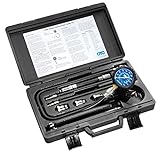
- OTC's Deluxe Compression Tester Kit offers a complete package for compression testing on gasoline engines and comes with commonly used standard and specialty adapters
- Kit includes the deep well connector used on recessed plug well style heads and the new Ford Triton engine adapter using 16 mm thread plugs
- Adapters work on both flat and tapered seat plugs; corrosion resistant nickel plated finish protects metal components
- Easy to read 2-1/2 inch gauge features a chrome bezel and rugged protective outer boot; Dual scale gauge reads 0-300 psi and 0-2100 kPa
- Extra long 25 inch flex hose gauge assembly with quick coupler allows easy viewing out of cluttered engine compartments
6. Does the Nissan RB26DETT belong on a reliability shortlist?
Yes, but the RB26DETT belongs on this list as a durable, high-performance engine—not as proof that a race-bred Skyline is cheap or trouble-free to own. Nissan’s official 1989 R32 Skyline GT-R heritage specification identifies the RB26DETT as a 2,568 cc DOHC twin-turbo inline-six producing 280 PS and 353 Nm.
The engine has a substantial bottom-end reputation, a huge aftermarket, and genuine motorsport validation. Nissan’s heritage account records 29 consecutive Group A victories for the R32 GT-R during the relevant championship period. That record is documented by Nissan’s NISMO heritage material, but competition success should not be confused with ordinary road-car reliability. Race engines are inspected, rebuilt, and operated within controlled maintenance programs.
Free tools Windows power users keep installed
One-click scans. No signup required.
Age and modification history are the decisive buyer risks. Inspect the oiling system, turbochargers, engine-management hardware, cooling system, wiring, and the quality of every aftermarket modification. An original or professionally rebuilt RB26 with clear records is a very different purchase from a neglected GT-R carrying unknown boost, fuel, and calibration changes.
7. Are BMW M54 inline-six engines reliable?
BMW M54 engines can be reliable long-term engines when their known age-related systems are renewed systematically rather than ignored. BMW’s technical training material for the E60 documents the M54B25 and M54B30 naturally aspirated inline-six engines and their Siemens MS45.1 engine-management system. The official BMW reference is useful for identifying the engine-management architecture and application context.
The M54’s advantages are maturity, widespread installation, accessible service procedures, and strong parts availability. Its naturally aspirated layout also avoids turbocharger and diesel high-pressure fuel-system costs. Those strengths make the M54 a sensible choice for a usable older BMW when the purchase price includes a realistic maintenance reserve.
The common mistake is treating a mature design as maintenance-free. Cooling-system components, crankcase-ventilation parts, intake hardware, gaskets, and sensors can all become age-related service items. A low purchase price does not mean a low first-year cost, and a pre-purchase inspection should look for accumulated deferred maintenance rather than only catastrophic engine damage.
8. Why is the BMW M57 a strong diesel choice?
The BMW M57 is a durable, torque-rich diesel family whose core strength is tempered by the complexity of the vehicles in which it was installed. BMW’s 2015 powertrain and chassis reference identifies the cited M57D30T2 as a 2,993 cc inline-six with an 84 mm bore, 90 mm stroke, 16.5:1 compression ratio, and 560 Nm of torque in the X5 application.
The M57’s broad use in passenger vehicles and SUVs provides substantial service knowledge, while the diesel’s strong torque suits long-distance driving and towing. The core engine can be very durable when oil, cooling, fuel, and turbocharger maintenance are handled correctly.
Vehicle complexity is the qualification. Turbocharging, emissions equipment, electronics, intake components, automatic transmissions, and diesel fuel-system repairs can turn a sound engine into an expensive ownership proposition. The M57 is a good candidate for buyers who understand diesel diagnosis and maintenance, not necessarily for someone seeking the simplest possible six-cylinder car.
Rank #4

- Professional Tester Kit: Our engine cylinder compression tester kit helps you measure pressure on gasoline engine cylinder quickly and accurately. Made of choice materials and treated with rust prevention and corrosion prevention, sturty and time-proof
- Compression Gauge: Large acrylic dial and double-scale gauge for more accurate reading of data. Pressure range up to: 300 psi & 20 bar. One-click release pressure before disconnecting to reduces the risk of fuel injection. Comes with scratch resistant coating and rubber protective cover
- Universal Connection: Two universal rubber cone adapters provide quick and easy connections suitable for most spark plug depths, and an extended hose allows you to get into tight Spaces. Connect with the dial using a quick connection coupler, simple and fast
- Complete Accessories: The cylinder compression tester Kit includes: 1 x compression gauge, 2 x rubber cone ends, 4 x Metal adapter, 1 x 14" extension hose and 1 x manual. Four adapter sizes are widely available for most cars, motorcycles, ATVs, boats, snowmobiles, etc
- Note: Most diesel engines do not use engine pressure gauges due to the low pressure range. Please read the manual carefully before using the compression tester kit. We will provide satisfactory solutions for any issues with the product
9. Is the Jeep/AMC 4.0L the easiest classic six-cylinder to maintain?
The Jeep/AMC 4.0L is one of the easiest classic six-cylinder engines to understand and service, thanks to its simple layout, broad production, accessible engine bay in many applications, and abundant parts. 1995 Jeep service information identifies the engine as a 4.0-liter, 242-cubic-inch inline-six and lists a six-quart oil capacity.
Crashes, No Sound, or Screen Glitches?
Random freezes, missing sound and display glitches usually trace back to one bad driver. Find and replace yours safely.Free scan · under a minutePC Slower Than It Used to Be?
A free scan shows the junk files, broken settings and background clutter dragging Windows down - then fixes them in one click.Free scan · Windows 10 & 11The 4.0L is appealing for a long-term project because routine mechanical work is familiar to independent shops and owners, and replacement parts remain widely available. It is a practical durability choice rather than a high-output performance choice.
Surviving Jeeps are old enough that leaks and surrounding-vehicle problems deserve serious attention. Check for rear-main-seal and other oil leaks, cooling-system neglect, cracked exhaust manifolds, poor wiring repairs, worn driveline components, rust, and suspension damage. A durable 4.0L can be attached to a vehicle requiring far more work than the engine itself.
10. What makes the GM 4.2L LL8 worth considering?
The GM 4.2L LL8 is a smooth and strong naturally aspirated inline-six that deserves more attention than its lower-profile reputation suggests. General Motors’ 2010 Performance Parts catalog lists 285 hp and 276 lb-ft for the 4.2L LL8 and identifies the engine as a crate-engine assembly.
The LL8 was used in midsize SUVs including the Chevrolet TrailBlazer and GMC Envoy. Its naturally aspirated design, broad torque curve, smooth inline-six balance, and large North American production base make it a reasonable choice for an affordable driver or project where parts availability matters.
Do these 3 things before closing this tab:
1Fix the driver behind crashes, sound loss and screen glitches2Clear out junk files and repair common Windows errors3Scan for outdated or missing drivers - takes under a minuteThe main caveat is application age, not an assumption that the engine is maintenance-free. Inspect the electrical and electronic systems, cooling system, oil leaks, transmission, suspension, and body condition. A healthy LL8 can be a good value; a neglected SUV can consume the savings through vehicle-level repairs.
Which engine is best for a specific long-term project?
The best engine depends on the project’s purpose, fuel preference, access to parts, and tolerance for electronic or fabrication work. There is no single winner across remote travel, commercial duty, daily driving, restoration, and high-power performance.
| Project goal | Strongest shortlist choices | Why | Trade-off |
|---|---|---|---|
| Remote travel and simple diesel ownership | Toyota 1HZ | Naturally aspirated diesel architecture, conservative output, and Land Cruiser service knowledge. | Limited performance compared with turbocharged alternatives; age and vehicle rust are major concerns. |
| Heavy-duty truck, industrial, or conversion use | Cummins 6BT/6BTA 5.9 | Commercial-duty foundation, cast-iron block, mechanical variants, and broad technical support. | Installation, cooling, gearing, chassis, and legal-conversion issues can dominate the project. |
| Large gasoline four-wheel-drive vehicle | Toyota 1FZ-FE | Large naturally aspirated displacement, strong torque, and robust Land Cruiser application. | Fuel consumption and the cost of the surrounding four-wheel-drive vehicle still matter. |
| Simple classic gasoline project | Jeep/AMC 4.0L | Accessible service, familiar layout, broad production, and abundant parts. | Most surviving vehicles need age-related leak, cooling, rust, and driveline work. |
| Reliable performance project | Toyota 2JZ or Nissan RB26DETT | Strong specialist ecosystems, substantial performance support, and capable architectures. | Modification quality, boost, tuning, turbochargers, oiling, and cooling determine the result. |
| Older European daily or touring car | BMW M54 or Mercedes-Benz OM606 | Mature service knowledge and strong engines when maintenance is documented. | Vehicle electronics, fuel systems, cooling systems, transmissions, and corrosion can be expensive. |
How do naturally aspirated, turbocharged, gasoline, and diesel engines compare?
Naturally aspirated and mechanically simpler engines usually offer fewer high-cost systems to diagnose, while turbocharged and electronically managed engines can provide more torque or power without being inherently unreliable. The correct choice depends on whether the owner values simplicity, efficiency, performance, or heavy-duty capability.
| Comparison | Typical advantage | Typical risk | Examples from this shortlist |
|---|---|---|---|
| Naturally aspirated versus turbocharged | Naturally aspirated engines generally have fewer turbo-related components; turbocharged engines can deliver more torque and performance. | Turbochargers, intercoolers, boost control, and higher thermal loads add inspection points. | 1HZ, 1FZ-FE, M54, Jeep 4.0L, and LL8 versus OM606, 6BT, 2JZ-GTE, RB26DETT, and M57. |
| Gasoline versus diesel | Gasoline systems can be simpler in older naturally aspirated engines; diesels often suit torque-heavy and long-distance work. | Diesel injection, turbocharging, fuel quality, and emissions systems can be costly; gasoline engines can still suffer from cooling and ignition faults. | Gasoline: 1FZ-FE, 2JZ, M54, Jeep 4.0L, LL8. Diesel: 1HZ, OM606, 6BT, M57. |
| Mechanical versus electronic control | Mechanical systems may be easier to diagnose in remote or specialist settings; electronic systems can improve control and drivability. | Electronic faults may require brand-specific diagnostic equipment, while mechanical injection still requires specialist adjustment when worn. | Mechanical 6BT variants and Bosch-pump OM606 applications versus electronically managed M54 and M57 examples. |
| Stock versus modified | A carefully engineered modification can improve capability when supporting systems are upgraded. | Unknown boost, poor calibration, weak fuel delivery, inadequate cooling, and abuse make reliability evidence from the stock engine irrelevant. | Especially important for 2JZ-GTE, RB26DETT, OM606, 6BT conversions, and turbocharged M57 vehicles. |
What should you check before buying a car with one of these engines?
A used-engine inspection should establish the condition of the individual example, not merely confirm that the engine has a good reputation. Use the following sequence.
The Tool Desk
Outbyte PC Repair FREERepair Windows errors before they cause bigger problemsFix Now →Outbyte Driver Updater FREEFix the driver behind crashes, sound loss and screen glitchesFind Drivers →Best Value

- 🔧【COMPLETE 14-PIECE COMPRESSION TESTER KIT】This professional compression tester kit includes: 1 pressure gauge (0-300 PSI), 2 spark plug testers, 1 straight rod, 1 bent rod, 1 extension hose, 5 metal adapters (M10x1, M12x1.25, M14x1.25, M16x1.5, M18x1.5), 4 rubber O-rings, and 1 plastic storage case. Designed for gasoline engines only—NOT for diesel.
- 🔬【HIGH-VISIBILITY FLUORESCENT GAUGE – DAY & NIGHT READABLE】Features a large 2.5" Ø63mm dial with triple-scale readings: 0-300 PSI, 0-20 Bar, and 0-21 kg/cm². The fluorescent dial finish ensures clear visibility in both bright workshop lighting and low-light conditions. With a built-in Schrader valve inside the gauge for stable, reliable peak pressure readings—no extra adapter needed.
- ⚙️【QUICK & EASY TEST PROCEDURE – 5 COMPRESSION STROKES】Save time and money on mechanic visits. Simply: (1) Run engine to normal operating temperature, then remove all spark plugs and disable the ignition system; (2) Open the throttle to wide open position; (3) Select correct adapter and hand-tighten into spark plug hole; (4) Crank the engine for at least 5 compression strokes until the gauge needle stops rising; (5) Press the quick-release safety valve to reset before testing the next cylinder. Use the 10% deviation rule to identify engine issues. Complete diagnosis in minutes.
- 🔍【DIAGNOSTIC ACCURACY – 10% DEVIATION RULE】Use the 10% deviation rule for accurate engine health assessment: compare readings across all cylinders—a deviation of more than 10% between the highest and lowest readings indicates potential engine problems. The built-in Schrader valve ensures stable, reliable peak pressure readings every time. Includes 2 spark plug testers for quick ignition system troubleshooting—simply connect between spark plug and plug wire, start engine, and observe the spark to detect defective cables or connections.
- 📦【DURABLE METAL ADAPTERS & STORAGE CASE】Built with high-quality metal adapters and durable hose for workshop-grade reliability. Quick-release safety valve allows safe one-handed pressure release after each test. Includes 4 rubber O-rings for secure sealing. All components neatly organized in a protective carrying case for easy storage and portability. Ideal for professional mechanics and DIY enthusiasts.
- Confirm the exact engine code and application. Verify the engine family, vehicle, model year, market, fuel system, transmission, and any conversion work. “2JZ,” “M57,” or “6BT” alone does not describe every component or installation.
- Review service and modification history. Look for evidence of oil and filter servicing, cooling-system work, timing-system work where applicable, injector or fuel-system service, turbocharger replacement, and professional repairs. Treat undocumented boost increases, engine swaps, race use, and improvised wiring as risk multipliers.
- See the engine start cold. Observe starting speed, smoke, idle quality, noises, warning lights, and the time required to build normal temperature. A warm engine can conceal difficult starting, excessive smoke, or abnormal noise.
- Inspect for leaks and overheating evidence. Check the engine, radiator, hoses, expansion tank, oil cooler, turbo plumbing, fuel system, and underside. Look for coolant loss, oil contamination, pressurization, repeated overheating repairs, and residue around gaskets and seals.
- Perform a compression test where appropriate. An engine compression tester kit can reveal uneven cylinder sealing before purchase, but compression results must be interpreted for the exact engine and test procedure. A compression test cannot by itself diagnose every cooling, oiling, turbocharger, injector, electronics, or transmission problem.
- Check oil pressure and scan the management system. An oil-pressure check can help assess the lubrication system where the engine and manufacturer procedure make it appropriate. On electronically managed engines, scan for stored faults and confirm that warning lights behave normally at startup and after the test drive.
- Inspect the entire vehicle. Evaluate rust, chassis condition, transmission, differential, suspension, brakes, wiring, air conditioning, emissions equipment, and four-wheel-drive hardware. The most reliable engine on the list cannot make a structurally poor or neglected vehicle a sound purchase.
For a serious project, keep a vehicle-specific repair manual that matches the engine code, vehicle, model year, and market. Factory documentation is particularly valuable for compression procedures, valve clearances, oil capacities, wiring, fault codes, and service specifications; the Toyota Supra service documentation illustrates why engine-specific information is more useful than a generic manual.
Older engines also benefit from correctly sourced replacement parts for classic engines, especially cooling-system components, gaskets, filters, ignition parts, timing components, and diesel fuel-system parts. Match every component to the exact engine and vehicle rather than relying on a family name alone.
Why can a reliable engine still be an expensive vehicle?
Engine durability is only one part of ownership reliability. A strong long-block may be paired with a failing automatic transmission, corroded chassis, weak cooling system, worn turbocharger, contaminated fuel system, obsolete electronics, or damaged driveline. On old Land Cruisers, Jeeps, BMWs, Mercedes-Benz cars, and performance Nissans, the surrounding vehicle can require more money and downtime than the engine.
Application also changes the verdict. A lightly used, stock engine with documented maintenance is easier to evaluate than a swapped, tuned, overheated, or neglected example. Climate, fuel quality, towing, dust, short-trip use, storage, and previous owners all affect the real reliability of the vehicle in front of you.
Recommended Free Tools
What is the final verdict on the most reliable six-cylinder engines?
Toyota’s 1HZ and 1FZ-FE are the strongest choices here for conservative, heavy-duty ownership; Cummins’ 6BT is compelling for commercial and industrial work; and the Mercedes-Benz OM606 is an unusually durable diesel foundation for a well-supported project. Toyota’s 2JZ and Nissan’s RB26DETT are the standout performance engines, while BMW’s M54 and M57, the Jeep 4.0L, and GM’s LL8 can all be sensible choices when the individual vehicle passes a careful inspection.
The honest answer to “which inline-six lasts the longest?” is not a mileage number. Choose the engine whose duty cycle, complexity, parts supply, and known service requirements match your project—and buy condition and maintenance history rather than reputation alone.
Frequently Asked Questions
Is the 2JZ really the most reliable engine?
No. The Toyota 2JZ is one of the strongest performance-engine reliability choices, but no manufacturer-neutral evidence ranks it as the universally most reliable six-cylinder. Stock condition, cooling, tuning, boost, maintenance, and vehicle history determine whether a particular 2JZ is dependable.
Is the Toyota 1HZ indestructible?
No. The Toyota 1HZ has a strong reputation because of its conservative naturally aspirated diesel architecture and heavy-duty applications, but overheating, injection wear, poor maintenance, age, and vehicle rust can still make an individual 1HZ-powered vehicle unreliable.
Which diesel six-cylinder engine is best for reliability?
The Toyota 1HZ is the strongest choice for simple, conservative remote-use diesel ownership; the Cummins 6BT is better suited to commercial, industrial, and conversion work; and the Mercedes-Benz OM606 is attractive for a durable, rebuildable European diesel project. The best choice depends on the application and the condition of the individual engine.
Can a compression test prove that a used six-cylinder engine is reliable?
A compression test is useful but cannot prove long-term reliability by itself. Buyers should combine compression results with cold-start observation, service-history review, leak and cooling-system inspection, oil-pressure testing where appropriate, electronic diagnosis, and a professional inspection of the entire vehicle.
The Bottom Line
Bottom line: The Toyota 1HZ, Toyota 1FZ-FE, Mercedes-Benz OM606, Cummins 6BT, and Toyota 2JZ families make the broadest reliability cases in this shortlist, but none is indestructible. A stock, well-maintained example with a healthy cooling system and documented service is a safer bet than a heavily modified or neglected vehicle carrying a famous engine code.
Quick Recap
Product prices and availability are accurate as of the date/time indicated and are subject to change. Any price and availability information displayed on Amazon at the time of purchase will apply.
The Tool Desk
Outbyte Driver Updater FREEScan for outdated or missing drivers - takes under a minuteDriver Scan →Outbyte PC Repair FREEClear out junk files and repair common Windows errorsFree Scan →