Carmakers are replacing some V6 options with turbocharged four-cylinder engines and hybrids because smaller engines can use less fuel in ordinary driving while turbocharging or electric motors help deliver power when needed. But V6 engines are not disappearing everywhere in 2026: the shift is selective, differs by vehicle and market, and can reverse when buyers respond to a change.
Are V6 engines being phased out everywhere in 2026?
No. “Phasing out” describes changes to particular model lineups, not a universal industry deadline. Engine availability varies by model year, vehicle class, trim and country. The available U.S. fleet data provide context for the broader move toward fewer-cylinder gasoline engines, but they do not establish a complete list of 2026 V6 cancellations or explain why any one automaker dropped a specific engine.
The U.S. Environmental Protection Agency’s 2025 Automotive Trends Report, published in February 2026, reports that four-cylinder gasoline engines accounted for 60% of the gasoline-engine market in model year 2024. Average new-vehicle engine displacement that year was about 159 cubic inches, or 2.6 liters. These are U.S. model-year 2024 figures—not 2026 sales figures or a global estimate.
Why replace a V6 with a turbocharged four-cylinder?
The central engineering idea is downsizing: use a smaller engine for everyday operation, then use a turbocharger to increase power when the driver demands it. The EPA says many turbocharged engines are designed to combine the improved fuel economy of smaller engines during normal operation with the ability to provide larger-engine-like power when boosted. Gasoline turbocharged engines accounted for more than 44% of vehicle production in model year 2024, and most were four-cylinder engines, according to the EPA report.
The Tool Desk
Outbyte Driver Updater FREEScan for outdated or missing drivers - takes under a minuteDriver Scan →Outbyte PC Repair FREERepair Windows errors before they cause bigger problemsFix Now →#1 Best Overall

- 【Fitment】The Engine Coolant Radiator Fit for Nissan Frontier L4 2.4L 1998-2004, for Frontier L4 2.4L 2006-2008, for Frontier L4 2.4L 2011-2015, for Frontier V6 3.3L 1999-2004, for Xterra L4 2.4L 2000-2004, for Xterra V6 3.3L 2000-2004
- 【Replacement Part Number】2215, CU2215, 8012215, 214609Z000, 2146092000, 214604S100, 214603S600, 214103S600, 214103S200, 214103S00
- 【Package Includes】Engine Coolant Radiator *1
- 【1-Year Warranty & Versatile Options】 We provide a 1-year quality warranty for our products. AxleyHub Store with an extensive inventory of automotive parts, we are well-equipped to meet your diverse needs
- 【ATTENTION】Prior to purchase, please verify your vehicle's compatibility with this product. As no installation guide is included, professional installation is strongly recommended to ensure safety and proper function
This is a design rationale, not a guarantee that every turbo four gets better real-world fuel economy than every V6. Results depend on the vehicle, engine calibration, load and driving conditions. Nor does similar advertised power establish equal towing ability, power delivery, durability or ownership cost.
How hybrids are changing the engine mix
Hybrid systems give automakers another way to meet performance and efficiency goals without relying on a V6. Honda describes its current two-motor hybrid system as paired with a 2.0-liter four-cylinder engine and has announced plans for 15 next-generation hybrid models globally by the end of fiscal year 2030. That is a manufacturer’s forward-looking plan, not a claim that all those vehicles replace V6 models.
Rank #2

- Location: Intake (Left & Right)
- For Hyundai Azera 3.3L 2012-2017, Genesis/Genesis Coupe 3.8L 2012-2016, Santa Fe 2012-2018, Santa Fe XL 3.3L 2013-2019
- For Kia Cadenza 3.3L 2014-2016, K900 3.8L 2015-2017, Sedona/Sorento 2012-2018
- For V6 engine ONLY
Volkswagen has announced a full hybrid system combining two electric motors with a turbocharged petrol engine for the Golf and T-Roc. The company says the system does not require a charging cable or external charging infrastructure. Its April 23, 2026 announcement scheduled launches for the fourth quarter; that timing is a plan, not confirmation that the vehicles are already available.
What the fleet data can—and cannot—explain
The EPA’s figures show an industry-wide direction, not the cause of an individual lineup decision. The report says the specific power of new gasoline engines, excluding hybrids and plug-in hybrids, more than doubled between model years 1975 and 2024. That helps explain how manufacturers can pursue power with fewer cylinders, but it does not prove that regulation alone caused a particular V6 to be discontinued.
Do these 3 things before closing this tab:
1Repair Windows errors before they cause bigger problems2Fix the driver behind crashes, sound loss and screen glitches3Clear out junk files and repair common Windows errorsRank #3
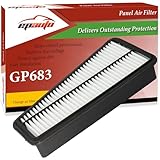
- Compatible with Toyota V6 Engines – Fits Tacoma V6 (2005–2015), 4Runner V6 (2003–2009), Tundra V6 (2005–2010), and FJ Cruiser (2007–2009)
- OEM Replacement Fit – Replaces 17801-0P010 and CA9683; built to match factory specifications for easy drop-in installation
- Protects Your Engine – Captures dirt, dust, and debris to prevent wear and ensure clean airflow
- Boosts Efficiency – Helps improve throttle response, fuel economy, and engine longevity
- Quick DIY Install – No tools required; easy to replace as part of routine vehicle maintenance
Automakers’ hybrid plans and powertrain choices are evidence of their strategies, not proof that every hybrid replaces a V6 or that one engineering approach is best for every driver. The available figures do not quantify how much of a particular V6’s removal was driven by regulation, cost, packaging or customer demand.
Why some automakers are keeping—or restoring—larger engines
The trend is not one-way. Mazda’s stated strategy retains inline-six engines for vehicles built on its large architecture, while Ram’s lineup shows how quickly an engine decision can change. Ram shifted the 2025 Ram 1500 lineup to six-cylinder engines, then announced the return of the 5.7-liter HEMI V8 for the 2026 model year in response to customer feedback.
Rank #4

- Compatible with Toyota Camry V6 (2012-2017), Highlander Gas (2014-2019), Sienna (2011-2020), Avalon V6 (2013-2018), Tacoma (2024-2026), 4Runner (2025-2026)
- Compatible with Lexus RX350 (2010-2022), RX350L (2018-2022), ES350 (2013-2018), NX300 (2018-2021), NX200t (2015-2017)
- Compatible with Jeep Grand Cherokee 3.6L/5.7L/6.4L (2011-2021), Grand Cherokee WK (2022); Compatible with Dodge Durango 3.6L/5.7L/6.4L (2011-2026)
- Compatible with FRAM CA10755; Replacement Made for Toyota/Chrysler Genuine Part# 17801-0P050, 17801-0P051, 17801-31130, 17801-31131, 17801-YZZ11, 04861756AA, 4861756AA, 4861756AC
- Helps extend performance. Protect against dirt. Improve fuel mileage, Recommended replacement every 12,000 miles
Ram brand CEO Tim Kuniskis described the change as a correction, saying, “Everyone makes mistakes, but how you handle it defines you. Ram screwed up when we dropped the HEMI — we own it and we fixed it.” That is an executive’s characterization of the decision, not an independent assessment. The example illustrates why a lineup change should not be mistaken for an irreversible industry-wide phaseout.
Independent reader supportYour contribution helps us test, update, and keep practical guides available for everyone.How to compare a V6 with its replacement
For a specific vehicle, compare the actual model-year versions and trims rather than relying on cylinder count or headline horsepower alone. Check:
Best Value

- RUGGED CONSTRUCTION: K&N Advantage Plus Air Filters are manufactured with durable, premium materials to last for up to 18,000 miles of use.
- EXTENDED LIFE 18K: K&N Advantage Plus Air Filter provides 50% longer life compared to standard 12,000-mile filters.
- SUPERIOR FILTRATION & PROTECTION: K&N uses a premium filter media that provides up to 99% efficiency to protect your engine.
- REPLACE EVERY 18K Miles: Engine air filter only needs to be replaced every 18,000 Miles under normal highway driving conditions (1.5 years based on the average miles driven per year of 12,000 miles)
- NO-HASSLE WARRANTY: 1-Year Limited Warranty.
- Fuel economy: Compare official ratings and, where available, real-world results for the same kind of driving.
- Power delivery: Look at horsepower and torque, including how and when the turbocharger or electric motors deliver power.
- Work capability: Compare the exact towing and payload ratings for the configurations you would buy.
- Price and availability: Check purchase price, trim availability and whether the engine is offered in your country and model year.
- Driving character: Consider noise, smoothness and how the vehicle feels under load.
- Ownership needs: Account for the components and maintenance requirements associated with turbocharging or hybrid systems; do not infer durability from cylinder count alone.
The figures and announcements above are not a like-for-like test of a V6 against a replacement engine. A meaningful verdict requires comparing the specific vehicles and versions.
Quick Recap
Product prices and availability are accurate as of the date/time indicated and are subject to change. Any price and availability information displayed on Amazon at the time of purchase will apply.




