Recommended Free Tools
No one can point to a single, documented present-day location for “the Eleanor” from the 2000 Gone in 60 Seconds. Several cars were built for that film, and several more have been offered for sale with claims that they were used on screen. The public record identifies those cars by VIN and by past auction results, but it does not establish where they are now or who owns them. Any article that names one city or one owner without a VIN and dated documentation is going further than the evidence allows.
First, which Eleanor are we talking about?
The name refers to different cars in different films, so the answer depends on which movie you mean.


- The 1974 original: the Eleanor of the first Gone in 60 Seconds is a yellow fastback Mustang with black stripes.
- The 2000 remake: the car is a gray Mustang with black stripes, presented on screen as a Shelby GT-500. This is almost certainly the car most readers mean when they search for “the Eleanor Mustang.”
A court filing reproduced in a U.S. Supreme Court docket PDF draws the same distinction and notes that two Eleanor-designated cars appear in the 2000 film. The filing’s appendix states: “This time, ‘Eleanor’ is the codename for a Shelby GT-500 Ford Mustang.” That sentence describes the film’s storyline and naming. It is not a technical inspection of any individual car’s factory identity, and it should not be read as proof that a car offered today is a factory Shelby or a film car.
What the VIN trail shows
The most detailed public account of claimed 2000-film cars comes from a Dutch Shelby Mustang GT500 specialist site (shelby.nl). It lists three VINs for cars offered with 2000-film provenance. The table below reproduces what that source reports, along with the qualifications it attaches.
#1 Best Overall
| VIN | Reported history | Current location or owner | Qualification in the source |
|---|---|---|---|
| 7R02S211287 | Auction sales reported in 2009 and 2019 | Not stated | Past sales do not establish the present owner or location. |
| 7R02C173895 | Auction sale reported in 2012, followed by later auction offers that did not sell | Described as appearing to be in Germany (“schijnt in Duitsland te verblijven”) | A qualified claim, not a verified current location. |
| 7R02C179710 | Auction sale reported in 2013 for $1 million; described as a prominent “hero” car used for promotional events and photographs | Not stated | The sale record does not show where the car is today. |
The same source says it is uncertain whether all three cars were functional film cars, or whether damaged cars were rebuilt with replacement parts. It also mentions a fourth car, associated with VIN 7F02C229830, that has not been assessed as an original film car. Taken together, these points mean that a car’s appearance, a seller’s description, or a headline auction price cannot by itself establish screen-use provenance.
Licensed replicas and tribute cars are not the film cars
Several Eleanor-style cars on the market are officially licensed reproductions or tribute builds. Readers who see one of these in a listing should treat it as a separate category of car.
Rank #2
- Licensed reproduction (RM Sotheby’s catalog): the listing documents a reproduction built on a new bodyshell and records the auction location as Dubai. That location describes the auction, not the screen-used cars, and the car is not evidence that a film car is in Dubai.
- Officially licensed tribute edition (Mecum Auctions catalog): the listing describes a tribute build. An Eleanor look does not mean a car was used in the movie.
How many were built, and how many survive?
The project Eleanor Gone Again, which describes its work on the Eleanor cars, says the Cinema Vehicle Services team built 11 Eleanors for the 2000 film, as stated on its website in 2026. The same project describes a planned limited run of 25 continuation cars based on 1967 Mustang donor cars. Those figures come from the project’s own statements. They are not an independent inventory of surviving screen-used vehicles, and the project notes that specifications may change and that images may be illustrative.
No independent survey or authoritative registry of surviving 2000 screen-used cars was found in the sources reviewed for this article. The number built, the number that survive, and the number whose film use has been independently authenticated are three different figures. Do not treat them as one statistic.
What’s actually slowing this PC down?
Pick the symptom - the matching free tool is one click away.
Rank #3

- 100% authentic 1:43 true-to-scale detail.
- Protective acrylic case includes a plastic base, perfect for displaying out in the open.
- 100% Die-cast metal body & chassis with chrome accents and real rubber tires.
- Authentic movie decoration and themed packaging.
- Limited edition and officially licensed.
How to check a claimed Eleanor
If you encounter a car described as “the Eleanor” or as a movie car, work through these checks before accepting the claim:
- Get the VIN. A car without a VIN cannot be tied to any historical record. Compare it with the VINs reported above and with any builder or film-fleet record you can find.
- Look for film-specific documentation. A seller’s description or a matching appearance is not enough. You want evidence that links that specific car to the production.
- Date the location claim. Auction results and past sales show history, not current location. Ask when the most recent location or ownership record was made and by whom.
- Identify the type. Decide whether the car is a screen-used vehicle, a licensed reproduction, a tribute build, or a new continuation car. Each category carries different claims.
- Check the condition history. Ask whether the car was damaged, rebuilt, or assembled on a new bodyshell. The source above says some film-car histories remain uncertain on this point.
What is and is not established
- “Eleanor” refers to different cars in the 1974 and 2000 films.
- Multiple cars were built for the 2000 film, according to the project’s own statements.
- Three VINs have been reported in connection with claimed surviving 2000 film cars: 7R02S211287, 7R02C173895, and 7R02C179710.
- The reported location of 7R02C173895 in Germany is a qualified claim that is not confirmed.
- No source reviewed establishes a single current location or owner for any screen-used example.
If a source gives you a precise present-day location for “the Eleanor,” ask it for the VIN, the date of its evidence, and the documentation that links that car to the film. If it cannot provide those, treat the location as unverified.
Quick Recap
Best Value
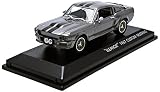
- 1 / 43scale Green Light GREENLIGHT ELEANOR 1967 Custom Movie Star MUSTANG Eleanor Mustang GONE IN 60 SECONDS
Rank #4

- AUTHENTIC REPLICA: Officially licensed 1:64 scale diecast model of the iconic 1967 Ford Mustang 'Eleanor' from Gone in Sixty Seconds movie in silver chrome finish
- PREMIUM QUALITY: Constructed with durable diecast metal materials featuring detailed exterior styling and authentic movie-accurate design elements
- COLLECTIBLE ITEM: Part of the exclusive Greenlight collection, perfect for movie memorabilia and diecast model car enthusiasts
- DISPLAY READY: Comes in protective packaging with detailed chrome accents and custom wheels that showcase the legendary muscle car's design
- SPECIFICATIONS: 1:64 scale collectible for ages 14 and up, no batteries required, made by Greenlight with precise attention to detail
“
Product prices and availability are accurate as of the date/time indicated and are subject to change. Any price and availability information displayed on Amazon at the time of purchase will apply.




