PC Slower Than It Used to Be?
A free scan shows the junk files, broken settings and background clutter dragging Windows down - then fixes them in one click.Free scan · Windows 10 & 11Outdated Drivers Are Slowing You Down
One free scan finds every outdated or missing driver and matches the right update for your exact hardware.Free scan · exact hardware matchThe difference between axial-flux and radial-flux electric motors is the direction in which their main magnetic field crosses the air gap.
- Radial-flux motors send magnetic flux toward or away from the shaft. Their rotor and stator are usually arranged as concentric cylinders.
- Axial-flux motors send magnetic flux parallel to the shaft. Their rotor and stator are usually arranged as flat discs, producing a short, “pancake” motor.
That geometry affects more than the motor’s appearance. It changes how much torque the motor can produce for its size, where it fits in a vehicle, how it is cooled, and how difficult it is to manufacture. Neither design is automatically more powerful, efficient, or better for electric cars.

As an Amazon Associate I earn from qualifying purchases.
Axial flux vs. radial flux: the quick comparison
| Characteristic | Axial-flux motor | Radial-flux motor |
|---|---|---|
| Magnetic flux | Parallel to the motor shaft | Across the air gap toward or away from the shaft |
| Typical shape | Thin disc or stack of discs | Cylindrical |
| Main packaging advantage | Very short axial length | Smaller diameter and conventional cylindrical packaging |
| Typical vehicle use | Compact traction systems, direct drives, in-wheel or near-wheel applications | Most current EVs, hybrids, industrial motors and general-purpose drives |
| Manufacturing | More specialized, particularly for air-gap control and stator construction | Highly mature, with established laminations, windings, housings and assembly methods |
| Cooling | Can support short end windings and direct oil cooling, but thermal paths can be difficult | Well-established jacket, air and oil-cooling arrangements |
| Main mechanical challenge | Axial magnetic forces, rotor-disc stiffness and maintaining a uniform air gap | Rotor balance, radial forces and conventional cylindrical air-gap control |
These are general tendencies rather than fixed rules. A particular radial-flux motor can be lighter or more torque-dense than a particular axial-flux motor, and an axial-flux motor can be designed for high speed even though many are aimed at low-speed, high-torque applications.
How a radial-flux motor works
A conventional radial-flux motor has a cylindrical stator surrounding an inner rotor. The stator carries the windings and the rotor carries magnets, conductive bars or another excitation system, depending on the motor type. The main magnetic field crosses the cylindrical air gap in a radial direction.
#1 Best Overall

- High‑Quality Material: Multi‑layer PCB coil structure, high‑strength transparent acrylic stacking bracket, durable propeller and metal fasteners. Precision‑assembled magnetic components for stable power output.
- Practical Design: Unique stacked axial‑flux structure, visible internal coil layout. Equipped with propeller for intuitive high‑speed rotation demonstration, adjustment knob for convenient speed control.
- Easy to Use: Pre‑assembled electronic modules, no complicated soldering. Just connect power supply, adjust knob to change rotating speed, easy to observe axial‑flux motor electromagnetic working principle.
- Safe & Durable: Stable stacked acrylic frame reduces shaking during high‑speed running. Fine‑processed propeller, solid fastening structure, avoid loose parts for short‑time demo operation.
- Widely Applied: Perfect for electromagnetic physics teaching, popular science demonstration, tech‑theme desktop ornament, maker lab display, suitable for students, electronic enthusiasts and tech collectors.
In a typical permanent-magnet EV motor, the stator’s rotating magnetic field pulls and pushes the rotor magnets around the circumference. The resulting tangential force produces torque at the shaft. Some radial-flux motors instead use induction, reluctance or wound-field excitation.
Radial flux is the familiar layout behind most electric motors used in cars, pumps, fans, compressors and factory equipment. It works with established electrical-steel laminations, cylindrical housings, conventional bearings and highly developed winding equipment. That production base is a major advantage when an automaker needs millions of motors at a predictable cost.
How an axial-flux motor works
An axial-flux motor usually places one or more rotor discs face-to-face with a stator disc. The magnetic field crosses a flat air gap along the shaft axis rather than across a cylindrical gap.
Do these 3 things before closing this tab:
1Clear out junk files and repair common Windows errors2Fix the driver behind crashes, sound loss and screen glitches3Repair Windows errors before they cause bigger problemsCommon arrangements include:
- Single-sided: one rotor and one stator.
- Double-sided: one stator between two rotors, or one rotor between two stators.
- YASA-style or yokeless segmented stator: separate stator segments reduce or remove much of the conventional stator yoke.
- Coreless: the stator has no iron core, which can reduce some iron losses but creates other structural and winding challenges.
“Axial flux” describes the geometry, not the electrical technology. An axial machine can use permanent magnets, induction, reluctance or wound-field excitation. The same is true of a radial machine.
Why axial flux can produce high torque in a short package
Motor torque is created by tangential force acting at a radius. An axial-flux motor can place a large amount of active electromagnetic material at a relatively large mean radius while keeping the motor short along the shaft.
That makes the design attractive for a vehicle where there is plenty of room across the motor’s diameter but very little room along its length. Examples include an in-wheel or near-wheel drive, a compact hybrid transmission, a low-profile direct-drive system or a marine propulsion installation.
There is an important qualification: axial flux does not guarantee greater torque density. In a controlled comparison of 10-kW, 200-rpm permanent-magnet machines, a selected radial-flux design produced higher torque density than the corresponding axial- and transverse-flux designs. The result depended on the specified dimensions, materials, cooling, speed and optimization limits.
Rank #2
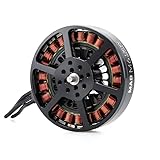
- Delivers up to 10.4 kg thrust per axis
- Engineered for 2.5–5 kg single-axis payloads
- Optimized for use with 18–24 inch carbon fiber propellers
- Supports a broad voltage range from 6S to 12S
- Lightweight motor design at 214g
The more accurate conclusion is that axial flux offers a strong geometric route to high torque density. Whether it actually wins depends on the complete design.
Packaging: thin versus narrow
Axial-flux motors are most useful when axial length—the distance along the shaft—is the difficult dimension. A disc-shaped motor can fit where a conventional cylindrical motor would be too long.
Radial-flux motors are usually the better fit when the vehicle favors a narrower outside diameter or needs to use existing motor housings, shafts, bearings, reduction gears and mounting points. Their cylindrical shape also integrates naturally with many current EV drive units.
Comparing only motor length can therefore be misleading. A fair vehicle-level comparison should include:
- Motor diameter and length
- Inverter and power electronics
- Cooling hardware and fluid connections
- Bearings and structural supports
- Reduction gearing or differential
- Rotor containment and protective structures
- Total mass and installation envelope
An axial motor may be shorter but wider. It may also need stronger disc structures or a different mounting arrangement. The best layout is the one that fits the complete vehicle system, not simply the one with the thinnest motor housing.
Cooling and continuous power
Axial-flux designs can have useful cooling advantages. Some have short end windings, stator windings close to a cooling surface, segmented stators or direct oil and spray cooling. A double-sided design may also provide access to both sides of the active stator.
Those benefits depend on the implementation. A compact motor can still concentrate copper, core and magnet losses in a small volume. Heat may struggle to escape from an enclosed or double-sided assembly, and continuous output can be limited by winding temperature even when the motor can deliver a much higher short-duration peak.
Rank #3

- 【Wide Application Scenarios】: Ideal for axial flux generators, DIY wind turbines, and micro hydro power systems. Suitable for small-scale off-grid energy projects, DIY renewable power builds, and backup power setups, meeting various low-power generation needs.
- 【Coreless Disc Coil Design】: Features advanced coreless technology to reduce iron loss, enhance power generation efficiency, and minimize magnetic drag. The disc-shaped design ensures smooth operation and stable performance in DIY power systems.
- 【Precise Dimension Options】: Available in 4 specifications: 90mm diameter × 5mm thick, 90mm × 9mm thick, 160mm × 5mm thick, and 160mm × 9mm thick. Each variant is made to exact dimensions for proper fit in different generator builds.
- 【Durable Construction】: Built with heat-resistant materials rated up to 105℃ for reliable use in diverse environments. The robust winding structure resists wear and maintains consistent output during long-term operation.
- 【Efficient Power Generation】: Designed for 300W power output, delivering stable energy conversion for small-scale power systems. Ideal for DIY enthusiasts building low-wattage renewable energy projects at home or off-grid locations.
Radial-flux motors have a larger base of proven cooling solutions, including water-glycol jackets around the housing, forced air, internal air circulation and oil cooling. A well-cooled radial motor can deliver better continuous performance than an inadequately cooled axial design.
Quick wins for a faster PC:
Clear out junk files and repair common Windows errorsFree Scan →Fix the driver behind crashes, sound loss and screen glitchesFind Drivers →Repair Windows errors before they cause bigger problemsFix Now →For an EV, peak power and continuous power should not be confused. Peak power is often available for acceleration or brief high-load events. Continuous power is mainly a thermal question: how much heat the motor can remove while keeping the windings, magnets, insulation and bearings within their limits.
Manufacturing and cost differences
Radial-flux motors benefit from mature, high-volume manufacturing. Common processes include stamped electrical-steel laminations, stacked stator cores, established distributed or concentrated windings, cylindrical housings and standard bearing arrangements.
Axial-flux motors can require more specialized production because their magnetic circuit is three-dimensional and their stator may be disc-shaped, segmented or built using unusual materials. The rotor and stator discs must remain parallel, and the air gap must be controlled across the entire face of the machine.
That air-gap requirement is a particularly important engineering issue. Permanent magnets can exert strong axial attraction between the rotor and stator. The discs must remain stiff enough to resist deflection during assembly, acceleration, heating and operation. Uneven spacing can increase losses, cause torque ripple or allow mechanical contact between moving parts.
What’s actually slowing this PC down?
Pick the symptom - the matching free tool is one click away.
Soft magnetic composites, segmented stators, printed-circuit windings and specialized laminations can address some axial-flux manufacturing problems. They can also introduce new costs involving materials, tooling, production speed, quality control and repairability.
Axial-flux motors can be mass-produced; the technology is not limited to laboratory prototypes. The practical question is whether a particular design and production process can meet the required cost, volume, consistency and service life.
Rank #4

- 1.Advanced 12N14P Brushless Motor – 12 stator slots and 14 permanent magnets provide low cogging, smooth start‑up, and stable rotation.
- 2.Wide Voltage Compatibility – Works with 12V, 24V, or any DC supply in between (12‑24V).
- 3.Energy Efficient – Typical operating power only 4‑5W, ideal for battery‑powered or low‑power systems.
- 4.Speed Adjustable – Built‑in potentiometer allows continuous speed control from 1000 to 1500 RPM.
- 5.Quiet & Balanced – The 85 mm 3‑blade propeller and precision motor reduce vibration and noise during high‑speed rotation.
Efficiency and high-speed operation
Neither topology automatically wins on efficiency. The result depends on copper resistance, winding length, iron losses, magnet and rotor losses, air-gap size, flux density, inverter operation, cooling temperature, mechanical losses and the vehicle’s duty cycle.
An axial design may reduce end-winding copper or provide a favorable active radius, while a radial design may offer better high-speed containment, cooling integration or field-weakening behavior. The motor that performs best at 200 rpm may not be the motor that performs best at 15,000 rpm.
High-speed axial-flux operation is possible, but it requires careful attention to rotor-disc stress, magnet retention, balance, bending, windage, eddy-current losses and air-gap stability. A radial-flux motor is not automatically superior at high speed either; its safe operating range also depends on its rotor construction and electromagnetic design.
Any efficiency claim should state the operating point. A motor may reach an excellent laboratory peak efficiency while delivering a less impressive result across the speed and load range used by a car.
Independent reader supportYour contribution helps us test, update, and keep practical guides available for everyone.Which type is better for electric cars?
Axial flux may make sense when:
- Axial installation space is severely restricted.
- The vehicle benefits from high torque at a large diameter.
- A direct-drive or near-direct-drive layout can reduce gearing.
- Low mass or high peak torque is worth additional manufacturing complexity.
- The design can support specialized oil cooling and precise structural control.
- The motor is part of a performance, aerospace, marine or unusual packaging application.
Commercial axial-flux traction motors are already available. For example, YASA lists 400–800-volt series motors including the 125-kW peak YM360 and 350-kW peak YM720, both using dielectric-oil cooling. Those are specifications for specific products, not universal limits for every axial-flux motor.
Radial flux may be the better choice when:
- Low production cost and manufacturing risk are priorities.
- The vehicle has room for a conventional cylindrical drive unit.
- Existing suppliers, housings, bearings and service procedures matter.
- High-volume production and standardized tooling are required.
- The motor needs a broad speed range and established field-weakening behavior.
- A slightly longer motor is acceptable in exchange for simpler integration.
Common misconceptions
“Axial-flux motors are always more efficient.”
No. Efficiency is determined by the complete electromagnetic, thermal and control design. Axial flux can produce excellent results, but the name of the topology is not an efficiency guarantee.
The Tool Desk
Outbyte Driver Updater FREEScan for outdated or missing drivers - takes under a minuteDriver Scan →Outbyte PC Repair FREEClear out junk files and repair common Windows errorsFree Scan →“Axial flux always means smaller and lighter.”
Not necessarily. It often means shorter, but the motor may be wider and may require heavier rotor supports, tighter air-gap control or more complex cooling hardware.
Best Value
“Radial-flux motors are outdated.”
Radial flux remains the dominant, highly optimized motor architecture for good reasons. It can deliver very high power and torque density while using established manufacturing and cooling methods.
“Axial and radial flux are different kinds of motor.”
They are different magnetic topologies. Either can be a permanent-magnet synchronous motor, induction motor, reluctance motor, wound-field machine or generator.
FAQ
Are axial-flux motors better than radial-flux motors for EVs?
Not universally. Axial flux is attractive when a car needs a short motor with high torque at a relatively large diameter. Radial flux is usually easier and cheaper to manufacture, package in conventional drive units and cool using established methods.
Free tools Windows power users keep installed
One-click scans. No signup required.
Do axial-flux motors have more torque?
They can have high torque density because their active material can operate at a large mean radius. However, torque depends on the full design. A well-optimized radial-flux motor can match or exceed an axial-flux motor under particular speed, size, cooling and material constraints.
Why are most electric-car motors radial flux?
Radial-flux motors benefit from mature laminations, winding equipment, cylindrical housings, established cooling systems, suppliers and production experience. That combination reduces cost and manufacturing risk at automotive volumes.
Can an axial-flux motor be used at high speed?
Yes, but high-speed operation requires careful design of rotor strength, magnet retention, balance, windage, eddy-current losses and air-gap stability. Speed capability is a property of the particular motor, not of axial flux alone.
The Bottom Line
Axial flux is a packaging and torque-density opportunity; radial flux is a mature, broadly optimized motor platform. Choose axial flux when a short, high-torque motor justifies more demanding structural, thermal and manufacturing engineering. Choose radial flux when conventional cylindrical packaging, cost, production scale, serviceability or proven high-speed operation carries more weight. For an electric car, the right comparison includes the motor, inverter, cooling system, gearing, mounting structure, duty cycle and production target—not just the motor’s shape.
Recommended Free Tools
Quick Recap
Product prices and availability are accurate as of the date/time indicated and are subject to change. Any price and availability information displayed on Amazon at the time of purchase will apply.




