What’s actually slowing this PC down?
Pick the symptom - the matching free tool is one click away.
The Mitsubishi 4G63T became special not because every version shared one set of parts or output figures, but because Mitsubishi developed a compact 2.0-liter engine into a turbocharged, intercooled powerplant for performance cars—and then paired it with the rally-oriented Lancer Evolution’s full-time four-wheel drive and chassis revisions. Its story runs from the Sirius engine family to successive, application-specific upgrades.
How the 4G63 grew out of Mitsubishi’s Sirius family
Mitsubishi says production of its 4G6 Sirius engine family began in September 1979. The water-cooled inline-four family included the 2.0-liter 4G63, which arrived in April 1980 and became a flagship passenger-car engine. The turbocharged Evolution engine therefore grew from an established engine line rather than appearing as a one-off racing design. Mitsubishi’s company history traces the family and its applications.
In 1987, Mitsubishi introduced a DOHC, turbocharged and intercooled 4G63 in the Galant VR-4. Mitsubishi reports output of up to 205 PS at 6,000 rpm for that application. The combination of a two-liter four-cylinder, forced induction and an intercooler provided the foundation for the engine’s later performance-car reputation.
Why the Lancer Evolution made the engine’s reputation
Mitsubishi launched the first Lancer Evolution in October 1992. The company describes it as a compact Lancer fitted with a 4G63-type intercooled turbo engine and a full-time 4WD system; its reported output was 250 PS. The engine mattered, but so did the car around it: Mitsubishi also cites greater body rigidity, weight reduction, aerodynamic improvements and optimized suspension. Mitsubishi’s Evolution heritage page sets out that launch context.
#1 Best Overall

- 🔸Engine Model: for Mitsubishi Engine 4G63 4G63T 2.0L, 4G64 2.0L 2.4L
- 🔸Compatible Model: for Mitsubishi Forklift FG10, FG14, FG15, FG18, FGC10, FGC15, KFG20, KFG23, KFG25; for Mitsubishi Vehicle Galant III/IV, L 300 / Delica II Bus, Lancer CELESTE Coupe, Lancer II, Sapporo I/II
- 🔸Compatible Model: for Caterpillar Forklift GP15, GP18, GP25, GP48; for Clark Forklift G127, C20, C25, CGC20, CGC25, CGC30, CGP20, CGP25, CGP30, GCX20, GCX25
- 🔸Durable And Reliable: Pre-tested and proven many times by the factory, it has a long life and reliable quality
- 🔸Perfect Replaces: Easy-to-install replacement part that perfectly matches the original, offer a six-month-waranty
That pairing is central to what made the 4G63T distinctive. It was part of a complete, rally-oriented sedan package, with four-wheel drive and chassis work intended to put the turbo engine’s performance to use. Treating the engine’s fame as a story about peak power alone misses the vehicle that gave it a defining role.
What changed as the 4G63T evolved
The name does not describe one mechanically identical engine across every car and year. Mitsubishi’s documentation shows continued development, and specifications should be attached to the particular application they describe.
Rank #2

- ✦Part Number: 4G63 4G63T 8V Engine
- ✦Wide Range Application: Apply for Mitsubishi Clark Vorkheftruck CMP15 18 20; Forklift GC15 18 20 25 GP15 18 20, this kinds is for 4G63 8 valves, not 16 valves
- ✦Key Feature: Our Overhaul Gasket Set ensures superior sealing performance, excellent heat and corrosion resistance, and effectively prevents fluid leaks, extending engine life
- ✦Durable Construction - Manufactured using robust materials with wear and corrosion resistance, designed for reliable operation and long-term durability
- ✦Professional Installation Recommended - To achieve best results and ensure proper function, installation by qualified personnel is suggested
Evolution VII: revisions aimed at stronger midrange response
For the Evolution VII, Mitsubishi lists an uprated intercooler, magnesium rocker cover, hollow camshaft and stainless-steel exhaust pipe. The company reports maximum torque of 39.0 kg-m at 3,500 rpm and describes improved mid-speed torque characteristics for this version. These are Evolution VII details, not universal specifications for all 4G63T engines. Mitsubishi’s Car History page documents the generation’s changes.
Evolution VIII: a separate set of published specifications
A Mitsubishi technical information manual for the 2003 Evolution VIII, available as a copy hosted by the third party TuningEvo.Club, lists 1,997 cc displacement, an 85.0 × 88.0 mm bore and stroke, and 8.8:1 compression. It gives maximum output as 206 kW at 6,500 rpm and maximum torque as 392 Nm at 3,500 rpm. The manual describes the engine as basically the same as the Evolution VII’s while providing these Evolution VIII specifications. View the third-party-hosted Evolution VIII technical information manual.
Rank #3
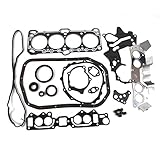
- 🚜Engine Model: for Mitsubishi 4G63 4G63T Engine
- 🚜Part Name: 4G63 Engine Full Gasket Kit
- 🚜Application: for Mitsubishi Clark Vorkheftruck CMP15 18 20; Forklift GC15 18 20 25 GP15 18 20
- 🚜Warm Tips: There has 2 kinds: for 8 valves and 16 valves, this link is for 8 valves, if you need for 16 valves, please inform to us!
- 🚜Service: 90 day warranty and 24-hour support for customer service. Please feel free to contact us by email if you have any question with the product.
The reported figures use different units and come from distinct sources and applications: Mitsubishi’s first-Evolution heritage page gives 250 PS, its Evolution VII page reports torque in kg-m, and the Evolution VIII manual uses kW and Nm. They should not be treated as directly interchangeable ratings for every 4G63T, nor as proof that one generation is universally superior.
How to compare 4G63T applications accurately
A useful comparison starts with the exact car and version, rather than the engine label alone. Check the application and market, then compare the documented hardware and ratings for that specific version.
Rank #4

- For Eclipse Talon 4g63 4g63t 2.0 Engine Water-cooled Oil-cooled Drum TD05 16G Turbocharger
- High-precision cutting process is used to ensure air tightness and air flow dynamic efficiency
- The accessories are lighter, improving the stability and service life of the components
- Optimized friction loss at high speeds, low vibration and long-term maintenance-free
- The core components are coated to effectively resist corrosion and oxidation at extreme temperatures
- Vehicle and generation: Identify whether a specification belongs to a Galant VR-4, first-generation Lancer Evolution, Evolution VII or Evolution VIII.
- Induction and valvetrain: Look for the documented turbo and intercooler setup, cylinder-head and valvetrain details, and any generation-specific revisions.
- Rated performance: Record power and torque with their units and engine speeds; do not merge ratings from different applications.
- Drivetrain and chassis: Consider the transmission and four-wheel-drive arrangement alongside the engine, plus the body, suspension and weight changes Mitsubishi describes.
The available examples establish a development story, not a complete generation-by-generation specification chart. They support the conclusion that Mitsubishi kept refining the package; they do not provide enough comparable data to rank every 4G63T variant.
Independent reader supportYour contribution helps us test, update, and keep practical guides available for everyone.What made the 4G63T special
The 4G63T’s significance came from the path Mitsubishi gave it: a 2.0-liter Sirius-family engine became a DOHC turbocharged, intercooled unit, then a defining part of the Lancer Evolution’s four-wheel-drive, rally-focused package. Its later revisions show that the engine was developed over time, while its changing specifications make one rule essential: quote the figure for the specific model and year, not for every 4G63T.
Do these 3 things before closing this tab:
1Repair Windows errors before they cause bigger problems2Scan for outdated or missing drivers - takes under a minute3Clear out junk files and repair common Windows errorsQuick Recap
Best Value
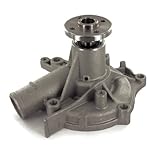
- Replacement for Mitsubishi MD972457
Product prices and availability are accurate as of the date/time indicated and are subject to change. Any price and availability information displayed on Amazon at the time of purchase will apply.




