The Tool Desk
Outbyte PC Repair FREERepair Windows errors before they cause bigger problemsFix Now →Outbyte Driver Updater FREEScan for outdated or missing drivers - takes under a minuteDriver Scan →MPG means miles per gallon: the number of miles a vehicle travels using one gallon of fuel. Higher MPG generally means less fuel used for a given trip, but there is no single MPG figure that makes every vehicle “good.” Compare vehicles in the same category, consider your driving pattern, and look at fuel consumed and expected costs—not just the headline number.
What MPG tells you
Miles per gallon is a distance-per-fuel measure. A vehicle rated at 30 MPG is estimated to travel 30 miles per gallon under the rating’s test and calculation methods. For the same distance, a higher MPG figure usually means fewer gallons used.

In the United States, gasoline-vehicle labels show city, highway, and combined MPG. The combined figure weights city driving at 55% and highway driving at 45%, making it a useful quick comparison when your exact driving mix is unknown. The U.S. Environmental Protection Agency (EPA) explains the label and its comparison framework at FuelEconomy.gov’s gasoline vehicle label guide.
These are standardized estimates, not a promise that every driver will reach the displayed number. EPA develops the data used on new-car and light-truck labels through prescribed tests and calculations, and periodically updates its methods to account for vehicle technology, driving behavior, and conditions. Its major revision for model year 2008 applied to vehicles beginning with that model year; a later calculation change for model year 2017 lowered some estimates by 1 MPG and a small number by 2 MPG. Those changes describe EPA’s historical method updates, not a general adjustment to apply to vehicles today. See the EPA overview of fuel-economy labels and its model-year 2017 label update.
Do these 3 things before closing this tab:
1Repair Windows errors before they cause bigger problems2Fix the driver behind crashes, sound loss and screen glitches3Clear out junk files and repair common Windows errors#1 Best Overall
What counts as good MPG?
There is no universal “good MPG” cutoff in EPA’s label guidance. A compact car, pickup, and large SUV do different jobs, so comparing them using one bare number can be misleading. A practical definition is: good MPG is favorable among vehicles in the same category while still meeting your needs and expected operating costs.
- Compare like with like. Check combined MPG for vehicles in the same EPA category rather than comparing unrelated classes.
- Match the ratings to your driving. If most of your miles are in town, pay closer attention to city MPG; if you mostly drive on highways, examine highway MPG. The combined figure is a weighted estimate, not a personalized forecast.
- Consider the label’s cost estimates. EPA’s annual fuel-cost estimate assumes 15,000 miles of driving per year and a projected fuel price. The projected price and resulting cost depend on the label and model year, so treat them as a standardized comparison, not your bill.
- Personalize the math. Use your expected annual mileage, local fuel prices, and driving habits with FuelEconomy.gov’s fuel-cost calculator.
- Compare consumption, too. When you want to know how much fuel a vehicle uses rather than how large its MPG rating looks, compare gallons per 100 miles.
Why a five-MPG increase can save very different amounts
MPG does not rise in a straight line with fuel savings: it is the reciprocal of fuel consumed per mile. As a result, the same increase in MPG matters much more when the starting figure is low. EPA’s gasoline-label example estimates that, over 1,000 miles, improving from 10 to 15 MPG saves about 33 gallons, while improving from 30 to 35 MPG saves about 5 gallons. These are EPA’s illustrative comparisons, not predictions for a particular car. The agency calls this the “MPG illusion” and notes that gallons per mile or per 100 miles can make consumption comparisons clearer; see its explanation of the MPG illusion.
For a simple personal comparison, divide 100 by the MPG rating to get approximate gallons used per 100 miles. For example, 25 MPG corresponds to about 4 gallons per 100 miles (100 ÷ 25). This conversion helps show the difference in fuel consumption, though actual use will still vary.
MPG versus MPGe
MPGe means miles per gallon of gasoline-equivalent. EPA uses it for vehicles whose energy use cannot be described simply as gallons of gasoline consumed, including electric vehicles. It expresses how far a vehicle could travel using energy equivalent to the energy in a gallon of gasoline; it does not mean an electric vehicle burns or buys gasoline.
PC Slower Than It Used to Be?
A free scan shows the junk files, broken settings and background clutter dragging Windows down - then fixes them in one click.Free scan · Windows 10 & 11Outdated Drivers Are Slowing You Down
One free scan finds every outdated or missing driver and matches the right update for your exact hardware.Free scan · exact hardware matchRank #3

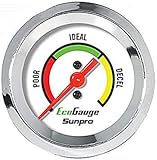
- Plug and Play: This automotive gauge is easy to install, requiring no complicated wiring or professional installation; it connects directly to the vehicle's system.
- Fuel Economy Monitoring: Designed to help track and optimize fuel consumption, allowing drivers to monitor vehicle efficiency and potentially reduce fuel costs.
- Portable Design: This compact and lightweight gauge can be easily moved between different vehicles or removed when not needed. This fuel economy monitor can easily fit into your armrest box.
- Universal Compatibility: Suitable for vehicles using gasoline, diesel, water, and lubricants, making it suitable for a wide range of automotive applications.
Electric-vehicle labels also show energy consumption, commonly in kilowatt-hours per 100 miles (kWh/100 mi), which more directly describes electricity use. When comparing an electric vehicle with a gasoline vehicle, read the units shown on each label rather than treating MPGe and gasoline MPG as identical measures of fuel purchases. EPA explains these label measures in its electric-vehicle label guide.
Independent reader supportYour contribution helps us test, update, and keep practical guides available for everyone.Why your real-world MPG may differ
Your fuel economy can vary with driving behavior, vehicle maintenance, air conditioning and other accessories, weather, road conditions, and vehicle load. EPA lists these among the factors that can affect results. The label is best used to compare vehicles on a common basis; it cannot account for every route, driver, or season. For EPA’s consumer explanation, see how driving habits affect fuel economy.
Rank #4

- Adjusts speed limiter
- Read and erase trouble codes
- See instant fuel economy
- Customize gauges and set safety warnings
When checking your own mileage, calculate it over several fill-ups rather than drawing a conclusion from one trip: record miles driven and gallons added, then divide miles by gallons. That gives you an observed MPG for those conditions, not a replacement for the standardized label comparison.
Quick Recap
Product prices and availability are accurate as of the date/time indicated and are subject to change. Any price and availability information displayed on Amazon at the time of purchase will apply.
Free tools Windows power users keep installed
One-click scans. No signup required.