Semi-trailers are built around the freight they carry: enclosed vans protect general or temperature-sensitive cargo, open decks handle loads that need side or overhead access, and specialized trailers move liquids, loose materials, machinery, or containers. In the usual U.S. tractor-semitrailer hookup, a trailer-mounted kingpin locks into the tractor’s fifth wheel; air-brake lines and an electrical cord must also be connected and checked.
What are the different types of semi-trailers?
These are common freight-oriented categories, not a complete universal taxonomy. The right choice depends on the freight, loading method, dimensions, route, and equipment available. Trailer dimensions and capacities can vary by manufacturer and production year, as DSV notes in its trailer-type overview.
Enclosed trailers: dry vans and reefers
- Dry van: An enclosed trailer for general freight that needs protection from exposure. In the federal classification at 49 CFR § 523.10, a box van has fixed sides, a nose, and a roof; without the specified front-mounted HVAC equipment, it is a dry van.
- Refrigerated van (reefer): An enclosed van with front-mounted HVAC equipment under that same federal classification. It is used when freight needs temperature control, but the unit and operating settings must suit the particular cargo; not every reefer serves the same temperature range.
Open-deck trailers: flatbeds and lower decks
- Flatbed: An exposed platform for cargo that can be secured on the deck or needs loading from the side or above, such as some oversized or machinery loads.
- Step deck (single drop): A flatbed-style trailer with a lower deck section, useful when cargo height or route clearance makes a standard flatbed unsuitable.
- Lowboy (double drop or low loader): A low-deck configuration often used for large machinery. Deck geometry, capacity, and permitted loads depend on the specific trailer and route.
- Removable gooseneck (RGN): A specialized trailer with a removable gooseneck/loading arrangement for certain cargo configurations. Features and capabilities differ by model.
- Curtainside or Conestoga: Covered or retractable-side equipment that combines some weather protection with access from the side. The degree of coverage and loading access varies by design.
A National Transportation Library report excerpt gives approximate deck heights of about 60 inches for standard flatbeds, 38–40 inches for drop-decks, and 22–24 inches for lowboys. These are report figures, not universal specifications or legal clearance limits; check the actual trailer and route.
Bulk, container, and multiple-trailer equipment
- Tank trailer: Carries bulk liquids. Tank construction and fittings must match the material and service.
- Dump trailer: Carries and discharges loose material such as gravel or soil.
- Container chassis: Supports an intermodal container for road transport. Under 49 CFR § 523.10, the container itself is not a trailer; the chassis is the road equipment.
- Pup: A short semi-trailer, often used in multiple-trailer combinations. A converter dolly may connect a following trailer; the dolly is coupling equipment, not a cargo trailer in the cited federal classification.
How do you choose a semi-trailer for a load?
Start with what the freight needs, then confirm that the specific trailer, tractor, and route can accommodate it. Compare these factors:
What’s actually slowing this PC down?
Pick the symptom - the matching free tool is one click away.
#1 Best Overall
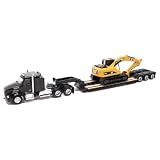
- Diecast Masters | 1:87 Scale Kenworth T880s SBFS 40in-Sleeper Tandem Tractor with Lowboy Trailer and Cat 320D L Hydraulic Excavator | Model 84420
- Protection and temperature: Decide whether the load needs an enclosed body, controlled temperature, or only weather covering.
- Size, weight, and loading: Check cargo dimensions and weight, tie-down or containment needs, and whether loading must happen from the rear, side, or above.
- Deck height and route: A lower deck may help with tall machinery, but the actual trailer dimensions and route restrictions determine suitability.
- Freight form: Palletized freight, machinery, bulk liquid, loose material, and containerized cargo call for different equipment.
- Compatibility and instructions: Confirm that the tractor and trailer coupling match and follow the vehicle and coupling manufacturers’ operating and inspection instructions, along with applicable rules.
How does a semi-trailer connect to a truck?
The common U.S. tractor-semitrailer connection is a mechanical coupling plus air and electrical connections. A kingpin fixed beneath the trailer’s front enters the tractor-mounted fifth wheel. As the tractor backs under the trailer, the fifth wheel’s locking jaws close around the kingpin and secure it. The articulated coupling allows the tractor and trailer to move relative to one another while turning and travelling over uneven surfaces. Landing gear supports the trailer’s front when it is uncoupled and is raised for travel.
The mechanical lock alone does not complete the hookup. The tractor and trailer also need connected air-brake lines and an electrical cord for trailer circuits such as lighting. The FMCSA’s Commercial Driver’s License Manual (July 2014 edition) describes common coupling checks; it is driver guidance, not a substitute for current training or the instructions for the specific equipment.
Rank #2

- International lonestar, flatbed W/forklift pallets, 1: 43 Diecast New Ray toys #16643 White
What is a fifth wheel on a semi-truck?
The fifth wheel is the coupling plate mounted on the tractor behind the cab. It receives and locks around the trailer’s kingpin. The connection must be properly engaged, and the fifth wheel’s position must leave adequate clearance for turns so the tractor frame or cab does not strike the trailer or landing gear. Sliding fifth wheels, where fitted, must be locked in position.
Inspection is more than checking that the trailer appears attached. The FMCSA manual calls for checking the fifth wheel, kingpin, jaws, release mechanism, and connection visually. In particular, the locking jaws must close around the kingpin shank, not its head, and there should be no visible gap between the upper and lower fifth-wheel plates.
Recommended Free Tools
Rank #3

- Diecast Masters | 1:87 Scale Peterbilt Model 579 UltraLoft Tandem Tractor with Lowboy Trailer and Cat D5M Dozer | Model 84419
What are the red and blue air lines for?
Air lines connect the tractor and trailer air-brake systems. U.S. drivers commonly refer to red and blue hoses, but the FMCSA manual cited here does not define their functions by color. Do not identify a hose by color alone when connecting equipment: follow the tractor and trailer markings and their specific operating instructions. The lines must be correctly connected, undamaged, leak-free, securely routed, and long enough to allow turning without pulling tight. The electrical cord must also be firmly plugged in and secured.
What should be checked after coupling?
Use the applicable training and vehicle-specific procedure. For common tractor-semitrailer combinations, the FMCSA manual’s inspection points include:
Rank #4

- 🚛 39.6" MASSIVE SHOWSTOPPER & ULTIMATE GIFT: Stop settling for tiny, underwhelming toys. Measuring an incredible 39.6 inches(truck + trailer) long with the tailgate extended, this giant RC semi-truck guarantees a jaw-dropping unboxing experience. Fully compliant with US safety standards, it’s the perfect birthday or holiday gift that will make any 6-12 year old truck enthusiast's dream come true(Overall Size: 39.6" L × 5.0" W × 6.8" H)
- 🎮 PRO-LEVEL 16-CHANNEL 2.4GHz CONTROL: Experience true-to-life operation without signal interference. Using the 2.4GHz remote, kids can precisely steer, switch between fast/slow modes, drive the cab solo, and trigger authentic engine sounds, the working horn, LED headlights, and the signature dual water-vapor exhaust smoke—delivering a fully immersive driving experience
- 🔋 UPGRADED 60-MIN PLAYTIME & USB-C CHARGING: Say goodbye to constant recharging tears! This heavy-duty transport hauler includes TWO upgraded 3.7V/1000mAh rechargeable batteries for the truck, delivering up to 60 minutes of combined uninterrupted hauling. The modern, safer USB-C charging port completely eliminates the frustration of broken charging pins found on older RC models
- 💪 HEAVY-DUTY HAULING & 17-LB PAYLOAD: Built for serious backyard construction sites. The robust 4WD chassis and extra-long flatbed can securely transport up to 17 lbs of smaller cars, building blocks, or construction vehicle toys. Boasting a massive 100–160 ft control range, it effortlessly conquers driveways, carpets, and parks for versatile indoor and outdoor play
- 🔥 AUTHENTIC MECHANICS & HANDS-ON LEARNING: Spark their engineering curiosity! Features include a manually opening hood, dual smoke nozzles, an adjustable tailgate, and extendable lifting outriggers. (Pro Tip: A gentle mechanical clicking sound when adjusting the outriggers is normal and ensures secure locking!) This interactive design naturally develops hand-eye coordination through immersive play
- Check that the lower fifth wheel is securely mounted and undamaged, and that the upper plate and kingpin are sound.
- Verify visually that the jaws secure the kingpin shank, there is no visible gap between the fifth-wheel plates, and the release arm and safety lock are seated and engaged.
- Check air lines and glad-hand connections for damage, leaks, secure routing, and sufficient slack through turns; confirm the electrical cord is plugged in and secured.
- Confirm the landing gear is fully retracted before travel. Inspect it for damage and, where power-operated, leakage.
- Check that a sliding fifth wheel is secured by its locking pins and positioned to preserve turn clearance.
- Follow the coupling manufacturer’s lubrication instructions for fifth-wheel maintenance; the manual includes lubrication in its inspection guidance.
Coupling procedures are not identical for every combination. The FMCSA manual cautions: “However, there are other ways of coupling and uncoupling the many types of truck-trailer and tractor-trailer combinations that are in use.” Drivers should learn the correct method for the actual vehicle from authorized training and manufacturer or owner instructions, especially for specialty heavy-haul equipment and non-U.S. designs.
Independent reader supportYour contribution helps us test, update, and keep practical guides available for everyone.How do doubles and triples connect?
In a multiple-trailer combination, a converter dolly can connect a following semi-trailer. The dolly’s fifth wheel receives the rear trailer’s kingpin, while a drawbar and pintle connection attach the dolly to the preceding trailer. The FMCSA manual’s overview includes positioning and visually checking the dolly connection, connecting air hoses and light cords, and checking for air at the rear trailer. This is not a substitute for authorized training or the procedure for the actual combination.
Quick Recap
Best Value
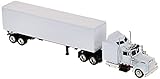
- Expertly Designed.
- True to Life Detail.
- Made from Quality Parts.
- Ships from USA.
- Brand New Item.
Product prices and availability are accurate as of the date/time indicated and are subject to change. Any price and availability information displayed on Amazon at the time of purchase will apply.




