PC Slower Than It Used to Be?
A free scan shows the junk files, broken settings and background clutter dragging Windows down - then fixes them in one click.Free scan · Windows 10 & 11Crashes, No Sound, or Screen Glitches?
Random freezes, missing sound and display glitches usually trace back to one bad driver. Find and replace yours safely.Free scan · under a minuteA crankshaft position (CKP) sensor tells the engine controller how fast the crankshaft is turning and where it is in its rotation. Most systems detect a rotating target with a patterned wheel, then use the resulting signal to coordinate engine controls such as ignition and fuel injection. The two common sensor designs—inductive and Hall-effect—produce that signal in different ways, so they also require different diagnostic approaches.
What a crankshaft position sensor does
The CKP sensor monitors crankshaft rotation and sends an electrical signal to the engine control module (ECM). A toothed or otherwise patterned reluctor wheel rotates past the sensor, changing the sensor’s output. The ECM interprets the repeating pulses and any distinctive feature in the pattern as a reference for crankshaft speed and angular position.
Depending on the engine’s control strategy, CKP information helps the ECM coordinate ignition timing and fuel injection, and may contribute to misfire detection. The crankshaft signal can also be interpreted alongside the camshaft position (CMP) signal to establish engine phase. The exact pattern and how the controller uses it depend on the engine.
The two main CKP sensor types
Inductive and Hall-effect sensors both detect a changing magnetic relationship between a sensor and a rotating target, but they create their electrical outputs differently. Knowing which type is fitted is essential before testing it.
#1 Best Overall

- [Vehicle Fitment]: Compatible with Hyundai Accent 2012-2019, Elantra 2011-2020, Elantra Coupe 2013-2014, Elantra GT 2013-2020, Tucson 2013-2018, Compatible with Veloster 2012-2015/2017/2019; Compatible with Kia Forte 2015-2019, Forte Koup 2014, Rio 2012-2019, Soul 2010-2019; Compatible with Dodge Attitude 2011-2014
- [Reference Number]: PC934, 907-787, 907787, 2351456, 5S12470, SU13885, S0410058, 0410058, 0902267, TF-C465, 39180-2B000, 180-0735, 1800735, 39180-2B000, 391802B000
- [Specification]: ① Terminal Quantity: 2 Pins; ② Terminal Type: Blade; ③ Color: Black; ④ Package Quantity: 1x Crankshaft Position Sensor; ⑤ Packaging Type: Box
- [Directly Fit]: OE Replacement Brand New Crankshaft Position Sensor. Please enter your vehicle information in the top left corner to confirm the vehicle compatibility before purchasing.
- [Buy with Confidence]: A-Premium offers a one-year unlimited-mileage guarantee on our meticulously crafted Crankshaft Position Sensor. We offer a wide variety of automotive accessory categories, ensuring that you can hit the road with peace of mind.
Inductive (variable-reluctance) sensors
An inductive sensor typically contains a coil wound around a permanent magnet. As a reluctor tooth approaches and moves away, the magnetic flux through the coil changes, inducing an alternating voltage. The output is generally an AC waveform: its frequency follows rotational speed, while its amplitude can vary with design and operating conditions.
These sensors are commonly passive, but circuit designs can vary. A technical bulletin hosted by the National Highway Traffic Safety Administration describes the coil-and-magnet construction and advises following the vehicle’s service specifications. Do not assume that a sensor is inductive—or choose a test—based only on how it looks.
Rank #2

- [PREMIUM PERFORMANCE] - Bosch Original Equipment Crankshaft Position Sensors provide accurate detection of engine speed - engine speed is the main control variable for ignition timing
- [ACTUAL OE] - Bosch Original Equipment Crankshaft Position Sensors aren't just a quality replacement component, they're the same sensor your vehicle was equipped with when manufactured - minus the expense of brand name packaging
- [SUPERIOR ENGINEERING] - Robust design features precise digital measurement of rotational speeds, high resistance against external interference, and a wide temperature range that withstands extreme hot and cold operating conditions
- [LONGER LIFE] - Bosch Crankshaft Position Sensors deliver the precision operation and long service life your vehicle needs for superior performance, lowest emissions, and optimum fuel mileage
- Replaces OE numbers 0031532728, 0031532828, 05080352AA, 31532728, 5080352AA, 6519050000, A0031532728, A0031532828, A31532728, A6519050000, MN960274, MN960372
Hall-effect sensors
A Hall-effect sensor contains powered sensing electronics. As a target changes the magnetic field at the sensor, the electronics switch the output, commonly producing a digital pulse train. Unlike the typical inductive waveform, this is an electronically switched signal; its supply and signal-circuit arrangement must be checked against the vehicle’s wiring information.
For example, a reproduced 2005 Cadillac service description identifies a Hall CKP sensor with a 12-volt reference, low reference and signal circuit. In that application, it reads a 58-tooth reluctor and sends digital pulses. Those details describe that Cadillac implementation, not a universal voltage, wiring layout or tooth count.
Rank #3

- PRECISE ENGINE TIMING SIGNALS – Delphi Engine Crankshaft Position Sensors are engineered to deliver accurate crankshaft position and engine speed data through a precision-designed sensing gap, helping support proper ignition timing, fuel injection, and reliable engine management for consistent vehicle performance.
- OE-QUALITY DIGITAL PERFORMANCE – Manufactured to meet or exceed original equipment requirements, Delphi Crankshaft Position Sensors feature a digitally engineered output that maximizes the signal-to-noise ratio, providing dependable communication with the engine control module for accurate engine operation.
- IMPROVED DRIVABILITY & EMISSIONS CONTROL – Advanced sensing technology provides reliable crankshaft position feedback to help support smooth engine operation, responsive performance, and efficient engine management that contributes to reduced emissions and improved overall drivability.
- BUILT FOR LONG-TERM DURABILITY – Designed to maintain consistent performance across a wide operating temperature range, Delphi Engine Crankshaft Position Sensors feature robust sensor protection that helps resist heat-related performance changes and supports long-lasting reliability in demanding under-hood environments.
- Delphi products purchased through, from, or on this site do not qualify for Delphi’s standard LIMITED warranty. When purchased through, from, or on this site, any warranty on this product is offered by and is the sole responsibility of the seller identified on the shipment details of your order. Please review all warranties carefully and contact the identified seller for all warranty details and claims.
How the reluctor pattern gives the controller a reference
A target wheel’s repeating teeth provide a signal as the crankshaft turns. A missing tooth or another distinctive feature creates a recognizable change in that pattern, allowing the controller to identify a reference point and infer crankshaft position. Ford service information describes a missing-tooth pulse wheel used to synchronize ignition and determine crankshaft position. The specific tooth counts in that information apply only to the engines it names.
Vehicle examples illustrate why there is no single CKP pattern standard. The Cadillac service description above uses a 58-tooth reluctor. A Stellantis Alfa Romeo service example describes an inductive sensor facing a 60-2 phonic wheel: the changing magnetic flux induces alternating voltage, which the controller uses for speed and crank angle. Its stated 0.8–1.5 mm air gap is an application-specific figure, not a general setting.
Rank #4
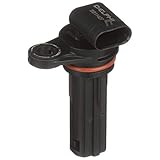
- PRECISE ENGINE TIMING SIGNALS – Delphi Engine Crankshaft Position Sensors are engineered to deliver accurate crankshaft position and engine speed data through a precision-designed sensing gap, helping support proper ignition timing, fuel injection, and reliable engine management for consistent vehicle performance.
- OE-QUALITY DIGITAL PERFORMANCE – Manufactured to meet or exceed original equipment requirements, Delphi Crankshaft Position Sensors feature a digitally engineered output that maximizes the signal-to-noise ratio, providing dependable communication with the engine control module for accurate engine operation.
- IMPROVED DRIVABILITY & EMISSIONS CONTROL – Advanced sensing technology provides reliable crankshaft position feedback to help support smooth engine operation, responsive performance, and efficient engine management that contributes to reduced emissions and improved overall drivability.
- BUILT FOR LONG-TERM DURABILITY – Designed to maintain consistent performance across a wide operating temperature range, Delphi Engine Crankshaft Position Sensors feature robust sensor protection that helps resist heat-related performance changes and supports long-lasting reliability in demanding under-hood environments.
- Delphi products purchased through, from, or on this site do not qualify for Delphi’s standard LIMITED warranty. When purchased through, from, or on this site, any warranty on this product is offered by and is the sole responsibility of the seller identified on the shipment details of your order. Please review all warranties carefully and contact the identified seller for all warranty details and claims.
How inductive and Hall-effect designs compare
| Feature | Inductive / variable reluctance | Hall effect |
|---|---|---|
| How it senses rotation | Changing magnetic flux induces voltage in a coil around a permanent magnet. | Powered electronics switch their output as the target changes the magnetic field. |
| Typical signal | Alternating-voltage waveform; frequency tracks rotation, and amplitude varies with design and operating conditions. | Commonly a digital pulse train. |
| Power and circuits | Commonly passive, although circuit designs vary; verify the vehicle’s circuit information. | Requires powered sensing electronics; supply, ground and signal arrangement vary by application. |
| Identification and testing | Use the correct service procedure and expected waveform or values for the vehicle. | Identify the sensor before testing; do not assume an inductive resistance check applies. |
| Target wheel | Pattern and air gap are engine-specific. A Stellantis Alfa Romeo example uses a 60-2 wheel. | Pattern is engine-specific. A 2005 Cadillac service example uses a 58-tooth reluctor. |
The available technical examples establish how the designs work, but they do not support a universal ranking for durability or accuracy. Sensor appearance and connector pin count alone may not reliably identify the design. HELLA specifically warns that an ohmmeter resistance test can damage a Hall generator if the sensor type has not first been established. Confirm the part using reliable vehicle service information or parts data before testing.
Independent reader supportYour contribution helps us test, update, and keep practical guides available for everyone.How to approach a suspected CKP sensor problem
A fault code or no-start condition does not by itself prove the sensor has failed. The signal depends on a working sensor circuit and a target wheel that the sensor can read; diagnosis should therefore consider the complete system and the conditions under which the fault occurs.
What’s actually slowing this PC down?
Pick the symptom - the matching free tool is one click away.
Best Value

- Direct replacement - this engine crankshaft position sensor is designed to match the fit and function of an original sensor on specified vehicles
- Ideal solution - engineered to help ensure the engine control unit receives proper inputs when an original sensor has failed from heat or internal component damage
- Durable construction - designed and manufactured to strict specifications for reliable performance
- Trustworthy quality - backed by a team of product experts in the United States and more than a century of automotive experience
- Ensure fit - Input your vehicle into the garage tool and check Confirmed Fit bar at the top of the page. If there is an “i” in a blue circle, additional verification is needed. Please hover over the "i" to verify fitment notes match your vehicle.
- Identify the exact application and sensor type. Use the vehicle’s service information or reliable parts data for its year, make, model and engine. Confirm the sensor type before selecting a test, and obtain the correct pinout and specifications.
- Inspect the connector and wiring. Check for visible damage, loose connections or other circuit problems using the vehicle’s prescribed procedure. Do not assume a connector’s pin count identifies the sensor design.
- Consider the target wheel and sensor installation. Check the reluctor or patterned target and, where applicable, the sensor air gap. Use only the specification for that engine; a gap or tooth pattern from another vehicle is not transferable.
- Test the signal using the method for that sensor. HELLA describes different checks for inductive and Hall outputs. The NHTSA-hosted 2012 technical bulletin describes using an oscilloscope across an inductive sensor while cranking. Use the specified pins, operating condition and expected waveform or values in the vehicle service information.
- Decide on repair or replacement from the diagnosis. If replacement is indicated, match the part to the vehicle year, make, model and engine, connector, and applicable OEM part number. CKP sensors are replaceable components, but there is no universal sensor that fits every application.
An automotive oscilloscope can be useful for waveform diagnosis, but the appropriate tool, connection points and safe procedure depend on the vehicle and the technician’s skill. If the required pinout or test procedure is unclear, consult vehicle-specific service information or a qualified technician rather than applying a generic voltage, resistance or gap value.
Quick Recap
Product prices and availability are accurate as of the date/time indicated and are subject to change. Any price and availability information displayed on Amazon at the time of purchase will apply.




