A piston engine burns fuel in cylinders to move pistons; a turbine burns fuel in a continuous flow of compressed air and uses hot gas to spin a turbine. In aircraft, either type can drive a propeller, while turbojets and turbofans produce thrust from their exhaust flow. The better choice depends on the aircraft’s mission, speed, altitude, payload and operating costs—not on a universal claim that one engine is superior.
How piston and turbine engines make power
Both are internal-combustion engines, and both broadly take in air, compress it, burn fuel, expand hot gases and discharge exhaust. As the Federal Aviation Administration puts it, “Both piston (reciprocating) engines and gas turbine engines are internal combustion engines.” The key distinction is how those stages happen and how useful power is produced.
Piston engines: combustion in cylinders
In a reciprocating engine, each cylinder goes through the combustion cycle in separate events. Expanding gases push a piston, and the engine converts that back-and-forth motion into rotation, typically to turn an aircraft propeller. The FAA describes this conventional configuration as a choice when economy is needed in the low-speed range.
Gas turbines: continuous airflow
A gas turbine draws air through a compressor, mixes compressed air with fuel in a combustion section, and sends the hot gas through a turbine. The turbine drives the compressor; depending on the configuration, it can also provide shaft power to a propeller or another load. NASA Glenn identifies the compressor, combustion section, turbine and exhaust flow as common elements of turbine engines.
#1 Best Overall

- 3D-Printed TR900 Replica: Precision 3D-printed Aero Engine Model of the iconic TR900 Turbofan.This highly accurate 9.3-inch replica showcases complex internal mechanics,offering a true-to-life visual of turbofan engineering for enthusiasts and collectors
- DIY Toyan Engine Kit: A rewarding DIY project for adult or teen 14+ hobbyists. This Engine building Kit provides hands-on assembly,deepening understanding of mechanical science.The completed model serves as a striking desktop display
- Transparent Educational Design: Features a clear casing that reveals the operational blade structure and dual-flow system. An insightful mechanical science educational gift, perfect for visualizing and learning fundamental aerospace principles
- Functional Science Gift: More than a model,it's an engaging educational tool.Ideal for students and aviation fans to interactively explore aerospace engine mechanics, making it a memorable gift for learning and discovery(Battery not included)
- Premium Desktop Art: A sophisticated 23cm collectible art piece. Its exquisite design makes it a perfect desktop decoration and a conversation-starting gift for adult hobbyists,combining aesthetic appeal with engineering intrigue
“Turbine” covers more than one kind of aircraft propulsion
A turbine engine does not necessarily mean an aircraft is propelled primarily by a jet of exhaust. Its configuration determines how power reaches the aircraft:
- Turboprop: A gas turbine drives a propeller. It is a turbine-powered propeller aircraft, not a pure jet.
- Turbofan: A turbine drives a fan, and the engine produces thrust through the fan airflow and exhaust. Turbofans are common on high-speed airline aircraft.
- Turbojet: A turbine engine whose exhaust flow provides the primary thrust.
- Turboshaft: A gas turbine configured to deliver shaft power to a load, rather than functioning mainly as a jet engine.
So a useful comparison is not simply “piston versus turbine.” For many propeller aircraft, the practical distinction is piston-driven propeller versus turbine-driven propeller; airline jets introduce a different propulsion arrangement.
Rank #2
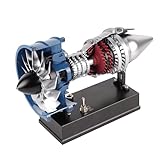
- Realistic & Authentic: The lifelike & visually stunning model provides a realistic depiction of a full-sized engine with main components including a first-stage fan, high-pressure rotor assembly, combustion chamber, high-pressure turbine assembly, low-pressure turbine assembly, and exhaust nozzle.
- High-Quality Construction: Made of high-quality metal, the meticulous model, full of detail and features, undergoes precision casting and CNC machining, along with sandblasting and anodized coloring treatment on the surface, ensuring durability and accuracy the same as the real model.
- Dynamic Display: Featuring a semi-transparent magnetic casing, this model offers a clear view of the engine's internal mechanics in motion when powered by the electric motor. The quick-release magnetic cover allows for effortless assembly and disassembly, making it ideal for demonstrations while protecting delicate components. Equipped with a sturdy mounting bracket and throttle control lever, this kit delivers an immersive hands-on experience with aviation engineering.
- DIY Assembly: Consists of 170+PCS (including screws & nuts) and comes with tools and paper-based English instructions. You will personally experience the entire assembly process, from small parts to the final completed model, constructing an awe-inspiring turbofan engine model.
- STEM Education: As an educational tool, this model unravels the internal workings of a turbofan engine, imparts knowledge about aerospace engineering, and stimulates interest, creativity, and awe for industrial technological achievements
Which aircraft missions suit each engine?
Engine selection reflects the aircraft’s intended speed, altitude, payload and operating economics. The following speed bands are general selection guidance, not hard boundaries: aircraft design, loading and flight conditions affect actual performance, and operating ranges can overlap.
| Engine or propulsion type | General mission context | What the cited guidance says |
|---|---|---|
| Reciprocating piston | Lower-speed aircraft where economy is important | The FAA describes relatively low cost and good efficiency as reasons to choose conventional reciprocating engines for low-speed operations. |
| Turboprop | Propeller aircraft needing more power per unit of weight or operating in a higher-speed range than typical piston applications | The FAA’s 2023 handbook says turboprops perform very well in the 180–350 mph range and have more power per unit weight than reciprocating engines in its comparison. |
| Turbofan | High-speed airline aircraft | The FAA’s 2023 handbook gives 350 mph to Mach 0.8–0.9 as a general range for airline turbofan operations. |
| Jet propulsion, broadly | Higher-speed flight | NASA’s 2017 publication The Power for Flight describes propellers and their power sources as most efficient for moving large air mass up to 500 mph, and jet engines as most efficient above 500 mph. This is broad explanatory context, not a direct piston-versus-turbine test or a universal crossover point. |
Those figures help explain why different engine types are associated with different missions, but they do not establish a speed at which every aircraft should switch from one engine type to another. The FAA also notes that turbine engines operate economically at high altitudes, while identifying turbine cost as a limiting factor in many cases.
Quick wins for a faster PC:
Scan for outdated or missing drivers - takes under a minuteDriver Scan →Repair Windows errors before they cause bigger problemsFix Now →Fix the driver behind crashes, sound loss and screen glitchesFind Drivers →Rank #3

- Authentic NikolaToy TR900 Turbofan Engine Model – Made popular by YouTube, this high-precision 3D-printed replica is offered by the NikolaToy brand store and is an ideal choice for aviation and engineering enthusiasts.
- Ultimate Aviation Collectible: A must-have for aviation lovers, this detailed TR900 Turbofan model brings the heart of the A380 to your desk. A tangible piece of aviation history, perfect for home or office display.
- Educational and Engaging: Not just a display piece, the NikolaToy model offers a hands-on learning experience for those interested in aircraft engineering. Perfect for enthusiasts and aspiring engineers.
- Show Your Passion: Express your love for aviation with this intricate 3D-printed engine model. A captivating centerpiece that sparks conversations and admiration.
- Ideal Gift for Aviators: Looking for the perfect gift? The NikolaToy TR900 Turbofan engine model is a stunning addition to any collection, making it an ideal gift for aviation fans and engineers alike.
Fuel and operating considerations
Fuel is specified for the engine and aircraft
The FAA identifies aviation gasoline (avgas) as specialized fuel for piston-engine aircraft. Jet aircraft and turbine-powered propeller aircraft use fuels similar to kerosene rather than avgas. That general distinction is not approval to substitute fuels: use only the fuel specified in the aircraft’s and engine’s approved documentation.
Costs depend on the aircraft and mission
A piston engine may be attractive where low-speed economy and lower engine cost matter. A turbine can make sense when the aircraft benefits from its power-to-weight characteristics, speed capability or high-altitude operation. The FAA’s broad selection guidance does not establish that every piston aircraft costs less to operate than every turbine aircraft. A fair cost comparison needs to be specific to the aircraft and intended use; there is no basis here for a universal lifecycle-cost, fuel-burn or reliability ranking.
Rank #4

- Wonderfully Detailed Model: Our 5-Cylinder Radial engine model kits feature genuine precision-cast and machined parts in anodized aluminum and stainless steel. Each piece is accurate, detailed and directly correlates to assemblies found in modern, high-performance automobile engines. This is a superb introduction into engineering and mechanics.
- Complete Accessories: The kit contains over 230 parts. Each finely-crafted part is labeled, and packaged in custom foam carriers to ensure they are organized, complete, and undamaged. A clear, full-color instruction manual is included. While the engine is complex, step-by-step instructions – along with some patience – ensure excellent results.
- Simulation Model: A real electric motor inside the starter motor housing drives the 5-Cylinder Radial engine. The crankshaft, rods and pistons can be observed through special viewing windows. You can observe the operation of the 5-Cylinder Radial engine during the whole process. It is not only a beautiful decoration, but also a simulation dynamic model that can simulate the operation of a real 5-Cylinder Radial engine. Even when not in motion, it is an impressive machine to see.
- Excellent Learning Activity: This kit is not recommended for unsupervised children under the age of 14, due to its small parts. However, it provides a great opportunity for adults to spend time with children. The child will learn to understand and follow illustrated instructions, manipulate parts and basic tools, and to know the accomplishment of a job well-done. It fosters an appreciation for the ingenuity in today’s technology as well as the need for it in coming generations.
Controls and propeller systems differ
Turboprops have powerplant controls and related systems specific to gas turbines. The FAA also describes constant-speed, full-feathering and reversing propellers as advantages in the turboprop aircraft covered by its transition guidance. These features and procedures vary by model; pilots should use the applicable aircraft flight manual for operating instructions and limitations.
Quick Recap
Best Value

- Authentic TR900 Replica – 1:20 Scale A380 Turbofan Engine Model: Highly detailed 28cm model faithfully replicates the iconic TR900 aircraft engine. Transparent cutaway casing reveals motorized spinning blades and internal dual-flow mechanisms.
- 3D-Printed Construction with Metal Bearings – Smooth Motorized Operation: Crafted from realistic 3D-printed PLA material with metallic texture finish. The metal bearings drive internal and external transmission for independent, smooth rotation.
- Motorized with LED Lights & Speed Control – Dynamic Mechanical Display: Adjustable speed settings and stunning LED light effects bring the turbofan engine to life. Delivers a mesmerizing visual display perfect for desk or bookshelf decor.
- STEM Educational Tool – Learn Jet Engine Mechanics Hands-On: Provides tangible understanding of aerospace engineering principles. Makes complex mechanical structures accessible, intuitive, and fun for students, hobbyists, and STEM learners.
- Engaging DIY Assembly Kit – Gift for Aviation Enthusiasts & Engineers: Challenging assembly project rewards hands-on skills with a stunning display piece. Built-in power supply base with USB charging cable included.
How to compare two aircraft fairly
- Define the mission. Decide whether the priority is local, lower-speed flying, regional travel, high-speed cruise or another use.
- Compare altitude and payload needs. Consider the aircraft’s intended operating altitudes and how much payload it must carry; turbine power-to-weight advantages may matter in some applications.
- Check fuel and costs for the specific aircraft. Confirm approved fuel requirements, then compare operating economics using aircraft-specific information rather than assumptions based on engine labels.
- Identify how thrust or shaft power is delivered. Distinguish a piston-driven propeller from a turbine-driven propeller, and both from turbofan or turbojet propulsion.
- Use model-specific operating documentation. Approved flight-manual procedures and limitations take precedence over general descriptions of an engine type.
Sources
- Federal Aviation Administration, Airplane Flying Handbook, Chapter 15
- Federal Aviation Administration handbook material on engine selection, performance and fuel
- NASA Glenn Research Center, “Gas Turbine Propulsion”
- NASA, The Power for Flight (2017)
Product prices and availability are accurate as of the date/time indicated and are subject to change. Any price and availability information displayed on Amazon at the time of purchase will apply.




