Free tools Windows power users keep installed
One-click scans. No signup required.
Toyota did develop and demonstrate a high-efficiency free-piston engine-generator—but it was a research prototype, not a crankshaft-free engine currently sold in a Toyota vehicle. Demonstrated in 2014, the Free Piston Engine Linear Generator (FPEG) used combustion to move a piston in a straight line, then converted that motion directly into electricity for an electrically driven vehicle. Toyota-associated research reported roughly 10 kW of output for the prototype configuration and simulated thermal efficiency of about 42% under specified conditions.
The concept was proposed primarily as a compact range extender or onboard electricity source for an EV. It was not presented as a conventional engine-and-transmission replacement, and the research does not establish that Toyota commercialized it.
As an Amazon Associate I earn from qualifying purchases.
What Toyota actually built
Most combustion engines send piston motion through a connecting rod to a crankshaft. The crankshaft converts the piston’s reciprocating motion into rotation, which can drive a transmission, generator, or other accessory.
Toyota’s FPEG removed that familiar rotary mechanism. Its piston moved linearly inside the cylinder, while an integrated linear generator converted the piston’s back-and-forth movement directly into electrical power. The prototype combined three principal elements:
#1 Best Overall

- High Performance: 2HP SPL 3450 RPM, Single Phase, Full Load Amps: 20/10 Amps, 115V/230V, SF: 1.0.
- Frame Type: 56 Frame, 5/8" Keyed shaft, 1.88" Shaft length, 0.188" Keyway Size.
- Open Drip-proof: Suggest using in clean and dry environments. Made of high-quality steel material, it can protect the engine, longer service life.
- Dual Rotation Direction: Motor is Reversible for CCW/CW rotation (Factory Setting is CCW), provides easier wiring operations.
- Safe & Durable: Tested with CSA certification. A sturdy steel frame, fast heat dissipation and compatible keyed shaft for longtime usage.
- A combustion chamber, where the fuel-air mixture produced the power stroke;
- A gas-spring chamber, which stored energy and returned the piston for the next cycle; and
- A linear generator, whose magnetic moving element passed through stator windings to produce electricity.
Toyota’s 2014 demonstration was therefore better understood as a small combustion-powered electrical generator than as a new engine intended to drive a vehicle’s wheels mechanically. Contemporary descriptions discussed it as a possible range extender for an electrically driven vehicle. Toyota’s prototype reporting should not be read as evidence of a production Toyota EV powertrain.
How a free-piston engine works
In a conventional engine, the crankshaft physically constrains the piston’s position and stroke. That mechanical relationship provides a reference for piston motion and makes it relatively straightforward to coordinate combustion, valve operation, and engine speed.
The FPEG has no crankshaft, connecting rod, or camshaft performing that job. During combustion, expanding gases push the piston through its power stroke. The piston’s attached magnet assembly travels through the generator’s stator, creating electrical power. The gas spring then pushes the piston back toward the combustion chamber, allowing the cycle to repeat.
Quick wins for a faster PC:
Clear out junk files and repair common Windows errorsFree Scan →Fix the driver behind crashes, sound loss and screen glitchesFind Drivers →Repair Windows errors before they cause bigger problemsFix Now →That arrangement can be mechanically shorter and may eliminate several friction-producing conversion parts. But the missing crankshaft is not simply an unnecessary component. It is also a mechanical position-control system. In a free-piston engine, piston movement becomes the result of several interacting forces:
- Combustion pressure;
- Gas-spring pressure;
- Electrical loading from the generator and inverter;
- Friction and pumping losses; and
- Pressure and temperature changes during each cycle.
The controller must continually manage those forces so the piston reaches the correct position at the correct speed. If it travels too far, too slowly, or too quickly, the next combustion event may be mistimed or unstable.
The unusual W-shaped piston
Toyota’s research prototype used a stepped piston design often described as a W-shaped piston. The geometry separated the combustion-side portion from the larger gas-spring side.
According to the published technical work, the larger gas-spring area could operate at lower pressure and temperature. Toyota’s design also included an internal oil passage intended to help cool the combustion-side piston. The arrangement was additionally intended to help shield the permanent magnets in the linear generator from combustion heat.
Recommended Free Tools
These details show that the prototype was not merely a conventional engine with its crankshaft removed. The piston, gas spring, magnetic assembly, cooling arrangement, lubrication system, and controls had to be designed as one system. They also represent features of the research prototype—not proof that Toyota had solved the durability and manufacturing requirements for mass production. The Sandia technical review provides useful context on the design rationale and the broader engineering challenges of free-piston engines.
Why Toyota considered it for an EV
A combustion engine mechanically connected to the wheels must respond to a constantly changing demand for speed and torque. A range extender has a simpler assignment: generate electricity for the battery or traction motor when needed.
That distinction could allow a range extender to operate near an efficient operating point rather than continually following wheel speed. The FPEG’s direct linear-to-electric conversion also offered potential packaging benefits. A compact unit could theoretically be placed in a vehicle without the same mechanical connection to the wheels required by a conventional engine and transmission.
There are several potential advantages to the architecture:
Rank #2

- Pay attention: Please read the instructions or pictures carefully, use the correct circuit diagram to avoid short circuit, short circuit will produce high temperature and Causing accessory damage
- Shaft Propeller Aperture:2mm/0.078"; Diameter:60mm/2.36"; Number of vane:4 vane and 3 vane;colour:Red & Blue & Yellow&Green&Clear(Random Color)
- DC Motors Color:Siler+Red;Voltage:DC 3V-12V;No-load speed: 9000RPM- 25000RPM ±10%; Motor Body Diameter:27mm/1.06";Shaft Size:10x2.0mm/0.39"x0.08"(L*D);Motor Body Length;38mm/1.46"
- High torque Strong magnetic Brushed Electric 130 MOTOR, can be used for Science Educational models, DIY STEM toys, etc.. It is recommended to use a 3V battery drive to avoid high-speed operation affecting the motor life.
- Package including:6pcs DC motor,6pcs 9V Battery Clip Connector,6pcs 2 x AA Battery Holder,6pcs motor mounting bracket,6pcs boat rocker switches,12pcs x electronic wire(25cm),8pcs Plastic wheels,4pcs 2*100mm shaft,4pcs 4 vanes propeller,2pcs 3 vanes propeller and 40cmΦ3 Heat shrink tube
- Fewer mechanical conversion parts: There is no crankshaft, connecting rod, or camshaft converting reciprocating movement into rotary output.
- Potentially compact packaging: The generator is integrated into the engine’s linear structure.
- Variable compression possibilities: Without a fixed crank mechanism, piston travel can potentially be controlled electrically and pneumatically.
- Efficient generator operation: As with other range extenders, the engine can be designed around electricity production rather than direct wheel torque.
- Possible fuel flexibility: Free-piston concepts have been studied with different fuels and combustion strategies, although that does not mean Toyota’s prototype was ready to use all of them.
Those are system-level possibilities, not guarantees. A range-extender vehicle still carries a combustion engine, fuel system, exhaust system, cooling hardware, generator, inverter, controls, and battery. It cannot automatically match a battery-electric vehicle’s efficiency or lifecycle emissions simply because its wheels are driven electrically.
Reported power and efficiency
Toyota-associated technical work reported approximately 10 kW of potential output for the prototype configuration. A later discussion suggested that two such units could theoretically provide around 20 kW—enough, in that concept discussion, to assist a small electric vehicle at highway speeds.
That 20 kW figure was an engineering projection, not an independently verified production-vehicle performance result. It should not be interpreted as a rating for a Toyota model or as proof that the prototype could sustain highway operation under every road, weather, load, and battery condition.
The research also reported simulated thermal efficiency of approximately 42% using a premixed charge-compression-ignition strategy. That is an important result, but it needs careful qualification:
- It was associated with defined research and simulation conditions;
- It refers to thermal efficiency, not overall fuel-to-wheel efficiency;
- It does not include every vehicle-level loss, such as generator, inverter, battery, motor, thermal-management, and accessory losses; and
- It was not a published efficiency rating for a production Toyota vehicle.
For readers who want a deeper grounding in combustion efficiency, emissions, engine controls, and performance calculations, Internal Combustion Engine Fundamentals, 2nd Edition by John B. Heywood is relevant background reading. It is an engine-engineering reference, not a Toyota FPEG service manual or a guide to building this prototype.
The central problem: controlling the piston without a crankshaft
The crankshaft in a normal engine does more than transmit power. It establishes the piston’s travel, provides a stable mechanical reference, and helps coordinate ignition, fuel injection, and valve timing. In a free-piston engine, those functions must be achieved through sensing, software, gas-spring design, combustion control, and generator loading.
Toyota’s SAE work identified piston-motion control as a central challenge. Combustion depends heavily on the piston’s position and speed, yet piston motion itself depends on the pressure produced by combustion. That creates a tightly coupled control problem: the combustion event affects the piston, while the piston’s motion affects the next combustion event.
The research examined feedback and resonant-control methods intended to keep the piston operating reliably as conditions changed. The linear generator and its power electronics are therefore not only energy-conversion components. They also become part of the mechanism that controls the piston’s motion.
What’s actually slowing this PC down?
Pick the symptom - the matching free tool is one click away.
In practical terms, the controller would need to manage variables such as:
- Top and bottom piston positions;
- Piston speed during compression and expansion;
- Combustion timing and consistency;
- Generator electrical loading;
- Gas-spring pressure;
- Starting and stopping behavior; and
- Changes in temperature, fuel quality, battery state, and vehicle demand.
A system that works for a short demonstration is not automatically a system that can repeat millions or billions of cycles in a vehicle while meeting noise, vibration, emissions, safety, cost, and service-life requirements.
Other engineering obstacles
Durability and continuous operation
Free-piston engines have fewer conventional moving parts, but that does not make them maintenance-free. The piston still needs durable sealing surfaces and lubrication. The linear generator must tolerate repeated high-speed motion and thermal cycling. The gas spring must retain its performance, and the control system must remain stable over long operating periods.
The Sandia review cautioned that many proposed free-piston performance claims had not been demonstrated through long-duration hardware testing. Continuous operation is a much higher bar than a controlled laboratory run.
Windows Errors? Fix Them Before They Spread
Repair common Windows errors and clear accumulated junk for a smoother, more stable PC - no reinstall needed.Free scan · no reinstallOutdated Drivers Are Slowing You Down
One free scan finds every outdated or missing driver and matches the right update for your exact hardware.Free scan · exact hardware matchRank #3
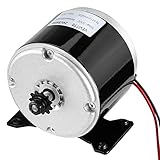
- Premium Material - Electric Brushed DC Motor, Aluminum Body, Full Copper Coil, Heat Resistant, Naturally Air Cooled, Low Noise High Quality More Long Life.
- High Performance - Powerful Electric Motor, High-speed brushed electric motor, 24VDC Permanent Magnet Generator 3000RPM,20A Current.
- Specification - Voltage-24V DC; Shaft Diameter: 8mm, Rated Speed-3000 RPM; Current: 20A.Compatible with Razor MX350, MX400 and E300.
- Reversible Motor - This motor is capable of rotation in either the clockwise or counterclockwise direction by reversing the motor's power wires.
- Wide Application - Widely fit for wind turbine scooter, small dolphin electric car, mechanical equipment, Mini Electric Motorcycle DIY Engine Kit, work for Razor Electric Scooter, Ebike Bicycle, Go Karts, E-bike, E Tricycle, Mid Drive Motor Kit, DIY Engine System, Cycling Part, even mower and more other machine.
Heat management
Combustion temperatures can threaten nearby seals, lubricants, sensors, and permanent magnets. Toyota’s stepped piston and internal oil passage addressed some of those concerns, but a production system would still require robust cooling for the combustion chamber, piston, generator, inverter, and surrounding structure.
Starting and stopping
A conventional starter motor turns an engine through a crankshaft until combustion becomes self-sustaining. A free-piston engine has no crankshaft to rotate. Its linear generator may be used to initiate piston motion, but starting still requires precise control of position, compression, fuel, ignition, and gas-spring behavior.
Vibration and noise
The piston’s reciprocating motion creates forces that must be managed even when there is no crankshaft. Multiple cylinders or synchronized modules might help balance those forces, but that adds packaging, control, and cost complexity. A vehicle application would need acceptable noise and vibration at startup, shutdown, changing loads, and fault conditions.
Gas exchange, lubrication, and emissions
The Toyota concept used a two-stroke combustion architecture. Two-stroke operation can offer a high power-to-size ratio, but it brings its own requirements for gas exchange, lubrication, and emissions control. Removing the crankshaft does not remove the need for intake and exhaust management, fuel control, catalysts or other after-treatment, and durable lubrication strategies.
The Tool Desk
Outbyte PC Repair FREERepair Windows errors before they cause bigger problemsFix Now →Outbyte Driver Updater FREEScan for outdated or missing drivers - takes under a minuteDriver Scan →Nor should the FPEG be called “zero-emission.” If it burns gasoline, hydrogen, or another fuel, it produces emissions that depend on the fuel, combustion process, operating conditions, and exhaust-treatment system. Driving the wheels with electricity changes the vehicle architecture; it does not by itself make the combustion source emission-free.
Was the free-piston engine ever used in a Toyota vehicle?
The available evidence supports describing the FPEG as a research prototype and technical-development program. The Toyota materials reviewed for current powertrain technology discuss production Dynamic Force engines, conventional crankshaft-based piston engines, and established hybrid power-split systems. They do not identify the FPEG as a production vehicle powertrain. Toyota’s official engine material is therefore useful context for distinguishing the prototype from the company’s production engines.
That does not prove the project was formally canceled or “quietly shelved.” Toyota has continued to investigate multiple powertrain paths, including battery-electric vehicles, hybrids, hydrogen fuel-cell vehicles, and improved combustion engines. The more defensible conclusion is narrower: no current production application for this Toyota free-piston engine was found in the official materials reviewed.
It is consequently inaccurate to describe the FPEG as a Toyota EV engine that consumers can buy today. There is also no supported evidence here of a Toyota-compatible FPEG kit, replacement component, plug-and-play range-extender module, hydrogen system, or vehicle accessory based on the prototype.
Do these 3 things before closing this tab:
1Scan for outdated or missing drivers - takes under a minute2Repair Windows errors before they cause bigger problems3Fix the driver behind crashes, sound loss and screen glitchesCould it have been better than a battery-electric drivetrain?
Not necessarily. The FPEG’s reported efficiency was promising for a small combustion generator, but a fair comparison must include the entire energy path. A range-extender vehicle loses energy in combustion, the generator, inverter, battery charging and discharging, motor, and drivetrain. A battery-electric vehicle has its own charging, battery, inverter, and motor losses, but it does not carry an onboard combustion system.
The free-piston design could make sense in specific situations: long-distance driving where battery mass or charging access is a concern, commercial vehicles that need compact onboard generation, or applications where liquid fuel has a practical energy-density advantage. Whether it is preferable depends on fuel availability, emissions rules, duty cycle, battery size, cost, durability, and the efficiency of the complete vehicle.
The technology’s strongest case was not that it automatically replaced batteries. It was that a small, potentially efficient generator might extend an EV’s usable range while allowing the traction motor to remain electrically driven.
Rank #4

- Powerful Performance: 0.75HP, Single Phase, Full Load Current: 12A/6A, AC 115V/230V 60Hz, 1725 RPM High Speed, SF: 1.15.
- Sturdy Frame Type: 56 Frame, 5/8" Keyed shaft, Shaft length: 1.88", Keyway size: 0.188".
- Dual Rotation Direction: Our electric motor offers reversible CW/CCW rotation, simplifying wiring installation and providing quick, versatile connections for various applications.
- Durable and Safe: Tested to CSA standards, this air compressor motor boasts a heavy-duty rolled steel shell for enhanced durability. It also includes overload protection with manual reset, ensuring longer service life and dependable performance.
- Wide Range of Applications: VEVOR 0.75HP general purpose motor is universally applicable, ideal for water pumps, agricultural machinery, and general equipment. It's perfect for DIY projects and repair replacements, providing versatile and powerful functionality for various needs.
Why the 2014 prototype still matters
The FPEG illustrates an important engineering trade-off. Removing mechanical parts can reduce one class of complexity while moving complexity into another class.
Toyota potentially eliminated the crankshaft-based mechanical conversion path, but the resulting system required advanced motion sensing, feedback control, gas-spring design, power electronics, thermal management, emissions control, and highly durable components. The prototype demonstrated that the concept could work as a research system. It did not establish that the concept was ready for affordable, reliable, mass-market vehicles.
That distinction is especially important when headlines describe the engine as “high efficiency” or “no crankshaft.” Both statements can be technically accurate while leaving out the difficult question: can the complete system operate reliably, quietly, cleanly, and economically for the life of a vehicle?
Bottom line
Toyota demonstrated a compact free-piston engine linear generator in 2014. Its piston moved in a straight line, a gas spring returned it for the next cycle, and an integrated linear generator converted combustion energy into electricity. The research reported approximately 10 kW for the prototype configuration and simulated thermal efficiency near 42% under specified conditions.
It was an intriguing candidate for an EV range extender—not a crankshaft-free Toyota engine currently available in a showroom. The hardest problems were not simply producing motion or electricity, but controlling that motion precisely, managing heat and lubrication, surviving continuous operation, limiting vibration, starting reliably, and meeting emissions requirements. On the evidence available, the FPEG remains best described as a significant Toyota research prototype rather than a production powertrain.
Frequently Asked Questions
What does FPEG stand for?
FPEG stands for Free Piston Engine Linear Generator. It combines a combustion engine with a linear electrical generator and does not use a crankshaft to convert piston motion into rotary output.
How efficient was Toyota’s free-piston engine?
Toyota-associated research reported simulated thermal efficiency of approximately 42% under defined conditions using a premixed charge-compression-ignition strategy. That is not the same as fuel-to-wheel efficiency and was not a production-vehicle rating.
How much power did the Toyota prototype produce?
The reported prototype configuration had potential output of about 10 kW. A later concept discussion suggested that two units could theoretically provide around 20 kW, but that was an engineering projection rather than a verified production-vehicle result.
Is Toyota’s free-piston engine used in a vehicle today?
The available official-production material reviewed does not identify the FPEG in a current Toyota vehicle. It is more accurate to call it a research prototype and proposed EV range extender.
Free tools Windows power users keep installed
One-click scans. No signup required.
Is the Toyota FPEG zero-emission?
No. The vehicle’s wheels would be driven electrically, but the FPEG burns fuel to produce electricity. Its emissions depend on the fuel, combustion system, operating conditions, and exhaust-treatment equipment.
Quick Recap
Product prices and availability are accurate as of the date/time indicated and are subject to change. Any price and availability information displayed on Amazon at the time of purchase will apply.




