Quick wins for a faster PC:
Fix the driver behind crashes, sound loss and screen glitchesFind Drivers →Repair Windows errors before they cause bigger problemsFix Now →On December 4, 1958, a Cessna 172 took off from Las Vegas. It did not land again until February 7, 1959—64 days, 22 hours, 19 minutes, and 5 seconds later. The airplane stayed airborne through repeated refueling from a moving truck, not by carrying enough fuel to last two months.
From December 4, 1958, to February 7, 1959, Robert Timm and John Cook kept a Cessna 172 airborne for 64 days, 22 hours, 19 minutes, and 5 seconds. The aircraft, named Hacienda, never landed during the attempt—but it was repeatedly refueled from a moving truck below.
As an Amazon Associate I earn from qualifying purchases.
That qualification matters. This was the recognized endurance record for a continuously airborne, manned, propeller-driven aircraft with in-flight refueling. It was not the longest commercial airline route, the longest flight without outside fuel, or something a standard, unmodified Cessna 172 could duplicate.
Who flew the Cessna 172 for 64 days?
Robert Timm was a slot-machine mechanic at Las Vegas’s Hacienda Hotel. He proposed using a record-setting airplane to promote the hotel, and owner Warren “Doc” Bailey reportedly committed $100,000 to the project. The publicity campaign was also presented as a fundraiser for the Damon Runyon Cancer Research Foundation.
#1 Best Overall

- Iconic B-2 Spirit Stealth Bomber Replica: A highly detailed 1:280 scale model of the legendary B-2 Spirit, the U.S. Air Force’s advanced long-range stealth bomber, developed to replace the aging B-52 fleet.
- Die-Cast Metal Construction: Made from high-quality die-cast metal with select plastic parts, this model captures the B-2’s unique boomerang shape and stealth-focused design, perfect for aviation enthusiasts.
- Stealth & Power in One Model: Accurately replicates the bomber’s specialized radar-evading shape and capability to deliver both nuclear and conventional payloads, including bombs and rotary launchers.
- Display-Friendly Size: Measures approximately 3 inches long with a wide 7 3/8 inch wingspan, ideal for desktops, shelves, or as part of a military aircraft collection.
- Includes Custom Display Stand: Comes with a sturdy plastic stand for dynamic display in flight mode, recommended for adult collectors and military aviation fans aged 14 and up.
Timm flew with John Cook, a professional pilot who became responsible for much of the flight’s documentation. They departed McCarran Field in Las Vegas—now Harry Reid International Airport—at 3:52:06 p.m. local time on December 4, 1958.
The idea was not entirely without precedent. In 1935, Fred and Al Key kept a Curtiss Robin airborne for 27 days, 5 hours, and 34 minutes. In 1958, Jim Heth and Bill Burkhart raised the standard again, flying a Cessna 172 called The Old Scotchman for 1,200 hours and 16 minutes—more than 50 days.
Timm and Cook passed that mark on January 23, 1959. Rather than land immediately after breaking the record, they continued flying until February 7, creating a much larger margin.
Windows Errors? Fix Them Before They Spread
Repair common Windows errors and clear accumulated junk for a smoother, more stable PC - no reinstall needed.Free scan · no reinstallCrashes, No Sound, or Screen Glitches?
Random freezes, missing sound and display glitches usually trace back to one bad driver. Find and replace yours safely.Free scan · under a minuteThe record airplane was far from a normal Cessna 172
The aircraft was a 1958 Cessna 172, historically associated with registration N9172B. It began life as a conventional light airplane, but the endurance project turned it into a specialized flying platform.
- Extra fuel: A 95-gallon Sorenson belly tank was installed below the fuselage. An electric pump transferred fuel from it to the wing tanks, bringing reported total capacity to 142 gallons.
- In-flight oil servicing: Oil lines and the oil filter were routed through the firewall so the ground crew could service or change the oil without landing or shutting down the engine.
- Stripped-down cabin: The copilot’s seat was removed and replaced with a four-inch foam pad.
- External platform: A folding platform outside the copilot’s door gave the pilots and ground crew limited room for refueling and movement.
- Basic washing facilities: A small stainless-steel sink allowed the pilots to wash and shave.
- Flight assistance: A Mitchell wing-leveler/autopilot helped keep the airplane on course while a pilot rested.
- Engine changes: A replacement Continental engine was initially fitted, but mechanical trouble led the team to reinstall the earlier engine. According to the historical account, that engine accumulated 1,559 hours continuously by the end of the flight.
- Alcohol system: An alcohol-injection system was intended to reduce carbon buildup. The lead mechanic reportedly questioned its value and rerouted it so the alcohol discharged rather than being injected into the engine.
The Federal Aviation Administration granted a special waiver allowing the aircraft to operate 350 to 400 pounds above its normal maximum takeoff weight. The additional fuel, hardware, supplies, and two-person crew made that exemption essential.
For readers who want a physical reminder of the aircraft, a Cessna 172 model kit is a reasonable representation of the airplane type—but a commercially sold model should not be assumed to depict the heavily modified historic N9172B configuration.
Rank #2

- Detailed Aircraft Toy: Die-cast metal Cessna C172 Skyhawk aircraft featuring detailed design and real markings.
- Runway Section Included: Includes a flexible rubber runway section that can be used with other RUNWAY24 sets.
- Build Your Own Airport: Combine runway sections from different RUNWAY24 sets to create your own airport setup.
- Military Aviation Design: Features a military aviation-style aircraft with realistic markings for imaginative play and collecting.
- Ages 3+: Designed for ages 3 and up, making it a fun addition to aircraft collections and imaginative play.
How did they refuel a plane that never landed?
The most remarkable part of the operation was not simply staying aloft. It was repeatedly transferring fuel to a small airplane while both the aircraft and the support vehicle were moving.
The ground crew prepared a Ford truck with a fuel tank, pump, hose, winch, and other equipment. The truck drove along a straight desert road, principally near Blythe, California. The airplane circled overhead, and radio communication was used to coordinate each rendezvous.
- The airplane descended toward the fuel truck’s operating area.
- A winch lowered a grappling hook from the aircraft.
- The hook caught the hose carried by the truck.
- The crew pulled the hose up and inserted it into the Cessna’s belly tank.
- The truck pumped fuel while continuing along the road.
- After the transfer, the hose was released and the aircraft climbed away.
Filling the belly tank took slightly more than three minutes. The plan called for roughly two refueling operations per day, and the process was repeated more than 128 times. Fuel was not the only material sent up from the ground. Food, water, towels, oil, and other supplies were transferred as well.
Meals were chopped into pieces and placed in thermoses so they could be passed safely to the pilots. The aircraft therefore stayed continuously airborne, but it was not self-sufficient for 64 days. Its record depended on a highly organized ground crew and frequent contact with the surface.
Where did the Cessna fly for two months?
Most of the flight took place over the desert Southwest. The aircraft spent substantial time circling near Blythe, California, and Yuma, Arizona, where the terrain and road network supported the refueling operation.
It occasionally flew west toward Van Nuys and Los Angeles to generate additional radio and television publicity. Overall, the airplane covered approximately 150,000 miles. Guinness World Records describes that distance as roughly equivalent to six trips around the world.
Rank #3
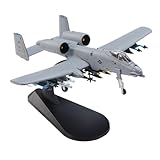
- A-10 is a twin-engine, United States-developed and -produced, ground-attack-specialized jet aircraft that performs low-altitude, close-range ground-attack missions
- 1:100 Scale Military Die-cast Plane Model. The size of the aircraft model is 7.2*5.9*5.3 inches, the weight is 0.45 pounds. This A-10 aircraft model requires no assembly and can be displayed directly after purchase
- The fighter casing is a high quality alloy, The tire and the propeller is engineering plastic. The stand base keeps the model plane in good condition
- A-10 military aircraft model accurately reproduces the appearance and details of the real jet airplane, including the visible cockpit, missiles hanging from the bottom, smooth lines and glossy curved surface
- Metal Airplane model is an excellent gift for aerospace enthusiasts, making it a fantastic birthday present and keepsake. It is suitable for display in the living room, study, or office
That mileage is best understood as an estimate or global equivalent, not as a single point-to-point route. The aircraft accumulated distance by flying repeated circuits rather than traveling between six defined destinations.
The pilots slept in four-hour shifts
Timm and Cook rotated flying duties approximately every four hours. The wing-leveler/autopilot gave the off-duty pilot an opportunity to sleep, but “off duty” did not mean comfortable or safe by modern standards.
The cabin was cramped, loud, hot or cold depending on conditions, and increasingly dirty from fuel and exhaust. The resting pilot still had to remain alert enough to respond to changing conditions, mechanical problems, and the next refueling operation. Cook’s journal and later accounts describe sleep deprivation, little physical activity, and the relentless burden of maintenance chores.
On the 36th day, the human limits of the plan became starkly clear. Timm fell asleep while flying at night. The airplane continued under the wing-leveler/autopilot for more than an hour before he woke. He later said he found the aircraft heading south through a canyon and did not immediately recognize the lights around him.
This was not a controlled experiment in human endurance. It was a record attempt conducted with 1950s equipment, improvised systems, and pilots whose ability to continue depended on constant discipline and considerable luck.
What went wrong during the flight?
Failures accumulated as the days passed:
- The generator failed on day 39.
- The pilots had to hand-pump fuel into the wing tanks.
- The tachometer failed.
- The autopilot or wing-leveling equipment experienced problems.
- The cabin heater failed.
- Landing and taxi lights failed.
- The belly-tank fuel gauge failed.
- The electric fuel pump failed.
- The refueling winch failed.
Night refueling became particularly difficult. On at least one occasion, the crew taped a flashlight to the grappling hook so the pilots could see it. A pathfinder truck drove ahead of the fuel truck to help the aircraft locate the rendezvous in the darkness.
Rank #4

- Diecast metal construction with some plastic components.
- Realistic panel lines, antennas, access panels and surface details.
- Pad printed markings and placards that won't fade or peel like decals.
- Presentation stand to display the aircraft "in flight". Authentic ordnance loads.
- Ages 14+
Engine condition also deteriorated. Carbon accumulated on the spark plugs and in the combustion chambers, reducing power. The Cessna became less capable of climbing when carrying a full fuel load, exactly when the aircraft needed enough performance to remain safely above the terrain and align with the ground crew.
Free tools Windows power users keep installed
One-click scans. No signup required.
Why the flight finally ended
After 64 days, 22 hours, 19 minutes, and 5 seconds in the air, the Hacienda returned to McCarran Field on February 7, 1959. The pilots had achieved the record and had no need to extend the risk any further.
They reportedly needed help getting out of the aircraft. The Cessna was grimy and streaked with exhaust, while the pilots were exhausted from weeks of poor sleep, constant engine noise, cramped conditions, and repeated operational demands.
The achievement was not just a feat of flying. It combined an overloaded airframe, extra fuel tanks, altered maintenance systems, a crude autopilot, moving-vehicle rendezvous, and a large support team working in the desert. Calling it simply “a Cessna 172 that flew for 64 days” understates how thoroughly the airplane and its operation had been transformed.
Independent reader supportYour contribution helps us test, update, and keep practical guides available for everyone.Where is the record-setting Cessna 172 now?
After the publicity faded, the airplane was flown to Canada in 1960. Steve Timm later found it on a farm in Carrot River, Saskatchewan, and brought it back to Las Vegas in 1988.
In 1992, the McCarran Aviation Heritage Museum—identified in later historical material as the Howard W. Cannon Aviation Museum—obtained the aircraft for permanent display. It was restored to its pre-flight condition and is reported to hang in the baggage-claim area at Las Vegas airport.
Best Value

- Realistic Design: Beautifully crafted model airplane with blue and white color scheme, it is a beautiful decorative item.
- Movable Parts: With sliding wheels, it can simulate the take-off condition for any occasions.
- Compact Size:Measures approximately 6 inches long and fits easily on desks, offices, bookcases, and displays
- Durable Construction: The fuselage is made of metal material, The wings are made of plastic, which can be played and displayed for a long time.
- Collectible Item: Whether for a model enthusiast or aviation fan, this airplane model makes a great addition to any collection.
The restored airplane may look like a familiar Cessna 172, but its historical significance comes from what was added around that basic design: the belly tank, transfer pump, modified oil system, external platform, endurance equipment, and the ground operation that kept it flying.
So, was it really the longest flight ever?
It was the recognized record for the longest time flying an aircraft in the category documented by Guinness World Records: a manned aircraft remaining airborne continuously with in-flight refueling. It should not be described as the longest airline flight, the longest flight by any aircraft in every possible category, or a flight completed without refueling.
One secondary account prints December 14, 1958, as the takeoff date. The more detailed and consistent historical record—including Guinness, AOPA’s account, and the EAA-reproduced material—places takeoff on December 4, 1958, which also fits the reported duration and February 7 landing. December 4 is therefore the date used here.
What’s actually slowing this PC down?
Pick the symptom - the matching free tool is one click away.
The central lesson is more interesting than the headline: the record was achieved by turning a small training-and-utility airplane into an airborne worksite, then supporting it with precise refueling runs, maintenance, logistics, and two pilots willing to live in the sky for more than two months.
Sources and historical notes
- Guinness World Records: the endurance record, pilots, aircraft, dates, location, and in-flight refueling qualification.
- AOPA’s historical account: the exact takeoff time, record context, route, and project background.
- EAA-reproduced historical material: aircraft modifications, refueling procedure, equipment failures, pilot accounts, and preservation history.
- Smithsonian Air & Space Magazine: useful corroboration for the aircraft and refueling details, but its printed December 14 takeoff date conflicts with the other accounts.
Frequently Asked Questions
How long did the Cessna 172 stay in the air?
Robert Timm and John Cook flew the Cessna 172 from December 4, 1958, until February 7, 1959—a total of 64 days, 22 hours, 19 minutes, and 5 seconds.
Did the Cessna 172 fly for 64 days without refueling?
No. The airplane never landed during the record attempt, but it received fuel, food, water, oil, and other supplies from a moving ground crew more than 128 times.
What kind of airplane broke the endurance record?
It was a 1958 Cessna 172 known as the Hacienda, historically associated with registration N9172B. It was heavily modified with a 95-gallon belly tank, an altered oil-servicing system, a folding external platform, and endurance equipment.
Recommended Free Tools
Where is the record-setting Cessna 172 today?
The aircraft was returned to Las Vegas after being found on a Saskatchewan farm. It was restored and is reported to be displayed in the baggage-claim area at Harry Reid International Airport, formerly McCarran International Airport.
The Bottom Line
The Cessna 172 Hacienda stayed airborne for 64 days, 22 hours, 19 minutes, and 5 seconds—but only through continuous in-flight refueling, extensive aircraft modifications, and a large desert ground operation. It remains an endurance-flight record, not a nonstop, no-refueling flight by an ordinary Cessna 172.
Quick Recap
Product prices and availability are accurate as of the date/time indicated and are subject to change. Any price and availability information displayed on Amazon at the time of purchase will apply.




