What’s actually slowing this PC down?
Pick the symptom - the matching free tool is one click away.
The Corvette’s mid-engine layout was an engineering vision for decades before it became a production car. Chevrolet’s 2020 Stingray, revealed on July 18, 2019, was the first production mid-engine Corvette. GM says the switch became necessary because the front-engine, rear-wheel-drive configuration had reached the limits of its performance potential by the C7. Earlier CERV experimental cars show how long the idea had been explored—but the available official accounts do not establish one definitive reason each stopped short of production.
Why did it take so long for the Corvette to go mid-engine?
Because exploring an architecture and committing a production model to it are different undertakings. GM president Mark Reuss’s retrospective traces a mid-engine vision from Zora Arkus-Duntov’s early work through a series of experimental vehicles. But these were research cars, not successive production Corvette programs. Reuss says the front-engine, rear-wheel-drive layout had been pushed close to its limits by C7; Chevrolet’s stated reason for changing course was to advance performance and driving dynamics.


GM’s published accounts explain that broad rationale, but do not document a complete business case or the specific cancellation decisions behind every earlier project. Cost, internal resistance, market demand, or any single executive decision should not be presented as the settled explanation for the delay.
From the original Corvette to the CERV experiments
The history begins with the Corvette itself. GM’s retrospective says the Corvette concept appeared at the General Motors Motorama at New York’s Waldorf-Astoria in January 1953 and reached assembly-line production within six months. Reuss says Arkus-Duntov encountered the car at that show and later developed a vision for a mid-engine Corvette. The experimental CERV cars put elements of that vision on wheels, but none was a production Corvette generation.
#1 Best Overall

- Versatile 3-in-1 Kit: Build your 1963 Chevy Corvette Sting Ray as factory stock, a street custom, or a drag gasser with this multi-option kit.
- Enhanced Features: Includes pre-lettered drag slicks, clear red taillights, and stock & custom wheels for an authentic and detailed build.
- Multiple Engine Options: Customize your model with various engine intake options, allowing for unique and personalized creations.
- Retro Styling: Comes with a full-color, retro-styled decal sheet and vintage “Street Rods Series” packaging, perfect for nostalgic collectors.
- High-Quality Collectible: AMT's improved reissue offers superior parts and detailing, making it a must-have for model enthusiasts and collectors.
| Vehicle | What GM’s retrospective reports | What it demonstrates |
|---|---|---|
| CERV I (1962) | Chevrolet Engineering Research Vehicle I was a mid-engine race car. Reuss reports a weight of 1,600 pounds, a 283-cubic-inch V-8 rated at 350 hp, and an 80-pound body. The experimental engineering included aluminum and magnesium components and mechanical fuel injection. | A lightweight mid-engine performance experiment—not a road-going production Corvette. |
| CERV II (1964) | GM describes a monocoque chassis, a 377-cubic-inch V-8 rated at 500 hp, and all-wheel drive. Reuss reports a claimed 0–60 mph time under three seconds and a 210 mph top speed. Separate torque converters drove the front and rear axles; GM patented the configuration in 1968, according to Reuss. | Exploration of high-performance power delivery and all-wheel-drive engineering. |
| CERV III (1990) | Reuss describes a mid-engine, all-wheel-drive car with a 5.7-liter V-8 rated at 650 hp and a weight of 3,400 pounds. It used extensive carbon fiber, including a carbon-fiber torque tube. | A more advanced technology demonstrator that still remained experimental. |
The performance and weight figures in this table are specifications or claims reported by GM president Mark Reuss in his 2025 retrospective, not independent test results. The CERV cars show sustained technical interest in the layout; their existence alone does not explain why GM did not put it into production sooner.
Why GM says it changed the layout for the C8
Reuss’s explanation is that the traditional configuration had reached a ceiling. “Once we got to C7, we had pushed the limits of what we could do with that configuration,” he wrote. Chevrolet’s 2019 launch announcement likewise said the front-engine vehicle had reached its performance limits and described the mid-engine layout as necessary to pursue greater performance and driving dynamics.
Rank #2
Chevrolet’s launch material presented the C8’s rear-biased weight distribution as a way to improve straight-line and track performance. Moving the driver closer to the front axle was intended to improve responsiveness and the sense of control. These are the manufacturer’s stated objectives and launch claims, not a neutral head-to-head test proving that every C8 is faster or better-handling than every C7.
What changed—and what Chevrolet kept
The move relocated the engine behind the passenger compartment and brought the cockpit 420 mm (16.5 inches) farther forward, according to Chevrolet’s 2019 launch material. A lower hood and improved forward sightlines were among the changes Chevrolet cited. Yet the new packaging was not presented as a rejection of everyday utility: the 2020 Stingray retained two trunks with a stated combined capacity of 357 litres (12.6 cubic feet), as well as a removable roof panel.
The Tool Desk
Outbyte Driver Updater FREEFix the driver behind crashes, sound loss and screen glitchesFind Drivers →Outbyte PC Repair FREEClear out junk files and repair common Windows errorsFree Scan →Rank #3

- Brand new box.
- Real rubber tires. Has opening doors.
- Detailed interior, exterior. Made of diecast with some plastic parts.
- Dimensions approximately L-7.5, W-3.5, H-2 inches.
At launch, Chevrolet specified a 6.2-liter LT2 small-block V-8 and an eight-speed dual-clutch transmission developed with TREMEC. The company quoted 495 hp and 470 lb-ft with performance exhaust, and claimed a 0–60 mph time under three seconds when equipped with the optional Z51 package. These are launch-era manufacturer specifications and claims for the 2020 Stingray, not figures to apply to every C8 model year or configuration.
Independent reader supportYour contribution helps us test, update, and keep practical guides available for everyone.When the mid-engine Corvette became real
Chevrolet introduced the 2020 Stingray on July 18, 2019, calling it the first-ever production mid-engine Corvette. That date marks the difference between decades of engineering exploration and a production commitment under the Corvette name. The CERV cars made the idea tangible; the C8 made it the architecture of a retail Corvette.
Rank #4
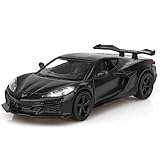
- High-Quality Materials:The Chevrolet Corvette die-cast car is made of zinc alloy,plastic parts and rubber tires,making it safe for children to play with.It features detailed interior and exterior trim, and is very sturdy.
- Function:No batteries are required, but the vehicle has a powerful pull back feature. Simply pull it back, then release your hand, and the car will go for a long distance. The doors may be opened to view the whole inside of the vehicle. So appealing to children and collectors alike.
- Size:1/36 scale vehicle model with beautiful English packaging,ideal for toddlers to play with and carry. Car collectors will appreciate the perfect small size, which allows them to collect a complete set of cars without taking up too much space.
- Grow From Play:Help children learn more about car ,expand their knowledge ,increase the hand-eye coordination and the reaction speed of the children in the play.
- Ideal Christmas Festival Gift:All of TOKAXI die-cast model cars are attractively packaged in English, making them the perfect Christmas, Birthday, Children's Day, New Year gift for kids, party favors, home decorations, or travel toys for boys and girls.gifts for boys girls.
For the historical framing and CERV specifications, see Mark Reuss’s 2025 GM retrospective. Chevrolet’s 2019 introduction of the first mid-engine Corvette documents the launch rationale and 2020 Stingray specifications. Chevrolet’s Corvette heritage page provides additional brand history.
Quick Recap
Best Value
Product prices and availability are accurate as of the date/time indicated and are subject to change. Any price and availability information displayed on Amazon at the time of purchase will apply.




