TAG Heuer’s Formula 1 watch collection debuted in 1986, but the company’s connection to Formula 1 racing began earlier through team sponsorships and timing work. The watches borrowed their name and motorsport identity from that history; they were not themselves the same thing as TAG Heuer’s partnerships with the sport. The brand says it served as Formula 1’s Official Timekeeper from 1992 to 2003, then returned to the role in January 2025.
How TAG Heuer’s Formula 1 story began
Heuer’s motorsport links predate both the TAG Heuer name and the watch collection. According to TAG Heuer’s vintage-history account, Heuer partnered with Ferrari from 1971 to 1979. Techniques d’Avant-Garde (TAG) sponsored Williams from 1979 to 1981, then invested in McLaren and funded its Porsche turbo engine. TAG completed its acquisition of Heuer in January 1986, and the Formula 1 watch collection followed that year. TAG Heuer’s vintage history traces the collection to this wider motorsport background.
The Formula 1 name drew on racing associations already established by Heuer and TAG. The first watches were not racing chronographs: TAG Heuer positioned them as a colorful, comparatively accessible quartz collection, distinct from its established dive watches. The bright cases and plastic straps gave the line a different look from the brand’s more traditional designs.
What the Formula 1 watches were like in each era
The collection changed substantially over time. Materials, sizes, movements and functions varied by model, so no single specification describes every TAG Heuer Formula 1 watch.
Free tools Windows power users keep installed
One-click scans. No signup required.
| Period | What changed |
|---|---|
| 1986 launch | Bright fiberglass-reinforced plastic cases, plastic straps and quartz movements. The initial sizes were 28 mm and 34 mm. |
| 1989 | TAG Heuer’s retrospective dates the addition of chronographs to this year; the collection was no longer limited to time-only watches. |
| 1998–2000 | A new series arrived in 1998. The original collection was discontinued in 2000, following LVMH’s acquisition of TAG Heuer in 1999. |
| 2004 return | The collection returned with a redesign and upgraded materials, including steel construction and sapphire crystal, as well as larger cases. |
| 2012 generation | Automatic movement variants joined the range; quartz models remained part of the collection’s broader evolution. |
| 2015 redesign and later | A new case style marked a substantial redesign. Later editions included special collaborations. |
TAG Heuer’s published retrospective also reports sales of “over 3,000,000 watches,” without giving a publication year for that figure. It therefore should not be read as a current sales total. The late-1980s advertising line reproduced in the brand’s magazine captured the collection’s deliberately robust pitch: “The Heuer Formula 1. Guaranteed not to break down during high speed knocks and scrapes.” The vintage-history page provides the brand’s account of the line’s evolution.
#1 Best Overall

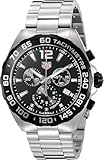
- Dial Color: Black, Case Shape: Round, Dial Glass Material: Sapphire Crystal
- Band Color: Silver, Band Material: Stainless Steel
- Watch Movement Type: SwissQuartz, Watch Display Type: Analog
- Case Material: Stainless Steel, Stainless Steel Bezel
- Warranty type:Manufacturer; 2 Years International Warranty
When TAG Heuer was Formula 1’s Official Timekeeper
TAG Heuer says it held Formula 1’s Official Timekeeper role from 1992 to 2003, and returned to it beginning in January 2025. These are two distinct periods in the brand’s relationship with the championship, rather than a continuous appointment. TAG Heuer’s January 2025 account also lists a McLaren partnership from 1986 to 2015 and an Oracle Red Bull Racing partnership beginning in 2016. The January 2025 TAG Heuer magazine article presents these dates as the company’s own history.
That article describes the brand’s motorsport record in terms of more than 230 Grand Prix wins, more than 500 podium finishes, 15 World Drivers’ Championship titles and 11 World Constructors’ Championship titles. Those are figures TAG Heuer published in January 2025; they are not independent tallies established here.
Rank #2
What the modern collection looks like
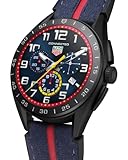
In its January 2025 retrospective, TAG Heuer describes the Formula 1 range as spanning quartz and automatic movements, with materials including carbon and ceramic. One named example is the Formula 1 Chronograph x Oracle Red Bull Racing, reference CAZ101AZ.FT8090, which TAG Heuer says was unveiled in December 2024. It shows how the collection continues to connect watch design with racing partnerships, while remaining one example rather than a specification for the entire range. The dated announcement does not establish current stock or price. TAG Heuer’s Formula 1 collection page presents the range.
Why the watch collection and the racing partnership are different stories
The Formula 1 collection began in 1986, drawing on motorsport associations TAG and Heuer had built through sponsorships, investment and timing work. The Official Timekeeper periods came later, from 1992 to 2003 and again from January 2025, according to TAG Heuer. Keeping those timelines separate explains the connection without implying that every Formula 1 watch was made for a team, used in race timing, or shared the same technical specification.
Quick Recap
Rank #4

- Featuring a Silver-tone Band, Silver-tone Case, Scratch Resistant Sapphire Crystal
- Automatic movement
- Anthracite dial
- Date display
Product prices and availability are accurate as of the date/time indicated and are subject to change. Any price and availability information displayed on Amazon at the time of purchase will apply.




