Classic American muscle is remembered through more than big displacement: the car an engine powered, its hardware and tune, and whether it was built for the street or shaped by racing all mattered. The documented examples here—from the 1964 Pontiac GTO to Chevrolet’s 1966 Corvette 427s and Ford’s distinct 429 variants—show why a badge or cubic-inch figure alone never tells the whole story.
How the muscle-car era took shape
General Motors’ heritage account marks the beginning of the muscle-car era with the 1964 Pontiac GTO: a midsized car equipped with a V8 rated at 325 horsepower. The page also names the Chevrolet Chevelle Malibu SS, Oldsmobile 4-4-2 and Buick GSX as offerings from other GM divisions. That is useful era context, not detailed documentation of those models’ engine variants or specifications. GM Heritage’s overview is undated; 1964 is the GTO’s model year, not the page’s publication date.
That distinction matters because “muscle-car engine” can refer to an engine family, a particular configuration, or a specific engine-and-car combination. Treating every engine with the same displacement as interchangeable erases the distinctions that made particular versions notable.
Why displacement is not a complete engine identity
A cubic-inch number tells you an engine’s displacement, but not its exact hardware, tune, rated output or intended use. Chevrolet’s 427 and Ford’s 429 illustrate the point in different ways: GM records two output ratings for the 427 in one model year of Corvette, while Ford Racing describes three distinct 429 variants with different hardware and purposes.
What’s actually slowing this PC down?
Pick the symptom - the matching free tool is one click away.
#1 Best Overall
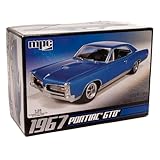
- V8 POWER: The model features a 400 cubic inch V8 engine, reflecting the muscle and power that defined the GTO's reputation.
- DETAILED SUSPENSION & EXHAUST: The kit incorporates separate rear suspension and exhaust detailing, adding to the realism of the model.
- BUCKET SEATS & CONSOLE: The model's interior features bucket seats and a floor shifter with a console, capturing the iconic look and feel of the GTO.
- OPTIONAL SUPERCHARGER: For those seeking more power, the kit offers an optional supercharger, allowing you to customize your model.
- CLEAR & COMPREHENSIVE INSTRUCTIONS: The included instructions are clear and user-friendly, making the kit accessible to modelers of different skill levels, from beginners to experienced hobbyists.
Chevrolet’s 1966 Corvette 427 came in two ratings
General Motors’ collection record says the 1966 Corvette introduced a 427-cubic-inch V8 in two ratings: 390 horsepower and 425 horsepower. Those figures belong to the 1966 Corvette record; they are not universal ratings for every Chevrolet 427. The collection page is undated, and the model year is 1966. See GM’s 1966 Corvette record.
The useful takeaway is not that one number defines the “real” 427. It is that a meaningful specification needs the application and version alongside the displacement. A bare “427” comparison can conceal important differences.
Rank #2

- A PERENNIAL CLASSIC FOR EXPERIENCED MODELERS: AMT’s 1/25 scale 1967 Shelby GT-350 is the perfect project for muscle car builders. Add it to your collection today!
- FEATURE PACKED: The 1967 Shelby GT-350 is a historical muscle car that stands alone! Fully paintable, it features authentically detailed water-slide decals. Build it up right with a Ford 289 V8 engine and all the Shelby touches—custom rear lower pan, chrome wheels, custom taillights and front grille, bucket seats, and more. Wrapped up nicely in retro-styled packaging!
- QUICK SPECS: 1/25 Scale, 123 Parts, 7 inches long once assembled. Parts molded in white, clear and transparent red, with black vinyl tires. Some parts are chrome plated. Plastic model kit paint and cement required (Testors or Tamiya brands recommended). Paint guide included in kit. Skill Level 2. For ages 10+
- THE PERFECT PRESENT: Don't know what to get dad for his birthday? Or maybe you have an avid hobbyist or collector in your life. This model kit makes an ideal gift for any occasion!
Ford’s 429 names described different engines
Ford Racing’s engine-history document distinguishes the 429 Cobra Jet (CJ), Super Cobra Jet (SCJ) and Boss. It is undated in the available source record, so the descriptions below are attributed to Ford Racing rather than assigned a publication year. Read Ford Racing’s engine-history document.
| Variant | Documented distinction | Purpose or application context | Output in the cited source |
|---|---|---|---|
| 429 Cobra Jet (CJ) | Hotter cam, larger carburetor and larger ports and valves than the comparison engine described by Ford Racing. | A performance variant; the cited description does not establish a specific car application here. | Not stated in Ford Racing’s cited document description. |
| 429 Super Cobra Jet (SCJ) | Ford Racing identifies four-bolt main caps and mechanical-valvetrain details. | A distinct CJ-related configuration; the cited description does not establish a specific car application here. | Not stated in Ford Racing’s cited document description. |
| 429 Boss | A competition design with aluminum heads and crescent-shaped combustion chambers. | Competition purpose, with a documented NASCAR homologation connection described below. | Not stated in Ford Racing’s cited document description. |
Ford Racing states that production of the CJ and SCJ ended in 1971. That end date should not be extended to the Boss: the cited statement names only the CJ and SCJ.
Rank #3

- 1:25 scale, skill level 2, paint & glue required
- 82 parts
- Molded in white, clear, transparent red, and some chrome-plated parts
- Black vinyl tires
- Metal axle
The Boss 429’s Mustang role was tied to racing
The Boss 429 shows why a road car’s engine story can involve more than the car’s own competition record. NHRA’s 2025 account says Ford put the Boss 429 in 1969 and 1970 Mustangs in a homologation context, even though the Mustang was not the car that would race in NASCAR. In other words, the Mustang application served a purpose within a racing program; that does not mean the Mustang itself was the NASCAR race car. NHRA’s Boss 429 history.
What these engines reveal—and what this account cannot establish
The examples establish a practical way to read classic engine names: identify the car and model year, distinguish the variant and its documented hardware, and state the engine’s purpose where the evidence supports it. The GM heritage overview is an era marker; GM’s Corvette collection record supplies the 1966 427 ratings; Ford Racing’s document describes the 429 variants; and NHRA adds the Boss’s homologation context. Those sources support specific examples, not a cross-marque horsepower ranking.
Rank #4

- Revell Model Kit #14531, Skill Level 5, Contains 77-Parts, Recommended for ages 13 and up
- Detailed 440+6 V-8 engine, hood scoop that can be positioned open or closed
- Detailed interior with separate side panels and a front bench seat
- Molded in white and clear with chrome plated parts and black vinyl tires
- Illustrated assembly instructions. Requires paint and glue. (not included)
This is a focused GM-and-Ford account, not a complete history of every American muscle-engine family. GM’s overview names Buick, Oldsmobile and Pontiac models, but it does not provide enough engine-variant detail to make comparable claims about them here. The cited material likewise does not support a detailed Chrysler/Mopar account. Those marques deserve their own treatment grounded in model- and engine-specific sources rather than assumptions based on reputation.
Independent reader supportYour contribution helps us test, update, and keep practical guides available for everyone.Why the names still need context
Engine labels can recur across eras, which makes the name alone an unreliable guide. In a March 26, 2026 article about the then-new 2027 Corvette LS6, GM News quoted Small Block assistant chief engineer Mike Kociba: “We’re trying to recreate some of what worked in the muscle-car era.” GM News’ 2027 Corvette V8 explainer. That is a modern engineer describing inspiration, not a statement from the original muscle-car era; the LS6 name has also referred to different engines in different periods.
Quick Recap
Best Value

- CLASSIC MUSCLE STREET MACHINE – Aggressive custom 1967 Charger styling.
- 426 HEMI ENGINE OPTIONS – Blown injected or cross-ram carb setup.
- CUSTOM STREET DETAILS – Hood scoop, traction bars, and chrome side pipes.
- WIDE GOODYEAR RACING TIRES – Pre-lettered vinyl tires included.
- RETRO MPC BOX ART – Authentic 1980s-style packaging.
Product prices and availability are accurate as of the date/time indicated and are subject to change. Any price and availability information displayed on Amazon at the time of purchase will apply.




