Using Autocar India’s decade-by-decade selections of production road-car speed leaders, the list runs from the Duesenberg Model SJ in the 1930s to the Koenigsegg Agera RS in the 2010s. The 2020s remain unresolved: the Koenigsegg Jesko’s often-cited 483 km/h is an expected target, not an achieved, verified speed. These are attributed selections, not an independently adjudicated record series.
What “fastest” means here
This comparison uses the cars and figures selected by Autocar India’s decade list, which presents production road cars as decade leaders. Its figures are useful as a historical guide, but the available material does not establish a uniform measurement method or independently verify every entry. A quoted specification, a speed recorded by a modified car and a run made in a special record configuration are not automatically equivalent.
The FIA’s land-speed records are a separate category: they apply to wheeled vehicles under defined classes and rules. Its outright record is 763.035 mph (1,227.985 km/h), set by the jet-powered ThrustSSC in October 1997—not a production sports car. See the FIA land-speed records for the category distinction.
Fastest sports car selections by decade
| Decade | Autocar India selection | Stated speed | Important qualification |
|---|---|---|---|
| 1930s | Duesenberg Model SJ | 225 km/h | Autocar attributes 320 hp to the supercharged version and says 36 SJs were made. |
| 1940s | Jaguar XK 120 | 215 km/h | Autocar reports 214 km/h at Ostend in 1949 for a car after modifications; 215 km/h is its rounded headline figure. |
| 1950s | Mercedes-Benz 300SL | 246 km/h | Named by Autocar as the decade’s production-car leader. |
| 1960s | Lamborghini Miura | 280 km/h | Autocar identifies the Miura as the decade’s leader and notes its centrally mounted V12. |
| 1970s | Ferrari 512 Berlinetta Boxer | 303 km/h | Autocar names the 1976 512 as the decade’s leader. |
| 1980s | Ferrari F40 | 325 km/h | Autocar’s selection; Porsche separately described the 959 as a then-record series-production sports car at 317 km/h. |
| 1990s | McLaren F1 | 386 km/h | Named by Autocar as the decade’s leader. |
| 2000s | Shelby Ultimate Aero TT | 414 km/h | Named by Autocar as the decade’s leader. |
| 2010s | Koenigsegg Agera RS | 431 km/h | Autocar’s rounded figure; Bugatti separately reports a 431.072 km/h Veyron Super Sport record in 2010. |
| 2020s | Unresolved | No verified winner established here | Autocar lists a 483 km/h expectation for the Koenigsegg Jesko, not a completed verified result. |
All decade selections and their stated speeds in the table are attributed to Autocar India. Its opened page does not establish a publication date in the available text, so no year is assigned to that list.
#1 Best Overall
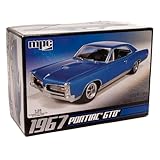
- V8 POWER: The model features a 400 cubic inch V8 engine, reflecting the muscle and power that defined the GTO's reputation.
- DETAILED SUSPENSION & EXHAUST: The kit incorporates separate rear suspension and exhaust detailing, adding to the realism of the model.
- BUCKET SEATS & CONSOLE: The model's interior features bucket seats and a floor shifter with a console, capturing the iconic look and feel of the GTO.
- OPTIONAL SUPERCHARGER: For those seeking more power, the kit offers an optional supercharger, allowing you to customize your model.
- CLEAR & COMPREHENSIVE INSTRUCTIONS: The included instructions are clear and user-friendly, making the kit accessible to modelers of different skill levels, from beginners to experienced hobbyists.
Where the ranking needs context
The 1940s: a modified XK 120 run
The Jaguar entry illustrates why a decade list should not be read as a clean set of like-for-like test results. Autocar gives the XK 120 a 215 km/h headline speed, while its account of the 1949 Ostend run gives 214 km/h and says the car had been modified. That reported run supports the car’s historical significance, but it is not evidence that an unmodified production XK 120 achieved the same speed.
The 1980s: F40 selection, 959 record claim
Autocar selects the Ferrari F40 at 325 km/h. Porsche’s 959 history and press-kit page gives the 959 a 317 km/h top speed and calls it the then world record holder for a series-production sports car. Porsche says 292 examples were built from 1987 to 1988. These claims do not by themselves settle every possible comparison: sources may use different definitions of “sports car,” production status, and record conditions.
Rank #2

- A PERENNIAL CLASSIC FOR EXPERIENCED MODELERS: AMT’s 1/25 scale 1967 Shelby GT-350 is the perfect project for muscle car builders. Add it to your collection today!
- FEATURE PACKED: The 1967 Shelby GT-350 is a historical muscle car that stands alone! Fully paintable, it features authentically detailed water-slide decals. Build it up right with a Ford 289 V8 engine and all the Shelby touches—custom rear lower pan, chrome wheels, custom taillights and front grille, bucket seats, and more. Wrapped up nicely in retro-styled packaging!
- QUICK SPECS: 1/25 Scale, 123 Parts, 7 inches long once assembled. Parts molded in white, clear and transparent red, with black vinyl tires. Some parts are chrome plated. Plastic model kit paint and cement required (Testors or Tamiya brands recommended). Paint guide included in kit. Skill Level 2. For ages 10+
- THE PERFECT PRESENT: Don't know what to get dad for his birthday? Or maybe you have an avid hobbyist or collector in your life. This model kit makes an ideal gift for any occasion!
The 2010s: rounded figures and a specific record run
Autocar gives the Agera RS 431 km/h. Bugatti’s account reports that the Veyron Super Sport achieved 431.072 km/h in 2010. The figures are close, but their precision and underlying claims differ; the extra decimal places do not turn the decade ranking into a single, consistently verified comparison. Bugatti also reports 407 km/h for the Veyron 16.4 and 351 km/h for the EB110, but those model figures do not replace the separate Veyron Super Sport record claim.
The 2020s: a target is not a record
Autocar’s Jesko figure of 483 km/h is explicitly an expectation. Without a completed, verified production-road-car result established in the cited material, naming a 2020s winner would overstate the evidence.
Recommended Free Tools
Rank #3

- Revell Model Kit #14533, Skill Level 4, Contains 104-Parts, Recommended for ages 12 and up
- Iconic Shelby 427 Cobra S/C body with an opening hood and separate chrome detail parts.
- Highly detailed 427-cubic-inch V-8 engine, separate tube frame, and side-mount exhausts Moteur V-8.
- All-new decal sheet with the 427 Cobra’s signature over-the-top twin stripes and optional race markings.
- Molded in white, transparent red, and clear with chrome plated parts and soft black tires. Paint and glue required(not included).
Why production-car speed claims differ
Before comparing two headline speeds, check what each number actually represents:
- Production status and scope: Was the car a series-production road car, a limited production model, or a specially prepared vehicle? “Sports car” is not applied consistently across every historical list.
- Configuration: Is the number a manufacturer’s model specification, a speed reached by a modified car, or a result from a special record run? Bugatti says the Chiron’s 490.484 km/h figure came from a 2019 record run; it should not be presented as the standard top speed of every Chiron road car. See Bugatti’s account of the Veyron and Chiron records.
- Measurement and verification: A published speed needs context about how it was measured and what rules applied. The FIA’s class-based land-speed framework is not interchangeable with a publisher’s selection of production-car leaders.
- Date and category: Distinguish the car’s model decade from the date of a speed run, and worldwide claims from explicitly national or class-limited ones.
National qualifiers matter too. Porsche’s 2022 account calls the 911 Carrera RS 2.7 “the fastest German production car of its day.” It gives 152 mph (about 245 km/h) for the Sport version and 149 mph for the Touring version. That is a German production-car claim, not proof of a worldwide decade record. Porsche attributes the statement, “The 911 Carrera RS 2.7 was intended as a homologation special. It was to be a very light, fast sports car,” to Peter Falk, then Head of Testing for series production cars. Read Porsche’s 2022 account of the 911 Carrera RS 2.7.
Quick Recap
Best Value

- 2-in-1 format with stock and drag racing parts
- Pre-lettered M&H Racemaster vinyl drag slicks
- Pre-lettered M&H Racemaster vinyl drag slicks
- Full color decal sheet
- Vintage illustrated packaging
Rank #4

- Accurate Scale Model Kit
- Paints and Glue Required
- Easy to Build
- Detailed Instructions Included
- This is the 1: 25 Scale 68 Camaro Z/28 Plastic Model Building Kit by AMT, Item No 868, This is not a toy
Product prices and availability are accurate as of the date/time indicated and are subject to change. Any price and availability information displayed on Amazon at the time of purchase will apply.




