The Boeing P-12/F4B family has the strongest claim to being the company’s most successful historical fighter: the U.S. military bought 586 across its variants, and the type served as a frontline Army and Navy fighter through much of the 1930s. The P-26 is the more important technical milestone, while Boeing’s F7B is a stronger candidate for its least successful fighter development. The XF8B-1 belongs in a different category: it was an ambitious aircraft that did not reach major production after wartime priorities changed.
These are editorial judgments, not a definitive historical league table. “Best” here weighs adoption and service, contribution to fighter design in its era, and how well an aircraft met its intended role. “Worst” refers to documented development shortcomings or an unsuccessful program outcome—not a claim that every cancelled prototype was inherently poor. The scope is Boeing-origin historical aircraft; current Boeing product listings are not treated as proof of original design authorship.
As an Amazon Associate I earn from qualifying purchases.
How to compare Boeing’s fighters
A fair comparison separates four questions: Did the aircraft enter service in meaningful numbers? Did it advance fighter design for its time? Was it suited to its intended role? And did its development result in a successful production or service program? These measures can point to different aircraft. A technical breakthrough is not automatically the most successful operational fighter, and a cancellation does not by itself prove an aircraft was deficient.
Free tools Windows power users keep installed
One-click scans. No signup required.
- Adoption and service: distinguish totals for a whole aircraft family from figures for a specific variant.
- Technical contribution: judge a design against the technology and expectations of its era.
- Role fit: compare a pursuit fighter with other fighters of its period, not solely by raw speed against later aircraft.
- Program outcome: separate a documented technical shortcoming from a project ended by changing priorities.
Best overall historical success: P-12/F4B
The P-12 for the U.S. Army and its Navy counterpart, the F4B, form Boeing’s clearest success story by adoption and service. Boeing’s historical catalog records that the military purchased 586 aircraft across the family’s versions. The Museum of Flight gives the same family total and describes the P-12/F4B as a premier frontline fighter for the U.S. Army and Navy throughout the 1930s. That broad use gives it a firmer case for overall historical success than an aircraft chosen chiefly for technical novelty.
#1 Best Overall
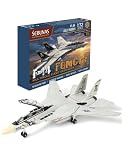
- Experience the legendary F-14 Tomcat through a highly detailed model designed for aviation collectors and hobby enthusiasts. The finished model becomes a striking desktop or showcase centerpiece.
- This 3D puzzle is designed for beginner-level assembly enthusiasts, offering an immersive hands-on building experience that helps cultivate patience, concentration, and mechanical problem-solving skills.
- This product is manufactured using high-quality, environmentally friendly plastic and employs an ultra-fine etching process to ensure durability, structural precision, and realistic aircraft details.
- Encourages understanding of aircraft engineering concepts while improving hand-eye coordination and spatial thinking through engaging mechanical assembly.
- Ideal gift for childs, engineers, collectors, model builders, and puzzle lovers for birthdays, Children’s Day, Christmas, or special hobby occasions.
The U.S. Naval History and Heritage Command’s National Naval Aviation Museum says the F4B-4 was the Navy’s first-line fighter from 1932 to 1937 and describes it as highly successful. That service record applies specifically to the F4B-4; the 586 procurement figure is for the wider P-12/F4B family, not that single variant.
Boeing’s catalog lists a top speed of 178 mph, a range of 675 miles, a service ceiling of 26,200 feet and two machine guns for the P-12/F4B family. Those specifications help identify the aircraft’s period and configuration, but the family’s procurement and front-line use are the stronger evidence for calling it Boeing’s most successful historical fighter.
Rank #2

- IFF antenna array in front of the cockpit distinguishes this CCIP-equipped model from other F-16s.
- Curved form of the F-16 accurately reproduced with trademark Tamiya precision.
- Moveable horizontal stabilizers. "Flaperons" can be modelled in the up or down positions.
- Full ordnance load including AGM-88 HARM, AIM-120C AMRAAM, AIM-9M/X Sidewinder, ECM pod, and fuel tanks included.
- Centerline and inner wing pylons as well as tail assembly feature polycaps to allow easy detachment for storage.
Most important technical transition: P-26 Peashooter
The P-26 deserves recognition for what it signaled in fighter design, rather than an unsupported claim that it was Boeing’s best fighter in combat. The Smithsonian describes it as a high-performance, all-metal monoplane fighter whose general form would become standard during World War II. Its significance is the transition it represents; that does not settle how it compares operationally with the P-12/F4B.
Recommended Free Tools
Procurement totals vary by the scope of the account. The National Museum of the U.S. Air Force reports that 111 P-26A production aircraft and 25 later B and C models were ordered. In a separate account of the all-metal airplane, the museum says 139 P-26 fighters were purchased from 1932 through 1936. These figures describe differently framed totals and should not be collapsed into a single variant count.
Rank #3

- Enjoy building and displaying this 1/72 F-15EX Eagle II plastic model kit for adult and teen that is a snap together model plane kit no glue no paint. Designed as a USAF military fighter jet toy for boys and kids, it features an opening canopy, movable rudder, and pop-up airbrake for action posing. The 44 piece quick assembly plastic airplane kit with hidden storage stand tucks away spare landing gear and intake parts, making it a top desk display military aircraft model for aviation collector.
- This replica captures the USAF F-15EX Eagle II next generation air superiority fighter model, the newest American strike fighter plastic model kit for history buff. Built to replace the legendary Eagle, the Eagle II warplane collectible for shelf display is a must-have modern jet fighter model for collector and US Air Force desktop plane for office decor. Own a piece of air power history with this detailed F-15EX Eagle II scale replica for adult hobby enthusiast.
- Switch between ground attack stance display model with landing gear down and in flight nose down tilt pose with retracted gear using the swappable landing gear fighter model kit for dynamic display. Includes two styles of rectangular air intake for customizable jet model look, and all extra parts store inside the hidden compartment display stand for snap build airplane model. This snap fighter kit with removable gear and dual intakes delivers multiple poseable display modes for plastic model aircraft collector, creating a standout interactive warplane model for desk shelf.
- This 1/72 scale snap model plane measures 27cm long, 18cm wingspan, and 8.5cm tall, weighing just 210g. The fast easy build no tools needed hobby project for teen and adult beginners assembles from 44 pieces into a pre-colored plastic aircraft model for home decor. Perfect as a desk shelf office display model or a striking man cave desktop fighter jet replica, it’s an easy assembly jet fighter model for casual model fan and a bold 27cm long US Eagle model for display cabinet.
- Looking for an aviation model gift for men, boys, and kids who love airplanes? This easy assembly US fighter jet model birthday present for son also fits as F-15EX Eagle II Christmas gift for dad or Fathers Day surprise warplane model for husband. It serves as a hands on STEM building toy for children and adults away from screens, ideal as screen free hobby prize for teenager or beginner model kit for scale fighter plane replica collector. A must-have Eagle II collectible model for military enthusiast.
China received an export version in 1934 and used it in combat against Japan, according to the Air Force Museum. That establishes combat use, not overall superiority in combat.
Weakest documented fighter development: F7B and F6B
If “worst” means a poor development outcome rather than a universal ranking of aircraft quality, Boeing’s F7B is a defensible candidate. A Naval History Magazine retrospective describes the F7B prototype as a 231 mph monoplane that was unstable. That is a direct, specific shortcoming; the available record does not establish a comprehensive all-time comparison of Boeing fighters.
Rank #4

- 【Newly designed assembly model】The F-35 fighter jet assembly model kit is based on the real F-35 fighter jet, and the appearance carefully restores the classic features of the F35 fighter jet, such as the unique aircraft shape, exquisite spraying details and airplane model wheels, etc. The fighter jet model perfectly demonstrates the modern technology of the military aircraft. And the texture is very good, making the model look more refined.
- 【Easy-to-use assembly experience】The parts of the F-35 fighter jet model kit are carefully designed and made with good compatibility and fit, and can be assembled without special tools. It comes with an assembly step-by-step diagram, so even beginners can easily get started. At the same time, the assembled F35 fighter jet model is also movable, the cabin can be opened, and the fighter wheels can also move, bringing you a more vivid display effect.
- 【Product size and painting】The F-35 fighter model kit is restored according to the prototype ratio of 1:72, with specific dimensions of 24.5*17.5*5 and a weight of 0.175 pounds. The F35 fighter jet model is made of high-quality plastic material, which is not only sturdy and durable, but also not easy to oxidize and fade. The material is exquisite and lightweight, it has no sharp edges, and can effectively prevent the model from being damaged during assembly and play, which is safer.
- 【Unique decoration and gift】The F-35 fighter model is not only a beautiful handicraft, but also can be used as a decoration and collection. It is very suitable for military enthusiasts and model collectors to collect or give as gifts. For teenagers and children, the assembly process of this 1/72 F35 airplane model can exercise hands-on ability. Whether you collect it yourself or share it with like-minded people, this F35 military aircraft model can bring you endless fun and satisfaction.
- 【Worry-free Purchase】The product contains tiny parts, be careful not to let children swallow them by mistake. The fighter model kit uses a hard carton as the outer packaging to better protect the helicopter from damage during transportation. We insist on strict production requirements to control the quality of this F35 military fighter jet model to ensure that every customer is satisfied with the high-quality product. If you encounter any problems, please feel free to contact us!
The F6B was another unsuccessful fighter development. The same retrospective describes it as a 1933 prototype developed from the F4B and later redesignated BFB-1 for a bomber-fighter role. Its history illustrates why program outcome and role change should be discussed separately from a simple label such as “bad aircraft.”
What’s actually slowing this PC down?
Pick the symptom - the matching free tool is one click away.
XF8B-1: a cancelled program, not a proven bad aircraft
The XF8B-1 was an unusually ambitious carrier-based fighter-bomber. Boeing’s historical record calls it the heaviest carrier-based aircraft built before the end of World War II. Designed for both torpedo-bomber and fighter duties, it had one crew member and dual six-blade contra-rotating propellers. Boeing lists a top speed of 432 mph, a range of 3,500 miles and a ceiling of 37,500 feet.
Best Value

- QUICK BUILD DESIGN: Snap-fit assembly system allows completion in 15-30 minutes without glue or paint, perfect for beginners and experienced builders seeking instant gratification
- AUTHENTIC F-22 RAPTOR REPLICA: Precision-molded parts capture the stealth fighter's distinctive twin-tail design, angular fuselage, and swept wings with 1:72 scale accuracy
- EDUCATIONAL STEM VALUE: Enhances spatial reasoning and fine motor skills while teaching aerospace engineering principles through hands-on construction of America's premier air superiority fighter
- DISPLAY-READY QUALITY: Pre-colored gray plastic with engraved panel lines and cockpit details creates museum-worthy presentation straight from the box, no painting required
- COMPLETE KIT INCLUDED: Contains 20+ interlocking pieces, rotating landing gear, movable canopy, illustrated instructions, and display stand for immediate assembly and showcase
Only three XF8B-1 aircraft were built in 1944 and 1945, and the type never entered major production. Boeing attributes that outcome to changing wartime strategy, which required the company to concentrate on land-based large bombers and transports. The cancellation therefore supports calling the XF8B an unsuccessful production program, but not declaring it a poor-performing aircraft. Naval History Magazine notes that the Navy’s attack role instead went to the Douglas AD/A-1 Skyraider and Martin AM Mauler.
Verdict by category
| Category | Aircraft | Why it fits |
|---|---|---|
| Strongest historical success | P-12/F4B family | Military procurement of 586 across the family and substantial Army and Navy frontline service in the 1930s. |
| Most significant technical transition | P-26 | An all-metal monoplane fighter design that anticipated the form that became standard during World War II. |
| Clearest documented technical shortcoming | F7B | The Naval History Magazine retrospective specifically describes its prototype as unstable. |
| Clearest case of changed priorities ending production | XF8B-1 | Only three were built; Boeing says shifting wartime requirements redirected the company toward bombers and transports. |
What about today’s Boeing fighters?
Boeing’s current Fighters and Bombers page lists the F-15EX and the F/A-18 Super Hornet and EA-18 Growler. A current product listing establishes that these aircraft are in Boeing’s portfolio; it does not, on its own, establish that Boeing originated every modern design. They are therefore outside this origin-based historical ranking.
Quick Recap
Sources
- The Boeing Company, “Select Products in Boeing History: P-12/F4B Fighter”.
- National Naval Aviation Museum / Naval History and Heritage Command, “F4B-4”.
- National Museum of the U.S. Air Force, “Boeing P-26A” and “Advent of the All-Metal Airplane”.
- The Museum of Flight, “Boeing 100/P-12/F4B”.
- The Boeing Company, “Select Products in Boeing History: XF8B-1 Fighter-Bomber”.
- Naval History Magazine, U.S. Naval Institute, “FB = Fighter Boeing,” December 2005.
- The Boeing Company, “Fighters and Bombers”.
Product prices and availability are accurate as of the date/time indicated and are subject to change. Any price and availability information displayed on Amazon at the time of purchase will apply.




