Recommended Free Tools
Honda’s most important performance cars tell a story that runs from the company’s early sports-car ambitions through VTEC, the NSX supercar and the track-focused Type R family. This is an editorial selection, not an official Honda ranking: the order weighs engineering influence, performance and competition significance, and each car’s contribution to Honda’s performance identity.
How these ten Honda performance cars fit together
They are not all trying to be fast in the same way. Some are sports cars or roadsters; others bring a performance focus to compact or family-car nameplates. The NSX’s mid-engine development and Honda’s lightweight, track-focused Type R approach represent different strands of the story. VTEC connects several generations: Honda says the technology launched through the 1989 Integra and was later adapted for the NSX, Accord and Civic.
The selection draws on Honda’s own heritage and history accounts. Those sources establish milestones and Honda’s stated intentions, but they do not provide an official ranking of which cars matter most. The sequence below is a historical argument, not a scorecard.
| Car | Why it belongs |
|---|---|
| Honda S500 | An early statement of Honda’s sports-car ambition. |
| Honda Civic CRX Si | A compact performance direction, marked by the 1985 model year. |
| Honda CR-X VTEC | A prominent link between the CR-X and the story of VTEC. |
| Honda Integra Type R | A focused front-wheel-drive expression of the Type R approach. |
| Honda NSX | Honda’s first supercar and the first model to wear the Type R badge in Japan. |
| Honda Prelude VTEC | A reminder that Honda’s sporty identity extended beyond Type R. |
| Honda Civic Type R | The Type R idea applied to a compact Civic. |
| Honda Accord Type R | The Type R approach brought to a larger family-car platform. |
| Honda S2000 | A modern roadster that carries forward the S-car spirit. |
| Honda NSX-R | A more track-oriented chapter in the NSX and Type R story. |
The ten most important Honda performance cars
1. Honda S500: an early sports-car ambition
The S500 earns its place as an early marker of Honda’s intent to build sports cars, not just practical transport. Honda’s heritage presentation describes it as a purist’s sports car and includes it among the company’s heritage models. Its significance here is that early ambition; the available Honda history does not establish a specification comparison with the later cars on this list.
The Tool Desk
Outbyte Driver Updater FREEScan for outdated or missing drivers - takes under a minuteDriver Scan →Outbyte PC Repair FREEClear out junk files and repair common Windows errorsFree Scan →#1 Best Overall

- Pullback Action: Experience realistic racing with the pullback action feature.
- Opening Doors: Explore the intricate interior details with the opening door feature.
- 1:38 Scale: Enjoy a detailed 1:38 scale die-cast model (approx. 5 inches long).
- Authentic Design: Modeled after the iconic 1967 Ford Shelby Mustang GT500.
- Display Piece: A must-have collectible for car enthusiasts and model collectors.
2. Honda Civic CRX Si: a performance-minded compact
Honda’s Civic history identifies the CRX Si with the 1985 model year and describes it as bringing a performance-driving focus to the lineup. That makes it an important step in the compact-car side of Honda’s performance identity: performance did not have to mean a separate, exotic flagship. The milestone is tied to that model year, rather than a claim that every CRX in every market had the same equipment or specification.
3. Honda CR-X VTEC: a bridge to a defining technology
Honda’s UK heritage page credits the CRX 1.6i-16 with introducing the world to VTEC, while Honda’s technology history says VTEC launched through the 1989 Integra. Those accounts point to different market and model contexts, so they should not be flattened into one universal “first.” Together, they show why the CR-X matters: it became part of the early public story of a technology that would help define later Honda performance cars.
Rank #2
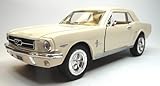
- Authentic 1:36 Scale: Meticulously crafted 1964 1/2 Ford Mustang model car with impressive 5-inch length.
- Realistic Details: Die-cast metal body with opening doors and eye-catching blue finish.
- Interactive Play: Engaging pull-back action for thrilling motion across smooth surfaces.
- Collectible Quality: Ideal for model car enthusiasts and collectors seeking miniature automotive replicas.
- Brand: KiNSMART, a trusted name in die-cast vehicle models and toys.
Honda says VTEC was subsequently adapted to the NSX, Accord and Civic, extending its reach beyond one model or body style. That link helps explain the CR-X’s place in a longer engineering lineage.
4. Honda Integra Type R: a front-wheel-drive car made for focus
The Integra Type R showed how Honda could apply a track-focused brief to a front-wheel-drive car. Honda’s Type R histories emphasize weight reduction, greater body rigidity, engine tuning and handling as parts of the approach. Its importance is not that it pursued the same format as the NSX; it proved that Type R could mean a disciplined, chassis-led performance car in a very different package.
Rank #3

- Highly detailed 1:24 scale diecast model kit of 1929 Ford Model A
- Comes with everything needed for assembly including screwdriver
- Features opening parts, rolling wheels and pre-painted metal body
- Easy to assemble, creates fully functional rolling replica model car
- Fun and educational STEM activity for kids to build realistic miniature vehicle
5. Honda NSX: the engineering statement
Honda presents the NSX as its first supercar. Its mid-engine development made it the company’s clearest statement that it could build a high-performance flagship, while its engineering became a reference point for the rest of Honda’s performance history. Honda’s NSX account says the aluminum body reduced body weight by 140 kg and the whole car by nearly 200 kg compared with a steel-bodied equivalent. These are Honda’s comparisons in its heritage history, not figures for every NSX configuration.
The NSX also begins the Type R badge story: Honda’s timeline identifies it as the first model to wear the red Type R badge in Japan, in 1992. That connects the supercar to a program Honda later extended to front-wheel-drive Integra, Civic and Accord models.
Rank #4
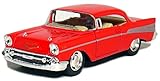
- AUTHENTIC REPLICA: Highly detailed 1:40 scale model of the iconic 1957 Chevrolet Bel Air Coupe, measuring 5 inches in length with classic finish
- WORKING FEATURES: Functioning doors that open and close, plus pull-back motor action for interactive play value
- QUALITY CONSTRUCTION: Die-cast metal body construction provides durability and authentic feel, enhanced with detailed plastic components
- REALISTIC DETAILS: Features rubber tires for enhanced realism and smooth rolling action on various surfaces
- DISPLAY WORTHY: Perfect size for collectors and enthusiasts, combining playability with showcase appeal
6. Honda Prelude VTEC: the sporty identity beyond Type R
The Prelude belongs because Honda’s performance story was broader than the Type R badge. Honda’s heritage presentation includes the Prelude among its important legacy models, and the Prelude VTEC name captures the model’s place in the VTEC-era performance landscape. Honda’s histories vary by market and generation, so it is safer to treat “Prelude VTEC” as a family-level milestone here than to assign one universal specification or launch date.
7. Honda Civic Type R: the Type R idea in a Civic
The Civic Type R carried Honda’s track-focused Type R philosophy into the Civic line. It matters because it made that performance identity part of a compact model family rather than keeping it confined to the NSX or Integra. Honda describes Type R as a track-focused approach and calls the current Civic Type R a high-performance icon; the historical importance of the Civic Type R line is broader than any one generation’s specification.
Best Value
- Doors Open
- Pullback Action
- Die Cast Metal Body
- PULL BACK ACTION WITH FREE ROLLING WHEELS
Honda reported about 200,000 Type R models sold worldwide as of January 2022. That is a dated cumulative figure for the Type R family, not a current total and not a ranking of individual models.
8. Honda Accord Type R: a larger car with a Type R purpose
The Accord Type R extended the Type R approach to a larger family-car platform, showing that Honda did not treat the formula as exclusive to smaller cars. Honda’s timeline says the first Accord Type R used a 2.2-liter engine mechanically related to the engine in the U.S.-market Prelude VTEC. That relationship is specifically described against the U.S. Prelude application; it should not be generalized into a claim that Accord Type R specifications were identical in every market.
9. Honda S2000: the S-car spirit in a modern roadster
Honda dates the S2000’s arrival to 1999 in its heritage history and presents it as part of the company’s sports-car lineage. As a roadster, it offered a distinct expression of Honda performance from the NSX supercar and the Type R models. Its place on this list reflects that continuity: Honda’s S-car ambition did not end with the early S500.
10. Honda NSX-R: the supercar turned toward the track
The NSX-R closes the loop between Honda’s flagship and its track-oriented engineering. Honda’s Type R timeline documents a Japan-market lineage, and the NSX-R should be understood as part of that history rather than treated as a single globally uniform specification. It also helps clarify the distinction between the original NSX Type R—the first to carry the badge in Japan—and later NSX-R versions.
Outdated Drivers Are Slowing You Down
One free scan finds every outdated or missing driver and matches the right update for your exact hardware.Free scan · exact hardware matchPC Slower Than It Used to Be?
A free scan shows the junk files, broken settings and background clutter dragging Windows down - then fixes them in one click.Free scan · Windows 10 & 11What the list says about Honda performance
- Honda developed more than one performance formula. The NSX represented a mid-engine supercar direction; Type R applied a track-focused approach to models including the front-wheel-drive Integra, Civic and Accord.
- Technology connected otherwise different cars. Honda traces VTEC from its 1989 Integra launch to later adaptations in the NSX, Accord and Civic, while the CR-X’s heritage story also became closely associated with the technology.
- Performance reached across the lineup. The S500 and S2000 express Honda’s sports-car lineage; CRX, Civic and Integra models show a compact-car thread; Prelude and Accord variants broaden the picture.
Honda’s own histories support those milestones, but the decision to select these ten—and to order them this way—is an editorial judgment. Regional naming, generation differences and market-specific equipment matter, particularly for cars such as the CR-X, Prelude VTEC and NSX-R.
Quick Recap
Product prices and availability are accurate as of the date/time indicated and are subject to change. Any price and availability information displayed on Amazon at the time of purchase will apply.




