Tesla shares fell about 14.3% on Thursday, June 5, 2025, in one of the largest single-day declines in the company’s history. The stock reportedly dropped as much as 18% during the session before recovering part of the loss by the close.
The selloff followed a public rupture between Tesla CEO Elon Musk and then-President Donald Trump. The dispute centered on Trump’s large tax-and-spending bill, but investors were also reacting to broader concerns about Tesla’s dependence on Musk’s public image, political exposure, brand reputation, and federal policy affecting electric vehicles.
As an Amazon Associate I earn from qualifying purchases.
What happened to Tesla stock on June 5, 2025?
Tesla closed down approximately 14.3% on June 5, 2025. Contemporary reporting described the move as Tesla’s 11th-worst trading day ever, a ranking attributed to Forbes and based on the historical return data available at the time.
The stock’s intraday decline was even steeper. CBS reported that shares fell by roughly 18% at one point before recovering some of the loss. The closing move, rather than the intraday low, is the more useful figure for comparing the session with other historical trading days.
#1 Best Overall

- Theme: Sport
- Toy vehicle form: Car
- Included components: Batteries
- Material: Metal
The decline erased an estimated $150 billion to $152 billion in Tesla market value in a single session. The modest difference between those estimates reflects normal variations in the share price, the time used for the calculation, share-count assumptions, and rounding.
Why did Tesla shares fall so sharply?
The immediate catalyst was an increasingly hostile public dispute between Musk and Trump.
Musk had recently criticized Trump’s major tax-and-spending proposal, commonly called the One Big Beautiful Bill. Musk argued that the legislation would worsen federal deficits. Trump responded publicly and threatened to consider terminating or withdrawing government support, contracts, or other federal relationships involving Musk’s companies.
That threat mattered to Tesla even though the dispute was not triggered by a new Tesla vehicle, earnings report, factory shutdown, or production announcement. Investors had to consider several possible consequences at once:
- Political risk: Musk’s break with Trump could create hostility between Tesla and the federal government.
- Policy risk: The legislation contained provisions affecting federal electric-vehicle incentives.
- Reputational risk: Musk’s political conduct could affect how customers view Tesla and its brand.
- Key-person risk: Musk’s identity is unusually closely linked to Tesla’s valuation and public image.
- Management distraction: Musk’s involvement in politics and other businesses could raise questions about his attention to Tesla.
The market reaction therefore reflected a sudden repricing of uncertainty, not a conclusion that Tesla’s factories, vehicles, or financial statements had lost 14% of their value overnight.
The EV tax-credit connection
The political dispute also had a direct policy dimension for Tesla. The House-passed version of H.R. 1 proposed ending the new clean-vehicle tax credit, the used clean-vehicle credit, and the commercial clean-vehicle credit, subject to the bill’s transition provisions.
That legislation later became Public Law 119-21 after Congress passed it and the President signed it on July 4, 2025. Subsequent Congressional Research Service summaries described the law as terminating those three electric-vehicle tax credits.
Rank #2
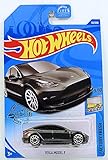
- Hot Wheels 2020 Factory Fresh Tesla Model 3 112/250, Gray
EV incentives can affect vehicle affordability, consumer demand, automaker pricing, and the competitive position of electric vehicles relative to gasoline-powered cars and hybrids. The precise financial effect on Tesla depends on factors such as vehicle eligibility, timing, pricing, consumer behavior, and how competitors respond. Nevertheless, the policy provisions gave the Musk–Trump dispute a clear connection to Tesla’s operating environment.
It is important not to overstate the sequence. The June 5 stock decline followed public threats and uncertainty; it was not the result of a same-day completed cancellation of Tesla contracts. The later enactment of the law was a separate development that confirmed the policy issue was economically relevant, but it did not itself cause the June 5 closing move.
Why Musk’s feud had an unusually large effect on Tesla
Most companies can separate their corporate identity from the personal conduct of their chief executive. Tesla has historically been different. Musk’s public statements, political activity, product vision, and personal reputation have been tightly connected to the company’s identity in the eyes of many customers and investors.
That connection can benefit Tesla when Musk’s reputation reinforces confidence in the company’s technology, growth plans, or leadership. It can also increase downside risk when his public actions become controversial or appear unrelated to Tesla’s core operations.
The Tool Desk
Outbyte PC Repair FREEClear out junk files and repair common Windows errorsFree Scan →Outbyte Driver Updater FREEFix the driver behind crashes, sound loss and screen glitchesFind Drivers →On June 5, investors were reassessing whether Musk’s political role could create costs for Tesla, including:
- customer backlash or reduced brand appeal;
- greater scrutiny from regulators and lawmakers;
- more difficult relationships with federal agencies;
- uncertainty over incentives and other EV policies;
- additional distractions for Tesla’s chief executive; and
- greater volatility caused by Musk-related news.
Tesla’s own risk disclosures provide context for this interpretation. Its 2025 Form 10-K discusses political, regulatory, economic, trade, and environmental uncertainty. The filing also warns that changing consumer preferences, negative publicity, media scrutiny, reputational damage, and public perception can affect Tesla’s business, demand, operations, and share price.
Those disclosures do not prove that any one factor caused the June 5 decline. They do show that the market’s reaction was consistent with risks Tesla had already identified in its public filings.
Rank #3

- 【High-Density 300T Manufacturing Process】Our Tesla sunshade boasts a superior density compared to the standard 240T model, significantly enhancing the shading efficiency.
- 【Precise Fit】Tailored for Tesla Model 3 and Model Y, ensuring a perfect match for your car's front windshield.
- 【Collapsible Design with Storage Pocket】The Tesla Sunshade is equipped with a collapsible design for swift deployment and easy storage, complemented by a convenient storage bag.
- 【Better Cooling】Due to our 300T high-density design, compared to other 240T sunshade products, our Tesla sunshade has a lower light transmission rate, so the temperature inside the car will be lower than other products.
- 【Easy Installation】Our Tesla sunshade can be installed without extra tools and a cumbersome installation process, we are equipped with instructions and installation videos.
How much money did the selloff erase?
Estimates put the loss in Tesla’s market capitalization at approximately $150 billion to $152 billion. Market capitalization is calculated by multiplying the company’s share price by its outstanding shares. It is not the same as cash leaving Tesla’s bank account, and it does not represent a completed transfer of that entire amount from shareholders to someone else.
What’s actually slowing this PC down?
Pick the symptom - the matching free tool is one click away.
The figure describes the change in the market value assigned to Tesla’s outstanding equity at the relevant price points. It can change slightly depending on whether an analyst uses the closing price, an intraday price, a particular share count, or rounded figures.
Elon Musk’s personal paper wealth also fell substantially because of his Tesla holdings. Axios estimated that the move reduced his wealth by just under $20 billion that day. This was an estimate of the value of his holdings at market prices—not money he necessarily sold or paid out in cash.
Was the entire market falling for the same reason?
No. The broader U.S. market was affected, but Reuters characterized Tesla’s decline as a major company-specific drag rather than evidence that the whole market had moved for the same reason.
Large technology and automotive stocks can influence market indexes, particularly when their market capitalizations are high. Even so, the unusually large Tesla move was tied primarily to Tesla-specific and Musk-specific uncertainty. There was no comparably significant Tesla operational announcement that day to explain the decline on its own.
Do these 3 things before closing this tab:
1Scan for outdated or missing drivers - takes under a minute2Repair Windows errors before they cause bigger problems3Fix the driver behind crashes, sound loss and screen glitchesWhat “11th-worst day ever” does—and does not—mean
The phrase refers to a historical ranking reported by Forbes. It should be treated as a time-specific description rather than a permanent universal statistic.
Such rankings depend on the return series being used. A ranking may differ depending on whether it includes every trading session, uses closing-to-closing returns, incorporates stock splits correctly, or measures the largest percentage decline versus the largest dollar loss. The June 5 decline was approximately 14.3% at the close, while the intraday loss was larger.
Rank #4
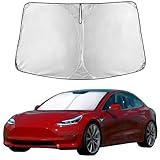
- Compatible for Tesla Model 3 & Model Y Juniper 2017-2024 2025 2026 Windshield Sun Shade: Precisely designed windshield sunshade fit for Tesla Model 3 & Model Y Juniper 2017, 2018, 2019, 2020, 2021, 2022, 2023, 2024 to provide full windshield coverage with 100% light blocker.
- Maximum Heat & UV Blocking Windshield Sunshade: Reflective windshield sun shade with a 4-layer cover blocks 99.89% of UVA & 99.95% of UVB and offers SPF 100 & UPF 80+ protection, reducing harmful UV rays and extreme heat, keeping the car’s interior cooler while protecting the dashboard, seats, and steering wheel.
- Premium Insulated Sunshade Material: High-density 280T front windshield sunshade with multi-layer reflective insulation effectively deflects sunlight and reduces interior heat buildup during hot summer days.
- Quick Install Folding Windshield Sun Shade: Foldable Front Window shade installs in seconds and stores easily in the glove box or door pocket when not in use.
- Durable Long-Lasting Windshield Sunshade: Reinforced stitched edges prevent warping, bending, or tearing, making the sun shade ideal for daily windshield protection and long-term use.
Accordingly, the careful conclusion is that June 5 was reported as Tesla’s 11th-worst day based on the historical calculation cited at the time—not that it will always remain the company’s 11th-worst day under every methodology.
A short timeline of the Musk–Trump break
- Before June 5, 2025: Musk was a prominent Trump supporter and had taken a major role in the administration’s Department of Government Efficiency. That made the eventual split politically and financially significant.
- June 5, 2025: Musk criticized Trump’s spending bill. Trump and Musk exchanged public attacks, and Trump threatened consequences involving Musk’s companies.
- June 5, 2025: Tesla shares fell approximately 14.3% at the close, after reportedly falling about 18% intraday.
- June 5, 2025: Reports estimated that the move erased roughly $150 billion to $152 billion in Tesla market value.
- July 3–4, 2025: Congress passed H.R. 1 and the President signed it as Public Law 119-21. Later CRS materials described the law as terminating three EV tax credits.
- Later 2025 filings: Tesla continued to identify political, regulatory, reputational, demand, and consumer-preference risks in its SEC disclosures.
What the selloff revealed about Tesla
The June 5 decline is best understood as a case study in key-person risk, political risk, and policy risk.
PC Slower Than It Used to Be?
A free scan shows the junk files, broken settings and background clutter dragging Windows down - then fixes them in one click.Free scan · Windows 10 & 11Outdated Drivers Are Slowing You Down
One free scan finds every outdated or missing driver and matches the right update for your exact hardware.Free scan · exact hardware matchKey-person risk occurs when a company’s performance, reputation, strategy, or investor confidence is unusually dependent on one individual. Tesla’s market reaction suggested that investors viewed Musk as more than a conventional executive: his public actions could affect perceptions of Tesla even when the company had not announced a material operational change.
Political risk was also unusually visible. Musk’s role in government and his public relationship with Trump meant that a personal dispute could raise questions about government contracts, agency relationships, public policy, and regulatory treatment involving Musk’s wider business portfolio.
Policy risk was present because changes to EV incentives can affect the economics of buying and selling electric vehicles. Ending credits does not automatically determine Tesla’s sales or profitability; customers, competitors, prices, financing costs, regulations, and product availability all matter. But a change in incentives can alter the market conditions investors use to value an automaker.
Finally, the episode highlighted brand concentration. If consumers associate a company strongly with its CEO, the CEO’s political activity can become a commercial issue. Whether that effect persists is an empirical question requiring evidence from sales, deliveries, margins, customer surveys, and Tesla’s subsequent financial results—not just one day of trading.
Free tools Windows power users keep installed
One-click scans. No signup required.
What investors and car buyers should watch next
The June 5 move alone cannot establish the long-term effect of the feud. More informative evidence would include:
Best Value

- [Vehicle Fitment] Replacement for Tesla: Model 3 (2017-2026), Model Y (2020-2026).
- [OE Numbers] Replacement for Tesla: 1107681-00-A.
- [Reference Number]: Replacement for CF12774 , XC11952C.
- The different model year spans involved: 2017, 2018, 2019, 2020, 2021, 2022, 2023, 2024, 2025.
- Vehicle deliveries and orders: whether demand changes after the controversy.
- Pricing and incentives: whether Tesla must use larger discounts to maintain sales.
- Gross margins and profitability: whether policy or demand changes affect financial performance.
- Brand and customer sentiment: whether political controversy changes purchase intentions.
- Federal policy implementation: how the termination of EV credits affects eligible vehicles and buyers.
- Management attention and governance: how Tesla handles Musk’s responsibilities across multiple companies.
- Regulatory and government relationships: whether threats translate into actual contract, approval, or oversight consequences.
- Subsequent SEC filings: whether Tesla changes its risk disclosures or reports measurable business effects.
Historical price data can show how severe the June 5 move was, but it cannot by itself determine whether Tesla’s intrinsic value changed permanently. That requires operating and financial evidence over time.
What the June 5 decline does not prove
The selloff does not prove that Trump personally caused Tesla’s entire decline. It also does not prove that Musk’s political activity was the only factor affecting the share price.
The defensible interpretation is narrower: the public Musk–Trump feud was the immediate, widely reported catalyst for the June 5 selloff, while investors were simultaneously pricing broader concerns about Tesla’s brand, demand, governance, policy exposure, and dependence on Musk.
Nor does the decline demonstrate that Tesla’s vehicles or factories suddenly became 14% less valuable. Stock prices incorporate expectations, uncertainty, risk premiums, and sentiment. A one-day repricing can be economically meaningful without corresponding to a one-day change in production capacity or reported revenue.
Frequently Asked Questions
How much did Tesla stock fall on June 5, 2025?
Tesla shares closed down approximately 14.3% on June 5, 2025. They reportedly fell as much as about 18% intraday before recovering part of the loss.
Why did Tesla lose about $150 billion in market value?
The loss followed the public break between Elon Musk and Donald Trump. Investors reacted to possible political, regulatory, reputational, policy, and management risks connected to Musk and Tesla. The market-value estimate was approximately $150 billion to $152 billion.
Was June 5, 2025, Tesla’s worst day ever?
No. Forbes reported it as Tesla’s 11th-worst day based on its historical calculation. The exact ranking can vary depending on the return series and methodology used.
Quick wins for a faster PC:
Fix the driver behind crashes, sound loss and screen glitchesFind Drivers →Clear out junk files and repair common Windows errorsFree Scan →Did the EV tax-credit law cause the June 5 Tesla selloff?
Not directly. The selloff occurred on June 5 after the public dispute and threats involving Musk’s companies. The relevant EV-credit provisions were later enacted as Public Law 119-21 on July 4, 2025, making the policy issue important to Tesla but separate from the immediate trading-day catalyst.
Did Elon Musk lose $20 billion in cash?
No. The reported figure—just under $20 billion—was an estimate of reduced paper wealth based largely on the change in the value of his Tesla holdings. It was not necessarily realized cash or a sale of shares.
The Bottom Line
Tesla’s June 5, 2025, plunge was a historically large market reaction to the public Musk–Trump rupture and the risks investors associated with it. The roughly 14.3% closing decline and $150 billion-plus market-value loss reflected uncertainty around Musk’s political conduct, Tesla’s brand, federal EV policy, and government relationships—not a sudden 14% deterioration in Tesla’s factories or financial statements. The lasting business effect required subsequent evidence from sales, margins, filings, and policy implementation.
Quick Recap
Product prices and availability are accurate as of the date/time indicated and are subject to change. Any price and availability information displayed on Amazon at the time of purchase will apply.
Recommended Free Tools




