Free tools Windows power users keep installed
One-click scans. No signup required.
Yes—researchers have developed solar-powered vehicle-cooling prototypes, including photovoltaic-powered compressor air conditioning, thermoelectric cooling, and systems intended to reduce heat buildup while a car is parked. The published results show experimental development, not a verified, broadly compatible retrofit for ordinary vehicles.
What “solar-powered car air conditioning” can mean
The phrase covers different systems, not one standard design. A photovoltaic (PV) panel produces electricity, but the cooling hardware and energy storage determine whether that electricity can refrigerate a cabin, provide limited cooling, or simply run fans.
- Compressor-based air conditioning: Uses a refrigerant cycle, as in conventional air conditioning, with PV electricity supplying a DC system.
- Thermoelectric cooling: Uses electrical modules to move heat. It is a different cooling method from a refrigerant compressor.
- Thermal storage: Uses phase-change material to absorb heat and can help limit cabin temperature rise while parked.
- Ventilation: Fans move cabin air but do not refrigerate it. A solar ventilation fan is not an air conditioner.
Vehicle-cooling prototypes researchers have reported
PV-powered DC air conditioning
Pang, Yu, Zhang, and Yan described an experimental photovoltaic-powered DC vehicle air-conditioning system using R134a refrigerant. Their work examined cooling a parked cabin in strong sun. For the conditions they studied, the authors said a minimum refrigerating capacity of approximately 1,500 W was needed to maintain thermal equilibrium inside the unoccupied vehicle. That figure is specific to their experiment, not a universal sizing requirement for cars. Read the 2019 study record.
Solar-powered thermoelectric cooling
A 2026 study by Eid Mohamed evaluated a light-vehicle cabin prototype with four thermoelectric modules, a 410 W flexible PV panel, battery storage, and maximum power point tracking. The study reports that the cabin reached 24 °C in 4.23 minutes with four modules and in 5.94 minutes with two. Its conventional air-conditioning comparison responded faster under the reported conditions. The 410 W panel is a component in this prototype, not a general recommendation for panel size. Read the 2026 study.
Windows Errors? Fix Them Before They Spread
Repair common Windows errors and clear accumulated junk for a smoother, more stable PC - no reinstall needed.Free scan · no reinstallOutdated Drivers Are Slowing You Down
One free scan finds every outdated or missing driver and matches the right update for your exact hardware.Free scan · exact hardware match#1 Best Overall
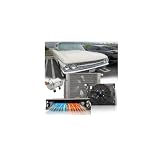
- 🚗Innovative Inverter Cooling & Low-noise Tech - Our underdash inverter a/c units intelligently adjusts its operating frequency, minimizing energy consumption. Come with a household-type ultra-quiet evaporator, smart temperature control, and operates below 50dB, creating a serene and comfortable space.
- 🚗Efficient Cooling Performance - The truck air conditioning units are equipped with a professional grade 20cc scroll compressor that cools quickly with R-134A (Not Included), regulating the interior temperature in as little as 8 minutes. 3000-speed motors ensure that the air is circulated quickly for instant comfort.
- 🚗Cost-Efficient Cooling - Save up to $6,000/year with our Under Dash Air Conditioner for Car. It can work on electricity from the car battery or an external battery, ensuring continuous operation even when the car engine is off, helping you cut spending on fuel bills significantly.
- 🚗Integrated 3-in-1 Design - Simplify installation with our 3-in-1 Assembled unit, consolidating traditional A/C parts into one. By integrating Receiver Dryers, condenser fan, and condenser into a single component, we make connection and installation a breeze.
- 🚗Versatile Applications - Our compact Unit Size (5.5*12.6*15.7inch) fits seamlessly into Passenger cars, RV, Vans, Excavators, Agricultural Vehicles, Engineering vehicles, Ships, and bus, providing versatile cooling solutions for diverse applications.
Phase-change cooling for a parked vehicle
A 2017 paper proposed a portable solar-powered cabin-cooling arrangement using a PV panel and supercapacitor storage alongside phase-change materials. The approach is aimed at limiting heat buildup while parked; it is distinct from evidence that a conventional, full-capacity air conditioner can be run from a panel alone. Read the 2017 paper.
Wireless power transfer and a separate parked-car arrangement
Another 2017 study combined solar collection, wireless power transfer, supercapacitors, and a cabin cooling module. It reported prototype electrical output and a simulated cabin-temperature change; those results do not establish a commercial, full-capacity air conditioner. Read the study.
Rank #2

- Wide Compatibility: This car fan 12V fits all 12V vehicles, including cars, trucks, boats, SUVs, and RVs.
- Cooling Airflow: This Cooling Air Fan delivers strong airflow to quickly circulate air and push out hot air, helping keep both front and rear passengers (and pets) more comfortable during hot drives.
- Comfortable Blow: Designed as a quiet Car Air Cooler, it operates with low noise to ensure a peaceful ride without disturbing passengers, even during rest or long trips.
- Portable and Durable: Built with durable ABS material, this 12V portable air cooler is designed for long-lasting use. Its compact size fits easily in your car and can be securely fixed in place with tape for stable use.
- Easy to Use: This car air conditioning fan alternative uses evaporative cooling technology—simply add water or ice to create a cooler breeze. Plug into the cigarette lighter socket. Compact, secure, and easy to install without tools.
A NASA Technical Reports Server record describes a parked-vehicle setup using a solar panel, thermostatic switch, fans, and thermoelectric coolers. This is another approach to parked-car climate control, rather than evidence of a standard retrofit. See the NASA record.
Solar-assisted air conditioning and fuel use
A 2022 study reported a 25% reduction in fuel consumption against its conventional-air-conditioning comparison. That is the result of that study’s particular test vehicle and setup; it should not be generalized to other vehicles or solar systems. Read the 2022 study.
The Tool Desk
Outbyte Driver Updater FREEScan for outdated or missing drivers - takes under a minuteDriver Scan →Outbyte PC Repair FREEClear out junk files and repair common Windows errorsFree Scan →Rank #3

- Notice & Cooling Principle:** Please note that this is a portable 12V personal cooling fan that uses water or ice for evaporative cooling. It does not use a compressor or refrigerant and is not designed to function as an automotive air conditioner or to rapidly lower the overall temperature inside a vehicle. When water or ice is added to the tank, the unit uses natural evaporation to provide a cooler, refreshing airflow in the area directly around the unit. Its compact and portable design makes it suitable for localized personal cooling in vehicles and other small spaces.
- Adjustable Cooling: Enjoy personalized comfort through two adjustable car fan speeds, equipped with filter sponge, and the option to add ice or water to blow out cold air during the journey for additional refreshing effects.
- Fixed Placement: This air conditioning fan comes with sturdy double-sided anti slip stickers that can be safely secured to the front and rear seats of cars, trucks, or vehicles without slipping.
- Easy to install: Simply insert the cigarette lighter plug to use, with dimensions of 20 x 11 x 15cm, compact and portable. When using for the first time, soak the blue filter sponge in water for 3-5 minutes until it becomes soft and completely soaked.
- Widely Used: Compatible with all vehicles featuring a standard 12V cigarette lighter port, including cars, trucks, vans, and SUVs, making it a convenient cooling solution for various travel needs.
How to interpret the reported results
These projects do not measure the same thing, so their headline numbers are not directly comparable. The 2019 paper reports a refrigerating-capacity estimate for maintaining thermal equilibrium in a parked vehicle exposed to strong sun. The 2026 study reports how quickly its prototype reached a specified cabin temperature. Other work describes concepts, prototype electrical output, or simulated temperature changes.
- Vehicle and test conditions matter: Cabin size, sun exposure, starting temperature, weather, and whether the vehicle is parked or operating affect results.
- Cooling hardware matters: A compressor, thermoelectric modules, phase-change material, and fans do not provide equivalent cooling.
- Power supply matters: PV output varies with conditions, while batteries or supercapacitors add storage but are part of the system—not proof that a panel can run air conditioning by itself.
- Comparison baselines matter: A result against one conventional system or test setup is not a general performance guarantee.
Does this mean a solar AC retrofit is available for your car?
The cited work establishes research and prototype development, but does not establish a mass-market retrofit with verified compatibility across ordinary vehicles. It also does not provide fitment, field-reliability, or retail-availability evidence for a particular car. Treat claims about a complete solar air-conditioning kit as vehicle- and product-specific, and verify that the system is actually designed for the vehicle and cooling task before relying on it.
A flexible solar panel is only an enabling component. It does not, by itself, supply a complete cooling system: the panel, energy storage, controls, cooling hardware, and vehicle compatibility all matter. A solar-powered ventilation fan may help move hot air from a parked cabin, but it does not produce refrigerated air.
Quick Recap
Product prices and availability are accurate as of the date/time indicated and are subject to change. Any price and availability information displayed on Amazon at the time of purchase will apply.




