Slammed describes a car that sits substantially lower than stock. Stance is the broader culture built around the relationship between ride height, wheel-and-tire fitment, camber, bodywork, and the car’s intended use. The two terms overlap, but they are not interchangeable: a car can be slammed without being culturally stanced, while a stanced car may be low without using the most extreme camber, tire stretch, or ground clearance.
That distinction matters because stance is not a universal checklist. Static coilover builds, air-suspension show cars, Japanese VIP sedans, Shakotan classics, bōsōzoku-inspired machines, Euro fitment cars, and drift-influenced builds may all sit under the same broad umbrella while pursuing very different visual and engineering goals.
Stance is a relationship, not a single specification
There is no official ride-height measurement, wheel offset, camber number, or tire-stretch requirement that turns an ordinary car into a stanced car. Community definitions vary. Some enthusiasts consider a car stanced only when it has visible negative camber and aggressive wheel fitment; others use the term for any deliberately low, carefully fitted build.
The most useful definition is functional: stance is the chosen relationship among the suspension height, wheel position, tire shape, bodywork, and use case. A daily-driven Euro hatchback on conservative coilovers, a VIP Lexus with air suspension, and a dramatically widened Kaido Racer may all be stance cars, but they communicate different ideas.
#1 Best Overall

- 【Fit Perfectly】for Honda Civic 1988-1991 EC ED EE EF Rear fork type bracket model only; for Honda Civic 1992-1995 EG EH EJ; for Honda Civic 1996-2000 EJ EK EM ; for Honda CR-X 1988-1991 ED EE EF; for Honda CR-X del Sol 1992-1995 EG (EG1); for Acura Integra 1990 -1993 DA DB; for Acura Integra 1994-2001 DC2 DC4
- 【Spring Rate】 Front Spring rate: 8 kg/mm (448 lbs/in) & 5 kg/mm (280 lbs/in) with spring preload: 7-10 mm. Spring length Front: 180mm & Spring length Rear: 180mm; Coilover overall length Front: 365mm-410mm & Coilover overall length Rear: 435mm-480m
- 【Adjustable Height】 The height is adjustable for 1-3 inches(Notice: does not keep to the original ride height.), allowing you to have a more aggressive stance, This design helps eliminate turning noise and also improves steering feel and response
- 【Twin-tube Structure】 Compared to mono-tube construction, the twin-tube has longer stroke and higher height adjustability, and they will give you a more comfortable riding experience by reducing the pressure on the joints
- 【Excellent Material】The product comes with 6061 aluminum alloy with T6 for increased hardness, high quality precision parts, high strength and durability. It is fully loaded and safe for installation.
Modern stance culture is also not exclusively Japanese or American. It combines influences from Japanese VIP and Shakotan cars, bōsōzoku and Kaido Racer styling, drifting, hot rods, European tuning, American custom cars, and modern air-suspension show builds. The platform and the visual language usually tell you more than the word stance alone.
The vocabulary: slammed, static, bagged, cambered, and fitted
| Term | What it describes | What it does not automatically tell you |
|---|---|---|
| Slammed | A vehicle lowered substantially below its factory ride height. | Whether it uses springs, coilovers, air suspension, or a safe amount of suspension travel. |
| Stanced | A broader visual and cultural approach involving low height, deliberate fitment, and often negative camber or tire stretch. | That the car must scrape, use extreme camber, or be impractical. |
| Static | A fixed driving height set with lowering springs, coilovers, or custom suspension components. | That the suspension is crude or unsafe. A well-designed static car can retain useful travel and clearance. |
| Bagged or aired | Air springs and an air-management system that allow the ride height to vary. | That the car is automatically safe at its lowest setting or that it has a complete vehicle-specific kit. |
| Camber | The inward or outward tilt of the wheel when viewed from the front. Negative camber puts the top of the wheel inward. | That more negative camber automatically produces better handling. |
| Fitment | The complete relationship among wheel diameter, width, offset, tire size, fenders, suspension, brakes, and clearance. | That a wheel looking flush while parked will clear under steering, compression, passengers, or cargo. |
| Stretch | A tire narrower than the wheel’s nominal width, creating a pulled-in sidewall. | That stretched tires are required for stance or suitable for every wheel and tire combination. |
| Flush | The wheel face or outer tire sits close to the fender edge. | A specific suspension type or subculture. |
| Tucked | The wheel or tire sits farther inside the fender opening. | That the car has useful clearance at full suspension compression. |
Hellaflush is best treated as a community and historical fitment term, not a technical suspension category. It generally refers to an aggressive wheel-to-fender relationship. A car described that way might be static, bagged, Japanese, European, American, or built around almost any platform.
The major sub-styles within stance culture
1. Static stance
A static car has one predetermined ride height while driving. The builder may use lowering springs, adjustable coilovers, shortened or reworked dampers, or other custom suspension components, but the vehicle cannot simply be raised to clear a steep driveway or road obstacle.
Coilovers are common because their threaded bodies or adjustable spring perches allow the builder to set the height during installation and alignment. Once that height is chosen, however, it remains fixed on the road. The appeal is consistency, mechanical simplicity, and the commitment of driving the car at its selected height rather than changing it for every photo.
The Tool Desk
Outbyte Driver Updater FREEFix the driver behind crashes, sound loss and screen glitchesFind Drivers →Outbyte PC Repair FREEClear out junk files and repair common Windows errorsFree Scan →Static does not automatically mean uncomfortable, impractical, or unsafe. The important questions are whether the dampers match the springs, whether adequate suspension travel remains, whether the tires clear the body and suspension, and whether steering and alignment remain within a sensible range. A car that has been lowered until it rests on bump stops may look extremely low but has surrendered much of the suspension function that makes it controllable.
When shopping for a vehicle-specific coilover suspension kit, check the application, spring rates, damper adjustment range, maximum and minimum usable height, replacement-part support, and the legal clearance requirements in your area. Coilovers are not interchangeable simply because two cars share a brand or chassis family.
2. Bagged or air-suspension stance
Air suspension separates show height from driving height. Air springs replace conventional coil springs, while a compressor, tank, valves, lines, controls, and often height sensors or pressure sensors manage the system. The car can sit low for display, rise over obstacles, and settle at a selected driving height.
Air-management systems differ in what they measure. Air Lift Performance’s 3H system uses height sensors at each corner, while 3P uses pressure-based control. The systems can store presets, but pressure and height are not identical: passengers, luggage, temperature, and load distribution can change the height associated with a given pressure. Air Lift’s later ALP4 system is pressure-based out of the box and can be upgraded to height-based control.
Windows Errors? Fix Them Before They Spread
Repair common Windows errors and clear accumulated junk for a smoother, more stable PC - no reinstall needed.Free scan · no reinstallCrashes, No Sound, or Screen Glitches?
Random freezes, missing sound and display glitches usually trace back to one bad driver. Find and replace yours safely.Free scan · under a minuteThat distinction is why a air suspension management system should not be confused with a complete vehicle-specific air kit. The management hardware may control the system, but the air springs, brackets, dampers, lines, tank, compressor capacity, wiring, and chassis clearances still need to suit the particular vehicle.
Air suspension also does not automatically make an extreme build road-safe. It can change ride height, but it cannot by itself correct fender interference, poor alignment, insufficient suspension travel, brake-clearance problems, or an exhaust and chassis that contact the road. A useful system should have a defined driving height rather than treating the fully aired-out position as a normal road setting.
Air Lift’s Stance Guard is an example of this separation: it warns when the vehicle is below a safe driving height and can lock out adjustments while the car is moving. The larger principle applies to any air setup: parked height and driving height should be deliberately different when the lowest setting compromises clearance or suspension operation.
3. VIP or Bippu
VIP, often called Bippu, is centered on large Japanese luxury sedans and an executive, controlled appearance. Common cues include a low and wide stance, large multi-piece wheels, restrained paint, subtle lips or aero, polished or chrome details, and a carefully finished interior.
What’s actually slowing this PC down?
Pick the symptom - the matching free tool is one click away.
VIP generally favors understatement over visual chaos. The car may be dramatically low, but its presentation is often formal and clean rather than covered in oversized wings or theatrical body extensions. Large Toyota, Lexus, Nissan, and Infiniti sedans are traditional starting points, although the influence has spread to wagons, minivans, compact cars, and non-Japanese platforms.
A modern European sedan with air suspension and polished multi-piece wheels may be VIP-influenced, but calling every low luxury car VIP erases the style’s original platform and design language. The defining feature is not maximum negative camber. It is the combination of luxury-car proportions, low and wide fitment, formal detailing, and controlled presentation.
Rank #2

- 【Fit Perfectly】 for Honda Civic 1988-1991 ED2 ED3 ED4 ED6 ED7 EC8 EE9; for Honda Civic 1992-1995 EG1 EG2 EG3 EG4 EG5 EG6 EG8 EG9 EJ1 EJ2 EH2 EH3 EH9; for Honda Civic 1995-2000 EK2 EK3 EK4 EJ6 EJ7 EJ8 EM1; for Honda CRX 1988-1991 ED8 ED9 EE8; for Honda Delsol 1992-1995 EG1; for Acura Integra 1990 -1993 DA DB;for Acura Integra 1994-2001 DC2 DC4 (Rear Fork Type Bracket Model Only)
- 【24 Levels Rebound Damping Force】 Level 0-8 suggest for street use;Level 9-16 suggest for mountain anfractuosities use;Level 17-24 suggest for race tracks use. You can adjust it at any time to suit your needs.
- 【High Tensile Spring】 Front Spring rate: 8 kg/mm (448 lbs/in) & 5 kg/mm (280 lbs/in) with spring preload: 7-10 mm. Spring length Front: 180mm & Spring length Rear: 180mm
- 【Adjustable Height】 The height is adjustable for 1-3 inches(Note: not keep to the original ride height.), allowing you to have a more aggressive stance.This design helps eliminate turning noise and also improves steering feel and response
- 【Twin-tube Structure】 Compared to mono-tube construction, the twin-tube has longer stroke and higher height adjustability, and they will give you a more comfortable riding experience by reducing the pressure on the joints
4. Shakotan
Shakotan is commonly understood as a low-car style associated with older Japanese vehicles, aggressive lowering, narrow or period-inspired tires, and carefully tucked or extended wheel fitment. The look often emphasizes the original shape of a classic Japanese coupe or sedan rather than replacing the entire silhouette with modern luxury or competition-inspired parts.
Shakotan is historically and terminologically fluid. Some enthusiasts use it as a broad description of very low Japanese cars, while others place it within a wider Kyusha or bōsōzoku-related family. It is therefore better to describe a build as Shakotan-influenced when the period cues are clear than to pretend that every community uses the word in exactly the same way.
Free tools Windows power users keep installed
One-click scans. No signup required.
Compared with VIP, Shakotan is generally less focused on executive luxury. Compared with bōsōzoku or Kaido Racer styling, it is often less dependent on oversized aero, elongated exhausts, and theatrical bodywork. The boundaries are porous, especially on older Japanese cars.
5. Bōsōzoku, Zokusha, and Kaido Racer
Bōsōzoku originated in Japanese youth and motorcycle culture and later influenced highly customized cars. The automotive styles associated with that influence can feature extreme lowering, dramatic front or rear aero, long exhausts, flared or widened bodywork, tall spoilers, and silhouettes inspired by touring cars, highway racers, and rebellious street presentation.
Kaido Racer is often used for the more race-inspired branch, with period competition cues and exaggerated extensions to the body. The result may include overfenders, deep spoilers, boxy flares, and a deliberately stretched or altered profile.
These cars should not be reduced to cars with lots of camber. Their identity comes primarily from cultural references, theatrical bodywork, historical imagery, and deliberate excess. A bōsōzoku-influenced build can be low and cambered, but its visual language is what separates it from a restrained static Euro car or a formal VIP sedan.
6. Euro stance
Euro stance is a useful shorthand for lowered European cars—often BMW, Volkswagen, Audi, Mercedes-Benz, or Porsche platforms—built around clean body lines, precise wheel fitment, understated paint, and a balance between show-car height and road-car presentation.
It is not a formal technical standard. A static Volkswagen with conservative camber may be better described as Euro fitment or Euro stance than as an extreme-camber car. A BMW on air suspension with polished multi-piece wheels might also be VIP-influenced. The labels describe overlapping design influences, not mutually exclusive classifications.
Euro builds often make the wheel design and body line do most of the visual work. The best examples tend to look intentional rather than simply low: the wheel diameter suits the body, the tire sidewall is chosen rather than accidental, and the paint, trim, and aero support the proportions of the platform.
7. Flush- and tuck-first builds
Flush and tucked builds prioritize the wheel-to-fender relationship above a regional identity. The wheel may sit nearly level with the fender edge, or the tire may disappear beneath the arch. Deep-dish wheels, low-profile tires, rolled or pulled fenders, spacers, and carefully chosen offsets are common tools for achieving the look.
Quick wins for a faster PC:
Repair Windows errors before they cause bigger problemsFix Now →Fix the driver behind crashes, sound loss and screen glitchesFind Drivers →Clear out junk files and repair common Windows errorsFree Scan →Rank #3

- 【Fit Perfectly】 for BMW 3 E90 2004-2011;for BMW 3 Touring E91 2004-2012;for BMW 3 Coupe E92 2005-2013;for BMW 3 Convertible E93 2006-2013. Note:this product fits RWD vehicles only, not for the M3 model
- 【High Tensile Spring】 Front Spring rate: 8 kg/mm (448 lbs/in)) & Rear Spring rate: 12 kg/mm (672 lbs/in); Spring length Front: 180mm & Spring length Rear: 230mm
- 【Lowering Kits】 The height adjustable by 1-3 inches, allowing you to have a more aggressive stance. This design helps eliminate turning noise and also improves steering feel and response.(NOTE): DOES NOT keep to original ride height
- 【Twin-tube Structure】 Compared to mono-tube construction, the twin-tube has longer stroke and higher height adjustment, and they will give you a more comfortable riding experience by reducing the pressure on the joints and also minimizing friction
- 【Excellent Material】The product comes with 6061 aluminum alloy with T6 for increased hardness, high quality precision parts, high strength and durability. It is fully loaded and safe for installation
Because flush and tuck describe outcomes, they can appear in VIP, Euro, Japanese classic, muscle-car, truck, and even performance contexts. They also create some of the greatest practical risks. The visible position at parked ride height does not reveal what happens when the suspension compresses, the steering reaches full lock, the vehicle carries passengers, or the chassis encounters a pothole.
Fitment must account for wheel width, offset, tire width, sidewall shape, steering lock, brake clearance, suspension components, fender clearance, and alignment. A wheel that looks perfectly flush in a photograph may rub the inner liner, spring perch, control arm, or outer fender in actual use.
8. Drift-influenced stance
Drifting helped transmit low, aggressive Japanese styling into the wider stance scene, but drift setup and show stance have different priorities. A drift car needs steering angle, predictable suspension response, tire clearance, cooling, durability, and the ability to survive repeated impacts and high loads.
A drift-influenced street or show car may borrow the low ride height, aggressive wheels, livery, or bodywork of a competition car while keeping more road-car functionality. Conversely, an actual drift car may look stanced but retain more ride height, tire sidewall, steering clearance, and suspension travel than an extreme show build.
Extreme negative camber, minimal ground clearance, or heavily stretched tires should not be presented as automatic improvements for drifting or handling. Those choices may help a particular fitment objective, but they are separate engineering decisions from the requirements of a competition suspension setup.
How the labels overlap
The easiest way to classify a slammed car is with several dimensions rather than one ladder of increasingly extreme styles.
| Dimension | Possible choices | What it tells you |
|---|---|---|
| Platform | Luxury sedan, Japanese classic, European hatch, muscle car, truck, wagon, or minivan | The cultural and design starting point |
| Ride-height method | Springs, coilovers, custom suspension, or air suspension | Whether height is fixed or variable |
| Wheel relationship | Flush, tucked, poke, deep dish, or wide and aggressive | How the wheel occupies the fender opening |
| Tire treatment | Conventional sizing, low profile, or stretch | How the sidewall looks and how clearance is being managed |
| Camber | Mild functional negative camber through extreme visual angle | The alignment and fitment intent |
| Bodywork | OEM-plus, lip kit, overfenders, flares, or exaggerated aero | Whether the style is restrained or theatrical |
| Use case | Daily driver, cruiser, show car, project, or track/drift car | The compromises the builder is accepting |
For example, a Lexus sedan on air suspension with tucked multi-piece wheels is primarily a VIP-influenced, bagged build. A classic Nissan with narrow period tires and aggressive lowering may be Shakotan. A Volkswagen with fixed coilovers and a near-flush wheel position is Euro stance. A car with exaggerated flares and a tall spoiler may be Kaido Racer-influenced even if it also has air suspension.
These descriptions can all be true at once. The purpose of the taxonomy is not to police vocabulary; it is to explain what the builder is trying to achieve.
Recommended Free Tools
Static versus air suspension: which approach suits the build?
| Consideration | Static | Bagged or aired |
|---|---|---|
| Ride height | Fixed after setup | Adjustable between parked, driving, and obstacle-clearing heights |
| Strengths | Consistency, mechanical simplicity, and a direct connection to the chosen setup | Flexibility, show-height adjustment, and the ability to raise the car when conditions require it |
| Main compromises | Driveway angles, road debris, passengers, and clearance must be managed at all times | More components, installation complexity, maintenance, and the need to define a safe driving height |
| Typical mistake | Lowering beyond useful damper travel or ignoring bump steer and tire clearance | Assuming the lowest preset is suitable for driving or that air solves every clearance problem |
| Best question to ask | Can the car retain adequate travel and clearance at its fixed height? | Can the system reliably reach and hold a safe driving height under changing loads? |
Neither system is universally better. Static makes sense when the chosen height is genuinely usable and the owner values consistency. Air makes sense when the owner needs a show height and a separate road height, accepts the additional hardware, and installs the system around the vehicle’s actual suspension travel and wheel clearance.
What lowering changes mechanically
Suspension geometry
Lowering changes more than the distance between the rocker panel and the pavement. Depending on the vehicle’s suspension design and the amount of lowering, it can alter camber, toe, bump steer, roll-center position, shock travel, ball-joint angles, and the amount of usable compression travel.
Rank #4
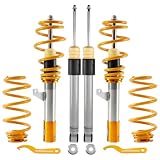
- 【Fitment】 for Volkswagen Golf MK5 MK6 2003-2012; for VW Jetta MK5 2006-2011;for VW B6 Passat 2006-2010; for VW EOS 2007-2014; for VW CC 2009-2014; for VW Tiguan 2009-2014; for VW Beetle 2012-2014; for Audi A3 FW2006-2014; for Audi TT FWD 2006-2014
- 【Lower Height】The ride height is adjustable for 0-25mm, allowing you to have a more aggressive stance. This design helps eliminate turning noise and also improves steering feel and response
- 【High Tensile Spring】 Front: 5kg/mm (280lbs/in)& Rear: 3.5kg/mm (196lbs/in). Under 600,000 times continuously test, the spring distortion is less than 0.04%. Plus, the special surface treatment is to improve the durability and performance.
- 【Factory Preset Damping Value】Maintain consistent and predictable handling characteristics, reduce the risk of overloading the suspension system
- 【Note】All modifications must be installed by licensed mechanics and in compliance with your local modification regulations
There is no universal stance alignment or ride-height setting. A height that works on a double-wishbone front suspension may create very different results on a strut-equipped car or a multi-link rear suspension. Adjustable control arms may be necessary on one platform and unnecessary—or counterproductive—on another.
Alignment and tire wear
Camber and toe are two of the major alignment angles. Lowering can introduce additional negative camber, while worn components or poor adjustment can create toe changes. Both affect tire wear and handling. One-sided shoulder wear may be related to camber or toe, but it can also indicate worn suspension components, incorrect inflation, bent parts, or a fitment problem.
Extreme negative camber is primarily a visual or clearance choice in stance culture. It is not inherently a performance upgrade. On some vehicles and in some driving conditions, changing the contact patch and tire loading can reduce useful braking, acceleration, or cornering performance. The correct target is the alignment range appropriate for the vehicle, tire, suspension, and intended use—not a particular photograph-ready angle.
If lowering has pushed the alignment outside the vehicle’s usable adjustment range, an adjustable camber kit or control arms may provide correction. These parts are highly vehicle-specific: verify the exact chassis, axle, suspension design, adjustment range, and intended alignment before buying, and do not use them to disguise worn or bent components.
Clearance through the full range of motion
Clearance must be checked with the suspension compressed and the steering moved through its usable range, not only with the vehicle parked at its lowest visual height. Check the inner sidewall against suspension components, the outer shoulder against the fender, the wheel against the brake hardware, and the tire against liners and wiring.
The check also needs to account for real use: passengers, luggage, fuel load, bumps, potholes, driveway transitions, and full steering lock. Inspection guidance used by the National Highway Traffic Safety Administration emphasizes checking interference when a vehicle is loaded and the suspension is compressed or bounced. Any bounce or load test should be done safely and with appropriate equipment; a vehicle supported only by a jack is not a safe workspace.
Do these 3 things before closing this tab:
1Clear out junk files and repair common Windows errors2Scan for outdated or missing drivers - takes under a minute3Repair Windows errors before they cause bigger problemsSuspension travel and damping
A low-looking car can still have useful suspension travel if the system is designed around the chassis, spring, damper, bump stop, and wheel package. A car that repeatedly rides on bump stops, bottoms its dampers, or loses steering clearance is not made functional by having an attractive ride height.
On a static setup, spring and damper selection matter as much as the height adjustment. On an air setup, the air spring’s operating range, damper travel, mounting geometry, and management calibration matter. In both cases, the lowest possible setting is not automatically the best setting.
Independent reader supportYour contribution helps us test, update, and keep practical guides available for everyone.A practical build-planning checklist
- Define the use case. Decide whether the car is a daily driver, weekend cruiser, show car, drift project, or a mixture. This determines how much ride height, tire sidewall, steering lock, and suspension travel you can reasonably sacrifice.
- Choose the visual language. Decide whether the platform suits VIP restraint, Shakotan period styling, bōsōzoku or Kaido Racer excess, Euro cleanliness, drift influence, or a fitment-first look.
- Record the baseline. Measure stock ride height, wheel width, offset, tire size, fender clearance, brake clearance, and alignment before ordering parts.
- Choose the height method. Use static hardware when the selected height is usable every day. Choose air when adjustable height has a real purpose, not merely because the parked position is lower.
- Calculate the wheel and tire package. Account for diameter, width, offset, tire section width, sidewall shape, load rating, speed rating, brake clearance, and the position of the suspension at compression and steering lock.
- Plan alignment correction. Determine whether the vehicle needs adjustable arms, camber plates, toe links, or another platform-specific correction. Do not assume that adding parts to obtain more camber is the same as correcting camber.
- Test clearance safely. Check full steering movement, compression, loading, and road transitions. Inspect for contact marks after careful low-speed testing and stop if the tire, wheel, brake, or suspension touches anything.
- Finish with alignment and inspection. Set ride height, torque hardware correctly, inspect brake lines and air lines, and obtain a four-wheel alignment using specifications appropriate for the vehicle and its intended use.
A digital camber gauge or ride-height measuring tool can help a builder document changes and repeat measurements, but a tool does not replace a professional alignment, tire inspection, or safety check. DIY measuring is most useful when it supports—not substitutes for—proper setup.
Common stance-build mistakes
- Choosing a wheel from a photograph. The same visual position can require different widths and offsets depending on the chassis, brake package, hub, and fender shape.
- Assuming stretched tires are mandatory. Stretch can create a particular sidewall appearance or help a fitment clear a fender, but it must remain within the tire manufacturer’s approved wheel-width range and load requirements.
- Using camber to hide poor fitment. Tilting the wheel inward may create fender clearance while introducing tire wear and handling compromises. It is not a substitute for selecting an appropriate wheel and tire.
- Ignoring toe after lowering. A dramatic visual camber angle attracts attention, but toe errors can rapidly damage tires and make the car unstable or unpleasant to drive.
- Confusing parked height with driving height. An aired-out car may be suitable for a show display but unsuitable for a road with speed bumps, potholes, or uneven transitions.
- Removing useful travel. A car that constantly bottoms out, rubs, or rides on bump stops has a setup problem even if its stance is visually successful.
- Forgetting load and temperature changes. Passengers, cargo, tire pressure, air temperature, and fuel can change the clearance and ride height that looked acceptable in an empty driveway.
- Buying universal suspension parts. Springs, dampers, control arms, air brackets, and management components need to match the exact vehicle and suspension design.
Choosing parts without losing the plot
A specialty retailer can be useful when a build needs a coordinated suspension, wheel, tire, and alignment plan. A vehicle-specific stance suspension retailer should be able to identify the exact application, explain spring rates or air-spring travel, confirm wheel and brake clearance, and provide fitment guidance rather than simply selling the lowest advertised part.
Quick wins for a faster PC:
Scan for outdated or missing drivers - takes under a minuteDriver Scan →Repair Windows errors before they cause bigger problemsFix Now →For an air build, verify whether the listing is a complete air-suspension kit or only the management component. Ask how the system establishes driving height, whether height sensors are included, what happens if a sensor or compressor fails, and how the installation affects trunk space, wiring, and service access.
For a static build, compare the usable adjustment range rather than choosing solely by the lowest claimed height. A quality setup should leave enough damper travel and should be alignable at the height you intend to drive. For wheels and tires, prioritize approved tire fitment, load capacity, brake clearance, and full-motion clearance over achieving a perfectly flush photograph.
Best Value

- Compatible With Honda Civic (FA/FG) 2006 2007 2008 2009 2010 2011
- Spring Rate: Front - 8 kg/mm (448 lbs/inch) | Rear - 10 kg/mm (560 lbs/inch) // Top Mount: Yes, Pillow Ball Camber Plate | No, Reuse Factory Top Mount // Damping Levels: 32 Ways
- Specially Designed Coil Springs Over Shock Kit To Lower The Vehicle Proper Way
- Mono Tube Shock With Steel Alloy Body And Valving Allows 32 Clicks Rebound Force Adjustment; Independent Spring Tension And Ride Height Settings To Allow Stiffness And Ride Height To Be Adjusted Separately
- These Coilovers are "Lowering Kit" and DOES NOT adjust to Factory Ride Height. No Installation Instructions; Install By Experienced Professionals Recommended
After suspension or wheel changes, a four-wheel alignment after lowering is one of the most useful services to budget for. A professional shop can identify toe and camber changes, worn components, bent parts, and tire-clearance problems that are easy to miss with the car sitting still. If the build also changes wheel width or tire size, a custom wheel-and-tire fitment service may be worthwhile before the parts are mounted.
Legal and road-use considerations
The following is a U.S.-focused warning, not legal advice. There is no single nationwide stance law that gives one universal legal ride-height number for every car. Federal rules apply differently to manufacturers, dealers, repair businesses, and individual vehicle owners. Businesses must not knowingly render safety equipment or compliant design elements inoperative, while state and local rules may govern vehicle height, bumper height, lighting, fender or wheel coverage, exhaust, emissions, inspections, and general roadworthiness.
Recommended Free Tools
Check the requirements for the state, county, or municipality where the car is registered and driven. A car that passes inspection in one jurisdiction may fail or attract enforcement in another. Outside the United States, consult the relevant national and local vehicle-modification rules.
Regardless of the law, a road-going car should retain reliable braking, steering, tire load capacity, lighting, and control. Wheel or tire contact, exposed tire tread, damaged brake lines, unsecured air lines, insufficient suspension travel, and unpredictable alignment are reasons to stop driving the car until the issue is corrected.
How to describe a slammed car accurately
Instead of assigning one label, describe the build in layers:
- Platform: a Japanese luxury sedan, classic Japanese coupe, Euro hatch, muscle car, or truck.
- Height method: static coilovers, springs, custom suspension, or air suspension.
- Fitment: flush, tucked, deep dish, poke, or wide-body.
- Alignment: mild functional negative camber or an extreme visual setting.
- Body language: OEM-plus, VIP, period Shakotan, Kaido Racer, drift-inspired, or exaggerated show aero.
- Use: daily, cruiser, show car, or competition project.
This approach avoids calling every low Japanese car bōsōzoku, every air-suspension car VIP, or every aggressive wheel position hellaflush. More importantly, it tells the reader what compromises the builder has actually chosen.
Frequently Asked Questions
Is every slammed car a stanced car?
No. Slammed only says that the car is substantially lowered. Stance is a broader cultural and visual approach involving ride height, fitment, camber, tires, bodywork, and presentation. A car can be slammed without fitting a recognizable stance sub-style.
Is static or air suspension better for a stance build?
Neither is universally better. Static suspension offers a consistent fixed height and fewer components, while air suspension allows separate show and driving heights. The correct choice depends on the car’s use, required clearance, suspension travel, budget, and willingness to maintain a more complex system.
Does extreme negative camber improve handling?
Not automatically. Mild negative camber can be part of a vehicle’s normal cornering geometry, but extreme camber in stance builds is usually a visual or clearance choice. It can contribute to uneven wear and may reduce useful tire contact in some driving conditions.
Are stretched tires required for stance?
No. Stretch is one fitment option, not a universal requirement. Any wheel-and-tire combination must remain compatible with the wheel manufacturer’s approved width range, the tire’s load requirements, brake clearance, steering movement, and the vehicle’s suspension travel.
What should be checked after lowering a car?
Check tire and wheel clearance through steering and suspension movement, suspension travel, brake and air-line clearance, ride height, camber, toe, tire wear, and hardware torque. Have the car professionally aligned after suspension or wheel changes, and verify local roadworthiness requirements.
The Bottom Line
The best stance builds are intentional rather than merely extreme. Start with the platform and the car’s real use, then choose the height method, wheel-and-tire package, alignment, and bodywork to support that goal. VIP, Shakotan, bōsōzoku, Kaido Racer, Euro stance, drift influence, flush fitment, and air-suspension styling can overlap, but each carries its own visual language and practical compromises. A car does not become a better build simply by sitting lower, showing more camber, or tucking a larger wheel; it becomes a better build when the appearance and engineering agree.
Quick Recap
Product prices and availability are accurate as of the date/time indicated and are subject to change. Any price and availability information displayed on Amazon at the time of purchase will apply.




