Quick wins for a faster PC:
Repair Windows errors before they cause bigger problemsFix Now →Scan for outdated or missing drivers - takes under a minuteDriver Scan →Clear out junk files and repair common Windows errorsFree Scan →Robotaxis should be allowed to operate—but only under conditional permits that require transparent safety data, accessible service, congestion and curb management, transit coordination, privacy and cybersecurity protections, clear liability, and worker-transition plans. Fully autonomous paid rides are now operating in multiple U.S. cities, but success in one defined service area does not prove that every automated vehicle is safe everywhere.
Robotaxis are here. The right response is conditional permission, not a blanket ban or a blank check.
Cities should allow robotaxis to operate in defined areas, then let them expand only when independent reviews show acceptable safety, accessibility, congestion, privacy, and emergency-response performance. Operators should publish comparable data, pay for the street and curb space they use, coordinate with transit agencies, maintain clear liability coverage, and help workers affected by automation.
That approach recognizes two facts at once. Fully autonomous, paid rides are no longer merely a prototype in the United States. But a successful ride in one city and one operating domain does not prove that every automated vehicle is safe on every road, in every weather condition, or under every deployment model.
What is actually operating today?
The word robotaxi covers materially different services. Before comparing safety claims, ask whether the ride is public and paid, whether a human driver or safety monitor is present, where the vehicle is allowed to operate, and what happens when the system reaches a situation outside its operating design domain.
#1 Best Overall

- Versatile Car Phone Mount: Cell phone car mount boasts premium suction strength and an upgraded air vent clip, allowing for flexible installation options on windshields, dashboards, and air vents. Note!3M Dashboard Pad is NOT REQUIRED when using a phone holder on windshield
- Strong Suction Performance: Car phone holder comes with a double-locked suction cup made of heat-resistant TPU material, guaranteeing it stays firmly attached to your dashboard even in extreme heat. Reactivate its sticky power by washing with water and air-drying.
- Fully Adjustable Design: Featuring a 360-degree rotating ball joint and an adjustable extension arm ranging from 3.7 inches to 5.9 inches, this dash-Mounted phone mount for cars allows you to customize your phone's placement to any desired angle or distance, offering maximum viewing flexibility.
- Universal Fit: Engineered to accommodate all smartphones ranging in size from 4.0 to 7.1 inches and devices up to 14mm thick, including GPS devices, this phone stand for trucks includes a one-touch release mechanism for swift and easy phone mounting. It serves as an excellent accessory for drivers requiring constant phone access, enhancing driving stability and safety.
- Comprehensive Safety Features: The car phone mount for iPhone includes a unique hook design fortified with stainless steel and padded with thick plastic, ensuring secure engagement with air vent blades without causing scratches. The robust silicone rubber provides sturdy protection, even on bumpy roads. Note: Not suitable for circular air vents desk mount.
| Operator | Current evidence | What readers should not infer |
|---|---|---|
| Waymo | Waymo said on February 24, 2026, that it had begun opening public rider access in Dallas, Houston, San Antonio, and Orlando, bringing its stated total to 10 commercial metropolitan areas. Its March 2026 safety update reported more than 220 million fully autonomous miles through the end of March. | Ten commercial metros does not mean universal availability within those metros. Access is being opened progressively, and service can be suspended for severe weather, technical problems, safety concerns, or public-health conditions. |
| Zoox | Amazon’s autonomous-vehicle subsidiary is moving from testing toward commercial service with a purpose-built vehicle that has four inward-facing seats and no conventional steering wheel or pedals. NHTSA granted a regulatory exemption in late July 2026, subject to state and local approvals. Zoox’s press materials describe the company’s vehicle and deployment work. | A federal exemption permits operation under specified conditions; it is not a general finding that the vehicle or the robotaxi category is safe everywhere. |
| Tesla | Tesla’s January 2026 filing listed planned robotaxi coverage in 11 state or metropolitan areas, including San Francisco, Austin, Dallas, Houston, Phoenix, Miami, Orlando, Tampa, and Las Vegas. The filing described Austin operations as “unsupervised” while separately identifying markets where active driver supervision remained required. Read the Tesla filing. | A vehicle called Robotaxi is not automatically equivalent to a rider-only Level 4 service. The supervision status, public availability, service area, and operating restrictions must be stated. |
Waymo is currently the clearest example of a scaled commercial robotaxi service. Its own rider guidance also makes the limits clear: a vehicle may not be available when conditions exceed the service’s capabilities. That is what Level 4 autonomy means in practical terms: the system can perform the driving within a defined operational design domain, but it is not a promise of autonomous travel anywhere, at any time.
Waymo’s safety evidence is substantial but operator-specific. A peer-reviewed study using 56.7 million rider-only miles through January 2025 found statistically significant reductions compared with selected human-driving benchmarks in overall crashes, injury-reported crashes, airbag deployments, and suspected serious-injury-or-worse crashes. Earlier research using 7.14 million rider-only miles reported 0.6 any-injury-reported crashes per million miles for the automated system, compared with 2.80 per million miles for its human benchmark. The company’s published safety-impact materials provide additional methodology and context.
Those results matter. They do not establish that Tesla, Zoox, or any future operator has the same performance. The studies concern Waymo’s hardware and software, its mapped service areas, its operating restrictions, its reporting approach, and the comparison populations used by the researchers.
The policy question has changed
The debate used to be framed as whether self-driving cars would ever arrive. That is no longer the useful question in cities where people can summon and pay for a ride without a human driver in the vehicle. The practical question is whether deployment should scale, where it should scale, and what an operator must prove before it gets more vehicles, more roads, longer hours, or more challenging conditions.
Do these 3 things before closing this tab:
1Scan for outdated or missing drivers - takes under a minute2Clear out junk files and repair common Windows errors3Fix the driver behind crashes, sound loss and screen glitchesA city should treat a robotaxi permit as a conditional operating authorization, not as a permanent endorsement. That distinction gives the public a way to learn from real service without surrendering control of the streets.
1. Permit deployment, but make expansion conditional
A reasonable initial permit would define a service area, fleet size, operating hours, weather limits, pickup and drop-off rules, emergency procedures, data obligations, and a process for suspending service after serious incidents. It would also specify who is responsible for the vehicle, remote assistance, passenger support, software updates, and claims.
Expansion should be earned through measured performance. Before an operator receives a larger geofence or fleet, an independent reviewer should examine actual trips and incidents—not just demonstrations or company-selected examples. The review should ask:
Rank #2

- Never Fall Off-Metal Hook Design: Miracase car phone holder adopts simplified locking design. The steel metal hook(with silicone pad and mat) will catch one of car air vent blades and provide excellent strudiness. It will work well for your car even in extremely harsh environments. NOTE: ONLY Compatible with horizontal and vertical vents. Not suitable for round vents.
- Universal Compatibility: Miracase cell phone stand for car mount is compatible with the smartphones (4.0-7.2 inches) and thicker cases. Note!!The lengh of vent clip hook is MAX 1.4inch(3.6cm), it will be compatible with vent blades less than 1.4 inches (3.6 cm) wide. NOTE:Not suitable for Round Vent.
- One-hand Operation: With quick release button, adjustable clamp arms and foot, Miracase car phone mount makes it very easy to insert and remove your phone with single hand. Provide you with safer driving whether you are talking, navigating or listening to music or charging.
- 360-degree Flexible Rotation: The 360-degree rotatable design will provide you with the best viewing angle to keep secure driving. You can place your phone in any orientation (landscape, portrait and more), Just enjoy the best drving experience
- Professional Support: Please contact us for any product issues, a satisfying solution is promised forever
- How often did vehicles become immobilized or require human intervention?
- How did they handle blocked lanes, construction, police activity, emergency vehicles, school buses, cyclists, pedestrians, and unusual road markings?
- Were incidents concentrated in particular neighborhoods, weather conditions, road types, or times of day?
- Could passengers summon help and safely exit when the vehicle stopped in an unsuitable location?
- Did the operator report every required crash and near miss completely and on time?
A blanket ban would discard potential safety, mobility, and accessibility benefits. An unrestricted rollout would allow companies to externalize risks onto pedestrians, transit systems, emergency responders, city streets, and workers. Conditional permission is the more defensible middle path.
NHTSA’s voluntary safety self-assessment index is useful as a disclosure resource, but the agency explicitly warns that appearing in the index is not federal endorsement or certification. Cities should use company disclosures as evidence to evaluate, not as a substitute for oversight.
2. Build a common safety-reporting system
The most important missing piece is not another promise from an operator. It is comparable public data. A crash rate cannot be meaningfully compared when one company reports rider-only miles, another reports all vehicle miles, and a third does not clearly distinguish a supervised test vehicle from an unsupervised commercial ride.
Every operator should report at least:
- Exposure: rider-only miles, passenger miles, total vehicle miles, number of trips, service hours, and the percentage of miles traveled with a human safety operator present.
- Crashes: incidents by severity, road user involved, injury outcome, airbag deployment, tow-away status, and whether the vehicle was carrying passengers.
- Near misses and conflicts: emergency braking, evasive maneuvers, pedestrian and cyclist conflicts, school-bus interactions, blocked-road events, and unexpected stops.
- Human involvement: remote-assistance requests, remote interventions, fleet-support calls, and the difference between giving a vehicle information and directly controlling it.
- Reliability: immobilizations, roadside recoveries, canceled trips, service interruptions, weather-related shutdowns, and passenger complaints.
- Context: geography, weather, lighting, road type, speed environment, construction conditions, and the category of vulnerable road user involved.
The definitions should be published before the data is collected, with enough raw detail for independent researchers to reproduce basic rates. A city should not accept a favorable percentage without knowing the denominator, exposure period, excluded incidents, and comparison group.
NHTSA maintains a standing general order requiring reporting of certain crashes involving automated driving systems and related systems. That national reporting channel is valuable, but it does not by itself create a complete robotaxi scorecard. Local permits should fill the gaps around trips, miles, remote assistance, blocked roads, accessibility, and service reliability.
The appropriate conclusion from current evidence is narrow: at least one deployed system, Waymo’s, has published studies showing favorable results against selected human benchmarks in defined operating domains. The evidence does not yet prove that robotaxis as a class are safer everywhere.
3. Make accessibility a service requirement
Robotaxis could improve independence for people who cannot drive. That benefit will not materialize merely because a vehicle has no driver. Accessibility applies to the entire journey: trip planning, booking, curbside pickup, vehicle entry, securement, in-vehicle communication, payment, exit, and finding the destination.
Rank #3
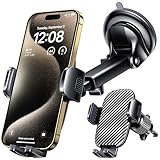
- 3 IN 1 Phone Holders for Your Car: Cell phone GPS navigation holder car is equipped with a suction cup and vent clip, which can be freely mounted on the windshield, dashboard, and air vent for feeding your different usage needs. Cell phone Camera Mounts holder is applied to most cars, pickup trucks, SUVs, taxis. A perfect assistant for Uber, Lyft drivers.
- Enhanced Powerful Suction Cup: Phone GPS navigation holder mount is equipped with double-lock suction cup and uses heat-resistant TPU material , which can provide strong suction power on smooth surfaces, and keep the mount stable in any conditions. To restore adhesion, simply rinse the sticky surface with warm water and wipe dry.
- Perfect Flexibility: Car phone Camera Mounts holder with 360 degree ball joint and adjustable telescopic arm, which can adjust your phone to any ideal angle without obstructing your view. The telescopic arm can be extended from 6.5 inches to 8.1 inches. Easily adjust the distance between you and the car mount.
- Full Protection: iPhone car mount with vacuum silicone rubber and thick panels can provide full protection for your phone from scratches and drops even at high speeds, bumps or turns.
- Easy Operation: Car mount for iPhone has a one-touch release button, you can release your phone with one hand while driving. Adjustable feet accommodate all 4-7 inch phones and most thick cases.
Requirements should cover:
- wheelchair boarding, space, and securement;
- pickup at an accessible curb rather than across a dangerous street or behind an obstruction;
- audible, visual, and tactile trip information;
- screen-reader-compatible apps and booking flows;
- service-animal accommodation;
- support for blind and low-vision, deaf and hard-of-hearing, and cognitively disabled riders;
- a reliable human support channel;
- assistance when the vehicle stops somewhere inaccessible or the app fails; and
- clear procedures for riders who cannot safely use a smartphone.
Waymo’s current help materials illustrate the gap between autonomous technology and accessible transportation. In San Francisco and Los Angeles, the company says wheelchair-accessible trips are provided through manually driven wheelchair-accessible vehicle service because riders with mobility-related disabilities cannot ride in its fully autonomous cars. Waymo also describes app accessibility settings and driver assistance. The important policy lesson is that a service should be judged by whether it completes an accessible trip, not by whether its flagship vehicle is autonomous.
For riders and caregivers, the practical question is whether an operator can connect them to wheelchair-accessible transportation and WAV services when the autonomous fleet cannot accommodate them. Cities should require a minimum accessible-service percentage, geographic coverage, response-time standards, transparent denial rates, and meaningful participation by disability organizations in testing and oversight. SAE’s 2026 recommended practice takes the same whole-journey approach, covering planning, pickup, authentication, entry, in-vehicle interaction, exit, and reaching the destination.
The Tool Desk
Outbyte PC Repair FREERepair Windows errors before they cause bigger problemsFix Now →Outbyte Driver Updater FREEScan for outdated or missing drivers - takes under a minuteDriver Scan →4. Manage empty miles, congestion, and the curb
Robotaxis may reduce private car ownership and eliminate some human-driver circulation. They can also create new traffic: vehicles traveling empty to a pickup, repositioning between demand areas, waiting for passengers, or driving because a cheaper shared ride was not available.
That risk is not theoretical. A 2026 analysis of California Public Utilities Commission data covering about 86 million vehicle miles and 14 million Waymo trips found that empty and pickup-related miles remained a substantial share of total robotaxi travel. A separate 2026 meta-analysis found an average 5.95% increase in vehicle miles traveled across the studies it examined. That broader result covers automated vehicles generally, not one precise forecast for every robotaxi market, but it is enough to reject the assumption that automation automatically reduces traffic. The California analysis is discussed in this review of Waymo’s first thousand days of commercial service.
City rules should therefore:
- designate pickup and drop-off zones instead of allowing vehicles to stop in travel lanes;
- prohibit extended autonomous waiting in bike lanes, bus lanes, crosswalks, and loading areas;
- price or meter curb access in high-demand locations;
- require operators to publish total vehicle miles, including empty and repositioning miles;
- encourage pooled rides where they genuinely reduce vehicle travel without undermining accessibility;
- use congestion pricing, per-mile fees, or fleet charges if robotaxis add traffic or impose curb-management costs; and
- evaluate the service by passenger movement and total transportation outcomes, not by the number of rides sold.
The objective should be more efficient shared mobility and fewer car-dependent trips—not simply replacing a paid human driver with an empty car circulating between fares.
5. Protect public transportation instead of hollowing it out
Robotaxis are most defensible when they complement transit. Useful roles include first-mile and last-mile connections, late-night service, low-density routes, paratransit support, and trips for people who cannot drive. They are less defensible when they pull riders and revenue away from high-capacity bus and rail corridors while adding more vehicles to those same streets.
Rank #4

- ✅【Designed for Magsafe】 - The most fashionable iphone car mount in 2026 Magsafe is designed for iPhone 18 Pro Max/17/16/15/14/13/12 Pro Max Mini and official Magsafe cases and other magnetic phone cases and can be fixed directly to these phones without the need to affix metal plates. All Android Phones Will Work: Metal rings are provided; they fit cases and other phones without magsafe. Based on Unique Grandmaster Design (Protected by US Design Patent No. US D1,112,194 S)
- ✅【STRONG MAGNETIC MagSafe Car Mount】 - This powerful magnetic phone holder can create a powerful attraction that firmly supports your device while allowing you to drive without distraction. it easily and securely holds your phone through bumps, sharp turns or even sudden stops, no worrying of dropping your phone.
- ✅【SUPER STICK FORCE】 - VHB Dash Mounted Holders adhesive provides strong stick force between the dashboard and the car phone holder, which can firmly stick to any plane in the car, fix your device, adapt to a variety of road conditions such as sudden braking, speed bump, and rugged mountain road.
- ✅【SAFE DRIVING VIEW】 - Mini-size, not taking up space, it is placed in the dashboard without blocking the view at all, and does not need to look down at the device to ensure your safe driving. Cell Phone Car Mount is suitable for most cars, pickups, SUV, taxi; It is the best assistant for Uber and Lyft drivers
- ✅【360° FREE ROTATION】 - With an adjustable swivel ball joint, you can rotate your smartphone or device at your own will, providing the best viewing angle. Quickly pick and place with one hand, free your hands and make calls and GPS navigation more convenient
Permits should require coordination with transit agencies. That can include shared curb planning, compatible service and accessibility data, connections at stations, rules against blocking bus stops, and contributions toward the transportation-system costs created by robotaxi operations. Cities should measure whether robotaxis are filling genuine mobility gaps or merely competing with routes that can move many more people per vehicle.
6. Address labor displacement before it becomes a crisis
Driving jobs are an obvious area of exposure, but the timing and scale of displacement remain uncertain. Robotaxi services are geographically limited, fleets may remain mixed for years, and autonomous operations still require vehicle maintenance, cleaning, charging, dispatch, customer support, remote assistance, safety operations, and incident response.
That uncertainty is not a reason to ignore workers. A credible deployment agreement should include transition assistance, training for maintenance and remote-support roles, portable benefits, wage insurance, and worker representation in decisions about service expansion. It should also require operators to disclose which functions are performed locally and which are shifted to contractors or distant support centers.
The emerging business model may be partnerships rather than an overnight replacement event. Uber’s 2026 policy work, for example, addressed autonomous-vehicle partnerships alongside concerns about jobs, congestion, and safety. That reporting is a reminder that platform companies, vehicle developers, fleet operators, and cities will all shape the transition.
Policy should avoid unsupported claims that robotaxis will eliminate a particular number of jobs. The more useful question is whether a city is requiring a fair transition before it approves a large-scale replacement of paid driving work.
7. Set privacy, cybersecurity, and liability rules before a serious incident
A robotaxi can collect location history, trip records, cabin images or audio, sensor data, payment details, device identifiers, and interactions with support staff. The rules should state what is collected, why it is needed, how long it is retained, who may receive it, and whether it can be used for advertising or unrelated commercial purposes.
Passengers should have a practical way to request access to and deletion of eligible personal data. Disclosure to police should require a defined legal process except in narrowly specified emergencies. Data about children, disability status, medical needs, and precise travel patterns deserves heightened protection.
Recommended Free Tools
Best Value
![ANDERY Compact Foldable Car Phone Holder for Magsafe [78+LBS Strongest Suction & 2400gf Strongest Magnetic] 360° Adjustable Car Phone Mount Installation Kit, for iPhone 18-12 Pro Max (Carbon Fiber)](https://m.media-amazon.com/images/I/411Y+Xi6UHL._SL160_.jpg)
- 360° Rotation & Dual-Axis Adjustment: This car phone holder features a 360° rotating base and 210° dual-axis folding metal arms, allowing easy angle adjustments to suit your needs. Whether in the car or at the office, switch between portrait and landscape modes effortlessly. Its unique folding design reduces the mount's size by 50% when not in use, keeping your space tidy. Built for daily use and tested over 3000 times, it stays stable and dependable over time. (Protected by US Design Patent No. US D1,076,905 S)
- Strong Suction & Stable Hold: This car phone mount uses advanced rotating-lock vacuum suction, boosting suction by 45% compared to traditional press-on mounts. It stays stable on bumpy roads or during sudden stops. The 4-layer high-strength nano gel suction cup supports up to 78lbs and holds firm in extreme temperatures (-40°F to 300°F). Backed by 9999+ durability tests and 200+ reattachments, it provides lasting suction and stability for everyday use.
- Stronger Magnetic Force: With 22 high-performance N55 magnets, this mount's magnetic strength is 200% stronger than standard magnets, providing a top-tier hold with up to 2400gf of force. It can support the weight of up to 50 phones. After 5000 vibration tests and extreme road simulations, your phone stays secure during bumps, sudden stops, or sharp turns. This precise magnetic setup keeps your phone secure through every drive while maintaining clear signals for everyday use.
- Circular Cooling Design: This magnetic phone holder for cars features a unique circular vent design that reduces contact between your phone and the holder, improving airflow and preventing overheating. Whether you're using GPS on a long drive or video calling during your commute, it keeps your phone cool, extending battery life and ensuring smooth performance. It helps reduce heat buildup so your phone can stay efficient and responsive throughout the drive.
- Broad Compatibility & 1s Easy Installation: This cell phone car mount is designed for iPhone 18/17/16/15/14/13/12 series and for all MagSafe devices, plus it includes a magnetic ring to provide the same strong magnetic hold for non-MagSafe phones. Whether your phone is bare or in a case, it attaches in just one second with one hand. Its exceptional compatibility works with various car models, ensuring a secure and easy fit in any vehicle. Designed for broad compatibility, it makes mounting quick, secure, and effortless in almost any driving scenario.
Cybersecurity oversight must cover more than the vehicle itself. It should include:
- the vehicle’s internal networks and wireless interfaces;
- cloud dispatch and fleet-management systems;
- remote-assistance tools and operator authentication;
- over-the-air software updates;
- mobile apps and payment systems; and
- suppliers and other software dependencies.
Liability must be equally clear. A pedestrian, cyclist, passenger, emergency responder, or property owner should not have to determine whether the fault belongs to the vehicle manufacturer, automated-driving developer, remote-assistance provider, fleet operator, mapping supplier, or platform that sold the ride. The operating permit should identify the responsible legal entity and require insurance sufficient for bodily injury, property damage, data breaches, and service failures.
NHTSA’s automated-driving-system materials recognize that deployment raises questions involving vehicle data, precise geolocation, and connected communications. Those questions should be answered in enforceable rules rather than left to a company’s privacy policy or a lawsuit after the fact.
A practical test for every new robotaxi launch
Before a city or rider treats a service as evidence of progress, ask these questions:
Crashes, No Sound, or Screen Glitches?
Random freezes, missing sound and display glitches usually trace back to one bad driver. Find and replace yours safely.Free scan · under a minuteWindows Errors? Fix Them Before They Spread
Repair common Windows errors and clear accumulated junk for a smoother, more stable PC - no reinstall needed.Free scan · no reinstall- Is it truly public and paid? A demonstration, employee test, or invite-only pilot is not the same as commercial service.
- Is anyone in the vehicle supervising? State whether there is a safety driver, an onboard monitor, or only remote assistance.
- Where can it operate? Identify the roads, hours, weather conditions, speed limits, and situations that trigger a shutdown or human response.
- What is the denominator? Look for rider-only miles, total vehicle miles, passenger miles, trip counts, and a clear incident definition.
- How are vulnerable road users doing? Require pedestrian, cyclist, wheelchair-user, school-bus, and emergency-response data rather than relying on a single overall crash figure.
- Can the service complete an accessible trip? Check the app, vehicle, curbside process, support channel, and backup transportation.
- What does it do to the street? Examine empty miles, curb dwell time, bus-lane conflicts, and whether trips replace private driving or transit.
- Who pays when something goes wrong? Riders and other road users need a clear claims process before launch.
Claims that should be retired
- “Robotaxis are safer than humans.” Too broad. Published Waymo-specific studies found lower rates than selected human benchmarks in defined operating domains.
- “Robotaxis are autonomous.” Incomplete. State the automation level, safety-driver status, remote assistance, service area, weather restrictions, and public-ride status.
- “Robotaxis will reduce congestion.” Unproven. Empty miles, pickup circulation, and induced demand may offset shared-mobility benefits.
- “Robotaxis will eliminate driving jobs.” A forecast, not a present fact. Effects will vary by city, service design, fleet mix, and deployment pace.
- “Robotaxis solve accessibility.” False unless the vehicles, apps, pickup infrastructure, and human support work for wheelchair users, blind and low-vision riders, deaf riders, people with cognitive disabilities, and service animals.
Bottom line
Robotaxis have crossed the threshold from speculative technology to a real transportation service. That is a reason to govern them seriously, not to celebrate every expansion and not to panic about every possibility.
The public should allow carefully bounded experiments and make growth contingent on transparent safety data, independent evaluation, accessible service, curb and congestion management, transit coordination, privacy and cybersecurity protections, clear liability, and worker-transition plans. The unresolved choice is whether cities will treat robotaxis as part of public transportation, regulate them as a software-enabled private fleet, or leave the rules to the companies operating them. The evidence supports experimentation with guardrails—neither complacency nor a blanket ban.
The Bottom Line
Robotaxis are real, but their broader effects are not settled. Cities should permit limited operations and require measurable safety, accessibility, data, curb, transit, privacy, liability, and worker protections before allowing them to scale.
Quick Recap
Product prices and availability are accurate as of the date/time indicated and are subject to change. Any price and availability information displayed on Amazon at the time of purchase will apply.
What’s actually slowing this PC down?
Pick the symptom - the matching free tool is one click away.




