The Tool Desk
Outbyte Driver Updater FREEScan for outdated or missing drivers - takes under a minuteDriver Scan →Outbyte PC Repair FREERepair Windows errors before they cause bigger problemsFix Now →Researchers successfully exploited Tesla’s modem and infotainment systems at Pwn2Own Automotive 2024, while the wider competition revealed 49 unique previously unknown vulnerabilities across connected-car systems, EV chargers, infotainment products, and automotive operating systems. The event took place in Tokyo from January 24–26, 2024, and awarded a total of $1,323,750. It did not demonstrate that a Tesla driving on public roads was remotely commandeered or crashed.
The short version
Pwn2Own Automotive 2024 was the first Pwn2Own competition dedicated entirely to automotive technology. Organized by Trend Micro’s Zero Day Initiative (ZDI) with VicOne, it brought researchers together at Automotive World in Tokyo to test selected automotive products under controlled contest rules.
As an Amazon Associate I earn from qualifying purchases.
- Tesla Modem: Synacktiv used a three-bug chain and won $100,000.
- Tesla Infotainment System: Synacktiv used a two-bug chain and won another $100,000.
- Automotive Grade Linux: Synacktiv exploited the operating system with a three-bug chain for $35,000.
- Final event tally: ZDI reported 49 unique zero-days and $1,323,750 in awards.
- Overall winner: Synacktiv became Master of Pwn with total winnings of $450,000.
Those results are significant, but “Tesla was hacked” is too broad a description. The published results identify successful demonstrations against Tesla’s modem and infotainment targets—not a takeover of steering, braking, propulsion, or a moving Model Y.
Crashes, No Sound, or Screen Glitches?
Random freezes, missing sound and display glitches usually trace back to one bad driver. Find and replace yours safely.Free scan · under a minutePC Slower Than It Used to Be?
A free scan shows the junk files, broken settings and background clutter dragging Windows down - then fixes them in one click.Free scan · Windows 10 & 11What was Pwn2Own Automotive 2024?
Pwn2Own is an ethical-hacking competition in which security researchers demonstrate previously unknown vulnerabilities against specified products. Contest officials verify the exploit, award points and money, and report the vulnerabilities to affected vendors for remediation.
#1 Best Overall
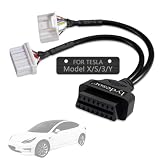
- Compatible Models:Designed for Tesla Model X, Model S, Model Y and Model 3(from 2019) vehicles, this obd adapter supports both 12-pin and 20-pin OBD2 diagnostic ports.
- Diagnostic Capability: Enables connection of OBD2 scan tools and code readers to access vehicle data and diagnose issues. Works together with La-unch X431 series/A-utel scanners and many other OBDii code reader that support Tesla diagnositic to diagnose your Tesla car.
- Diagnostic Port Location: Different vehicle models connect different ports. This Tesla obd2 diagnostic adapter cable can be connected to the Tesla X437 port (Below the central control screen) to diagnose Tesla S/ X all model year. It also can be connected to the Tesla CAN port (On the bottom of right front A-pillar) to diagnose Tesla Y all model year and Tesla 3 after 2021 (with Heat Pump).
- Work with La-unch/A-utel Scanners: Diagnostic software for Tesla Y / S / X / 3 models is available on following La-unch/A-utel scanners. 1)With this obd2 diagnostic adapter, you can connect to La-unch X-431 series code reader that support Tesla diagnositic. 2)With this obd2 diagnostic cable, you can connect to A-utel scanners that support Tesla diagnositic, such as: MaxiSys MS908S PRO, MS908S PRO II, MaxiCOM MK908 PRO II, Elite, Elite II, Elite II PRO, MS909, MS919, Ultra, Ultra Lite, MS909EV, Ultra EV.
- Plug-and-Play: Simply plug the adapter into your Tesla's OBD2 port to establish a secure connection with compatible devices.
The 2024 automotive event ran from January 24 through January 26 at Automotive World in Tokyo. According to VicOne’s event summary, 17 teams and individuals from nine countries entered more than 50 attempts.
The targets were divided into four broad categories:
- Tesla systems
- In-vehicle infotainment
- EV chargers
- Automotive operating systems
This distinction matters. The contest covered the connected-vehicle ecosystem, not just complete electric cars. Some targets were standalone home chargers, commercial charging equipment, aftermarket infotainment units, or software platforms.
What exactly happened to Tesla?
Tesla Modem: a three-bug chain
On the first day, Synacktiv successfully exploited the Tesla Modem using a chain of three bugs. The result earned the team $100,000 and 10 Master of Pwn points, according to ZDI’s Day One results.
A modem is an important connected-vehicle component because it supports communications between the vehicle and external services. However, the contest result alone does not disclose every technical detail of the chain, establish that it was exploitable over the public internet, or show that it reached safety-critical vehicle controls.
Tesla Infotainment: a two-bug chain and sandbox escape
Synacktiv also successfully targeted the Tesla Infotainment System with a two-bug chain, earning another $100,000. The event schedule described the attempt as a sandbox escape, and the result was reported in ZDI’s Day Two results.
Rank #2

- Compatibility: Compatible with Tesla Model 3 before 2019, providing a seamless connection between your vehicle's OBD2 port and diagnostic tools
- Durable Construction: Crafted with high-quality materials, ensuring long-lasting performance and reliability
- Plug-and-Play Installation: Easy to install, simply connect the adapter to your Tesla Model 3's OBD2 port and diagnostic scanner
- Diagnostic Functionality: Enables comprehensive vehicle diagnostics, code reading, and data monitoring using compatible OBD2 scanners
- Compact Design: Lightweight and portable, making it convenient to carry and use whenever needed
A sandbox is an isolation boundary designed to limit what an application can access. Escaping one can allow code to run outside that restricted environment, potentially with greater privileges. It is a serious security result, but a sandbox escape is not automatically control of steering, braking, propulsion, or other safety-critical systems.
Tesla’s event sponsorship included a Model Y among the products in scope. The official material reviewed for this event specifically documents successful Tesla modem and infotainment demonstrations. It does not establish that researchers hacked and drove a Model Y.
The wider EV attack surface
The event showed why automotive cybersecurity extends beyond the vehicle’s main control computers. Connected products increasingly combine wireless communications, cloud services, mobile applications, firmware, local networks, and operating systems.
EV chargers
The schedule included these charging products:
- ChargePoint Home Flex
- JuiceBox 40 Smart EV Charging Station
- Autel MaxiCharger AC Wallbox Commercial
- Phoenix Contact CHARX SEC-3100
- Ubiquiti Connect EV Station
- EMPORIA EV Charger Level 2
Researchers demonstrated issues including stack-based buffer overflows and improper input validation against charger targets. Smart chargers can expose Wi-Fi, Bluetooth, mobile-app, cloud-management, energy-monitoring, and firmware-update interfaces. A charger is not the same thing as a vehicle, but it is still a networked computer connected to an important energy system.
In-vehicle infotainment
Other infotainment targets included the Sony XAV-AX5500, Alpine Halo9 iLX-F509, and Pioneer DMH-WT7600NEX. These systems may handle media, navigation, Bluetooth, smartphone integration, and other functions. A successful infotainment exploit demonstrates a software security weakness, but its real-world severity depends on what the attacker can access next.
Automotive Grade Linux
Synacktiv earned $35,000 for a three-bug chain against Automotive Grade Linux. Operating-system vulnerabilities can matter across multiple products, but the consequences still depend on how the software is deployed, what privileges it receives, and whether strong isolation separates it from safety-critical networks.
Rank #3

- HELP RESTRICT UNAUTHORIZED OBD ACCESS: This OBD port lock creates a physical barrier at your vehicle’s diagnostic connector to help deter unauthorized tool connections. Adds protection against theft attempts involving OBD-based key programming or ECU access while your vehicle is parked or stored.
- SECURITY SCREWS WITH MATCHING TOOL: Secures the lock in place with security screws to help discourage casual removal. The matching tool is included for installation and authorized removal. Screw styles may vary by production batch; the supplied tool matches the screws in your package.
- SOLID 6061 ALUMINUM BODY: Precision-machined from 6061 aluminum, this OBD2 lock provides a rigid metal barrier over the diagnostic connector. A durable physical port protector for vehicle owners looking to add another layer of theft deterrence.
- ILLUSTRATED INSTALLATION & REMOVAL: Includes illustrated instructions and the security tool needed for setup and removal. When authorized diagnostics or servicing require OBD access, remove the lock with the supplied tool and reinstall it afterward. Keep the tool in a secure, accessible place.
- CHECK CONNECTOR FIT & CLEARANCE: Confirm your vehicle’s OBD2 connector shape, mounting position and surrounding space before purchase. Recessed, angled or tightly enclosed ports may prevent installation. A standard OBD2 connection alone does not guarantee that the lock will fit.
What does “49 zero-days” mean?
ZDI’s final event tally was 49 unique zero-day vulnerabilities. A zero-day generally means a previously unknown security flaw for which the vendor has had zero days—or insufficient time—to provide a fix at the point of disclosure.
In this context, 49 zero-days does not mean:
- 49 mass attacks against consumers;
- 49 compromised Teslas;
- 49 vulnerabilities affecting Tesla; or
- 49 ways to crash an electric car.
The vulnerabilities were distributed across chargers, infotainment systems, modems, and operating-system targets. The official summaries mention techniques such as memory corruption, command injection, improper input validation, and sandbox escapes, but they do not establish that every issue had a safety-critical consequence.
Not every contest attempt was a completely new bug
The results distinguish successful entries from bug collisions. A collision occurs when a vulnerability or exploit has already been submitted independently or is otherwise not unique for that attempt. Collision payouts are therefore not equivalent to a prize for a wholly new vulnerability.
What’s actually slowing this PC down?
Pick the symptom - the matching free tool is one click away.
For example, Synacktiv’s ChargePoint Home Flex attempt on Day One was listed as a bug collision and paid $16,000. Other ChargePoint, JuiceBox, Autel, Alpine, and Phoenix Contact entries were also marked as collisions. The final event total nevertheless counted 49 unique zero-days.
The competition also included failed attempts and withdrawals. Including those outcomes is important: a successful demonstration proves that a particular vulnerability chain worked under the contest rules, but the event was not a claim that every target was trivially exploitable.
Who won?
| Ranking or result | Researcher or team | Reported winnings |
|---|---|---|
| Master of Pwn | Synacktiv | $450,000 total |
| Second place | fuzzware.io | $177,500 total |
| Overall event awards | All participants | $1,323,750 |
Individual prizes, cumulative winnings, and Master of Pwn points measure different things. A team can earn money for one attempt, accumulate a larger total across several attempts, and receive points toward the overall Master of Pwn ranking.
Rank #4

- Precise OBD Fitment: The Hansshow OBD Hub Adapter for cybertruck connects directly to the OBD port under the steering wheel and above the driver’s knee for a factory-style integration
- 48W Dual Charging Power: With one USB-A and one USB-C port, USB-C delivers 30W and USB-A delivers 18W, Hansshow OBD Hub Adapter for cybertruck 2024+ supports fast charging for two devices at the same time
- Durable ABS Construction: Built with high-quality ABS material, the dual port fast charger for cybertruck is lightweight, heat-resistant, and designed for long-term daily use. The ABS housing provides reliable durability while maintaining a clean, factory-style appearance
- Works Perfectly with Phone Mounts: The OBD Hub Adapter lets you easily charge your phone while it stays securely on a mount, keeping your device safe and within reach
- Safe & Stable Power Delivery: The Hansshow OBD hub for cybertruck has dual port fast charger is equipped with smart protection to prevent overcurrent, overheating, and short circuits, giving you safe and reliable charging every time
Does this mean Tesla owners are in immediate danger?
No—not based on these results alone. The demonstrations show meaningful vulnerabilities in connected automotive systems and validate the value of independent security research. They do not establish that every Tesla is remotely exploitable, that an attacker could repeat the exploit outside the contest environment, or that steering and braking could be controlled.
Do these 3 things before closing this tab:
1Scan for outdated or missing drivers - takes under a minute2Clear out junk files and repair common Windows errors3Fix the driver behind crashes, sound loss and screen glitchesTo judge the practical severity of any automotive exploit, security professionals need to know:
- How initial access was obtained: physical access, nearby wireless access, a local network, an authenticated account, or the public internet.
- What boundary was crossed: an infotainment application, modem, charger, operating-system component, vehicle gateway, or safety-critical electronic control unit.
- What privileges were achieved: application-level execution, administrator or root access, firmware modification, or access to another vehicle network.
- Whether safety functions were reachable: charging, locks, immobilization, steering, braking, or propulsion.
- How reliable the exploit was: a one-time contest demonstration is different from a repeatable field attack.
- Patch status: which hardware and software versions were affected and whether the vendor issued a fix.
The official event results reviewed here do not provide all of those details. They should therefore be treated as evidence of exploitable flaws, not as proof of an active consumer attack or vehicle takeover.
Independent reader supportYour contribution helps us test, update, and keep practical guides available for everyone.Why the findings matter
Connectivity increases capability and exposure
Cellular services, remote diagnostics, smartphone integration, over-the-air updates, and cloud management make vehicles and chargers more useful. They also add software, credentials, APIs, wireless interfaces, and update paths that must be secured.
Isolation is valuable—but its boundaries matter
Vehicle architectures often separate infotainment and telematics from safety-critical systems. That separation can limit the damage caused by a compromised application. A sandbox escape, vulnerable gateway, or poorly isolated internal network can make the boundary much more important.
Recommended Free Tools
Chargers deserve independent security attention
A charger may not control a car’s steering, but it can contain sensitive account credentials, network access, firmware, cloud connectivity, and control over charging operations. Fleet and charging operators should treat chargers as operational technology rather than ordinary consumer accessories.
Best Value

- Compatibility: This OBD2 adapter cable is designed specifically for Tesla Model 3 and Model Y vehicles from 2019 to present, converting the 26-pin diagnostic port to a standard 16-pin OBD2 connector
- Diagnostic Functionality: Enables the use of various OBD2 code readers, scanners, and other diagnostic tools to read and clear trouble codes, view live data, and perform various diagnostic functions on compatible Tesla models
- Durable Construction: Made with high-quality materials to ensure reliable connectivity and long-lasting performance
- Plug-and-Play: Simply connect the 26-pin end to your Tesla's diagnostic port and the 16-pin end to your OBD2 scanner for seamless integration
- Wide Compatibility: Works with popular diagnostic tools like the X431 code reader and many other OBD2 scanners on the market
What consumers should do
- Install vehicle, infotainment, charger, and mobile-app updates from the manufacturer.
- Change default charger credentials and use a strong, unique password.
- Secure the home Wi-Fi network used by a connected charger.
- Avoid exposing charger management interfaces directly to the internet.
- Review account security, including multifactor authentication where available.
- Remember that aftermarket infotainment systems are separate security products with their own update policies.
There is no evidence from this event that a consumer VPN, antivirus package, or particular charger brand would solve the underlying firmware or product vulnerabilities.
What fleets and charging operators should do
- Inventory every charger, modem, gateway, backend service, mobile application, and management credential.
- Segment charging infrastructure from general corporate networks.
- Monitor for unusual charger-management and administrative activity.
- Require vendors to maintain vulnerability-disclosure and patch-management processes.
- Ask whether products support signed firmware, secure boot, multifactor authentication, and rapid security updates.
- Test charger APIs, cloud services, firmware, and embedded devices rather than assessing only the physical unit.
For larger operators, relevant professional services may include embedded-device penetration testing, firmware review and fuzzing, automotive Ethernet and CAN-bus assessments, EV-charger cloud testing, threat modeling, and managed detection and response. These are enterprise security activities, not consumer add-ons with a standard event-specific price.
What remains unknown
The public event summaries do not answer every question a vehicle owner or security engineer may have. They do not, by themselves, identify the exact affected versions, every exploit primitive, the remote-access conditions for each chain, the patch date for every product, or whether any chain crossed into safety-critical vehicle-control networks.
Those details must be established through product-specific vendor advisories and remediation notices. A zero-day is not necessarily unpatchable; it describes the vulnerability’s disclosure state at the time of the demonstration.
Bottom line
Pwn2Own Automotive 2024 was a landmark security test of the connected-vehicle ecosystem. Synacktiv demonstrated successful chains against Tesla’s modem and infotainment systems, and researchers collectively uncovered 49 unique zero-days across Tesla-related systems, chargers, infotainment products, and automotive software. The event shows that connected automotive technology has a substantial attack surface—but it does not show that criminals took over a moving Tesla or that ordinary owners faced an immediate, universal threat.
Quick Recap
Product prices and availability are accurate as of the date/time indicated and are subject to change. Any price and availability information displayed on Amazon at the time of purchase will apply.




