The Tool Desk
Outbyte Driver Updater FREEScan for outdated or missing drivers - takes under a minuteDriver Scan →Outbyte PC Repair FREEClear out junk files and repair common Windows errorsFree Scan →One-pedal driving lets you slow the car by easing off the accelerator: the electric drive system applies regenerative deceleration, which recovers some energy. Depending on the vehicle and conditions, the car may slow to a complete stop. It is a driving mode—not a promise that you can dispense with the brake pedal. Learn your vehicle’s controls and limits, and keep the brake ready.
What is one-pedal driving?
It is a mode in which lifting off the accelerator requests more deceleration than ordinary coasting. Regenerative braking uses the electric drive system to slow the vehicle while recovering some energy. In routine speed adjustments, this can reduce how often you move your foot between accelerator and brake.

Whether the vehicle stops fully, holds at a stop, or offers adjustable deceleration depends on its make, model, settings, battery state, road, grade, and load. “One-pedal driving” is not a standardized promise of identical behavior across vehicles.
How does one-pedal driving work?
When you release the accelerator, the vehicle increases regenerative deceleration according to its system and selected setting. Some vehicles can come to a complete stop in normal conditions; others use different controls or may not stop as expected in particular circumstances.
#1 Best Overall
Controls vary by vehicle
For example, Chevrolet describes selectable normal and high levels. Hyundai describes control using steering-wheel paddles, while Renault identifies a maximum regeneration level associated with One Pedal on applicable Megane E-Tech Electric vehicles. These are manufacturer-specific implementations, not a universal control scheme. Check the exact owner’s manual for the vehicle you drive.
Regeneration is not the same as guaranteed stopping
Do not assume the car will stop fully, hold on every slope, or recover a fixed amount of energy. The available manufacturer guidance describes conditions that can reduce or alter deceleration. Chevrolet also says its display indicates when regenerative braking is available and cautions against using the feature when the Regen indicator turns gray.
Rank #2

- Support motor voltage from 7V to 35VDC
- Maximum current up to 80A peak (1 second), 30A continuous, each channel
- On board MOSFETs are switched at 18 KHz for quiet operation
- Regenerative Braking
- Accepts RC (Radio Control), PWM, Analog voltage, UART data
When might one-pedal driving slow or stop the car differently?
Road and vehicle conditions can affect the response. Follow the owner’s manual for your specific model and use the brake pedal whenever you need more braking than the mode provides.
- Slippery roads: Chevrolet advises against using one-pedal driving on wet, snowy, or icy roads. Hyundai also lists slippery surfaces among conditions in which the vehicle may not stop as expected.
- Steep grades or added load: Ford warns that releasing the accelerator may not stop its vehicle on a steep grade and that increased load may reduce its ability to slow.
- Battery state or temperature: Chevrolet says a near-full battery and very hot or cold battery temperatures can affect regenerative deceleration. Its guidance describes brake blending on some models, while Bolt EV/EUV behavior differs; do not assume another vehicle uses the same fallback.
- Wheel slip or other listed conditions: Hyundai’s manual identifies additional circumstances in which stopping may be limited. Consult the vehicle’s own manual rather than relying on a general rule.
Is one-pedal driving a substitute for the brake pedal?
No. Keep the brake pedal available for ordinary situations where the vehicle does not slow enough, and for hard or emergency braking. Chevrolet advises: “Always use your brake pedal for hard, emergency braking situations when you need to bring the vehicle to a stop quickly.” Renault likewise warns that regenerative braking should not be substituted for the brake pedal.
Quick wins for a faster PC:
Scan for outdated or missing drivers - takes under a minuteDriver Scan →Repair Windows errors before they cause bigger problemsFix Now →Rank #3

- Specification: 36V, 350A, ITS, PDS Shunt
- Part Number: 609083, 73326-G02, 73326-G03, 73326-G04, 73326-G05, 73326-G06, 73326-G07, 73326-G08, 73326G02, 73326G03, 73326G04, 73326G05, 73326G06, 73326G07, 73326G08
- Compatible with E-Z-GO EZGO TXT Golf Cart 2000-2009
- Compatible with Curtis: 1206MX-4301, 1206MX-1115, 1206MX4301, 1206MX1115
- Compatible with Forepar: 6-230P, 6230P
Do brake lights come on with one-pedal driving?
Chevrolet says its brake lamps illuminate as its vehicles decelerate in One-Pedal Driving or Regen On Demand. That statement confirms Chevrolet’s described implementation; it does not establish how every make and model behaves. Check your vehicle’s manual for its brake-lamp behavior rather than assuming the answer is universal.
What should you check before relying on the mode?
- Read the exact owner’s manual. Find the instructions for one-pedal driving, regenerative braking, or the vehicle’s equivalent mode. Confirm its controls, stopping behavior, and stated limitations.
- Identify the settings and indicators. Learn how to select or adjust deceleration and what the dashboard shows when regeneration is limited or unavailable.
- Practice in a safe, familiar area. Get used to how quickly the vehicle slows when you release the accelerator and how it behaves as it approaches a stop.
- Keep using the brake when needed. Do not wait for regeneration to stop the vehicle if you need to slow more quickly or conditions make the response uncertain.
How to compare one-pedal systems
If you are comparing vehicles or settings, look for specific answers in each model’s documentation rather than relying on the feature name alone.
Quick Recap
Best Value
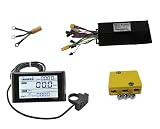
- 72V 40A Brushless DC Motor Controller
- 72V SW900 LCD Display
- used for 1000W-1500W E-bike Kit, Electric Bicycle Conversion kit
- Support Regenerative Function
- Display:Speed Display, Motor Power Ratio Display, Battery Level Display, Error Indication, Total Mileage, Single Mileage, Cruise Control, Single Running Time, Light Signal;
Rank #4

- Fitment: Replacement for Club Car Precedent, Tempo and Onward Electric Golf Cart 2014-2019
- Replace Part Number: 1515-5206, 103982301
- Smooth and Precise Operation: Offers smooth control of motor speed and torque, ensuring a smooth driving experience and precise handling, critical for safety and comfort on the course
- Robust Thermal Management: Equipped with advanced thermal management features to prevent overheating, ensuring reliable operation even in demanding conditions, which enhances the lifespan of the controller
- Plug-and-Play Installation: The controller's design allows for easy installation, minimizing downtime and making it accessible for you without extensive technical expertise
- Deceleration strength and adjustment: Does the vehicle offer multiple levels, paddle controls, or another way to tune regeneration?
- Stopping and holding: Does the manual say the vehicle can stop fully? Does it describe behavior on slopes or when loaded?
- Reduced-regeneration fallback: What happens when the battery is near full or at temperature extremes, and what indicator signals reduced availability?
- Brake-lamp behavior: What does the model’s documentation say about lamps during regenerative deceleration?
Product prices and availability are accurate as of the date/time indicated and are subject to change. Any price and availability information displayed on Amazon at the time of purchase will apply.




