The Tool Desk
Outbyte PC Repair FREERepair Windows errors before they cause bigger problemsFix Now →Outbyte Driver Updater FREEFix the driver behind crashes, sound loss and screen glitchesFind Drivers →Mode confusion happens when a driver cannot tell what an assistance system is doing, which control mode is active, or who is responsible for driving. It is a human-factors problem—not a synonym for every crash involving driver assistance—and it matters most when a system changes state while the person behind the wheel is expected to keep supervising.
What “mode confusion” means in a car
SWOV defines mode confusion as “uncertainty and misconceptions regarding who has what control over the driving task at any given moment.” The concept covers more than a driver misreading a dashboard symbol: the person may misunderstand whether the vehicle is controlling speed, steering, or another part of the driving task, and what they must still do themselves. SWOV’s 2025 report emphasizes that interaction quality matters alongside the technical performance of a system.

Confusion can arise when a system is available but not active, when activation fails, when the driver overrides it, or when it disengages. In each case, the interface needs to make the vehicle’s state and any change in responsibility understandable. NHTSA’s Tesla investigation describes system responses such as information about availability and state, confirmation or rejection of a requested transition, and visual or audible alerts. NHTSA’s EA22002 investigation summary treats unexpected responses during activation or inadvertent override as situations that can leave an operator unaware of the vehicle’s state.
Why drivers can misread cruise-control modes
A driver may ask, “Is adaptive cruise control on, or is this regular cruise control?” The difference is consequential: conventional cruise control maintains a set speed, while adaptive cruise control can adjust speed to traffic ahead. If the instrument display does not make the active mode obvious, a driver may expect one behavior while the car is providing another.
#1 Best Overall
In a 2006 NHTSA study, approximately 20% of interviewed adaptive-cruise-control owners reported some degree of confusion about whether adaptive or conventional cruise control was operating. That finding describes the study’s owners and vehicles at that time; it is not a current estimate for all drivers or cars. The same report presented small make-specific samples for integrated systems—23% of 13 Infiniti owners, 27% of 15 Lexus owners, and 13% of 24 Toyota owners reporting confusion. Those small groups do not support ranking brands, and NHTSA found no definitive display-design difference to explain the observed variation. Read the NHTSA adaptive-cruise owner study.
What a clearer interface should communicate
NHTSA’s adaptive-cruise report noted that drivers “may benefit from the use of a dedicated mode display indicator which is distinct and conspicuous.” It is a design implication, not proof that one indicator will eliminate confusion in every vehicle. A useful interface should make the following information easy to distinguish:
Rank #2
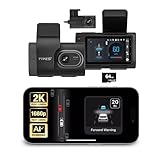
- Full Coverage, Front and Rear - The TYPE S T200 PLUS showcases a 2K 1440p front-facing dashcam and an optional 1080p rear camera. This configuration empowers you to capture both the front and rear perspectives of your vehicle while driving, greatly enhancing safety. This comprehensive coverage can provide crucial evidence in the unfortunate event of accidents.
- Minimize the Blind Spots - The TYPE S AI dash cam incorporates a crucial Blind Spot Warning feature to improve road safety. This system actively monitors the vehicle's blind spots, alerting the driver to the presence of other vehicles in these hard-to-see areas. Using visual or audible signals, the dashcam provides timely warnings, prompting the driver to exercise caution during lane changes or maneuvers.
- Front & Rear Collision Warning - The TYPE S ADAS dash cam features Front & Rear Collision Warning, a smart system that alerts you when you're too close to the car in front or if a vehicle behind is approaching too quickly. Using advanced driver assistance algorithms, it provides real-time warnings, enabling quick responses and enhancing overall road safety.
- Lane Departure Warning - The Lane Departure Warning built-into the TYPE S AI Dashcam uses AI triggered advanced sensors to monitor your vehicle's lane position. If any deviation is detected, it issues a prompt alert, enhancing driving safety by notifying you of deviations and potentially preventing lane-related incidents.
- Stop & Go Reminder - Stay vigilant at traffic stops as the 1440p AI dash cam by TYPE S recognizes when the car ahead starts moving while you're still. Our intelligent reminder keeps you on track, gently prompting you to get moving and prevent any traffic disruptions
- Active state: which assistance mode is controlling speed or steering now, rather than merely being available.
- Transitions: whether activation succeeded, failed, or was canceled, and whether an override changed the system state.
- Warnings: whether a visual alert, sound, or both signal that the driver must respond.
- Responsibility: what the driver must continue monitoring and when intervention is required.
- Operating limits: the road, traffic, and other conditions for which the system is designed.
These are useful questions when learning a particular car’s controls: What mode is active? What changes if I press this control or apply steering or braking? How will the car tell me if the system is unavailable or disengages? The owner’s manual and the vehicle’s own warnings are the right references for those model-specific answers; names and display conventions are not interchangeable across cars.
Why Level 2 assistance does not transfer responsibility
SAE Level 2 partial driving automation can assist with driving functions, but it still requires direct driver supervision. In its Tesla investigation, NHTSA said Autopilot operated at Level 2 and found that its controls did not sufficiently ensure driver attention and appropriate use. The agency described a mismatch between system capability and control authority on one side, and driver expectations on the other.
PC Slower Than It Used to Be?
A free scan shows the junk files, broken settings and background clutter dragging Windows down - then fixes them in one click.Free scan · Windows 10 & 11Outdated Drivers Are Slowing You Down
One free scan finds every outdated or missing driver and matches the right update for your exact hardware.Free scan · exact hardware matchNHTSA’s Office of Defects Investigation summarized the design obligation this way: “L2 systems should be designed to support the driver’s need to monitor the system in response to the constantly changing driving environment and, if necessary, take over the dynamic driving task.” A system name, hands-on prompt, or steering assistance should not be read as permission to stop supervising. What a specific feature can do—and where it can do it—depends on the vehicle and its operating limits.
Independent reader supportYour contribution helps us test, update, and keep practical guides available for everyone.What NHTSA’s Tesla case counts do—and do not—show
NHTSA’s investigation summary analyzed 956 crashes reported up to August 30, 2023. It excluded or found unrelated approximately half, or 489, and identified trends in the remaining 467 cases: 211 frontal-plane collisions with time for an attentive driver to respond, 111 roadway departures where driver inputs inadvertently disengaged Autosteer, and 145 roadway departures in low-traction conditions. The agency also recorded at least 13 crashes involving one or more fatalities in which foreseeable driver misuse played an apparent role.
Rank #4

- Universal Fit for Most 12V Vehicles-Designed for sedans, SUVs, and pickup trucks with DC 12V power systems. Professional installation is recommended. Includes an installation manual and radar angle alignment tool for accurate setup and optimal detection performance
- 24GHz Millimeter Wave Radar Detection-Built-in dual 24GHz millimeter wave radar sensors provide stable blind spot monitoring with a detection range of 1–32.8 ft (0.3–10 m). When a moving vehicle approaches from the side or rear blind zone, the LED warning indicator activates automatically
- Multi-Mode Blind Spot Warning Alerts-The system provides real-time alerts based on driving conditions for safer lane changes: 1.Turn signal OFF – the corresponding LED warning light stays illuminated when a vehicle enters the blind spot zone 2.Turn signal ON – the corresponding LED flashes and the buzzer sounds 3 warning beeps during lane changes 3. Hazard lights ON – the LED flashes continuously and the buzzer sounds 3 times for increased driver awareness
- Professional Installation Required-Radar sensors cannot penetrate metal surfaces. Please read the installation manual carefully before installation. Proper sensor mounting position, angle, height, and wiring are essential for accurate blind spot monitoring performance
- Enhanced Driving Safety in All Conditions-Improves driving awareness by monitoring vehicles approaching from rear and side blind spots. Effective during lane changes and in low-visibility conditions such as nighttime driving, rain, snow, or fog
These are counts from a specific investigation, not crash rates, a comparison of all driver-assistance systems, or proof that mode confusion caused each crash. NHTSA’s summary says Tesla filed a Defect Information Report on December 12, 2023, for a recall covering models equipped with Autopilot; the described remedy was intended to improve warning effectiveness and reduce mode confusion. NHTSA closed the engineering analysis in light of the recall while opening a separate recall query to assess remedy effectiveness. The linked agency record is the place to check for subsequent status changes.
What is known about how common the problem is
The available figures do not establish a representative current prevalence rate for mode confusion across the vehicle fleet. The approximately 20% figure comes from a bounded, older adaptive-cruise sample, while the Tesla counts concern a defined set of reported crashes in a particular investigation. They answer different questions and should not be combined into a general estimate of how often drivers misunderstand automation.
Do these 3 things before closing this tab:
1Fix the driver behind crashes, sound loss and screen glitches2Repair Windows errors before they cause bigger problems3Scan for outdated or missing drivers - takes under a minuteSWOV’s 2025 report addresses the concept and how it can be studied; it does not turn the older cruise-control result into a fleet-wide measure. A 2021 EE Times article framed the broader concern as drivers facing shifting modes and responsibilities, but it is context, not a prevalence study. Read the EE Times article.
A separate NHTSA study concerns smartphone app drive modes
A 2026 Federal Register notice describes planned NHTSA research into mobile-phone app “drive-mode” interfaces. The planned study is intended to examine app functionality and variability, distraction-guideline considerations, acceptance, and driver attention and performance. The notice says detailed implementation and test conditions remained subject to later planning. This is research about smartphone interfaces used while driving—not completed findings about automated vehicle control modes. Read the Federal Register notice.
Quick Recap
Product prices and availability are accurate as of the date/time indicated and are subject to change. Any price and availability information displayed on Amazon at the time of purchase will apply.




