In 1989, a modified Chevrolet van at Carnegie Mellon University could follow a road without a human steering every turn. The system behind the demonstration was ALVINN, short for Autonomous Land Vehicle In a Neural Network.
Calling ALVINN “the self-driving car from 1989” is useful shorthand, but technically inaccurate. ALVINN was the neural-network driving system; the vehicle was CMU’s Navlab research platform. Its achievement was real but narrow: it learned to turn camera and laser-range data into steering commands for road following under carefully limited conditions. It was not a driverless car capable of handling arbitrary traffic, routes, weather, or emergencies.
As an Amazon Associate I earn from qualifying purchases.
What was ALVINN?
ALVINN was a three-layer back-propagation neural network developed by Carnegie Mellon researcher Dean A. Pomerleau. Its job was to follow a road by estimating the steering curvature needed to move toward the road’s center.
PC Slower Than It Used to Be?
A free scan shows the junk files, broken settings and background clutter dragging Windows down - then fixes them in one click.Free scan · Windows 10 & 11Outdated Drivers Are Slowing You Down
One free scan finds every outdated or missing driver and matches the right update for your exact hardware.Free scan · exact hardware matchThe software ran on Navlab, a modified Chevrolet van built as part of CMU’s autonomous-vehicle research. CMU had been developing computer-controlled vehicles since 1984, making ALVINN one stage in a broader robotics program rather than a standalone production-car project.
#1 Best Overall

- 【Drifting Motion】 When the car is moving forward at high speed and suddenly turns left or right, the car will perform a drifting motion.
- 【Self-centering Steering】Designed with a self-centering feature, the car automatically returns to its original alignment after making a turn.
- 【Perfect for STEM education】 this toy encourages critical thinking, problem-solving, and hands-on exploration of engineering concepts.
- 【Long-Distance Remote Control】 Equipped with a powerful remote control, this toy car can be operated from distances of up to 160 feet in open areas. Children can explore and have fun with the car even from a significant distance, promoting outdoor play and exploration.
- 【Interference-Free Racing】Multiple cars can be raced simultaneously without interference from one another. Kids can enjoy thrilling races with their friends and family, fostering healthy competition and social interactions.
The foundational work was developed and documented around 1988–1989. Carnegie Mellon’s publication record dates the formal paper to December 1989, while the NeurIPS-hosted copy is filed under a 1988 identifier. The safest description is therefore the 1988–1989 ALVINN development and publication period (CMU publication record; original paper).
ALVINN was software, not the car
The distinction matters:
- ALVINN: the learned neural-network controller that converted sensor inputs into a steering decision.
- Navlab: the modified Chevy van carrying the computers and sensors.
- Carnegie Mellon: the research institution developing the autonomous-navigation system.
The original Navlab described in the paper carried three Sun computers, a Warp computer, a video camera, and a laser range finder. It was a research testbed, not a consumer vehicle. CMU’s Navlab project history places the work in the university’s longer-running autonomous-land-vehicle program.
How did ALVINN see and follow a road?
ALVINN’s basic pipeline was straightforward:
Road image + range data
          ↓
   ALVINN neural network
          ↓
 Steering-curvature command
          ↓
      Navlab vehicle
A video camera supplied a low-resolution view of the road. The laser range finder contributed information about nearby surfaces and obstacles. The network combined those signals and produced an output representing the steering direction—from sharper left turns through straight ahead to sharper right turns.
What’s actually slowing this PC down?
Pick the symptom - the matching free tool is one click away.
The architecture described in the original paper included:
- A 30×32 video input, or 960 image units.
- An 8×32 range-finder input, or 256 units.
- One road-intensity feedback unit.
- A 29-unit hidden layer.
- 45 steering-direction output units, representing increasingly sharp turns in either direction.
- A road-intensity feedback output.
That adds up to 1,217 input units: 960 video units, 256 range-finder units, and one feedback unit. The PDF also contains an apparent printed or scanning inconsistency that labels the video retina as “3002 units,” despite specifying 30×32 dimensions. The dimensions and total input count support the 960-unit interpretation.
The paper calls ALVINN a three-layer back-propagation network. The detailed architecture describes those layers as an input layer, one hidden layer, and an output layer—not three hidden layers. Back-propagation adjusted the network’s internal weights so its steering output increasingly matched the desired answer.
Rank #2

- Versatile Movement with Mecanum Wheels: This STEM toy features Mecanum wheels, allowing the car to move in multiple directions—forward, backward, sideways, and diagonally. It’s a perfect engineering kit for kids to explore the science of omnidirectional motion while having fun!
- Cool, Tech-Inspired Design: With its wooden laser-cut body, this toy car has a sleek, tech-inspired look that’s both functional and visually appealing. It’s a standout science kit for young minds who love building and experimenting with STEM projects.
- Easy to Assemble with Colorful Instructions: Designed as an accessible engineering kit, this toy includes a detailed, full-color instruction manual. The assembly process is simple yet engaging, making it ideal for beginners and experienced builders alike.
- Learn While You Build and Play: As you assemble and operate this Mecanum wheel car, you’ll gain a hands-on understanding of how these specialized wheels work. It’s a fantastic STEM project that combines education and entertainment, perfect for curious learners.
- The Perfect Gift for Curious Minds: Whether for personal use or gifting, it’s a great way to inspire young engineers and scientists to dive into STEM projects and explore the world of robotics.
How did it learn to drive?
ALVINN was not built from a giant list of hand-written rules such as “if the road looks bright, turn left.” It learned a relationship between sensory patterns and steering responses.
For the initial work, a simulated road-image generator created training examples. The generator varied factors including:
- Road position and orientation.
- Lighting conditions.
- Noise in the sensor data.
- Other changes in the road’s visual appearance.
The paper describes training on 1,200 simulated road snapshots. Each example paired an input pattern with the steering curvature that would move the vehicle toward the road center. This use of synthetic data was significant: it allowed researchers to create many controlled variations without physically driving a test vehicle for every example.
However, synthetic training did not make real-world testing unnecessary. The network still had to cope with the differences between generated images and actual roads, including surface texture, shadows, vegetation, sensor imperfections, and unexpected geometry.
What did ALVINN achieve in 1989?
The original paper reports two different kinds of results, and they should not be confused.
The Tool Desk
Outbyte Driver Updater FREEScan for outdated or missing drivers - takes under a minuteDriver Scan →Outbyte PC Repair FREEClear out junk files and repair common Windows errorsFree Scan →About 90% on novel simulated images
After 40 training epochs, ALVINN selected a steering curvature within two output units of the correct answer on approximately 90% of novel simulated road images. That was a result on generated data, measuring steering-curvature error. It was not a claim that the vehicle completed 90% of road miles autonomously, nor was it a safety score.
Rank #3

- PRE-ASSEMBLED 2WD ROBOT CHASSIS: Fully pre-assembled 2WD chassis with dual DC motors durable acrylic frame and battery holder ready to use out of the box saving assembly time and ensuring no missing components
- MOTORS WITH SPEED ENCODERS: Built-in encoders on both DC motors provide real-time speed feedback for precise motion control in line following autonomous driving and RC robot applications
- ARDUINO ESP32 COMPATIBLE: Works with Arduino Uno ESP32 ESP8266 Raspberry Pi and other 3.3V and 5V microcontroller boards for easy robot programming and rapid project development
- TUTORIALS AVAILABLE: Step-by-step tutorials available online by searching DIYables RC 2WD Car Chassis Kit ideal for STEM education robotics learning Arduino programming and coding projects
A limited real-vehicle demonstration
In the early Navlab test, ALVINN drove the vehicle at approximately 0.5 meters per second—about 1.1 mph—along a 400-meter path through a wooded area on the Carnegie Mellon campus. The reported conditions were sunny fall weather, and the paper says performance was comparable under those circumstances to CMU’s best traditional vision-based road-following algorithm.
That demonstration was an important proof of concept, but its boundaries are just as important as the headline. It was slow, short, and conducted in a constrained environment. The researchers explicitly said more extensive testing was needed before drawing definitive conclusions.
What “self-driving” meant in 1989
ALVINN demonstrated autonomous road following: keeping a vehicle aligned with a trained road pattern and producing steering commands without continuous manual steering.
Modern automated-driving systems are expected to address a much larger problem. Depending on the system, that can include:
- Recognizing vehicles, pedestrians, cyclists, signs, signals, lanes, and unusual obstacles.
- Localizing the vehicle and following a destination route.
- Predicting how other road users may move.
- Choosing legal and safe paths through intersections.
- Handling roadworks, adverse weather, emergency vehicles, and degraded sensors.
- Managing failures and staying within a defined operational design domain.
ALVINN did not establish those capabilities. It was genuinely autonomous within a narrow task, but it was not equivalent to a modern robotaxi or a consumer driver-assistance system.
What could it not do?
| ALVINN could do | ALVINN did not establish |
|---|---|
| Follow a road pattern represented in its training | General-purpose urban or highway driving |
| Combine camera and range-finder information | Human-level scene understanding |
| Produce direct steering-curvature commands | Complete route planning from one destination to another |
| Adapt to some changes in road appearance | Robust operation in arbitrary weather, traffic, or road layouts |
| Drive in constrained research tests | Consumer-ready autonomy or proven safety at normal road speeds |
The original paper points to several practical limitations:
Rank #4

- DIY Building: The F1 car kit requires assembly, which is a fun and challenging science kit for children and adults. The process of building the car helps to develop creativity, fine motor skills, and hand-eye coordination. Good choice for children aged 9-16.
- STEM Education: The F1 car kit is designed to be an educational toy that promotes STEM education. By building and assembling the car, children can learn about basic engineering concepts and gain problem-solving skills.
- High-Quality Wood Material: The F1 car kit is made of high-quality wood, ensuring durability and longevity. The wood material provides an authentic and unique feel to the product and enhances the overall building experience.
- Remote Control: The F1 car kit comes with a remote control that allows users to control the car's movements, making it a fun and engaging toy for kids and adults alike. The remote control is easy to use, making it accessible to everyone.
- Racing Experience: Once the car is built, it can be raced against other remote control cars or driven around to showcase its speed and agility. The F1 car kit provides a realistic racing experience and is sure to impress both kids and adults.
- Intersections and route planning: road following alone does not tell a vehicle which branch to take. The researchers discussed maps and higher-level planning for point-to-point navigation.
- Training coverage: the network needed examples that represented relevant road widths, lighting, positions, and disturbances.
- Recovery: learning to drive correctly while centered was not enough. The system also needed examples of how to recover after drifting away from the ideal path.
- Unexpected conditions: a learned controller can fail when the scene differs substantially from its training distribution.
- Obstacle handling: the range finder supplied proximity information, but the foundational ALVINN task remained road following rather than comprehensive obstacle reasoning.
The system also included road-intensity feedback because a road could be lighter or darker than its surroundings. That helped address a basic but important edge case: brightness could change the visual appearance of the same road. It did not solve the broader problem of understanding everything happening around a vehicle.
Why ALVINN mattered
ALVINN’s historical importance was not simply that a van moved without a person steering it. Its deeper contribution was showing that a neural network could learn a useful representation of a driving task from sensory data and use that representation to control a real vehicle.
The project connected several fields that are central to autonomous vehicles today:
- Machine learning: steering behavior was learned from examples rather than entirely hand-coded.
- Computer vision: the system extracted useful driving information from camera imagery.
- Sensor fusion: camera and laser-range data were processed together.
- Robotics: a learned output controlled a physical machine.
- Synthetic data: simulated road scenes expanded the training set in a controlled way.
It would be wrong to say ALVINN single-handedly invented modern self-driving technology. Autonomous vehicles also depend on decades of work in mapping, localization, planning, perception, hardware, simulation, control, and safety engineering. ALVINN was one influential milestone in that larger history.
The later ALVINN story
Later work should not be folded into the original 1989 baseline. A 1990 follow-up, Rapidly Adapting Artificial Neural Networks for Autonomous Navigation, described a faster training method in which the system learned from a human driver’s responses to new situations. Carnegie Mellon said this mode could train the system in under five minutes.
Free tools Windows power users keep installed
One-click scans. No signup required.
That follow-up also described training for single-lane paved and unpaved roads, multilane roads, and environments containing obstacles, with operation at speeds up to 20 mph (CMU follow-up paper). Those are later developments and broader experiments; they do not mean the original 1989 demonstration routinely drove at 20 mph.
Best Value
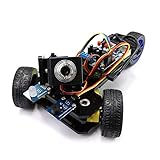
- Two Working Modes: Video mode (with camera) and Radar mode (with ultrasonic distance sensor) (Assembly required) (Raspberry Pi and Battery NOT included)
- Detailed Tutorial: Provide step-by-step assembly guide and complete Python code (The download link can be found on the product box) (No paper tutorial)
- Compatible Models: Raspberry Pi 5 / 4B / 3B+ / 3B / 3A+ (2B / B+ is also compatible but needs extra parts) (NOT included in this kit)
- Control Methods: Controlled wirelessly by your Android phone or tablet, iPhone and computer (run Windows or Raspberry Pi OS)
- Battery NOT Included: Please refer to the downloaded tutorial to buy
Similarly, longer, faster demonstrations reported in later Navlab publications should be identified by their own date, vehicle, and test conditions rather than presented as the capability of the initial ALVINN test.
ALVINN versus modern self-driving systems
Modern autonomous-driving technology is not simply ALVINN made larger. The difference is primarily one of scope and system design.
ALVINN performed a relatively direct mapping:
Sensor pattern → steering command
Modern systems commonly combine multiple specialized or semi-specialized functions, such as perception, localization, mapping, prediction, behavior planning, trajectory generation, vehicle control, redundancy, and safety monitoring. Some modern research also uses learned end-to-end components, but those systems operate with far more sensors, computing power, training data, validation, and operational constraints.
Do these 3 things before closing this tab:
1Scan for outdated or missing drivers - takes under a minute2Clear out junk files and repair common Windows errors3Fix the driver behind crashes, sound loss and screen glitchesALVINN therefore anticipated an important idea—learning control behavior from sensory input—without solving the complete autonomous-driving problem. Comparing the two as though they were competing versions of the same finished product misses the point. ALVINN was a focused research experiment; modern self-driving systems are complex vehicle-level systems designed for much broader environments.
The accurate historical takeaway
ALVINN did not solve self-driving in 1989. It did something both narrower and more consequential: it demonstrated that a neural network could turn raw camera and range data into real steering control, allowing a research vehicle to follow a road under constrained conditions.
That makes ALVINN an early landmark in learned robotic control—and a useful reminder that “self-driving” has always depended on precisely defining where, when, and how a vehicle is expected to operate.
Quick Recap
Product prices and availability are accurate as of the date/time indicated and are subject to change. Any price and availability information displayed on Amazon at the time of purchase will apply.




