What’s actually slowing this PC down?
Pick the symptom - the matching free tool is one click away.
The answer to “Lowest voltage I can still start my car?” depends on when the voltage is measured. A conventional 12V car battery may still start below 12.2 V, but 12.2 V is a warning point, not a cutoff. At 70°F, about 9.6 V during a standardized load test is a more useful health benchmark.
Resting voltage, cranking voltage, and the battery’s ability to deliver current are different measurements. Understanding all three prevents a normal-looking meter reading from sending you after the wrong repair.
As an Amazon Associate I earn from qualifying purchases.
Key takeaways
- Approximately 12.6 V at rest is a full-charge reference for a conventional 12V car battery, but resting voltage alone cannot guarantee a start.
- A resting reading below approximately 12.2 V usually means the battery needs charging and further testing; 12.2 V is not an absolute no-start cutoff.
- A standardized 15-second load test at half the battery’s CCA rating is more useful than open-circuit voltage alone.
- At 70°F, the usual minimum loaded-voltage reference is about 9.6 V; the threshold falls to 9.1 V at 30°F and 8.5 V at 0°F.
- A no-start with a normal voltage reading can result from corroded cables, a poor connection, a bad starter, an alternator fault, a blown fuse, or another electrical problem.
What is the lowest voltage I can still start my car?
There is no universal resting voltage that guarantees a car will start. For a conventional gasoline vehicle with a 12V starter battery, 12.6 V at rest indicates full-charge territory, while below 12.2 V calls for charging or testing; during a standardized load test, approximately 9.6 V at 70°F is the useful benchmark.
Free tools Windows power users keep installed
One-click scans. No signup required.
The distinction matters because a battery must deliver substantial current to turn the starter motor. A battery can display an acceptable open-circuit voltage and still collapse when the starter demands current. Engine size, diesel versus gasoline operation, oil viscosity, temperature, battery age, CCA rating, cable resistance, starter condition, and the vehicle manufacturer’s specifications all affect the actual starting requirement.
#1 Best Overall

- ENERGIZER 16 FEET JUMPER CABLES - 6 Gauge, 16 FT booster battery jumper cables for jump starting a dead or weak battery. Ideal for trucks, SUVs, full-size cars, mid-size cars and small/compact cars
- THICK VINYL COATING - Includes a strong spring and a comfortable handle for secure placement and easy positioning. Thick vinyl coating for protection against rust and corrosion.
- CARRYING CASE INCLUDED - Our Energizer jumper cables come with a high-grade travel bag for easy transport and compact storage.
- TANGLE FREE CCA BOOSTER CABLES - 16 Foot length makes it easy to reach from one car battery to another. Copper clad aluminum cables remains flexible even at -40°C.
- THE BRAND NAME YOU CAN TRUST - We are here to power your car battery and truck with our booster jumper cables. We keep you going and going!
What do car-battery voltage readings mean?
Resting voltage is a quick state-of-charge screening measurement, not a guaranteed start/no-start test. Measure directly across the battery’s positive and negative terminals after the vehicle has been switched off and surface charge has dissipated.
| Voltage condition | What it generally indicates | What to do |
|---|---|---|
| About 12.6 V at rest | Fully charged or healthy-charge reference for a conventional 12V battery | Do not assume the battery is healthy; test under load if starting is unreliable |
| Below about 12.2 V at rest | Substantial discharge or a battery that needs charging and testing | Charge the battery before judging its health when possible |
| 11.9 V or lower at rest | Interstate Batteries classifies the battery as dead | Charge and test it; replacement may be required if it will not retain charge |
| About 13.7–14.7 V with the engine running | Typical charging-voltage range cited by Interstate Batteries | Readings outside the vehicle’s specifications warrant charging-system diagnosis |
Interstate Batteries’ official FAQ gives 12.6 V or higher as a charged-battery reference, 11.9 V or below as dead, and 13.7–14.7 V as a typical engine-running charging range. These figures are useful screening points, not universal specifications for every vehicle or battery chemistry.
Will my car start with 11.8 volts?
A car may still start at 11.8 V, but the reading indicates a deeply discharged battery and provides no reliable promise that the engine will crank. Charge the battery and test it rather than repeatedly attempting to start the vehicle. Repeated cranking can further discharge the battery and overheat cables or the starter.
Why is cranking voltage more useful than resting voltage?
Cranking voltage shows how well the battery supplies current under a starter load. A proper load test applies a load equal to one-half of the battery’s rated CCA for 15 seconds, then compares the terminal voltage with the temperature-specific minimum.
| Battery temperature | Minimum loaded voltage | Test condition |
|---|---|---|
| 70°F | 9.6 V | 15-second load at half the rated CCA |
| 30°F | 9.1 V | 15-second load at half the rated CCA |
| 0°F | 8.5 V | 15-second load at half the rated CCA |
According to Interstate Batteries’ PowerVolt App Guide 2025, the standardized test applies “1⁄2 of the battery’s CCA rating for 15 seconds.” The same guide states that batteries below the applicable minimum fail the load test. ODYSSEY Battery/EnerSys gives the same 9.60 V pass threshold at 70°F or warmer in its official battery-testing guidance.
Rank #2

- 【5000A portable jump starter for car】Conquer dead batteries in just 1 second. Ideal for car, truck, motorcycle, lawnmower, boat, and more. Built-in Force Start tech inside the smart clamps delivers strong power to jump-start cars with completely drained 0V batteries. Whether you’re rushing to work, heading out on family trips, or stuck with a dead battery on frigid winter mornings, this jump starter gets your vehicle back up and running in no time.
- 【Magnetic Full-Panel LED Light】No more holding a flashlight while working under your hood! This built-in magnetic LED lamp securely clings to metal car parts for true hands-free operation.The full-panel LED light provides wider and more even illumination than traditional flashlights, with Lighting, Strobe, Red Strobe and SOS modes to support tyre changes, vehicle inspections, roadside emergencies, camping and other outdoor activities after dark.
- 【 Power Bank】Integrated 4 thinner, high-capacity battery packs, the battery jumper starter portable also works as a long-lasting power bank recharging any personal mobile device, like smartphones, tablets, or other USB devices.
- 【V0 Fireproof & 10-Safety Protection】Engineered with V0 rated flame retardant materials and a reinforced shockproof casing, this portable car battery charger with stands extreme conditions. The jumper cables feature 10 protections, including reverse polarity, spark-proof, short-circuit, overvoltage, overheating, and temperature safeguards, ensure complete safety for you, your vehicle, and your devices during jump starts, charging.
- 【Easy to Carry Detachable Lanyard for On-the-Go Convenience】Tired of bulky, cumbersome jump starters? Our TK60 model includes a quick-release button-style rubber carry loop for simple attachment and removal. Weighing only 0.8 lbs, this pocket-sized unit stores easily in your glove compartment, backpack or tool bag. Flexible placement modes—handheld, hanging or magnetic mounting—let you align the work light for lighting from various angles. Reinforced with shockproof non-slip texture and splash resistance, it stands up to roadside crises, outdoor excursions and unpredictable harsh weather.
The 9.6 V figure is not the universal minimum voltage a car needs to start. It is a battery-health benchmark for a particular standardized test. A real starter may draw a different current, and a vehicle can fail to crank even when a battery passes if the starter, cables, terminals, or control circuit has a fault.
How can I test the battery at home?
You can screen the battery with a DC-voltage multimeter or 12V car battery tester, but a proper load or conductance test gives a more meaningful health assessment.
Quick wins for a faster PC:
Fix the driver behind crashes, sound loss and screen glitchesFind Drivers →Clear out junk files and repair common Windows errorsFree Scan →- Switch the vehicle off. Turn off lights, climate controls, audio equipment, and other accessories.
- Measure at the battery. Touch the meter’s positive probe to the positive terminal and the negative probe to the negative terminal. Do not rely only on a dashboard voltage display.
- Interpret the resting reading. Treat approximately 12.6 V as a full-charge reference. Treat a reading below approximately 12.2 V as a reason to charge and test.
- Remove surface charge. After charging, apply a 150-amp load for 10–15 seconds if you have the correct professional equipment, or let the battery sit for 2–3 hours. Interstate describes both methods in its 2025 testing guide.
- Perform a rated load test. Apply half the battery’s CCA rating for 15 seconds and compare the result with the temperature-specific table above. A conductance tester can provide an alternative assessment when used according to its instructions.
- Check the result in context. A failed test supports battery replacement or professional diagnosis, but a passing battery does not rule out cable, starter, fuse, alternator, or wiring faults.
A 12V car battery tester or automotive multimeter is useful for the first screening step because it lets you measure the battery at its terminals instead of guessing from symptoms. A basic multimeter generally cannot perform the standardized high-current load test by itself.
Why can a battery show 12.6 volts but still not start the car?
A battery can show 12.6 V at rest and still fail because resting voltage mainly reflects state of charge, while starting depends on available current and internal resistance.
- High internal resistance: An aged or damaged battery may hold surface voltage but drop sharply under starter load.
- A failed cell: One defective cell can make the battery incapable of delivering enough voltage or current even after charging.
- Corroded or loose terminals: Resistance at the battery posts or clamps can prevent starter current from reaching the motor.
- Damaged battery cables or ground strap: A poor engine-to-chassis ground can mimic a dead battery.
- Failing starter: A worn starter may draw excessive current or fail to engage.
- Charging-system fault: A faulty alternator may leave the battery discharged after the engine runs.
- Fuse, relay, ignition, or control-system fault: The battery may be capable of cranking, while a separate circuit prevents the starter from operating.
If the engine does not crank normally with a normal resting reading, inspect and clean the connections, check voltage while cranking, and obtain a proper load or conductance test. If the battery passes, diagnosis should move to the starter and starting circuit rather than assuming the battery is the cause.
Rank #3
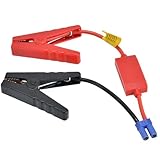
- Battery jumper cable designed to serve as a jump starter replacement cable clamp set ,Compatible with most car 12V jump portable starters, and mobile chargers to jump-start a dead or weak car battery.
- Anti-short connection protection: Connect the red clip with the black clip, when the power is on, no damage, no sparkle 。Anti-reverse charging protection: After the car is started, anti-reverse charge current is less than 1A.
- Wire: 10 AWG, Jacket: Silicone Rubber. Connector: EC5 Female Plug. Compatible with most 12V EC5 male output battery booster jumper .
- Strong alligator clamps with copper material cable,make sure great-quality and safety protection to is the more durable
- Please be careful when using this product:Do NOT reverse the operation sequence of the jump starter. this item can NOT be overloaded, check your device power before using, please. Do remove the product from the vehicle within 30 seconds after the vehicle is started, or it may cause security incidents.
How does cold weather change the answer?
Cold weather reduces the battery’s available power while increasing the effort required to turn the engine. A borderline battery may start on a warm afternoon and fail on a freezing morning because cold oil increases resistance and battery output falls.
Use the temperature-adjusted load-test values rather than treating 9.6 V as a fixed cutoff in every climate. Cold-weather starting also depends on the battery’s CCA rating, the engine’s size and condition, oil viscosity, cable resistance, and whether the vehicle uses a diesel engine.
What should I do if the battery is too weak to start?
If the battery is discharged but not damaged, an external boost may start the vehicle. A jump-start is a recovery measure, not proof that the battery or charging system is healthy.
| Recovery option | Best for | Important limitation |
|---|---|---|
| Heavy-duty jumper cables | Drivers who have access to another suitable 12V vehicle | Cables require a second vehicle, correct connection order, and a compatible electrical system |
| 12V portable jump starter | Drivers traveling alone or wanting a self-contained backup | Match the device to the vehicle and conditions; advertised peak current does not guarantee a start |
| Roadside or mobile battery service | Unsafe, damaged, repeatedly failing, or difficult-to-diagnose batteries | Availability, coverage, and price vary by location and provider |
For most passenger cars, AAA Club Alliance discusses four- or six-gauge jumper cables in the 10–20 foot range as practical choices. Use cables rated for the vehicle, match the voltage systems, follow the vehicle owner’s connection procedure, and connect the final negative clamp to a suitable grounded metal point away from the dead battery when that procedure applies. AAA Club Alliance’s jumper-cable guidance explains the connection sequence and safety precautions.
A 12V portable jump starter can be a practical alternative when no second vehicle is available. Choose a unit appropriate for the engine size and expected climate, with protections such as reverse-polarity and spark protection. Do not assume a large advertised peak-amp number guarantees that every vehicle will start.
The Tool Desk
Outbyte PC Repair FREERepair Windows errors before they cause bigger problemsFix Now →Outbyte Driver Updater FREEScan for outdated or missing drivers - takes under a minuteDriver Scan →Rank #4

- 【Newly Upgraded Jump Starter】IIXWUQ Jump starter cable is exclusively designed for seamless compatibility with Dewalt batteries(Compatible with Dewalt batteries models). It's a breeze to use—simply align the power adapter into the groove, push the converter, and ensure it's locked onto the battery. (Battery not included)
- 【Specifications】 8Awg Battery Jumper Cables For Jump Starting A Dead Or Weak Battery. Ideal For SUVs, full-size cars, Midsize Cars And Small/Compact Cars that Use 12V Batteries.
- 【Instructions for Use】: ①Connect the red battery clamp of the jumper cable to the positive terminal (+) of the vehicle, and the black clamp to the negative terminal (-). ②Insert the battery into the adapter and ensure it is securely locked. ③Attempt to start the car. ④Disconnect the connection between the car battery and your tool battery after successfully starting the car.
- 【User-Friendly Operation】①-Connect the red battery clip of the jumper cable to the positive pole (+) of the vehicle and the black to the negative pole (-); ②-Plug the jumper into the jumper starter socket; ③-Start the car and disassemble Lower clamp. (Please follow the correct steps after reading the instructions for use).
- 【Safety Precautions】Do NOT reverse the operation sequence of the jump starter. Please be careful when using this product, this item can NOT be overloaded, check your device power before using, please. Do remove the product from the vehicle within 30 seconds after the vehicle is started, or it may cause security incidents. Note: Always check if your power bank is capable of supporting your car. KEEP IN MIND, the jump starter doesn’t convert voltage/ Step-down voltage!
AAA Club Alliance warns: “If the battery has a failed cell, is swollen, cracked, or registers near zero volts, jump-starting may not work, and the battery should be replaced.” A battery in any of those conditions should be handled by a qualified technician or roadside professional, not repeatedly boosted.
Independent reader supportYour contribution helps us test, update, and keep practical guides available for everyone.When should I replace the battery or call for help?
Replacement or professional service is appropriate when the battery fails the temperature-corrected load test, has a failed cell, will not retain a charge, is physically damaged, or repeatedly requires jump-starts. A replacement battery must match the vehicle’s required group size, terminal arrangement, physical dimensions, CCA rating, battery technology, and any vehicle-specific programming or registration requirements.
Do not buy a generic battery solely because its voltage is 12 V. Use the owner’s manual or a vehicle-specific fitment lookup. A mobile battery test, roadside battery service, or battery installation provider is particularly useful when the battery reading looks normal but the car still will not crank, or when handling the battery at home would be unsafe.
Conventional gasoline vehicles with 12V starter batteries are the focus of these measurements. Hybrids and electric vehicles can contain high-voltage systems in addition to a separate 12V auxiliary battery. Follow the manufacturer’s service instructions and do not treat the traction battery as a conventional 12V starter battery.
Do these 3 things before closing this tab:
1Repair Windows errors before they cause bigger problems2Scan for outdated or missing drivers - takes under a minute3Clear out junk files and repair common Windows errorsA practical decision checklist
- 12.6 V or more at rest, but no crank: Check terminal and ground connections, then test under load and investigate the starter or control circuit.
- 12.2–12.5 V at rest: Charge the battery, remove surface charge, and retest. Do not diagnose battery failure from this range alone.
- Below 12.2 V at rest: Charge before making a health judgment when possible; check whether the battery retains the charge.
- Below the temperature-adjusted load-test threshold: The battery fails the standardized test and likely needs replacement or professional confirmation.
- Near zero volts or visibly damaged: Do not load-test or jump-start it yourself; arrange professional service or replacement.
- Starts after a jump but later fails again: Test both the battery and the charging system. The jump may have masked a weak battery or alternator problem.
The most accurate consumer answer is therefore conditional: 12.6 V at rest is full-charge territory, below 12.2 V is a warning to charge or test, and approximately 9.6 V during a standardized 15-second half-CCA load test at 70°F is the more meaningful battery pass threshold. No single resting-voltage number guarantees that a car will start.
Best Value
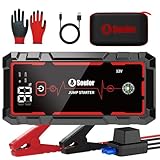
- Dead Battery Jump Starting:It can jump-start 12V vehicles (cars, motorcycles, etc.) up to 40 times on a single full charge. Operates stably in extreme temperatures from -4°F to 140°F, ensuring consistent performance when you need it most. The built-in Forced Start function enables successful ignition even when the car battery is severely depleted, keeping you prepared for any roadside emergency.
- 9-in-1 All-Round Practical Functions:More than just a jump starter, it integrates 8 essential tools: 3-mode LED torch (flashlight, strobe, SOS), a compass, a service card, insulated gloves, a portable power bank, and fast charging. Perfect for road trips, camping, and daily use, meeting multiple needs in one device.
- Compact & Portable Design:Boasting a space-saving design (Size: 7.28"×3.46"×1.77", Weight: 1.9 lbs), it’s roughly the same size as a standard power bank. Equipped with an S-class intelligent ternary lithium battery, it’s lighter and easier to carry — fits seamlessly in your car trunk, backpack, or handbag without taking up extra space.
- Fast-Charging Power Bank for Multiple Devices:Features dual USB-A ports (one fast-charge) and a USB-C port, supporting up to 50% faster charging. Allows simultaneous charging of your phone, tablet, and other electronic devices, making it an indispensable companion for travel and emergencies.
- 2.0-Inch Smart LCD Display:Equipped with a clear 2.0-inch smart LCD screen, it shows remaining power and output power in real time. Lets you stay informed at a glance, avoiding unexpected power shortages. With a 24-month standby time, it’s always ready to rescue you whenever needed.
Frequently Asked Questions
Will my car start with 11.8 volts?
A car may still start at 11.8 V, but 11.8 V indicates a deeply discharged battery and does not predict reliable cranking. Charge the battery and test it rather than repeatedly attempting to start the vehicle.
Is 9.6 volts the minimum voltage a car needs to start?
Approximately 9.6 V is the battery-health benchmark at 70°F during a standardized 15-second load at half the battery’s rated CCA. The acceptable threshold changes with temperature, so 9.6 V is not a universal real-world cranking cutoff.
Why does my car battery read 12.6 volts but the car will not start?
A 12.6 V resting reading shows charge level, not necessarily starting ability. High internal resistance, a failed cell, corroded terminals, bad cables, a failing starter, an alternator fault, or another electrical problem can still cause a no-start.
Can I jump-start a battery that reads near zero volts?
Do not jump-start a battery that is swollen, cracked, leaking, frozen, physically damaged, or near zero volts. A failed cell or damaged battery may not accept a jump safely or may require replacement.
The Bottom Line
Bottom line: A conventional 12V car battery may still start a vehicle below 12.2 V, so 12.2 V is not a hard cutoff. Treat 12.6 V at rest as a full-charge reference, charge and test readings below 12.2 V, and use a temperature-adjusted half-CCA load test—about 9.6 V at 70°F—to assess starting-battery health.
Quick Recap
Product prices and availability are accurate as of the date/time indicated and are subject to change. Any price and availability information displayed on Amazon at the time of purchase will apply.




