Recommended Free Tools
Jay Leno’s EcoJet was a completed, two-seat, mid-engine turbine-powered concept unveiled at the 2006 SEMA show. General Motors described it as a collaboration between Leno’s team and GM’s North Hollywood Advanced Design Studio, with a biodiesel-fueled Honeywell LT-101 turbine and a modified Corvette Z06 aluminum frame. GM listed 650 horsepower and 400 lb-ft of torque at 70% turbine speed; those are manufacturer-reported concept specifications, not independently verified test results.
What was Jay Leno’s EcoJet?
The EcoJet was a one-off design and engineering project developed by Jay Leno and GM Advanced Design Studio. GM’s account says the idea began in a conversation between Leno and Bernard Juchli, Leno’s chief mechanic, and grew into a two-seat, mid-engine supercar concept introduced at the 2006 Specialty Equipment Market Association (SEMA) show.
It was a built concept, not merely a styling sketch. The historical account describes a turbine-powered vehicle with a specified engine, chassis, body construction and dimensions. That does not establish that it entered production or that it was certified for ordinary road use.
Did the EcoJet actually run?
The 2006 GM material identifies the car as turbine-powered and gives engine specifications, but the available source does not document an independently verified driving or performance test. It therefore supports describing the EcoJet as a completed turbine-powered concept, but not making a specific claim about its present operating condition, road legality, or subsequent modifications.
What’s actually slowing this PC down?
Pick the symptom - the matching free tool is one click away.
#1 Best Overall

- DETAILED TWIN-SPOOL ARCHITECTURE: This 1:10 scale model recreates the layered structure of an aerospace turbofan engine, including a single-stage fan, two-stage low-pressure compressor, four-stage high-pressure compressor, single-stage high-pressure turbine, and two-stage low-pressure turbine.
- PRECISION METAL CRAFTSMANSHIP: Made from precision-cast and CNC-machined metal components, the model features sandblasted and anodized surfaces for durability, refined texture, and a professional industrial finish. Its substantial construction highlights the complexity of modern turbofan engineering.
- MOTORIZED AND FULLY VISIBLE: The cutaway engine casing reveals the internal rotating assemblies as the motor simulates coordinated turbofan operation. A fixed display stand, throttle control lever, and engine sound module create a more engaging mechanical demonstration.
- 1000+ PART ASSEMBLY PROJECT: Build the engine from more than 1,000 components, including screws and nuts. Tools and an English instruction manual are included. The manufacturer estimates approximately 10 hours of assembly time. The multi-stage process is intended for experienced model builders familiar with small components and detailed mechanical assembly.
- IMPRESSIVE ENGINEERING DISPLAY: Measuring approximately 14.96 × 6.50 × 9.25 inches and weighing about 11.68 pounds when completed, the DM119 becomes a commanding mechanical centerpiece for a home, office, studio, workshop, or aviation-themed collection.
What engine was in the EcoJet, and how much power did it make?
GM identified the powerplant as a Honeywell LT-101 turbine running on biodiesel. Its reproduced specifications list 650 horsepower and 400 lb-ft of torque at 70% turbine speed. These are figures stated in GM’s 2006 concept specifications, not results from an independent test. Car Body Design’s reproduction of GM’s release and specifications provides the source for the engine and figures.
Did “Eco” mean the car proved environmental benefits?
No environmental advantage is established by the available figures. The source names biodiesel as the turbine’s fuel but supplies no fuel-consumption value, emissions measurement, or comparison with another vehicle. Biodiesel identifies the stated fuel; by itself, it does not demonstrate lower emissions, better efficiency, or overall environmental superiority.
Rank #2
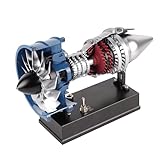
- Realistic & Authentic: The lifelike & visually stunning model provides a realistic depiction of a full-sized engine with main components including a first-stage fan, high-pressure rotor assembly, combustion chamber, high-pressure turbine assembly, low-pressure turbine assembly, and exhaust nozzle.
- High-Quality Construction: Made of high-quality metal, the meticulous model, full of detail and features, undergoes precision casting and CNC machining, along with sandblasting and anodized coloring treatment on the surface, ensuring durability and accuracy the same as the real model.
- Dynamic Display: Featuring a semi-transparent magnetic casing, this model offers a clear view of the engine's internal mechanics in motion when powered by the electric motor. The quick-release magnetic cover allows for effortless assembly and disassembly, making it ideal for demonstrations while protecting delicate components. Equipped with a sturdy mounting bracket and throttle control lever, this kit delivers an immersive hands-on experience with aviation engineering.
- DIY Assembly: Consists of 170+PCS (including screws & nuts) and comes with tools and paper-based English instructions. You will personally experience the entire assembly process, from small parts to the final completed model, constructing an awe-inspiring turbofan engine model.
- STEM Education: As an educational tool, this model unravels the internal workings of a turbofan engine, imparts knowledge about aerospace engineering, and stimulates interest, creativity, and awe for industrial technological achievements
How was the EcoJet constructed?
GM described the car as using a modified Corvette Z06 hydroformed aluminum frame, with aluminum and magnesium structural and chassis components. The body shell was carbon fiber over Kevlar. Its listed wheel sizes were 20 x 10 inches at the front and 22 x 12 inches at the rear.
The published project-partner list assigns GM Advanced Design Studio conceptual and build design, engineering, digital design and fabrication support; Alcoa chassis and wheel engineering; Metalcrafters body engineering and construction; Honeywell engine supply; Intermountain Turbine engine building; Dana chassis supply; BASF paint and finishing supplies; GE Plastics Lexan windows; and Viper Technologies wheel construction. These are historical roles associated with the project, not evidence of current availability or endorsement.
Rank #3

- EXPLORE A LOW-BYPASS TURBOFAN: Built at 1:10 scale, the DM135 presents the layered structure of a low-bypass turbofan engine. From the front fan and core engine to the low-pressure turbine, afterburner section, accessory gearbox, and exhaust nozzle, the cutaway design reveals how the major sections are arranged along the engine.
- WATCH THE MECHANICS COME TO LIFE: Once assembled, the motor drives the internal mechanism and turns the model into a working mechanical display. Open and cutaway casing sections keep the coordinated movement visible, while the included control panel adds an interactive element to the operating experience.
- BUILT WITH REAL METAL COMPONENTS: Aluminum alloy and stainless steel give the completed model a substantial weight and distinct industrial character. Precision casting, CNC machining, sandblasting, and anodized surface treatments bring definition to the individual parts and mechanical assemblies.
- A 600+ PIECE ENGINEERING BUILD: Assemble more than 600 components—including small screws, nuts, structural parts, and moving assemblies—into a detailed turbofan engine model. Included tools and illustrated English instructions guide the process, with an estimated building time of more than five hours.
- ENGINEERING DISPLAY WITH PRESENCE: Measuring approximately 17.72 × 4.96 × 7.76 inches and weighing about 8.95 pounds when completed, the model creates a noticeable mechanical centerpiece. The included stand supports display in a home, office, workshop, studio, classroom, or aviation collection.
What did the EcoJet look like, and what inspired its design?
The concept drew on aircraft and jet-age styling, Formula One racecars and Cadillac design cues. Ed Welburn, then GM vice president of Global Design, described the intent in GM’s release: “EcoJet’s esthetics were driven by aeronautical and jet-age influences. It’s a purpose-driven design that conveys power, capability and even danger, with a hint of Cadillac’s sophisticated design vocabulary.”
Leno recalled the early design process this way: “A couple of paper napkins later, Ed had begun to capture the essence of the car.” Juchli characterized the engineering challenge as a step beyond an earlier collaboration: “We thought we pushed the creative envelope with the ’66 twin turbo Toronado project with GM, but this turbine-powered monster is a whole new level of complexity.” Both statements are reproduced in the 2006 account of the project.
Rank #4

- 3D-Printed TR900 Replica: Precision 3D-printed Aero Engine Model of the iconic TR900 Turbofan.This highly accurate 9.3-inch replica showcases complex internal mechanics,offering a true-to-life visual of turbofan engineering for enthusiasts and collectors
- DIY Toyan Engine Kit: A rewarding DIY project for adult or teen 14+ hobbyists. This Engine building Kit provides hands-on assembly,deepening understanding of mechanical science.The completed model serves as a striking desktop display
- Transparent Educational Design: Features a clear casing that reveals the operational blade structure and dual-flow system. An insightful mechanical science educational gift, perfect for visualizing and learning fundamental aerospace principles
- Functional Science Gift: More than a model,it's an engaging educational tool.Ideal for students and aviation fans to interactively explore aerospace engine mechanics, making it a memorable gift for learning and discovery(Battery not included)
- Premium Desktop Art: A sophisticated 23cm collectible art piece. Its exquisite design makes it a perfect desktop decoration and a conversation-starting gift for adult hobbyists,combining aesthetic appeal with engineering intrigue
GM-reported EcoJet specifications
The figures below are the specifications published by GM for the 2006 concept, as reproduced by Car Body Design; they are not independently tested measurements.
| Specification | GM-reported figure |
|---|---|
| Engine | Honeywell LT-101 turbine |
| Fuel | Biodiesel |
| Power | 650 horsepower at 70% turbine speed |
| Torque | 400 lb-ft at 70% turbine speed |
| Wheelbase | 110 inches (2795 mm) |
| Overall length | 184 inches (4674 mm) |
| Width | 79.4 inches (2024 mm) |
| Height | 46.5 inches (1180 mm) |
| Front tires | 255/35R20 |
| Rear tires | 305/30R22 |
Source: Car Body Design’s reproduction of GM’s release and specifications.
Quick Recap
Best Value
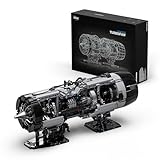
- Every gear, shaft, and joint is built for motion—an engineered engine flow you can set in motion with your own hands.
- Rotate the crank to drive linked parts in different directions and speeds, achieving a rare dual-direction, single-axis effect.
- A semi-exposed design lets you watch the mechanics at work, with metallic painted parts adding an authentic, engineered look.
- A hands-on challenge, leading to an engine you can see and operate—every gear and motion built by you.
- A build that engages both mind and hands, making this engine a memorable gift for any mechanical enthusiast.
Product prices and availability are accurate as of the date/time indicated and are subject to change. Any price and availability information displayed on Amazon at the time of purchase will apply.




