What’s actually slowing this PC down?
Pick the symptom - the matching free tool is one click away.
A conventional hybrid (HEV) uses gasoline and an electric motor, and does not plug in. A battery-electric vehicle (BEV) runs only on electricity stored in a rechargeable battery. A plug-in hybrid (PHEV) sits between them: it can drive on electricity for a limited distance, then use gasoline when its electric range runs out. Which is the better fit depends on charging access, driving habits, vehicle choice, and local energy costs.
At a glance: HEV vs. PHEV vs. BEV
| Type | How it gets energy | Plugs in? | Gasoline backup? |
|---|---|---|---|
| Conventional hybrid (HEV) | Gasoline engine and electric motor; the battery is charged onboard. | No | Yes |
| Plug-in hybrid (PHEV) | Electricity from a plug and gasoline for its combustion engine. | Yes | Yes |
| Battery-electric vehicle (BEV) | Electricity stored in a rechargeable battery. | Yes | No |
The everyday phrase “hybrid vs. electric” often means an HEV compared with a BEV. A PHEV is a separate, useful middle category—not another name for a conventional hybrid. The comparison below reflects U.S. guidance; prices, incentives, energy rates, and specifications vary by location and vehicle.
1. How the powertrain works
Conventional hybrids
An HEV combines an internal-combustion engine, an electric motor, and a battery. The electric motor can assist the engine, and the car can sometimes move electrically for short distances. It still burns gasoline.
Plug-in hybrids
A PHEV combines a plug-in battery and electric motor with a gasoline engine. It can drive electrically for a limited range, then rely on its engine when that range is depleted.
#1 Best Overall

- 【Efficient Charging】VDLPOWERVP level 2/level 1 EV charger is equipped with NEMA 6-20 Plug(220V/240V), it offers 16A current and up 3.5kW output. Two charging options, low current charging can effectively reduce battery wear and prolong service life. Choosing to connect the conversion line for charging can realize a full day's commute mileage in one night.
- 【Level 1 & Level 2 EV Charger Adapter】This portable ev charger is equipped with NEMA 6-20 plug (Level 2, 240V, 16A) and NEMA 5-15 adapter (Level 1, 110V, 12A), you can connect our electric vehicle chargers to a standard household socket or a dedicated industrial socket, use it flexibly from anywhere in the garage or driveway.
- 【Intelligent Charging-Durable and Safe】The intelligent chip design of its control box can keep monitoring the charging status at any time, provides multiple safety protections such as lightning protection and leakage protection. This electric vehicle charger is made of premuim and sturdy materials and is FCC certified. EV Control box is IP65 waterproof and dustproof.
- 【Easy Charging and Indication Displays】Just connect to the outlet and the car, the ev charger can work properly. LED indicators that can tell you the status as well as indicate errors while charging your electric vehicle. It can help you get the charging station status information quickly.
- 【Portable Design】The ev charger has a 20ft charge cable, which is long enough for you to charge without getting tangled.The appropriate cord length and weight allow you to easily put it in the trunk of an electric car whether you are visiting friends or renting a vacation house.
Battery-electric vehicles
A BEV uses electricity stored in its battery as its sole driving energy. It has no tailpipe because it does not burn fuel onboard. The U.S. Department of Energy’s Alternative Fuels Data Center (AFDC) explains the basic vehicle types.
2. Whether it needs to be plugged in
A conventional HEV does not connect to an external charger. Its battery is recharged by the engine and regenerative braking, which recovers some energy as the car slows. BEVs and PHEVs do plug in. A PHEV can still run on gasoline if it is not charged, but skipping regular charging means using less of its electric-driving capability.
3. Electric range and backup
HEVs are not designed for extended electric-only driving. The National Highway Traffic Safety Administration (NHTSA) says many full hybrids can operate electrically for a short distance, usually around one mile. NHTSA gives that broad description of hybrid operation.
Rank #2
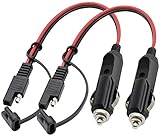
- Quantity:(2-Pack) Size:Length(30cm/12inch)Color:(Red-Black)
- Connectors 1 : 2 pin SAE power quick connect disconnect solar jack. Connectors 2 : Connectors 1 : Cigarette lighter male jack (With Fuse)Conductor Gauge:16AWG/ 2C(Wire diameter 1.29 mm)100% copper core cable,very thick and durable.
- Quick disconnect SAE connector, bullet lead design, suits for electrical wiring project, solar panel project, cars, motorcycles, RV’s project and other devices you want to charge
- With Dust Cap: Protecting standard SAE type connector from rain and dust, which stay clean and dry inside when you don't use it.
- Fast and easy to connect and disconnect.Standard SAE Plug works with most brands SAE outlets,Ideal for connection and transfer of solar battery and car battery, convenient to use and install.
Published category ranges differ by source and should not be treated as vehicle specifications. NHTSA describes typical PHEV electric-only range as 20 to 70 miles, while the U.S. Energy Information Administration (EIA) gives a span of 8 to 45 miles. EIA reports that new BEVs typically range from about 114 to 450 miles. These are broad summaries, not guarantees for a particular model; check the vehicle’s current EPA label and specifications. EIA also notes that extreme heat and cold can affect BEV range. See EIA’s transportation overview.
The Tool Desk
Outbyte Driver Updater FREEScan for outdated or missing drivers - takes under a minuteDriver Scan →Outbyte PC Repair FREEClear out junk files and repair common Windows errorsFree Scan →4. Refueling and charging routine
Gasoline stops
An HEV refuels at a gas station. It can suit drivers who do not have reliable access to charging at home, work, or nearby public locations.
Plug-in charging
BEVs require external charging; PHEVs benefit from it. Charging may be available at home, work, or public sites. EIA says about 75% of EV owners charge at home, though that figure does not mean every driver has a private parking space or charger.
Rank #3

- ATTENTION:As long as your charger is 240-volt compatible,the portable j1772 to 5-15/20 will work.Make sure your charger meets this condition, or it could damage your device.
- Compatibility:Compatibility with a wide range of electric bikes, scooters, and unicycles and other charging devices. With a total length of about 20Inch, it is more flexible when charging.
- Portable: This charging adapter weighs only about 0.77 pounds,Its portable size allows for easy storage in your backpack, bag, or glove compartment, so you can charge your vehicle anytime, anywhere.
- Durability : Crafted from high-quality materials.
- Usage: The discharger plug J1772 end into the charging station, the NEMA 5-15 end into the socket.
EIA’s broad charging examples are:
- Level 1: 120-volt charging adds roughly 2–5 miles of range per hour.
- Level 2: 240-volt charging adds roughly 10–20 miles per hour.
- DC fast charging: can bring a vehicle to 80% in 20 minutes to an hour.
These are estimates, not fixed charging times: the vehicle, charger, battery state, and conditions affect the result. EIA’s charging explanation provides the underlying ranges. Follow the owner’s manual and manufacturer instructions for charging safety, maintenance, and operation, as NHTSA advises.
5. Fuel and energy efficiency
There is no single efficiency figure for every HEV, PHEV, or BEV. Compare the current EPA label for the exact models under consideration. BEV efficiency is commonly shown in MPGe—miles per gallon equivalent—which allows an energy comparison with gasoline vehicles; it does not mean the car uses gasoline. Driving conditions and the demands of cabin heating or cooling affect energy use. HEV performance also varies with the hybrid system and how the vehicle is driven. AFDC describes EV efficiency ratings and the MPGe measure.
Free tools Windows power users keep installed
One-click scans. No signup required.
6. Routine energy cost
Fuel or electricity cost per mile depends on the vehicle’s efficiency and local gasoline and electricity prices. AFDC’s 2023 guide gives illustrative costs of 2–6 cents per mile for BEVs, 3–10 cents per mile for PHEVs in electric mode, and 4–36 cents per mile for PHEVs running on gasoline. For comparison, it lists 10–15 cents per mile for conventional gasoline or diesel sedans. These are guide estimates, not guaranteed current rates or a personalized comparison. Public charging prices and utility tariffs can differ from home electricity rates. AFDC’s 2023 guide explains the assumptions behind its cost figures.
Rank #4

- Important Note:If the vehicle is running on bumpy roads, it is forbidden to use the car charger in case it burns due to a poor connection. The Company will not be responsible for any loss caused by non-standard operation. To avoid burns or damage, do not plug or unplug the cable immediately after charging while the metal parts are still hot. Allow the connector to cool before disconnecting to protect both your device’s port and the cable’s contacts.
- Wide Compatibility: DC7909 to DC8020 car charger is designed for power station. Compatible Models: Jackery Explorer 3000 Pro/2000 Plus/2000 Pro/2000/1500/1500 Pro/1000 Plus/1000 Pro/1000/880/550/500/300/300 Plus(Works with the E300 Plus & E240 v2 but a DC8020 to USB C adapter is required.)/290/240/160 Power Station; BLUETTI Power Station EB3A/EB70/EB70S; GRECELL 288Wh Solar Generator 300W; Goal Zero Yeti Power Station; Anker 521 535 555 Power Station / II 400, II 800, 500W/777Wh PowerHouse;
- Wide Compatibility: DC7909 to DC8020 Car Cigarette Lighter charger is compabitble with BALDR 200W 330W 500W 1000W Power Station. PAXCESS Rugged 330 Rugged 330 Capacity 330W Portable Camping Generator Power Station; Geneverse Homepower; ExpertPower; MAXOAK; Westinghouse;
- UL Certified Power Cord & Heavy-Duty Specifications: The car charger comes with a 6.6-foot 14AWG UL Certified Power Cord, ensuring safety and reliability. The connector size is 8.0mm, and the cable is longer than competitors. The power cable is made of 100% pure copper wire, providing a stable current for your devices. Its weatherproof, double PVC jacket and 14 AWG heavy-duty power cable with UL Certified 15A safe fuse ensure durability, flexibility, and the best overheat protection.
- DC Input 12V to 24V: Versatile and adaptable, this car charger is suitable for use in various vehicles, including cars, trucks, RVs, buses, SUVs, ATVs, vans, boats, bikes, travel trailers, campers, and motorcycles. It operates seamlessly with most vehicles having a DC voltage range of 12 to 24V, offering an input range from 12V to 24V and an output of 180W max 360W.
For a practical estimate, use annual mileage, your local gasoline and electricity prices, and the EPA efficiency ratings of the specific vehicles. For a PHEV, account for how often you expect to charge and how much driving will happen after its electric range is used.
Independent reader supportYour contribution helps us test, update, and keep practical guides available for everyone.7. Tailpipe and lifecycle emissions
A BEV has zero tailpipe emissions. A PHEV has zero tailpipe emissions while operating in electric-only mode, but its engine emits when it runs. An HEV burns gasoline and produces tailpipe emissions.
Tailpipe emissions are not the same as lifecycle emissions. A fuller comparison also accounts for producing electricity and fuel and manufacturing the vehicle. Grid mix and how often a PHEV is charged affect the comparison. AFDC’s 2023 guide says BEVs generally produce one-third the emissions of conventional vehicles and PHEVs one-half under its comparison; these broad figures are not a universal result for every model, location, or current electricity mix. AFDC discusses emissions alongside electric-vehicle basics.
Best Value

- 【Delay Timer - Adjustable Current】Ev charger can adjust the current (8A/10A/12A/16A) through the physical button of level 1 ev charger. Charging power can reach up to 3.68KW (240V/16A). One-touch switch for ev charger operation. Built-in 2–8 hour delay timer for off-peak charging to save on electricity bills.
- 【NEMA 6-20 Plug & NEMA 5-15 Adapter】Nema 6-20 plug for 240V outlets and 5-15 adapter for standard 120V realize plug-and-charge (With 5-15 adapter, need to adjust the current to 12A or below, otherwise the charger may be demeged). Overall length of ev charger level 2 is 27FT, providing enough charging distance across garages at home or outdoor. Portable storage bag supports you take portable EV Charger during travel, business trip, electric vehicle charging stations anywhere.
- 【ETL/FCC and IP67 Safety】J1772 charger is equipped with advanced safety functions such as overvoltage, overheating, and short-circuit automatic shutdown. IP67 waterproof and dustproof, extreme temperature protection level for withstanding harsh weather conditions from -40°F to 131°F in sunny, rain, snow and sandstorm. Electric car charger has ETL certified, FCC listed, meets UL safety standards. Industrial-grade construction with high-strength TPU-coated cables and 99.95% oxygen-free copper cores.
- 【J1772 Connector】J1772 charger works for all J1772 standard electric vehicles, Ford, GM, Nissan, Audi, Kia, Honda, BMW, Hyundai, Gmc, Chevy, Mercedes, and all PHEV/BEV. [Not fits Tesla cars/Nacs connector]
- 【One-Touch Charging Operation】16A electric car charger supports plug-and-charge functionality and features one-touch scheduled charging and current adjustment. Its intuitive and user-friendly operation allows flexible customization of personalized charging plans. Level 1 ev charger automatically shuts off when your car is fully charged.
8. Routine maintenance
BEVs have no conventional engine and generally have fewer moving parts and fluids to service; AFDC says they typically require less maintenance than conventional vehicles or PHEVs. PHEVs retain combustion engines and their associated maintenance needs. That general pattern does not establish a precise lifetime saving for any particular car. Review the manufacturer’s maintenance schedule for the model you are considering. AFDC outlines the maintenance differences.
9. Battery warranty and care
Battery chemistry, thermal management, warranty coverage, and service terms vary by vehicle. NHTSA notes that temperature control matters because extreme temperatures can affect battery performance and lifespan. AFDC’s 2023 overview describes a typical battery warranty as eight years or 100,000 miles and expected battery life as 12 to 15 years under normal operating conditions and moderate climates. These are guide figures, not a promise about an individual vehicle. Check the actual warranty, its conditions, and—when buying used—the battery’s condition. AFDC’s overview discusses battery life and warranties.
10. Purchase incentives and total ownership cost
Do not count an expired federal credit as a current discount. As of October 8, 2026, the IRS says the previously owned clean vehicle credit applied only to vehicles acquired on or before September 30, 2025. The IRS page for the residential charging property credit says qualified property must have been placed in service before July 1, 2026. Both deadlines have passed. State, local, and utility programs may differ; check current official listings for your location. IRS: Previously Owned Clean Vehicle Credit; IRS: Alternative Fuel Vehicle Refueling Property Credit.
Compare the full cost rather than purchase price or energy cost alone: include financing, fuel or electricity, any charging installation, insurance, taxes, maintenance, and resale value. The result depends on the exact vehicles and your circumstances, so a category label cannot establish which option is cheapest.
Which type fits your driving?
- Consider an HEV if you want gasoline-station refueling and do not want to depend on charging access.
- Consider a PHEV if you can charge regularly and want electric driving for some trips while retaining a gasoline engine for longer journeys.
- Consider a BEV if your charging arrangements and typical trips suit an all-electric vehicle, and you are comfortable planning charging for longer journeys.
Before choosing, compare your home or work charging access, daily mileage, long-trip frequency, exact model range, local fuel and electricity prices, applicable current incentives, warranty and maintenance terms, and the electricity mix where you charge.
Quick Recap
Product prices and availability are accurate as of the date/time indicated and are subject to change. Any price and availability information displayed on Amazon at the time of purchase will apply.




