Start with the basics that preserve your Mustang EcoBoost’s intended setup: set the tires to the pressure on the driver-door placard, use the recommended tire size, remove cargo you do not need, and drive with smoother acceleration and fewer unnecessary stops. Ford identifies driving style, speed, stop-start driving, air-conditioning use, accessories, payload, towing, tire inflation, temperature, short trips, and terrain as factors that can affect fuel use. None of the steps below has a verified MPG gain, so judge changes by repeated comparisons rather than a promise.
Begin with the changes least likely to affect performance
Fuel economy depends on how the car is used as well as how it is set up. Ford’s Mustang Owner’s Manual says real-world consumption is influenced by driving style, high-speed driving, stop-start driving, air-conditioning use, add-on accessories, payload, and towing. Ford also identifies incorrect tire inflation and unnecessary weight as factors. Short trips, lower temperatures, and terrain can affect consumption as well. These are reasons to start with ordinary maintenance and driving habits—not to alter the engine or chase an unverified accessory claim.
As an Amazon Associate I earn from qualifying purchases.
For an EcoBoost owner who wants to retain normal performance, a sensible order is: verify tire pressure and fitment, remove needless load, make fewer abrupt speed changes, and compare fuel records under similar conditions. That approach addresses factors Ford names without assuming that a tune, intake, tire choice, or fuel grade will deliver a specific economy result. It also helps separate a real pattern from changes caused by weather, route, traffic, or the kind of trip you are making.
Free tools Windows power users keep installed
One-click scans. No signup required.
Ford’s guidance is about influences on real-world fuel consumption, not a promise that changing any one of them will produce a particular MPG improvement. There is no verified savings figure for the steps here. The useful aim is to avoid conditions that can unnecessarily increase consumption while keeping the Mustang in its prescribed configuration and driving it normally.
#1 Best Overall

- HIGH ACCURACY: Every ETENWOLF's pencil tire gauge is calibrated to ANSI B40.1 Grade B, it is accurate to 2% of span in the middle 50% of range and 3% of span in the lower and upper 25% of range. Each ETENWOLF pencil tire pressure gauge is manually calibrated and has its unique calibration number printed on the pencil
- WIDER RANGE: ETENWOLF's tire gauge offers 2 pressure ranges: 10-50PSI, 20-120PSI for all types of vehicles
- ALL METAL: ETENWOLF tire gauges are made of all solid metal, zinc alloy head and stainless steel body, they are durable and can be used for many years unless you lose them
- DEFLATION: You can also use ETENWOLF's tire gauge to deflate tires when the tire pressure is overinflated
- 16 CAPS IN 2 CASES: ETENWOLF even offers 16 valve stem caps, so you won't worry about losing tire caps anymore
Set tire pressure and size to the car’s specification
Use the door placard, not a universal PSI figure
Check the tire-pressure specification on the driver-door placard or in the owner’s manual for your exact model year and configuration. There is no single PSI number established here for every Mustang EcoBoost. A tire-pressure gauge lets you check the tires against that vehicle-specific specification; do not substitute a generic number or the maximum pressure printed on a tire’s sidewall.
Ford lists incorrect tire inflation pressure as one of the factors that can affect fuel economy. That makes checking pressure a sensible first step, but it does not establish a universal target or quantify how much fuel a correction will save. Use the placard value for your car rather than inflating beyond the specification in pursuit of economy. If a tire is repeatedly losing pressure, treat that as a maintenance concern rather than compensating by inflating it above the placard value.
For a useful check, keep a gauge in the car, consult the placard, and compare the measured pressure with the listed specification. Recheck when conditions are comparable so you are not comparing readings taken under different circumstances. The cited Ford guidance does not provide a one-size-fits-all pressure number, so avoid advice that gives a generic PSI figure without identifying the exact Mustang year and configuration.
The Tool Desk
Outbyte Driver Updater FREEScan for outdated or missing drivers - takes under a minuteDriver Scan →Outbyte PC Repair FREERepair Windows errors before they cause bigger problemsFix Now →Keep the recommended tire size
Check that the tires are also the size recommended for your Mustang. Correct pressure and fitment are supported maintenance choices, but the available evidence does not quantify an MPG improvement from either one. If you need replacement tires, compare options first on correct vehicle fitment and the characteristics you need from a tire, not on an unverified claim that a particular size or category will improve economy without affecting handling or performance.
A replacement tire can be considered on fitment and the characteristics you need, but the evidence available does not establish that a particular low-rolling-resistance tire will improve this Mustang’s fuel economy while preserving its handling or performance. Do not treat an economy label or a general claim about a tire category as a guaranteed result for your car. No particular tire model or product comparison is established here.
Use a smoother driving pattern
Ford names driving style, high speeds, and stop-start driving among the influences on real-world fuel consumption. A practical response is to accelerate moderately, maintain a steady speed when conditions allow, and anticipate traffic so you can avoid needless cycles of hard acceleration and braking. These are ways to reduce the conditions Ford identifies; they are not a promise of a particular MPG gain.
Rank #2

- Professional Tire Pressure Gauge for Cars - This heavy duty mechanical tire pressure gauge is calibrated to ANSI B40.1 Grade B (2%) international accuracy standard so you get a precise, accurate pressure reading every time you use it. Makes great car accessories, car stuff, tire deflator, car stuff for men, cool car gadgets, car gifts for men, him, dad.
- Recommended by mechanics - It features a steel and brass construction with an extended 5mm chuck tip, so you get a great seal with no air leakage. This automotive tool is also surrounded by a rubber cover, so it is protected from drops and is easy to grip.
- No batteries required - This top-rated, professional tire monitoring system is easy to use and is reliable in all weather conditions. A perfect accessory for your car, motorcycle, truck, bike, SUV, RV or ATV - it will not let you down.
- Easy to read dial with a 45 degree angled and fully swivelling chuck. Our built in relief valve allows you to press the bleed button whilst the gauge is still on the tire valve, releasing air until you reach the exact target required.
- Car accessories for men and women - Give as the perfect gifts for men, car accessories gifts for men, gifts for dad, car gifts, car gifts for men, car stuff for men, gifts for car guys, car guy gifts for men, gifts for car lovers, cool car gifts, car lovers gifts for men.
Driving smoothly does not mean holding up traffic, using an unsafe speed, or trying to make every journey identical. Drive appropriately for road, weather, traffic, and local limits. The aim is to avoid unnecessary speed changes where circumstances allow, rather than to sacrifice useful performance or make the car impractical to use.
What’s actually slowing this PC down?
Pick the symptom - the matching free tool is one click away.
Adjust to the route rather than forcing a single technique
- On a route with frequent signals or congestion, look ahead and allow more time to slow down instead of repeatedly rushing up to traffic. Ford specifically identifies stop-start driving as a fuel-use factor.
- On open roads, avoid choosing a higher speed than the trip requires; Ford identifies high-speed driving as a factor. Keep a steady, appropriate pace when conditions allow rather than accelerating and slowing without a reason.
- Use air conditioning when you need it, but include its use in your comparisons because Ford lists air-conditioning use as a factor. The cited guidance does not give a quantified penalty or prescribe when you should use it.
- Do not judge a change from one unusually easy or difficult drive. Weather, traffic, route, and trip length can obscure the effect of a small adjustment.
The goal is not to drive so slowly or cautiously that the car becomes impractical. Smooth, predictable inputs are a reasonable way to address the named factors while retaining the car’s normal operation. If you compare a new driving habit with your prior pattern, keep the route and type of trip as similar as reasonably possible, and repeat the comparison before drawing a conclusion.
Reduce unnecessary weight and drag-producing add-ons
Remove items from the car that you do not need to carry. Ford lists payload and unnecessary weight among the factors affecting fuel economy. A practical check is to look through the trunk and cabin for cargo that has no purpose on the trips you regularly make, then leave only what you actually need. This is a low-impact way to address load without changing the vehicle’s mechanical setup.
Ford also identifies add-on accessories as a factor, but that does not establish that every accessory causes a measurable loss or indicate how large any effect might be. If you use an accessory that changes the car’s load or exterior configuration, consider it when comparing fuel records. Keep it only when it serves a real need, and do not attribute a difference to that accessory unless the comparison controls for other conditions. No specific accessory or quantified penalty is established here.
For example, if one set of records includes an accessory or a full load and another does not, the results are not a clean test of a change in driving style. Note those differences rather than treating them as proof that a particular item caused a particular MPG change. This is especially important when the observed change is small or when route, temperature, and trip length changed at the same time.
Account for weather, trip length, terrain, and towing
A change in fuel use does not automatically mean that the car has developed a problem or that a recent driving adjustment failed. Ford says short trips and lower temperatures can reduce fuel economy, and terrain matters. Towing also affects consumption. Those conditions can make two otherwise ordinary driving periods poor comparisons.
Rank #3

- Accurate, Dependable Readings: Factory‑calibrated to ±1 PSI, so you can confidently match your vehicle’s recommended PSI (check the door jamb sticker). Ideal for monthly checks and road trips — consistent results every time, cold or warm.
- Bright Backlit Display & Nozzle Light: The illuminated nozzle helps you find the valve stem in the dark, while the backlit LCD makes readings crystal clear in dim garages or at night. No more squinting or holding a flashlight.
- 4 Measurement Units, One Button: Quickly switch among PSI, Bar, Kgf/cm², and KPA with a single press. No complex settings — just press and cycle to your preferred unit. Perfect for drivers who need multiple scales.
- Broad Compatibility for Everyday Vehicles: 0–150 PSI covers cars, SUVs, motorcycles, and spare tires (often 60 PSI). Fits standard Schrader valves; just press on for a reading.
- Auto‑Off to Extend Battery Life: The gauge automatically powers down after 30 seconds of inactivity, so the included 2*AAA batteries last longer. Always ready for your monthly checks without surprise dead batteries.
- Short trips: Compare similar trip lengths; a period dominated by short journeys may not match one made up of longer drives. Ford identifies short trips as a condition that can reduce fuel economy.
- Cold weather: Record the weather context rather than treating a colder period as a clean test of another change. Ford notes that lower temperatures can reduce economy; the cited material does not supply a correction factor.
- Hills and terrain: Use the same route or similar terrain when possible. Terrain affects fuel use, so a hilly route and a flatter route are not directly comparable on that basis alone.
- Towing: Keep towing periods separate from ordinary driving records because the load changes the comparison. Ford lists towing as an influence on real-world consumption.
- Traffic and speed pattern: Note whether one period involved more stop-and-go traffic or higher-speed driving. Both are named by Ford as factors.
These are context factors, not reasons to expect an exact adjustment. The cited material gives no formula for correcting an MPG figure for weather, terrain, trip length, traffic, or towing. Instead, record the circumstances and compare like with like as far as practical. A winter month with frequent short trips, for instance, is not a fair direct benchmark for a milder period of longer drives.
Choose fuel by the exact manual, not by an MPG promise
The cited Ford manuals recommend regular unleaded gasoline rated at least 87 AKI for the 2.3L EcoBoost. One cited manual says premium is recommended for severe-duty use such as trailer towing to provide improved performance. The manuals do not establish that premium universally improves fuel economy or is required for normal performance in every model year and market.
| Use case | What the cited Ford manuals say | What to check |
|---|---|---|
| General use of the 2.3L EcoBoost | Regular unleaded rated at least 87 AKI is recommended. | Confirm the recommendation in the owner’s manual for the exact model year and market. |
| Severe-duty use, such as trailer towing | One cited manual recommends premium for improved performance. | Check whether this guidance applies to your exact car and operating conditions. |
Use the fuel recommendation for your specific Mustang rather than choosing a higher grade solely in hopes of seeing better MPG. Premium is not established as a universal fuel-economy upgrade for this engine, and the severe-duty note is not a blanket recommendation for every driver. Fuel guidance can depend on the exact model year and market, so consult the manual for your car before applying a recommendation from another Mustang.
Do these 3 things before closing this tab:
1Repair Windows errors before they cause bigger problems2Scan for outdated or missing drivers - takes under a minute3Clear out junk files and repair common Windows errorsIf you tow or operate under severe-duty conditions, pay attention to the wording in your own manual: one cited Ford manual connects premium with improved performance in such use. That is distinct from claiming premium will improve economy in everyday driving. Do not treat a fuel-grade change as an MPG experiment unless other driving conditions are kept comparable, and do not disregard the grade specified for your vehicle.
Measure fuel use in a way that makes comparisons useful
A single trip-computer reading is a weak basis for deciding whether a change worked. Ford describes the trip computer’s average fuel-economy figure as a calculation and says a more accurate measurement is obtained after 2,000 mi (3,000 km). Treat that as measurement guidance, not as a savings estimate or a promise that a particular driving change will show a gain over that distance.
Before you change a habit or setup, write down a baseline. Include the average fuel-economy reading and enough context to make it interpretable: route, trip length, weather, speed pattern, traffic, load, accessory use, air-conditioning use, and whether you were towing. You do not need to produce a scientific test; the point is to avoid forgetting that the comparison periods may have been quite different.
Rank #4

- PROCESS LEVEL ACCURACY: This heavy duty tire pressure gauge is calibrated manually to ANSI B40.1 Grade A (±1% of span)
- PRESSURE RANGE 0-75 PSI: ETENWOLF’s tire gauge can measure pressure of pickup, motorcycle, truck, bike, SUV, RV or ATV
- EASY TO READ IN THE DARKNESS: The large glow dial helps you clearly read the pressure at night or in low light
- EASY TO USE: 360 degree swivel chuck allows you to measure and take a reading from a tire valve at any angle
- ACCURACY IN EXTREME WEATHER: PSI gauge works normally even in extreme cold or hot weather
- Record a baseline. Note the average fuel-economy reading and the driving conditions before changing your habits or setup. If the trip computer is your measure, remember Ford describes its average as a calculated figure.
- Keep the comparison similar. Use comparable routes and take note of speed pattern, load, weather, trip length, air-conditioning use, and towing. Ford identifies these kinds of conditions as influences on fuel use.
- Change one thing at a time. If pressure, load, driving style, and route all change together, the records cannot show which change mattered. A cleaner comparison makes it easier to tell whether a pattern repeats.
- Repeat the comparison. Look for a pattern across multiple records rather than treating one favorable or unfavorable trip as proof. Short trips and unusual traffic can make a single reading especially unrepresentative.
- Allow enough distance. Ford says a more accurate fuel-economy measurement is obtained after 2,000 mi (3,000 km); do not present a short run as a definitive result. This figure describes measurement accuracy, not expected savings.
Do not compare a mostly highway period with a mostly stop-and-go period and credit the difference to one adjustment. The factors Ford names can change at the same time, and no recommended action here comes with a verified, model-specific MPG figure. Likewise, if a reading moves in the wrong direction once, that does not by itself show that a modest adjustment made the car less efficient; weather, terrain, trip length, and load may be different.
Think of the trip computer as a way to follow a trend, not an instrument that proves the cause of a change. Keep records consistent enough to spot repeated patterns, and make any conclusion proportionate to the quality of the comparison. If conditions cannot be matched closely, describe the result as an observation, not a guaranteed effect of tire pressure, driving style, or another single factor.
Independent reader supportYour contribution helps us test, update, and keep practical guides available for everyone.Why an aftermarket tune or intake is not a proven economy fix
The available evidence does not establish that an aftermarket tune or intake improves fuel economy on the Mustang EcoBoost while preserving performance, warranty status, or emissions compliance. That is not proof that every product has the same outcome; it means these modifications cannot be recommended here as proven, low-risk economy steps. No supported product comparison or model-specific savings figure is available to make a responsible recommendation.
If fuel economy is the priority, begin with the vehicle’s prescribed tire setup, avoid carrying unnecessary load, drive smoothly, and measure consistently. Do not assume that a modification advertised for power or efficiency will retain the factory behavior you want. Performance, warranty, and emissions implications are not established for a specific tune or intake here, so do not treat any one as a guaranteed way to save fuel without a tradeoff.
A practical order of operations
- Read the driver-door placard and confirm the owner-manual guidance for your exact model year and market.
- Check tire pressure with a gauge and verify that the tires are the recommended size.
- Remove cargo you do not need and note any accessories or towing that affect the car’s load or use.
- Drive with smoother acceleration and fewer unnecessary speed changes, while accounting for traffic and route.
- Use the fuel grade specified for your car and check whether any severe-duty guidance applies.
- Compare repeated fuel-use records under similar conditions, allowing the distance Ford recommends for a more accurate reading.
After following this order, resist the temptation to assign credit based on one tank or one trip. Pressure and tire fitment, load, driving, speed, air conditioning, route, weather, and trip length can all differ between periods. If you want to test one change, keep the other factors as steady as possible and give the comparison enough distance to be useful.
Recommended Free Tools
This sequence prioritizes actions that support the car’s intended operation. It does not guarantee a particular result; the useful outcome is a better-controlled comparison and fewer avoidable influences on consumption. Where a model-specific specification matters—especially tire pressure, tire size, and fuel grade—the placard and owner’s manual for your exact Mustang take precedence over generic advice.
Best Value
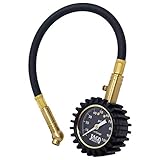
- Mechanic Recommended - performance tested, certified, & calibrated accurate within ANSI Standards (±1.5%) at our ANSI accredited calibration facility, ensuring precise tire pressure readings without relying on batteries
- Feels rugged in the hand & built to last from solid brass shielded by our durable shock-resistant gear-style protective guard; features our signature HybridFlex leak-proof air hose providing a soft feel with superior strength & flexibility
- Robust design is equipped with a built-in air bleeder valve to reduce pressure in overinflated tires, and the handy 360-degree swivel chuck allows for easy access to the tire valve from any angle
- Larger, 2" glow dial features easy-to-read 100 PSI single increment scale that glows in the dark, providing accurate readings that "lock" in place until the pressure reset button on the brass neck is pressed
- 100% Lifetime Warranty by JACO when you order today, so click buy with confidence and enjoy longer-lasting tires, improved gas mileage, and a smoother car driving experience with the help of properly inflated tires.
Frequently Asked Questions
How can I improve my Mustang EcoBoost’s fuel economy without sacrificing performance?
Start with Ford’s supported basics: use the pressure on your car’s driver-door placard, keep the recommended tire size, remove cargo you do not need, and avoid unnecessary abrupt acceleration and speed changes. Compare repeated records under similar routes and conditions. Ford identifies several influences on real-world fuel use, but no specific MPG gain is verified for any of these steps.
What tire pressure should I use in my Mustang EcoBoost?
Use the specification on the driver-door placard or in the owner’s manual for your exact model year and configuration. There is no universal PSI number established for every EcoBoost Mustang. A tire-pressure gauge can help you check against the vehicle-specific value.
Does premium gas improve MPG in a Mustang EcoBoost?
The cited Ford manuals recommend regular unleaded rated at least 87 AKI for the 2.3L EcoBoost. One manual recommends premium for severe-duty use such as trailer towing to provide improved performance. The cited guidance does not say premium universally improves fuel economy; check the manual for your exact year and market.
Will low-rolling-resistance tires improve fuel economy without hurting performance?
No model-specific evidence here establishes that a particular low-rolling-resistance tire will improve this Mustang’s economy while preserving handling or performance. If replacing tires, first verify the recommended size and fitment, and do not treat a general economy claim as a guaranteed result.
How long should I track fuel economy before deciding whether a change helped?
Ford says the trip computer calculates an average fuel-economy figure and that a more accurate measurement is obtained after 2,000 mi (3,000 km). Treat that as measurement guidance, not a predicted savings interval. Compare repeated records and keep route, speed pattern, load, weather, trip length, and towing as similar as possible.
Should I install an aftermarket tune or intake to save fuel?
The cited material does not establish that a Mustang EcoBoost tune or intake improves economy while preserving performance, warranty status, or emissions compliance. It therefore does not support recommending either as a proven economy fix.
The Bottom Line
For a Mustang EcoBoost, begin with its own placard and manual: check tire pressure, keep the recommended tire size and fuel grade, remove unnecessary load, and drive smoothly. Then compare repeated fuel-use records under similar conditions. Ford identifies many influences on real-world consumption, but the guidance cited here does not promise an MPG gain from any single adjustment, tire, premium fuel, or modification.
Quick Recap
Product prices and availability are accurate as of the date/time indicated and are subject to change. Any price and availability information displayed on Amazon at the time of purchase will apply.




