Recommended Free Tools
To remove air pockets safely, follow the refill and bleeding procedure for your exact vehicle, engine, and cooling circuit. There is no reliable universal sequence: bleed screws, fill points, coolant specifications, and pump-cycling requirements vary. Always start with a fully cool system, and never open a hot coolant cap or reservoir.
Why the procedure depends on your vehicle
Air can remain trapped after a coolant refill or repair and interfere with circulation and cooling. Some vehicles use bleed screws; others are filled through a degas reservoir or require a vacuum refill tool. Hybrid and electric vehicles, as well as supercharger intercooler loops, may have separate circuits and procedures.
Before loosening a cap or bleed screw, find the instructions for the vehicle’s model year, market, engine, and the circuit that was serviced. Use the specified coolant and mixture; color alone does not establish compatibility.
Safety checks before bleeding
- Let the engine and cooling system become fully cool. A hot system may be pressurized and can spray coolant that causes serious burns. Toyota’s 2025 Camry Hybrid owner information specifically warns against removing the engine or power-control-unit coolant reservoir caps while the hybrid system is hot: Toyota Camry Hybrid Owner’s Manual.
- Park safely and check for leaks. Confirm that hoses, drain plugs, and service connections are secure before refilling.
- Use the coolant type and mixture specified for your vehicle. Toyota’s coolant guidance for the cited Camry Hybrid is model-specific; it calls for Toyota Super Long Life Coolant or a defined equivalent, not plain water or straight antifreeze.
- Keep old coolant away from children and pets, and dispose of it responsibly; antifreeze is poisonous.
A safe general framework
The following is a planning framework, not a substitute for the vehicle’s procedure. Do not open an unidentified bleed screw or transfer another model’s warm-up, heater, or pump sequence to your vehicle.
#1 Best Overall

- 【TROUBLESHOOTING & SAVING MONEY】28pcs universal radiator pressure tester and vacuum refill kit with functions of leak detection, temperature measurement, liquid filling, etc. If you use the coolant pressure tester, the tester can quickly and easily solve any problems related to radiator pressure, making your job easier and faster.Note: Please select the corresponding adapter according to the user manual; otherwise, leakage may occur. If a suitable adapter is not available, please use a universal adapter, which is suitable for all vehicle models.
- 【ALL-IN-ONE TOOL KIT】1 x Radiator manual pressure tester(0-35psi/0-2.5 bar); 1 x Pneumatic vacuum coolant refiller(-30 to 0inHg/ -76 to 0cmHg); 1 x 19" Rubber nylon resin hose; 1 x Thermometer(32 - 400 ℉); 3 x Radiator cap test adapters; 1 x Universal tapered rubber adapter; 17 x Adapters; 1 x Adapter handle; 2 x Connectors; 1 x Storage case.
- 【TOP QUALITY MATERIAL】Radiator manual pump pressure detector adopts a premium aluminum cylinder and accurate shock-proof gauge design. A vacuum-type coolant refiller uses reliable brass and plastic material—a rubber hose with brass parts, anti-corrosive and waterproof. American & European style air plugs are provided for various air hoses.
- 【KEY EASE-OF-USE FEATURES】Color-coded caps help you quickly choose the right adapter without confusion.All-in-one design eliminates need for multiple separate tools.Clear instructions guide you through pressure testing and vacuum filling.Quality gauge provides accurate, easy-to-read pressure measurements,that even if you're new to cooling system work, the comprehensive kit and straightforward process make it accessible for DIY mechanics.
- 【APPLICATION】The kit includes 3 radiator cap test adapters for common cap styles.Look at your expansion tank: Most adapters are designed for expansion tank necks.Color-coded system: Each adapter has a colored cap to help you quickly identify the right fit.Universal tapered adapter: Included as a backup option for unusual fittings.Compatible with: Mercedes-Benz, BMW, Audi, VW, Ford, GM, Toyota, Honda, Nissan, Mazda, Subaru, and many more brands.The comprehensive adapter selection means you'll likely have the right fit, and if one doesn't work perfectly, you can try others in the set.
- Identify the circuit and refill method. Check the owner or service manual for the correct fill point, coolant, bleed-screw locations and order, and whether the procedure calls for vacuum filling or electronic pump activation.
- Start cold and inspect. Once the system is fully cool, check for leaks and confirm service connections are secure.
- Fill as specified. Use the designated fill point and approved fluid. If the instructions call for bleed screws, open only those identified and follow the stated order and method. Refill slowly, and do not let a reservoir run empty during a procedure that requires it to remain filled.
- Follow the vehicle’s exact circulation or warm-up steps. Depending on the system, instructions may call for a particular heater setting, engine idle, thermostat or fan operation, vacuum refill, or electric-pump cycles. Use only the sequence documented for your vehicle and circuit.
- Check the specified indicators. Observe temperature, heater output, coolant level, and leaks as directed by the procedure. Stop if the temperature rises abnormally, coolant is expelled, or a warning sign specified by the manual appears. Shut down and let the system cool fully before opening it again.
- Recheck cold. After the prescribed drive or heat cycle, let the vehicle cool completely and check the level using the manufacturer’s instructions. Do not open a hot cap just to check the level.
Why example procedures should not be copied
General refill guidance
Haynes’ September 2020 guidance says bleed screws, when fitted, are typically at high points where air may collect. Its general example describes filling cold, topping up as the level falls, allowing the engine to reach thermostat or fan operation, then cooling and checking again. That is an example, not a universal sequence; consult the instructions for your vehicle. Haynes: How to bleed air out of a cooling system.
Ford installation instructions
Ford’s M-6642-MB instruction sheet permits vacuum filling or a specified manual method. That manual method uses maximum heater temperature and blower settings, an idle period, checks for hot air and a stabilized temperature indication, then shutdown and cooling before checking the degas-bottle level. The document’s warning about cool discharge air with no temperature-gauge movement applies to that procedure; it is not a diagnostic rule for every Ford. Ford M-6642-MB instructions.
Rank #2
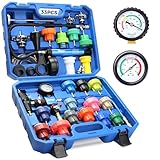
- 🔧【COMPLETE 33-PIECE MASTER KIT】This all-in-one coolant pressure tester and vacuum refill kit includes 23 radiator adapters (22 specific + 1 universal), a vacuum pump, a vacuum purge & refill tool, a probe thermometer, a wrench, EU & US air intake joints, O-rings, and hoses. Everything you need to diagnose cooling system leaks and refill without air pockets—all in one rugged carrying case.
- 🚗【WIDE COMPATIBILITY – 23 ADAPTERS FOR MOST CARS】With 23 different radiator adapters, this cooling system pressure tester works on most passenger vehicles, including Japanese, German, American, Korean, and European makes. Covers sedans, SUVs, trucks, and many light-duty vehicles. No more guessing which adapter fits—we‘ve got you covered.
- 🔍【DUAL FUNCTION: PRESSURE TESTING & VACUUM REFILL】Identify leaks quickly with the pressure testing function—check header tanks, expansion tanks, head gaskets, radiator cores, heater matrix, water pumps, and pipes. Then use the vacuum refill tool to purge air and refill coolant without any trapped air pockets. This two-in-one system saves time and prevents engine overheating.
- 📦【EASY ORGANIZATION & QUICK IDENTIFICATION】Color-coded adapters and molded size markings let you grab the right adapter instantly. The custom-molded carrying case keeps every component securely in its place, so you never lose a part. Hassle-free storage and transport for professional mechanics and DIYers alike.
- 💪【BUILT FOR DAILY USE – DURABLE MATERIALS】Constructed with quality aluminum alloy, nylon, rubber, and brass, this coolant pressure tester is engineered to withstand frequent use in busy workshops. The robust build ensures consistent performance and long-term reliability—year after year.
Separate supercharger intercooler loop
For the 2021–2024 F-150 5.0L supercharger application, Ford Performance and Whipple specify a spill-free funnel or equivalent at the relevant fill point, recommend vacuum purge/refill for the intercooler system, and describe ignition-controlled electric-pump cycles. The instructions warn that trapped air can cause pump pulsation and poor cooling performance, and say not to remove the filler cap hot. This is a separate, application-specific loop—not a procedure for an ordinary engine cooling circuit. Ford/Whipple F-150 installation instructions.
A different Ranger installation
A separate Ford/Whipple Ranger installation guide gives different bleeding instructions after the thermostat opens and specifies mixtures for its engine and intercooler systems. That difference is a reason to use the guide for the exact application rather than infer a procedure or mixture from another vehicle. Ford/Whipple Ranger installation instructions.
Outdated Drivers Are Slowing You Down
One free scan finds every outdated or missing driver and matches the right update for your exact hardware.Free scan · exact hardware matchWindows Errors? Fix Them Before They Spread
Repair common Windows errors and clear accumulated junk for a smoother, more stable PC - no reinstall needed.Free scan · no reinstallQuick Recap
Best Value
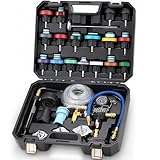
- FIND COOLING SYSTEM LEAKS BEFORE THEY BECOME BIGGER PROBLEMS: Pressure-test the cooling system to help identify leaks around the radiator, hoses, water pump, heater core, head gasket and related components before they lead to overheating or coolant loss.
- REFILL COOLANT WITHOUT TRAPPING AIR: The vacuum refill function helps draw coolant into the system while minimizing trapped air pockets, supporting a faster refill process after repairs or coolant replacement.
- COMPLETE 28-PIECE ADAPTER SYSTEM: Includes color-coded test caps and multiple adapters designed to fit a wide range of cooling systems, helping technicians quickly select the correct connection for different vehicles.
- ACCURATE PRESSURE MONITORING: The pressure pump and vacuum refill system feature easy-to-read gauges marked in PSI and BAR, helping users monitor pressure throughout testing and refill procedures.
- BUILT FOR PROFESSIONAL AND DIY COOLING SYSTEM SERVICE: Supplied in a durable blow-molded storage case that keeps adapters organized and protected. Suitable for cooling-system diagnostics, leak testing and coolant replacement across many vehicle makes.
Rank #4

- Universal Compatibility: 17 color-coded test caps and 3 test covers fit most Japanese, European, and American cars. Quickly identify the right adapter for efficient cooling system diagnosis
- Precision Engineering: Durable aluminum hand pump with dual rubber rings ensures superior airtightness. Tests 0-35 PSI for accurate cooling system leak detection you can trust
- Upgraded Vacuum Refill System: Advanced metal filling valve enhances stability and suction power. Gauge displays both psi and bar for easy pressure monitoring during use
- Effortless Operation: Tests cooling system integrity and replaces coolant with ease. Vacuum gauge ranges 0 to -30 inHg, pump tests 0-35 PSI – ideal for pros and DIYers
- Quality Build & 24/7 Support: Crafted from high-quality materials for lasting durability. Includes 3 radiator cap adapters with color-coded system. Backed by 24/7 customer service for peace of mind
Rank #3

- Comprehensive Tool Set: Orion Motor Tech's 33 pcs coolant pressure tester kit includes 22 adapters, a universal adapter, a vacuum pump, a vacuum purge & refill tool, a probe thermometer, a wrench, EU & US air intake joints, O-rings, and hoses
- Versatile Application: This cooling system pressure tester kit identifies leaks from the header and expansion tanks, head gasket, radiator core, heater matrix, and water pump & pipes, and ensures air pocket-free coolant refilling for radiators
- 23 Adapters for Most Cars: With 23 different radiator adapters, this coolant pressure tester kit is compatible with numerous vehicle makes and models such as BMW, Ford, Opel, Fiat, VW, Porsche, Mercedes-Benz, Nissan, Peugeot, Chrysler, and more
- Hassle-Free Organization: The color-coated adapters and molded size markings make it easy to quick identify the appropriate tool for the job. The custom molded carrying case keeps everything organized and ready for transport
- Built to Withstand Everyday Use: Constructed with quality aluminum alloy, nylon, rubber, and brass, this vacuum coolant fill kit is designed for enhanced strength and consistent performance for years to come
When to stop and investigate
- The temperature rises abnormally or coolant is expelled: stop the procedure. Do not open the system while hot; let it cool fully and consult the vehicle’s instructions or a qualified technician.
- The heater remains cold: treat this as a warning if the vehicle’s procedure identifies it as one. In Ford’s M-6642-MB manual method, cool discharge air with no temperature-gauge movement means coolant is low for that specific procedure.
- The level keeps dropping after a refill: inspect for a leak or another unresolved fault instead of assuming it is a one-time air pocket.
- You cannot identify the right bleed point or sequence: stop and get service information for the exact model, engine, and circuit. A high point that looks like a bleed screw is not enough to identify it.
Tools that may help
- Spill-free funnel: Useful only if its adapter fits the vehicle’s specified fill point and the procedure calls for that method. Haynes includes a funnel in its general tool guidance; Ford Performance names a Lisle 24680 or equivalent for one specific application.
- Vacuum cooling-system refill tool: Some procedures permit or recommend vacuum filling, including the cited Ford and Ford/Whipple examples. Whether it is appropriate depends on the circuit and service instructions.
- Approved coolant: Choose by the vehicle’s specified chemistry and mixture, not by color or a broad “universal” label.
- Exact service information: A manual or official instruction sheet matching the model year, engine, market, and circuit is essential when the refill or bleeding procedure is not obvious.
Product prices and availability are accurate as of the date/time indicated and are subject to change. Any price and availability information displayed on Amazon at the time of purchase will apply.