Quick wins for a faster PC:
Scan for outdated or missing drivers - takes under a minuteDriver Scan →Clear out junk files and repair common Windows errorsFree Scan →Fix the driver behind crashes, sound loss and screen glitchesFind Drivers →The EPA estimates an electric vehicle’s range by measuring how far it travels on prescribed laboratory driving cycles, adjusting those results, and combining city and highway estimates. The number on the window sticker is a standardized comparison—not a promise that every driver will travel that distance on a charge.
How the EPA measures EV range
The range test starts with a fully charged battery. In the single-cycle method, the vehicle is repeatedly driven over the EPA city cycle until its battery is depleted and it can no longer continue; the distance is recorded. The test is then repeated from a full charge using the highway cycle.
Both tests take place on a dynamometer. The EPA describes the device as one that “works like a treadmill for cars.” Automakers may instead use an optional multi-cycle procedure: four city cycles, two highway cycles, and two constant-speed cycles. EPA’s Fuel Economy and EV Range Testing page describes the procedures.
How laboratory results become the label range
1. EPA adjusts the test results
Laboratory cycles cannot fully represent conditions such as cold temperatures, air-conditioning use, and high-speed or aggressive driving. EPA therefore adjusts the test results to better reflect on-road use. Its most common method applies a 0.7 factor to test parameters including range: for example, a 200-mile laboratory highway result becomes 140 miles after adjustment. This is the most common approach, not a universal rule; regulations allow optional methods. EPA’s testing explanation and 2027 model-year guidance describe the adjustment, including the use of a five-cycle factor of 0.7 or a vehicle-specific value.
#1 Best Overall

- Auto Power Off: Pocket Digital Multimeter Auto power off, 3 1/2-digit LCD, with a max. Reading of 1999, more power saving.
- Upgraded Features: Auto range, Data hold, Low battery indication, Overrange indication, Negative Polarity indication.
- Multi-Functional: Mini digital dc voltmeter is great little DMM, it has all the needed functions.DC/AC Volts,AC/DC Amps, Ohms and Diode, continuity testing with tone.
- Power Supplied: Powered by 2 pieces 1.5V botton cell,LR44 or equivalent, before operating the first time, you need to remove the tape insulating the battery.
- Easy to carry: folding design and handheld, compact size, stable, accurate and reliable, easy to carry and operate.
2. It combines adjusted city and highway range
EPA weights adjusted city range at 55% and adjusted highway range at 45%. In EPA’s example, 168 miles of adjusted city range and 140 miles of adjusted highway range produce a combined estimate of 155 miles after rounding. That combined figure is the driving range shown on the EPA label. EPA’s explanation of the electric-vehicle label describes the displayed figures.
What the range estimate does—and doesn’t—tell you
The label provides a consistent way to compare vehicles under prescribed test procedures. It does not predict the exact distance a particular driver will cover. Actual range can vary with driving style and speed, maintenance, air conditioning and other accessories, weather, road conditions, vehicle load, and other factors, as EPA notes on its label guide.
Rank #2
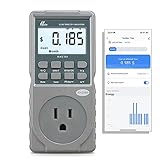
- EV CHARGER LEVEL 1 MONITOR: Ensure precise monitoring and safe using with our high power watt meter, redundant current pass through capacity design
- PRECISION ACCURACY METER: Benefit from built-in high precision current sensor, PN2500 providing professional Class 1.0 accuracy with 0.001A resolution
- ELECTRICITY TESTER: Gain comprehensive insights with a wide range of metrics including Watts/VA, kWh, Time, Amp, Start-up Amp, Volt, PF, Hz and Cost etc.
- Wi-Fi APP CONTROL: Effortlessly monitor all parameters from your iOS or Android device, take advantage of convenient management or access full functionality without app
- MONITORING WITHOUT GUESSWORK: Accurately track home charging and appliances usage. Calculate cost and forecast consumption by hour, day, week, month and year
Manufacturers submit fuel-economy data under specific procedures, and EPA says it confirms approximately 15% of test results. EPA’s National Vehicle and Fuel Emissions Laboratory tests a portion of new cars and trucks to verify manufacturer-submitted results; it does not test every EV. Details are on the agency’s vehicle and engine testing page.
Independent reader supportYour contribution helps us test, update, and keep practical guides available for everyone.Range is different from MPGe
Range is a distance estimate. MPGe is an energy-efficiency metric that lets shoppers compare an electric vehicle’s energy use with gasoline vehicles; it is not miles of driving range. EPA defines one gallon of gasoline’s energy equivalent as 33.7 kWh. Its MPGe figures assume Level 2 AC charging and account for losses in the charging cable and onboard charger, so they reflect energy drawn from the outlet more closely than energy delivered only to the battery. EV labels show city, highway, and combined MPGe alongside driving range. See EPA’s electric-label guide.
Quick Recap
Best Value

- [MULTIFUNCTIONAL TESTING CAPABILITIES] The load tester supports a wide range of measurements including voltage from DC8V to DC80V and current up to 50A, making it for different applications.
- [EASY DATA LOGGING] Features like bidirectional measurement and power failure memory allow for efficient data logging and retrieval for thorough analysis.
- [HIGH VISIBILITY DISPLAY] The bright color LCD screen makes it easy to read measurements even in low light conditions, enhancing usability in various settings.
- [SAFETY ALARMS INCLUDED] This device includes multiple alarm indicators that users to any unsafe conditions during testing processes.
- [SIZING REMINDER] Always refer to your specific requirements before utilizing the load tester.
Rank #4

- Energy Saving: 50A AC power meter through real-time monitoring of power consumption, energy waste or inefficient equipment can be identified. Voltage fluctuations, voltage sags, swells, transients, and other disturbances that may affect the performance of electrical equipment can be monitored, so that corresponding measures can be taken to optimize energy utilization and avoid unnecessary waste
- Electricity Safety: Aging electrical equipment may have various problems, such as over-power, over-rated current, overload, etc., which may lead to equipment failure. Use BOQNZN LCD display digital multimeter, the power consumption status of these devices can be monitored in real time, abnormal data can be found and eliminated in time, and old devices can be replaced or upgraded, reducing potential safety hazards and ensuring the normal operation of the devices
- Flame Retardant Material: The whole body of the monitor is made of PC flame retardant shell, which has excellent high temperature resistance, and will not produce dripping and burning at high temperature, which reduces the risk of fire spreading and provides additional security. It has good wear resistance and impact resistance, can withstand a certain degree of impact and pressure, and improves its service life
- High-Precision Monitoring: With its sensitive electromagnetic coil, watt meter panel can accurately monitor various data such as voltage, current, power, frequency, and power factor in real time. Product parameters: Voltage: 40-300VAC, Current: 0-50A AC, Power Draw: 0-9000W, Frequency: 45-65HZ, Power factor: 0.00-1.00PF, Power Usage: 0-99999kwh
- Data Recording and Recovery: Even in the event of a power outage, historical power consumption data can still be retained, which is useful for tracking equipment power consumption and analyzing power consumption trends. Long press the button on the right side of the electrical usage monitor to reset the recorded data, which can be used to monitor another electrical appliance
Rank #3

- Individually control two power outlets using your voice or an app, and control your lights and appliances on the go or based on presence.
- Matter-enabled to let you seamlessly control your home across smartphones and voice assistants of all major platforms.
- Get up and running in a flash with quick & easy set up / UL-certified / Cutting-edge Thread network technology for a robust smart home; enhances the stability and reach of your Thread network.
- 100% Privacy: No Eve cloud, no registration, no tracking. Local communication without cloud dependency.
- Requires iOS/iPadOS 16.4 (or later) or Android 8.1 (or later) plus a hub of your chosen platform: Apple Home: Apple TV 4K (2nd gen / 3rd gen 128 GB), HomePod (2nd gen), HomePod mini / Samsung SmartThings: SmartThings Hub v3, SmartThings Station / Amazon Alexa: Echo (4th gen), Echo Hub, Echo Plus (2nd gen), Echo Show 8 (3rd gen), Echo Show 10 (3rd gen), Echo Studio, eero 6 / 6+ / Pro 6 / Pro 6E / Max 7 / Google Home: Nest Hub (2nd gen), Nest Hub Max, Nest Wifi, Nest Wifi Pro
How to compare the numbers on EV labels
- Compare combined range with combined range, using the same model-year context.
- Look at city or highway range separately when that better matches your usual driving.
- Compare MPGe with MPGe to assess energy efficiency; do not treat it as a range figure.
- Use the label as a standardized estimate, then account for the conditions of your own routes and driving.
Product prices and availability are accurate as of the date/time indicated and are subject to change. Any price and availability information displayed on Amazon at the time of purchase will apply.




