Do these 3 things before closing this tab:
1Fix the driver behind crashes, sound loss and screen glitches2Repair Windows errors before they cause bigger problems3Scan for outdated or missing drivers - takes under a minuteThere was no front-engine version of the Porsche 911: the 911 is the rear-engine model. The front-engine cars often confused with it are separate Porsche lines—especially the 924, 928, 944 and 968. In those classic transaxle cars, the engine sits at the front and the gearbox sits at the rear axle, connected by a long shaft. That is the essential difference: the 911 and the transaxle models put their engines and transmissions in different places.
So when someone asks how a “front-engine 911” differs from a rear-engine 911, the helpful correction is that Porsche’s front-engine sports cars were not 911 versions. They were distinct model families with a different mechanical layout and, in some cases, different engine types.
As an Amazon Associate I earn from qualifying purchases.
First, what “front-engine 911” gets wrong
“Front-engine 911” sounds like a comparison between two versions of one model, but it combines two different Porsche model families. Porsche’s history describes the 911 as a rear-engine car: its original six-cylinder engine was mounted behind the passenger compartment, and Porsche says that position remained fundamental to the model line. The 924, 928, 944 and 968 were separate front-engine sports cars, not 911 variants.
The distinction is easy to picture from the passenger compartment. In a 911, the engine is behind the occupants, toward the rear of the car. In a classic front-engine Porsche, the engine is ahead of the occupants. The gearbox location is a second, separate question: in the transaxle arrangement used by these front-engine models, it is at the rear axle rather than beside the engine.
#1 Best Overall

- High-Quality Materials:The Porsche 911 Turbo die-cast car is made of zinc alloy,plastic parts and rubber tires,making it safe for children to play with.It features detailed interior and exterior trim, and is very sturdy.
- Function:No batteries are required, but the vehicle has a powerful pull back feature. Simply pull it back, then release your hand, and the car will go for a long distance. The doors may be opened to view the whole inside of the vehicle. So appealing to children and collectors alike.
- Size:1/36 scale vehicle model with beautiful English packaging,ideal for toddlers to play with and carry. Car collectors will appreciate the perfect small size, which allows them to collect a complete set of cars without taking up too much space.
- Grow From Play:Help children learn more about car ,expand their knowledge ,increase the hand-eye coordination and the reaction speed of the children in the play.
- Ideal Christmas Festival Gift:All of TOKAXI die-cast model cars are attractively packaged in English, making them the perfect Christmas, Birthday, Children's Day, New Year gift for kids, party favors, home decorations, or travel toys for boys and girls.gifts for boys girls.
There is no hidden 911 trim or generation that turns the car into one of these front-engine models. Porsche’s 911 history describes the rear-mounted engine as the concept carried through the nameplate’s development. The transaxle cars have their own model names, body designs and engineering histories. If the question is “Was there ever a front-engine 911?”, the answer is no in the sense relevant here: Porsche made front-engine sports cars, but they were the 924, 928, 944 and 968, not front-engine 911s.
What “transaxle” means on these Porsches
A transaxle combines the transmission and final-drive components at the driven axle. In the Porsche models discussed here, the engine is at the front while the gearbox is at the rear. A longitudinal shaft runs from the engine to the rear-mounted gearbox to carry power between them.
Porsche’s history of the 928 describes the shaft as running through a rigid central tube. The point of that arrangement was to distribute major mechanical components between the front and rear of the car. It does not mean that every transaxle Porsche had identical weight distribution, nor does the layout by itself prove that one car handled better than another.
The Tool Desk
Outbyte PC Repair FREEClear out junk files and repair common Windows errorsFree Scan →Outbyte Driver Updater FREEScan for outdated or missing drivers - takes under a minuteDriver Scan →This is why “front-engine” alone does not fully describe the mechanical difference. Many cars with a front engine also have the gearbox near the engine. In the Porsche transaxle arrangement, the engine and gearbox are separated: the engine is in front, and the gearbox is at the back. The central shaft carries the engine’s output rearward. The configuration does not relocate the engine; it changes where the transmission sits.
It is useful to separate three terms that are sometimes blurred together:
- Engine position: where the engine sits in relation to the passenger compartment.
- Transmission position: where the gearbox sits. A front engine does not automatically mean a front-mounted gearbox.
- Transaxle: the rear-axle arrangement that places the gearbox and final drive together, with a shaft connecting them to the front engine in these cars.
So the short mechanical diagram is: 911: engine behind the cabin; 924, 928, 944 and 968: engine ahead of the cabin, with the gearbox at the rear axle in the transaxle concept.
How the model families compare
| Model or family | Engine position | Gearbox position | Engine information established here |
|---|---|---|---|
| 911 | Rear, behind the passenger compartment | Not stated in the cited historical material used for this comparison | The original 1963 car had a two-liter six-cylinder engine |
| 924 | Front | Rear axle in the transaxle concept | Part of Porsche’s four-cylinder history |
| 944 | Front | Rear axle; Porsche says it retained the 924’s transaxle concept | The 1981 version had a 2.5-liter naturally aspirated engine |
| 928 | Front | Rear axle, connected by a longitudinal shaft through a rigid central tube | V8; Porsche’s historical accounts give figures with different units and contexts |
| 968 | Front, as part of Porsche’s transaxle model era | Rear axle in the transaxle concept | Not stated in the cited historical material used for this comparison |
The table is a layout comparison, not a claim that every model year or trim had identical specifications. Porsche identifies the 924, 928, 944 and 968 as its transaxle-era models, but the available historical figures below apply only to the specific cars and contexts named. The 924 and 944 belong to Porsche’s four-cylinder history; the 928 is the clear V8 example. The table deliberately does not fill in engine specifications for the 968 that are not established by the historical accounts discussed here.
It also helps to compare like with like. A meaningful description should identify the model and, where figures are involved, the model year or historical context. “A Porsche transaxle” names a layout used across several models and years; it does not mean that the cars shared one engine, one output figure or one exact specification.
Rank #2
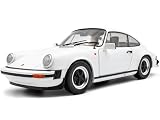
- SOLIDO BRAND QUALITY: Solido is known for producing high-quality diecast model cars with exceptional detail, durable construction, and accurate representations of real vehicles. Each model is crafted with precision and built to last.
- PORSCHE OFFICIALLY LICENSED MODEL: Officially licensed Solido replica of the 1974 Porsche 911 (930) 3.0 SC, finished in White and reproducing the iconic rear-engine German sports car.
- FEATURES & DETAILS: 1:18 scale diecast model featuring opening front doors, directional wheels, White finish and exterior styling faithfully based on the 1974 Porsche 911 (930) 3.0 SC.
- TOP QUALITY MATERIALS: Diecast metal body with molded plastic components, detailed interior, reproduced exterior trim, wheels, bodywork and White finish representing the 1974 Porsche 911 (930) 3.0 SC.
- COLLECTIBLE DISPLAY ITEM: Designed for collectors ages 14 and up. Intended for display by Porsche enthusiasts, classic sports car fans and diecast model collectors, making an excellent gift for any collection.
What Porsche’s historical figures tell us—and what they do not
The original 911
Porsche’s 2024 historical account gives the original 911, unveiled in 1963, a two-liter rear-mounted six-cylinder rated at 130 PS and a stated top speed of 210 km/h. Those are figures for the original car, not a description of current 911 specifications. They establish the rear-engine layout from the start of the model’s history; they are not a controlled performance comparison with a 924, 944 or 928.
The 1963 figures are useful as a historical anchor, not as a shortcut for comparing the whole 911 line with every transaxle model. A later 911 is not specified by the original car’s two-liter displacement or 130 PS output, just as the 1981 944’s launch-era numbers do not describe every 944. Model year and version matter whenever specifications are compared.
The 928
Porsche calls the 928 its first front-engine car. In a 2018 engineering-history article, Porsche Newsroom describes a 4.5-liter V8 assembly with 240 hp. A separate Porsche timeline dates the 928’s world premiere to 1977 and states output of up to 240 PS, depending on market. The two figures should retain their original units and qualifications: hp and PS are not interchangeable labels, and the timeline explicitly makes its maximum market-dependent.
Quick wins for a faster PC:
Clear out junk files and repair common Windows errorsFree Scan →Scan for outdated or missing drivers - takes under a minuteDriver Scan →Repair Windows errors before they cause bigger problemsFix Now →The 928 is the clearest example of the front-engine transaxle arrangement: V8 at the front, gearbox at the rear axle, and a longitudinal shaft connecting them. Porsche says the arrangement served weight distribution. That stated engineering aim is not evidence that every 928 had the same measured distribution or that it out-handled a 911 in every condition.
Porsche Newsroom’s 2018 history calls the 928 “the first Porsche with a front engine” in the context of a 4.5-liter V8 rated at 240 hp. That statement refers to the 928, not to a front-engine 911. Porsche’s 2026 timeline gives the 1977 premiere context and reports up to 240 PS depending on market, which is why the source and unit should stay attached to each figure.
The 944
Porsche’s 2016 four-cylinder history says the 944 retained the transaxle concept introduced with the 924. For the 1981 944, Porsche gives a 2.5-liter naturally aspirated engine rated at 163 hp. The same account lists a German price of 38,900 DM. That is a historical German list price for the launch-era car—not a current value, a price in another market, or a guide to used-car prices today.
The 944 example shows how the layout and engine architecture are separate comparison points. “Front-engine transaxle” describes the placement of engine and gearbox; “2.5-liter naturally aspirated” describes the particular 1981 944 engine cited by Porsche. Neither detail should be generalized to every model year in the family.
The transaxle era
Porsche’s 2026 timeline defines the transaxle era as 1975–1995 and names the 924, 928, 944 and 968. Porsche USA’s historical background says the 928 and 968 were retired in 1995. These dates frame a period in which Porsche built a distinct set of front-engine sports cars alongside the 911; they do not make those cars different 911 layouts.
Rank #3

- REMOTE CONTROL PORSHCE 911 :1/24 scaled back on the real Porsche 911 GT3 RS,officially licensed by Porsche,the Porsche car has all the functions of a real car.For Porsche car fans, this is a realistic small scale replica of a Porsche model
- FULLY FUNCTIONAL PORSHCE RC CAR :The Porsche remote control car has functions such as forward, backward, left turn, right turn; and easy to control.The rc car simulates a very powerful engine just like a real Porsche. Let you experience the fun of remote control
- SAFE MATERIALS AND Scratch Resistance :Non-toxic ABS plastic and smooth exterior can withstand many bumps. The unique design of the wheels and the independent suspension system can reduce the friction between the tire and the floor and prolong the use time of the remote control car
- EXCELLENT PERFORMANCE :Operated by 2.4Ghz frequency, provides stability and a wider range of control for the race, provides up to 80 feet of range, lets you have fun at speeds up to 4 mph
- IDEAL REMOTE CONTROL PORSCHE CAR :The remote control porsche car works well on a smooth surface, suitable to play inside and outside. You not only play with it using the remote control but also place it as an exhibit on a display shelf. It is a good choice for you at various festivals
The dates are useful context for why readers may encounter the word “transaxle” alongside several classic Porsche models. Porsche’s timeline groups the four models within a defined era. The model lines did not all have the same launch date or engine, and the 1975–1995 span is a historical period label rather than a claim that every named car was produced continuously throughout every year of it.
Why Porsche pursued both layouts
The two concepts reflect different engineering arrangements, not a simple choice between a “right” and “wrong” way to build a sports car. The 911 kept its defining rear-mounted engine. The transaxle models moved the engine to the front and placed the gearbox at the rear axle, distributing major components along the car’s length. Within that family, Porsche also pursued different engine choices: the 928 used a V8, while the 924/944 history is associated with four-cylinder engines.
Porsche’s retrospective account places the 924, 944 and 928 in a period when the company considered models that could step into the 911’s footsteps. They did not replace the 911; Porsche changed strategy and continued developing it. That history explains why the model lines coexisted and why Porsche explored a different layout. It is not proof that the company, buyers or engineers judged one arrangement universally superior.
What’s actually slowing this PC down?
Pick the symptom - the matching free tool is one click away.
This history makes the “two versions of one 911” framing especially misleading. Porsche was exploring and building separate sports-car families while the 911 remained in development. Its own account describes a change in strategy toward continuing the 911, rather than treating the front-engine models as a permanent successor that displaced it. That is a historical explanation of the model families’ relationship, not a technical verdict that one layout was objectively better.
Independent reader supportYour contribution helps us test, update, and keep practical guides available for everyone.What you can infer about handling
Engine and gearbox placement matter because they determine where substantial components sit in the car. The transaxle design deliberately separated the front engine from the rear gearbox; Porsche’s 928 history connects that arrangement to a weight-distribution goal. The 911’s rear-engine position is a different starting point. These facts explain why the cars are mechanically distinct, but they are not enough to rank their handling.
A fair handling comparison would need to specify the exact model year, trim, tires, condition and test conditions, then compare cars on the same basis. No matched comparative test is established by the historical material cited here. Avoid treating “rear-engine” or “transaxle” as a guarantee of neutral handling, grip, stability or superiority. Those outcomes cannot be concluded from the layout label alone.
For the same reason, a broad claim such as “all transaxle Porsches have the same balance” goes beyond what the layout description establishes. Porsche’s account says the 928’s arrangement served weight distribution; it does not provide a single measured distribution figure to apply across the 924, 944 and 968, or across every 928 version. If handling is the concern, compare specific cars and evidence rather than relying on the label.
Free tools Windows power users keep installed
One-click scans. No signup required.
A quick way to identify the difference
- Locate the engine relative to the cabin. Behind the passenger compartment means the 911’s rear-engine arrangement; ahead of it means the front-engine arrangement used by the transaxle models.
- Locate the gearbox separately. In the classic Porsche transaxle layout, it is at the rear axle even though the engine is at the front.
- Identify the model line. A 924, 928, 944 or 968 is a separate Porsche model, not a front-engine 911.
- Check the model year before using specifications. The historical figures here refer to specific cars: the 1963 911, the 1977-premiere 928 context and the 1981 944. They should not be transferred to other years or trims.
When comparing two cars in conversation or in a specification table, use the same checklist for each: engine location, gearbox location, engine type, model year and the car’s intended role. Then separate confirmed specifications from conclusions about how the car feels on the road. This avoids mixing a layout fact—such as the 928’s front V8 and rear gearbox—with a claim about performance that would require a direct test.
Rank #4
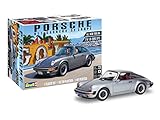
- Revell Plastic Model Car Kit #85-4521 is skill level 4 and contains 109 parts. Recommended for ages 12 and up.
- Assembled Dimensions: 7.00"x3.13"x2.19"
- 3.2-liter flat six engine. Positional front wheels & movable engine cover. Fuchs style wheels & optional front chin spoiler.
- Choice of left or right-hand drive version and either US or Euro spec front turn indicators and rear bumper guards.
- Molded in white and clear with soft black tires. Paint and glue not included.
The distinction in one sentence
The 911 is Porsche’s rear-engine model; the 924, 928, 944 and 968 are separate front-engine transaxle models, with the gearbox at the rear axle. “Front-engine 911” is therefore a misleading shorthand, not the name of a 911 configuration.
Frequently Asked Questions
Was there ever a front-engine Porsche 911?
No. The 911’s defining layout places its engine behind the passenger compartment. Porsche did build front-engine sports cars, including the 924, 928, 944 and 968, but these were separate model lines rather than 911 variants.
What does transaxle mean on a Porsche?
In the classic Porsche layout discussed here, the engine is at the front and the gearbox and final drive are at the rear axle. A longitudinal shaft connects the engine to the rear-mounted gearbox.
How is a Porsche 911 different from a 944 or 928?
The 911 has its engine behind the cabin. The 944 and 928 are front-engine transaxle cars, with the gearbox at the rear axle. The 928 used a V8; Porsche’s four-cylinder history covers the 924 and 944 families.
Did the transaxle layout make every Porsche handle the same way?
No. The layout separates the front engine and rear gearbox, and Porsche describes the 928 arrangement as serving weight distribution. That does not establish identical weight distribution or a universal handling advantage across models, years and trims.
When did Porsche’s transaxle era run?
Porsche’s 2026 timeline defines the transaxle era as 1975–1995 and names the 924, 928, 944 and 968. Porsche USA’s historical background says the 928 and 968 were retired in 1995.
The Bottom Line
Bottom line: Porsche did not make a front-engine 911. The 911 is rear-engine, while the 924, 928, 944 and 968 are separate front-engine transaxle models, with the gearbox at the rear axle. Compare specific model years for specifications, and do not treat the layout alone as proof of a handling winner.
Quick Recap
Product prices and availability are accurate as of the date/time indicated and are subject to change. Any price and availability information displayed on Amazon at the time of purchase will apply.




