The Tool Desk
Outbyte PC Repair FREEClear out junk files and repair common Windows errorsFree Scan →Outbyte Driver Updater FREEFix the driver behind crashes, sound loss and screen glitchesFind Drivers →There is no reliable one-size-fits-all annual price for owning a riding mower. Your total depends on how many hours you mow, the mower’s fuel use, local gasoline prices, maintenance and repairs, and whether you need to pay for storage. Estimate those costs separately instead of relying on a flat annual figure.
How to estimate your annual riding mower costs
Use this worksheet for the costs of fuel, upkeep, and storage. Add purchase price or depreciation only if you want a broader ownership total; those costs are separate from the fuel, maintenance, and storage estimate here.
As an Amazon Associate I earn from qualifying purchases.
- Fuel: annual mowing hours × gallons used per hour × your local price per gallon.
- Routine maintenance: oil and filter, air or fuel filters when due, spark plug(s), blade sharpening or replacement, lubrication, and any annual service you choose to pay for.
- Wear and repairs: allow separately for periodic replacement of items such as belts, the battery, tires, and blades, plus unexpected parts and repair labor. These items do not necessarily need replacing every year.
- Seasonal preparation: fuel stabilizer or fuel-draining supplies, oil service, battery care, and cleaning.
- Storage: include a cover, shed, garage adaptation, or rental only if you need to buy, build, rent, or alter space for the mower.
Parts, labor, fuel, and storage prices vary by location and over time. Current manufacturer and retail guidance does not establish a dependable national annual dollar total for residential owners, so use compatible parts and service prices and local fuel prices to fill in your own estimate.
Estimate fuel from hours and consumption
A 2021 University of Illinois residential life-cycle study modeled 40 mowing hours per year on a 0.3–2-acre lawn and fuel consumption of 1.89 liters (0.5 gallon) per hour for its gas riding mower. Those are study inputs, not a survey average or a prediction for your property. Applied to the formula, they equal about 20 gallons per year before multiplying by your local gasoline price.
#1 Best Overall

- PEAK POWER TECHNOLOGY: Combines power of up to six EGO 56V ARC Lithium batteries to deliver up to 20,000 watts of power, equivalent to a 21-horsepower gas engine.
- LONG RUNTIME: Cordless tractor cuts up to 1.5 acres on a single charge with six included 6.0Ah batteries.
- CUSTOMIZE YOUR RIDE: Digital LCD display includes three blade settings, three drive speeds, and cruise control. Mows at up to 6 MPH.
- TWELVE CUTTING HEIGHT POSITIONS: Easily adjust the cutting deck on the electric riding mower to get the grass height you want, anywhere from 1.5 to 4.5 inches.
- REAR TOW HITCH: Haul loads around your property with Power Beyond Belief.
Your actual use will vary with mowing time and the mower. Use your operator’s manual if it provides a consumption estimate, or track how much fuel you use over representative mowing sessions. Do not use figures for commercial mowing as a household estimate: a September 2010 U.S. Department of Energy Clean Cities guide reported 900–2,000 gallons annually for commercial operators mowing seven hours a day, depending on climate and growing season.
What routine maintenance costs cover
Regular service helps keep the mower operating, but the schedule and compatible parts depend on the model and engine. Follow the operator’s manual rather than assuming every listed item must be replaced each year.
Rank #2

- 24HP/726cc FR730 engine
- 54 inch FAB Deck
- Change engine oil and the oil filter at the specified interval.
- Inspect and clean or replace air and fuel filters as directed.
- Check spark plug(s), belts, blades, and tire condition; sharpen or replace blades when needed.
- Lubricate specified fittings and clean grass and debris from the mower.
- Include dealer or repair-shop labor if you do not perform the work yourself.
These categories are not interchangeable with a guaranteed annual bill. A blade may need sharpening rather than replacement, and belts, tires, and batteries are periodic wear items. For example, Lowe’s maintenance guide outlines annual and seasonal tasks but notes that prices and availability vary by market; manufacturer intervals should take precedence.
Prepare the mower for seasonal storage
Fuel, oil, battery care, and cleaning can affect both storage preparation and the chance of a trouble-free return to service. Briggs & Stratton warns that “Gas begins to degrade in as little as 30 days which can lead to your engine’s fuel system clogging and your equipment not starting the following season.” That is the manufacturer’s guidance, not a guarantee that every mower will fail after 30 days.
Rank #3
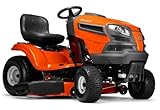
- Briggs & Stratton 19 HP 540cc Engine
- Pedal-Operated Transmission: Keep both hands on the wheel for more control
- 42-Inch Twin Blade Stamped Mower Deck
- Follow the fuel instructions for your mower and engine. Briggs & Stratton recommends adding alcohol-free stabilizer according to its package directions and running the machine so treated fuel circulates. Husqvarna advises buying only fuel usable within 30 days and describes draining the fuel system for storage of 30 days or longer, or using stabilizer according to its label. These approaches differ; use the procedure specified in your own manuals.
- Change the oil while it is warm if your manual calls for it. Briggs & Stratton includes this in its storage guidance.
- Attend to the battery. Follow the mower’s instructions for storage and charging; requirements vary by battery and model.
- Clean the mower and store it in a clean, dry place. Remove grass and debris as directed, and consider a protective cover if the storage area needs it. Lowe’s describes a cover as optional.
Count consumables such as stabilizer and any seasonal service in your estimate. If your storage space is already suitable, you may not have a new infrastructure expense; otherwise, include the cost of a cover, shed, rental, or necessary adaptation rather than treating storage as free.
Independent reader supportYour contribution helps us test, update, and keep practical guides available for everyone.What changes the total most?
- Hours and lawn conditions: more mowing time generally means more fuel use and accumulated wear.
- Local prices: gasoline, compatible replacement parts, and repair labor differ by place and date.
- Who does the work: do-it-yourself maintenance and paid service have different cash costs.
- Existing storage: an available clean, dry space avoids a new storage purchase; creating one adds a separate cost.
- Equipment choice: when comparing gas and battery riding mowers, consider purchase price, energy cost per mowing hour, maintenance parts and labor, battery replacement assumptions, runtime and area coverage, and access to charging or fuel. A 2021 life-cycle model is not a current retail price guide, and its maintenance totals should not be treated as present-day estimates.
For a useful annual figure, state the mower, yearly hours, local fuel price, and which maintenance, repair, and storage costs you included. Without those details, a single dollar amount can be misleading.
Quick Recap
Rank #4

- Cleaner, more even cuts than gas with constant 17K ft/min blade speed
- Out-cut traditional gas-powered mowers and conquer 2.5 acres with an industry-leading 8mph mowing speed
- 4X quieter than gas with LED Lights for early morning and late evening mowing
- Industry's only rear storage bin with universal front and rear attachment capability
- Removable battery isn't limited to just the mower—it's compatible with over 75 other Greenworks 60v tools
Product prices and availability are accurate as of the date/time indicated and are subject to change. Any price and availability information displayed on Amazon at the time of purchase will apply.




