Free tools Windows power users keep installed
One-click scans. No signup required.
Honda’s e:HEV is a two-motor hybrid system that can propel the car with its traction motor, use the engine to generate electricity for that motor, or connect the engine directly to the wheels for cruising. It switches among those modes automatically. That arrangement can make acceleration and lift-off deceleration feel different from a conventional engine-driven car, but it does not mean every Honda hybrid has the same steering, ride or cornering behavior.
The distinction matters because “handling” can refer to several things. Motor response and regenerative braking affect how the car speeds up and slows down; steering, suspension and vehicle-control systems affect how it turns and follows a road. The exact equipment and feel depend on the model, year, trim and market.
As an Amazon Associate I earn from qualifying purchases.
What Honda’s e:HEV system is
Honda’s e:HEV is a hybrid powertrain built around an engine, a traction motor, a generator motor, a battery and a power control unit. The traction motor is the component that can drive the wheels electrically. The generator motor converts engine power into electricity in Hybrid Drive. A clutch allows the engine to connect mechanically to the driveshaft in Engine Drive.
Recommended Free Tools
That combination is why e:HEV is not accurately described as either “an electric car with a generator engine” or a conventional hybrid that always uses the engine to turn the wheels. Depending on driving conditions, it can run with the engine off, use the engine to generate electricity while the traction motor propels the car, or send engine power to the wheels through a mechanical connection. Honda describes the operating modes and components in its e:HEV system overview.
#1 Best Overall

- COMPATIBILITY: Direct replacement for Honda lawn mower models including HRN216, HRR216K9/K10/K11, and HRX217K5/K6 series with electric start
- SPECIFICATIONS: 12-volt, 3.6Ah sealed lead-acid battery with maintenance-free AGM design for reliable starting power
- DIMENSIONS: Compact size measuring 4.02 inches long, 1.89 inches wide, and 2.58 inches high, weighing between 2.05-2.26 pounds
- TERMINAL TYPE: Features F2 terminals (0.250 inches wide) with F1 adapter compatibility for versatile connection options
- OEM REPLACEMENT: Genuine replacement for Honda part numbers 31500-VH7-801, 31500-VH7-800, and 31500-VH7-V31
The driver does not select these three modes manually. The car’s control system determines which mode to use as conditions change. Honda describes motor drive as efficient in lower- and mid-speed driving, and direct engine-to-wheel drive as useful for higher-speed cruising; those are general descriptions of the system, not guarantees about a particular trip, model or fuel-economy result.
What happens in each driving mode
| Mode | What powers the wheels | What the engine does | What to understand |
|---|---|---|---|
| EV Drive | The traction motor, using electricity from the battery | Off | The car is moving under electric motor power; this is not a promise of a particular electric-only distance. |
| Hybrid Drive | The traction motor | Turns the generator to produce electricity | The engine can be running without mechanically driving the wheels. Battery power can also support acceleration. |
| Engine Drive | The engine, connected to the driveshaft through a clutch | Drives the wheels mechanically | Honda uses direct engine drive for high-speed cruising when that is more efficient than keeping the traction motor at high rpm. |
Honda’s description of EV Drive, Hybrid Drive and Engine Drive makes an important terminology point: “Hybrid Drive” does not mean the engine is necessarily driving the wheels. In that mode, the engine’s job is to turn the generator; the traction motor provides wheel propulsion.
EV Drive: battery to motor
In EV Drive, the battery supplies electricity to the traction motor and the engine is off. The wheels are propelled electrically. The mode name describes how propulsion is being supplied at that moment; it should not be confused with a claim that the car is a plug-in hybrid, or that it can cover a specified distance without the engine. The cited Honda system description establishes the operating arrangement, not a universal battery range or charging procedure.
The Tool Desk
Outbyte PC Repair FREERepair Windows errors before they cause bigger problemsFix Now →Outbyte Driver Updater FREEFix the driver behind crashes, sound loss and screen glitchesFind Drivers →Rank #2
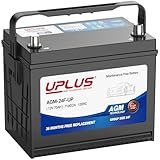
- Battery dimensions --- BCI Group size 24F, 10.7 x 6.77 x 8.98 inches, Terminal Layout: Left: - Right: +. Battery dimensions, cold cranking amps, terminal location and battery type are key factors in getting the right unit. Please measure your old battery and compare the size with this battery, if the measurements are the same, the positive and negative positions are the same, there is not much difference in CCA and it will fit your vehicle.
- 4 TIMES EXTRA CYCLING --- High density negative paste and Enhanced life alloy or Silver Calcium stamped alloy.Uplus Start and Stop AGM battery has 4 times extra cycle life compared to standard conventional batteries.
- DESIGNED FOR VEHICLES WITH START-STOP --- International standard size BCI Group 24F, easy to install.Ideal for vehicles with large electrical loads (DVD players, navigation systems, heated seats, power doors, etc.), vehicles used for frequent short trips or in stop-n-go traffic and vehicles that sit unused for days or weeks at a time.
- DEEP-CYCLE AND CRANKING POWER --- Calcium lead positive grid, maximizes conductivity and allows for low resistance.Highest cold cranking amperes (710CCA) for engine starts, even reliable during cold winter temperatures.
- TOP-LEVEL SAFETY --- 15 times more vibration-resistant.Vent cap design that resists acid leakage.Top-level safety features and absolutely no free acid.Original Spare Parts ensure the replacement battery has the same quality as the original one.
Hybrid Drive: engine generates, motor propels
In Hybrid Drive, the engine turns the generator, which supplies electricity for the traction motor. The battery may also provide power to support acceleration. In this configuration the engine is part of the energy path, but it does not have to be mechanically connected to the wheels. That separation between engine speed and wheel speed is a key reason the powertrain can feel unlike a conventional engine-and-gearbox arrangement.
Engine Drive: a direct mechanical connection
At high-speed cruising, e:HEV can engage a clutch that connects the engine to the driveshaft. Honda says this direct drive is useful when cruising because it avoids keeping the traction motor at high rpm when engine drive is more efficient. This is not a separate driver-selected gear or a promise that the engine always takes over at one fixed speed; Honda describes mode choice as automatic and dependent on driving conditions.
Why acceleration can feel different
Because the traction motor can propel the car in both EV Drive and Hybrid Drive, Honda says e:HEV uses motor drive for many everyday driving situations. That can give the car a motor-like response at lower speeds: accelerator input is answered through electric motor output, rather than requiring the engine to provide wheel propulsion directly in every circumstance. The exact sensation will vary by vehicle and conditions; the system description does not establish a single acceleration performance figure for all e:HEV models.
Rank #3

- Patented Connection for Honda Electric Lawn Mower: Our patented battery design provides a better connection for better reliability and battery life; A ribbed notch and spring-loaded connector prevent wobbling or shifting side-to-side or up/down in use
- Great Battery Run Time: Our 12 Ah lithium-ion batteries offer up to 45 minutes of run time, or about 0.37 acres, per charge, depending on your mowing conditions
- Easy-To-Read Indicator: The 4-LED indicator shows the level of charge with a quick press of the capacity indicator button, so it's easy to know if you're ready to mow, or if your battery needs to be placed on the battery charger
- Simple Charging: Each electric Honda lawn mower comes with a standard lithium battery charger (CV5020N1A) that will fully charge this battery in 370 minutes, but we also offer a fast charger (CV5080N1U) that delivers a 90-minute full charge
- 3-Year Residential Warranty: You can rest easy, knowing your electric mower battery is covered from top to bottom for 3 full years; 2-year commercial use warranty also included
Honda also describes two features of its intended response: Direct Acceleration and Linear Shift Control. In Honda’s account, motor output responds to accelerator input while engine speed is controlled to build progressively with vehicle speed. That coordination can create a rhythmic engine sound resembling shifts, even though the sound alone does not establish that the car is changing conventional gears. Honda explains this approach in its Evolution of the e:HEV Powertrain material.
What’s actually slowing this PC down?
Pick the symptom - the matching free tool is one click away.
These are powertrain characteristics, not a report of an independent road test. They explain why the accelerator response and engine sound may not track one another in the familiar way they do in a conventional car: the engine can be generating electricity while the motor drives the wheels, and the control system can manage engine speed separately. They do not establish that every Honda hybrid accelerates identically, nor do they tell you how a particular vehicle will corner or ride.
What happens when you lift off the accelerator
During deceleration, the traction motor can act as a generator. The vehicle’s motion turns the motor, which converts some of that motion into electrical energy and returns it to the battery. This is regenerative deceleration: it can slow the car while recovering energy that would otherwise be lost as heat through friction braking.
Rank #4

- Fast Starting Power: This 12V 35Ah 370 CCA delivers strong, steady starts is ready for any weather in any season.
- Made to Last: With its 57-minute Reserve Capacity supports longer run times and a longer overall battery lifespan.
- All Power, No Mess AGM Design: Sealed and spill-proof, the MM-G151R is built with high discharge output and deep discharge recovery to keep power steady when it counts.
- Strength That Starts on the Inside: The rugged construction resists shock, vibration, and harsh conditions, delivering reliable performance across a wide range of temperatures and tough environments.
- Tested Tough & Certified Safe: Mighty Max batteries are built in an ISO-certified facility and meet CE standards for quality, safety, and reliability
On vehicles equipped with Honda’s Deceleration Selector, steering-wheel paddles let the driver vary the requested deceleration when lifting off the accelerator. The paddles adjust the deceleration request; they are not a substitute for the brake pedal when stronger or emergency braking is needed. Honda says the system coordinates regenerative and friction braking to keep slowing stable, including when a fully charged battery prevents regenerative generation. The feature is described in Honda’s Deceleration Selector overview.
Whether a particular car has the selector, and how its controls are presented, is vehicle-specific. Check the owner’s manual or specifications for the exact model, model year, trim and market rather than assuming that every e:HEV has steering-wheel paddles. If the battery cannot accept regenerated energy, Honda’s description says friction braking is coordinated with the system; it does not mean the driver should change their braking habits or rely on regenerative deceleration alone.
Does e:HEV change steering or cornering?
The two-motor architecture explains propulsion and energy recovery. It does not, by itself, establish how a car steers, rides over bumps or behaves in a corner. Those qualities depend on the particular vehicle and its chassis, suspension, tires and control equipment. Honda’s general e:HEV description is not a model-by-model handling comparison.
Best Value
- Fast Starting Power: This 12V 35Ah 370 CCA delivers strong, steady starts is ready for any weather in any season.
- Made to Last: With its 57-minute Reserve Capacity supports longer run times and a longer overall battery lifespan.
- All Power, No Mess AGM Design: Sealed and spill-proof, the MM-G151R is built with high discharge output and deep discharge recovery to keep power steady when it counts.
- Strength That Starts on the Inside: The rugged construction resists shock, vibration, and harsh conditions, delivering reliable performance across a wide range of temperatures and tough environments.
- Tested Tough & Certified Safe: Mighty Max batteries are built in an ISO-certified facility and meet CE standards for quality, safety, and reliability
Honda separately describes Agile Handling Assist as an electronic control system intended to help a vehicle trace a desired line with less steering-wheel operation. That is a handling-related feature, not a defining part of the two-motor powertrain, and Honda’s cited material does not establish that it is fitted across the entire range. The Motion Management System page describes Agile Handling Assist; use the specifications for the vehicle in question to confirm availability.
Honda’s material about next-generation electric all-wheel drive discusses control procedures intended to support line-following and handling stability across road surfaces. This is a separate subject from the basic e:HEV operating modes, and it should not be taken as proof that every e:HEV is all-wheel drive or has that system. Honda presents the technology in its Next-Generation Electric AWD overview.
How to evaluate a specific car
If you are comparing how two Honda hybrids handle, identify the exact vehicles before drawing a conclusion. “Handling” is not one measurement: a car can respond quickly to the accelerator yet have a different steering feel, ride quality or cornering balance from another model. A meaningful comparison should use the same type of road and distinguish these characteristics rather than treating them as interchangeable.
- Confirm the vehicle: note model, model year, trim and market. Equipment can differ even when two vehicles share the e:HEV name.
- Separate response from cornering: observe low-speed accelerator response and lift-off deceleration separately from steering effort, line-following and body behavior in turns.
- Check the equipment: consult the relevant owner’s manual and specifications for Deceleration Selector, Agile Handling Assist and the drive layout. Do not infer that a feature is present from the powertrain name.
- Compare like with like: if you are judging steering or ride, compare vehicles under similar conditions and focus on that one quality rather than attributing every difference to the hybrid system.
How Honda’s hybrid names relate to one another
Honda has used different hybrid architectures over time. Its history overview identifies a single-motor i-DCD, a two-motor i-MMD and a three-motor SH-AWD among systems introduced in 2012. Honda later adopted e:HEV as the communication name for its two-motor hybrid system. The names therefore do not all refer to the same hardware. Honda’s hybrid-systems history provides that naming context.
On October 9, 2026, Honda announced that its next-generation system, based on technologies developed for e:HEV, would be called Honda Hybrid. The company said global rollout of models equipped with it would begin in 2027. Honda’s announcement headline states: “Global Rollout of New Models Equipped with Honda Hybrid Will Begin in 2027.” This is a planned future rollout and a name for the next-generation system; it does not rename all current Honda hybrids or establish which system a particular vehicle uses. See Honda’s October 9, 2026 announcement for the announcement’s scope.
For a model-specific answer, verify the system name and hardware for the vehicle’s market and model year. A broad label such as “Honda hybrid” is not enough to establish motor count, drive layout, control features or handling equipment.
Quick Recap
Product prices and availability are accurate as of the date/time indicated and are subject to change. Any price and availability information displayed on Amazon at the time of purchase will apply.




