What’s actually slowing this PC down?
Pick the symptom - the matching free tool is one click away.
Formula 1 teams assess straight-line speed with speed-trap readings and telemetry, then use aerodynamic development and car setup to balance low drag against the downforce needed for cornering. For 2026, active front and rear wings switch between Straight Mode, which reduces drag, and Corner Mode, which restores more downforce. A speed-trap figure is useful evidence about one point on one circuit—not a complete ranking of a car’s performance.
What a speed trap tells teams
A speed trap measures a car’s speed at a specific location. Formula 1 says traps are usually placed at a circuit’s fastest point, often near the end of a long straight. The reading can help teams assess performance there, but it does not by itself reveal how quickly a car accelerated along the whole straight or how well it performs over a lap. Formula 1’s glossary describes the speed trap as a localized measurement.
As an Amazon Associate I earn from qualifying purchases.
How telemetry adds context
Telemetry is real-time data used to analyze a car while it is on track. It gives teams information to interpret alongside speed, so they can consider how the car behaved through the lap rather than treating a single trap reading as the whole story. Public descriptions explain telemetry’s role but do not disclose private team channels or the exact analysis methods used by any particular team. Formula 1’s glossary defines the term.
The trade-off: drag versus downforce
Lower drag helps a car accelerate and reach higher speeds on a straight. Downforce pushes the car onto the track, helping its tyres generate grip and supporting higher corner speeds. A low-downforce setup can therefore favor straight-line speed while sacrificing some cornering performance; teams must balance the two for the circuit and the lap as a whole. Formula 1 explains this setup trade-off in its glossary.
#1 Best Overall
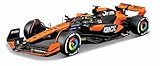
- Authentic Formula 1 Styling – Realistic race-inspired design and proportions
- Authentic Race Car and Driver's Helmet Details
- Collector-Scale Model – 1:24 scale ideal for shelves, desks, and displays. Includes Acrylic Box with Decorative Sleeve
- Authentic Race Car and Driver's Helmet Details for #4 Lando Norris
- Free-Rolling Wheels – Smooth-rolling wheels for display or light play
How teams develop aerodynamic performance
Simulation and wind-tunnel work
Teams use computational fluid dynamics (CFD) and wind tunnels to develop aerodynamic configurations. Wind-tunnel work can validate virtual modelling, while development allowances are constrained by the regulations. The available public explanations do not establish a universal sequence of tests, a standard team-by-team test plan, or the performance gains from individual development changes. Those details remain specific to teams and are not publicly established here. Formula 1’s glossary describes CFD and wind-tunnel use.
What changes for 2026: active aero modes
Under the 2026 regulations, active front and rear wings provide two operating modes. Straight Mode reduces drag on straights; Corner Mode provides more downforce for cornering. This replaces the previous DRS arrangement. Straight Mode should not be described solely as an overtaking aid: the FIA also identifies lower drag as important to energy efficiency with the 2026 power units. Formula 1 explains the new aerodynamics in its 2026 regulations guide, and the FIA outlines the broader package in its 2026 overview.
Rank #2
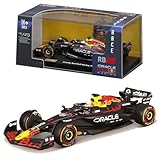
- Officially Licensed Replica – Authentic styling and branding from the original manufacturer
- Die-Cast Metal Construction – Durable metal body with detailed plastic components
- Highly Detailed Design – Realistic exterior styling and interior details
- Free-Rolling Wheels – Smooth movement for display or play
- Perfect for Collectors & Kids – Great gift for automotive fans
The FIA’s 2024 announcement set headline design targets of 30% lower downforce and 55% lower drag for the 2026 cars. These are regulatory design targets, not independently measured race outcomes or a claim that every car achieves precisely those reductions. The FIA’s announcement also describes the goal of a more agile car. FIA Single Seater Technical Director Nikolas Tombazis said: “With this set of regulations the FIA has sought to develop a new generation of cars that are fully in touch with the DNA of Formula 1 – cars that are light, supremely fast and agile but which also remains at the cutting edge of technology, and to achieve this we worked towards what we called a ‘nimble car’ concept.”
How to compare two cars’ straight-line performance
Use more than a single speed-trap number. A useful comparison considers the speed reached in the relevant low-drag configuration, the car’s cornering performance in its higher-downforce configuration, and where on the circuit the reading was taken. These are practical comparison axes, not an official FIA scoring formula.
Rank #3
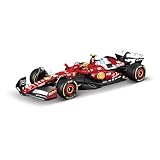
- Ferrari Die-Cast Race Vehicle in 1/43 scale
- Authentic Race Car and Driver's Helmet Details
- Acrylic Box with Decorative Sleeve
- 2025 Season Car
- Straight-line speed or acceleration: Compare performance on the relevant straight and in the low-drag configuration being used.
- Cornering speed and grip: Consider how the car performs when configured for the higher-downforce demands of corners.
- Circuit and measurement point: Note the layout and trap location; a reading at one point cannot stand in for the whole lap.
Public sources do not establish a universal method for correcting speed-trap readings for factors such as tow, wind, fuel, or energy deployment. Without a sourced correction method, those variables should be treated as context rather than used to claim a definitive adjustment.
Quick Recap
Rank #4

- FERRARI F1 TOY CAR – Boys and girls ages 10 and up and Ferrari fans can build, display and race the LEGO Speed Champions Ferrari SF-24 F1 Race Car and driver set
- 1 DRIVER MINIFIGURE – This vehicle set includes a driver minifigure wearing a special Ferrari outfit and a winged helmet for kids to place inside the cockpit and role-play thrilling race action
- AUTHENTIC DETAILS – F1 race car with design details from the real-life 2024 version, including a rear wing, a halo bar, sponsor stickers and wider rear tires imprinted with “Pirelli”
- F1 FUN FOR THE WHOLE FAMILY – Race for the checkered flag alongside the whole family with other building sets (sold separately) in the LEGO F1 range
- BUILD & DISPLAY – After kids have enjoyed playing out racing stories with the Ferrari F1 toy, they can display it on a shelf or bedside table
Product prices and availability are accurate as of the date/time indicated and are subject to change. Any price and availability information displayed on Amazon at the time of purchase will apply.




