What’s actually slowing this PC down?
Pick the symptom - the matching free tool is one click away.
Drive.ai’s central idea was to apply deep learning across much more of the autonomous-driving stack than was customary in 2017—not only to recognize cars, pedestrians, signs, and traffic lights, but also to interpret context, select driving behavior, improve data annotation, and cope with degraded sensors. That approach helped produce an impressive but tightly constrained demonstration. It did not prove general-purpose driverless autonomy: the Mountain View test used a premapped route, a safety driver, and included a manual takeover. Drive.ai later operated limited Texas pilots, but was acquired by Apple in 2019 while preparing to close.
The ride that showed both the promise and the limits
In 2017, an autonomous Drive.ai vehicle traveled through suburban Mountain View, California, on a route prepared in advance. The approximately 20-minute demonstration covered 16 intersections, including a four-way stop. The driving was generally smooth and deliberately cautious—but the safety driver had to take over once.
As an Amazon Associate I earn from qualifying purchases.
The most revealing moment came at a right turn on red. Drive.ai’s system declined to make the turn because its lidar could reliably see only about 50 to 75 meters in the described situation, while cross traffic could approach at roughly 45 to 50 mph. A human might judge the gap using additional visual cues or accept a smaller margin. The car chose not to proceed.
That decision was not evidence of failure by itself. Refusing an uncertain maneuver is an important safety behavior. But it establishes the correct context: Drive.ai was targeting Level 4 autonomy, while this test was conducted under Level 2 supervision, with a human required to monitor the vehicle and take control.
#1 Best Overall

- 【Drifting Motion】 When the car is moving forward at high speed and suddenly turns left or right, the car will perform a drifting motion.
- 【Self-centering Steering】Designed with a self-centering feature, the car automatically returns to its original alignment after making a turn.
- 【Perfect for STEM education】 this toy encourages critical thinking, problem-solving, and hands-on exploration of engineering concepts.
- 【Long-Distance Remote Control】 Equipped with a powerful remote control, this toy car can be operated from distances of up to 160 feet in open areas. Children can explore and have fun with the car even from a significant distance, promoting outdoor play and exploration.
- 【Interference-Free Racing】Multiple cars can be raced simultaneously without interference from one another. Kids can enjoy thrilling races with their friends and family, fostering healthy competition and social interactions.
The demonstration, reported by IEEE Spectrum, showed a promising engineering direction—not a commercially validated, driverless system.
Why perception is only the beginning
An autonomous vehicle must do more than identify objects. A conventional stack typically separates several jobs:
- Perception: Detecting and classifying vehicles, pedestrians, lane markings, signs, traffic lights, and obstacles.
- Localization and mapping: Determining where the vehicle is and relating that position to the road.
- Prediction: Estimating what nearby road users might do next.
- Planning: Choosing a route, maneuver, speed, and position.
- Control: Converting that plan into steering, braking, and acceleration.
- Safety and fallback: Defining what happens when confidence falls or equipment degrades.
Machine learning was already widely used for perception. The harder question was how to encode behavior in situations where the rules are ambiguous.
Consider a four-way stop. The vehicle must determine who arrived first, whether another driver is actually yielding, whether a pedestrian intends to cross, and whether a human driver is behaving aggressively. A right turn on red requires interpreting the signal, checking for pedestrians and cyclists, estimating cross-traffic speed, and deciding how much risk is acceptable.
It is possible to write rules for many of these cases. The problem is that real roads produce too many combinations of weather, lighting, road layouts, vehicle behavior, occlusions, and informal social cues to enumerate perfectly. Drive.ai argued that learned models could generalize from examples in a way that a growing collection of hand-written rules could not.
What “deep learning from the ground up” meant
Drive.ai’s “deep-learning-first” philosophy did not necessarily mean one neural network receiving raw camera pixels and directly outputting steering commands. The company described a more distributed architecture in which learned models contributed to several layers:
- Recognizing and tracking objects.
- Understanding the surrounding scene.
- Interpreting traffic context.
- Selecting behaviors and decisions.
- Supporting motion planning.
- Generating or assisting with data annotations.
- Continuing to operate when one sensor modality was missing or degraded.
This was a hybrid approach. Drive.ai retained rules, human-designed constraints, and modular components rather than making the entire vehicle an opaque end-to-end model.
Rank #2

- Versatile Movement with Mecanum Wheels: This STEM toy features Mecanum wheels, allowing the car to move in multiple directions—forward, backward, sideways, and diagonally. It’s a perfect engineering kit for kids to explore the science of omnidirectional motion while having fun!
- Cool, Tech-Inspired Design: With its wooden laser-cut body, this toy car has a sleek, tech-inspired look that’s both functional and visually appealing. It’s a standout science kit for young minds who love building and experimenting with STEM projects.
- Easy to Assemble with Colorful Instructions: Designed as an accessible engineering kit, this toy includes a detailed, full-color instruction manual. The assembly process is simple yet engaging, making it ideal for beginners and experienced builders alike.
- Learn While You Build and Play: As you assemble and operate this Mecanum wheel car, you’ll gain a hands-on understanding of how these specialized wheels work. It’s a fantastic STEM project that combines education and entertainment, perfect for curious learners.
- The Perfect Gift for Curious Minds: Whether for personal use or gifting, it’s a great way to inspire young engineers and scientists to dive into STEM projects and explore the world of robotics.
The case for a hybrid system
Fully learned behavior can be difficult to inspect. If a neural network makes an unexpected decision, engineers may not be able to point to one explicit rule that caused it. That complicates testing, debugging, certification, and safety analysis.
Rules have the opposite strength and weakness. They make boundaries explicit, but they can become brittle when faced with situations that the designer did not anticipate.
Drive.ai’s compromise was to let deep learning handle nuance and variation while using explicit logic and safety constraints to limit unacceptable actions. Modules could be evaluated separately, and human knowledge could constrain the learned system. The trade-off was engineering complexity: a hybrid architecture still requires careful coordination between learned predictions, planning, control, and fallback behavior.
The data flywheel mattered as much as the neural networks
Drive.ai’s proposed advantage was not simply that it used deep learning. It was the feedback loop connecting fleet operations, data engineering, training, simulation, and route expansion:
- Collect driving data. Test vehicles recorded camera, lidar, radar, and vehicle-state information while operating under supervision.
- Find failures and difficult cases. Engineers searched for disengagements, false positives, low-confidence decisions, and unusual situations.
- Annotate the relevant data. Humans labeled objects and events in video and lidar data.
- Automate part of the annotation process. Learned systems generated preliminary labels, which people could validate or correct.
- Retrain and test. The revised models were evaluated in simulation and on the road.
- Expand the challenge. Once a route became reliable, the team sought roads with different geometries, traffic patterns, lighting, and edge cases.
Drive.ai emphasized “hard mining”: concentrating on examples where the system performed poorly instead of treating every mile of ordinary driving as equally valuable. One cited example involved shadows beneath overpasses being mistaken for obstacles. Synthetic variations of those scenes could be created in simulation to test whether the system remained stable when the shadow’s position, shape, or lighting changed.
Why data quality beats raw mileage
More driving does not automatically produce better autonomy. Training data must be relevant, diverse, correctly labeled, and connected to actual system behavior.
A useful dataset should include different road geometries, weather, lighting, traffic density, vehicle types, pedestrian behavior, and sensor conditions. It should also contain rare but safety-critical situations—not merely millions of nearly identical clear-weather lane-following miles.
Rank #3

- PRE-ASSEMBLED 2WD ROBOT CHASSIS: Fully pre-assembled 2WD chassis with dual DC motors durable acrylic frame and battery holder ready to use out of the box saving assembly time and ensuring no missing components
- MOTORS WITH SPEED ENCODERS: Built-in encoders on both DC motors provide real-time speed feedback for precise motion control in line following autonomous driving and RC robot applications
- ARDUINO ESP32 COMPATIBLE: Works with Arduino Uno ESP32 ESP8266 Raspberry Pi and other 3.3V and 5V microcontroller boards for easy robot programming and rapid project development
- TUTORIALS AVAILABLE: Step-by-step tutorials available online by searching DIYables RC 2WD Car Chassis Kit ideal for STEM education robotics learning Arduino programming and coding projects
Drive.ai reported that conventional annotation could require approximately 800 human-hours for one hour of driving data. The company said its automated annotation tools reduced that burden, allowing human annotators to focus on new or difficult scenarios. That figure is a Drive.ai claim, not an independent industry benchmark; the cited feature does not provide a reproducible methodology or comparative study.
Free tools Windows power users keep installed
One-click scans. No signup required.
Automation also introduces a new risk. If a model generates incorrect labels and humans fail to catch them, those errors can be fed back into training. A scalable data pipeline therefore needs quality checks, human review, and tests that detect whether a new model has improved one scenario while damaging another.
Sensor fusion and degraded inputs
The reported 2017 vehicles used a substantial sensor suite: nine high-definition cameras, two radar sensors, six Velodyne Puck lidar units, and existing vehicle-integrated sensors including radar and rear cameras.
Cameras provide detailed visual information, including color and signs. Lidar supplies direct depth measurements. Radar can help detect objects and estimate motion, particularly in conditions where visual sensing is less reliable. Combining these modalities can provide redundancy, but it also increases cost, calibration requirements, computing demands, maintenance, and integration complexity.
Drive.ai described training the system to handle missing or degraded sensor inputs. The relevant failure modes included:
- Water droplets or dirt obscuring a camera lens.
- Darkness and glare reducing visual detail.
- Rain, hail, snow, and fog affecting sensing quality.
- Wet or reflective surfaces producing confusing returns.
- Lidar visibility and range limitations.
- A sensor producing technically valid data that was misleading in context.
Sensor fusion is not the same as guaranteed robustness. The feature reports Drive.ai’s training strategy, but does not supply independent failure rates, coverage measurements, or a formal safety case showing how the vehicle behaved across all of these conditions.
Traffic lights: recognition through context
Drive.ai presented traffic-light detection as an example of more humanlike visual reasoning. Rather than relying only on a map that specified the location of every light and exactly where the car should look, the company said it trained its system on traffic lights viewed from different angles and intersections, during day and night, and in rain, snow, and fog.
Rank #4

- DIY Building: The F1 car kit requires assembly, which is a fun and challenging science kit for children and adults. The process of building the car helps to develop creativity, fine motor skills, and hand-eye coordination. Good choice for children aged 9-16.
- STEM Education: The F1 car kit is designed to be an educational toy that promotes STEM education. By building and assembling the car, children can learn about basic engineering concepts and gain problem-solving skills.
- High-Quality Wood Material: The F1 car kit is made of high-quality wood, ensuring durability and longevity. The wood material provides an authentic and unique feel to the product and enhances the overall building experience.
- Remote Control: The F1 car kit comes with a remote control that allows users to control the car's movements, making it a fun and engaging toy for kids and adults alike. The remote control is easy to use, making it accessible to everyone.
- Racing Experience: Once the car is built, it can be raced against other remote control cars or driven around to showcase its speed and agility. The F1 car kit provides a realistic racing experience and is sure to impress both kids and adults.
The surrounding scene could also provide clues. If the light itself was difficult to see, the movement of nearby vehicles might help the system infer what signal state was controlling traffic.
Drive.ai claimed its traffic-light detector was “more accurate than a human.” That is a first-party performance claim. The IEEE Spectrum account does not provide the benchmark, sample size, test protocol, or independent validation needed to compare it rigorously with human drivers. The example demonstrates the company’s intended use of contextual learning, not a verified superiority result.
Windows Errors? Fix Them Before They Spread
Repair common Windows errors and clear accumulated junk for a smoother, more stable PC - no reinstall needed.Free scan · no reinstallCrashes, No Sound, or Screen Glitches?
Random freezes, missing sound and display glitches usually trace back to one bad driver. Find and replace yours safely.Free scan · under a minuteWhat the Mountain View demonstration actually proved
The drive provided evidence that Drive.ai could combine learned perception and behavior with maps, sensor fusion, explicit constraints, and human supervision on a prepared suburban route. It also illustrated the system’s conservatism and its limitations.
It did not establish:
- Reliable operation across an unrestricted geographic area.
- Driverless performance without a safety operator.
- Safety over a statistically meaningful mileage base.
- A collision, near-miss, or disengagement rate.
- Robust performance in every weather or traffic condition.
- A formal safety case or independent benchmark.
“Premapped” is an important qualification. Mapping and geofencing reduce uncertainty by giving the vehicle prior knowledge of road structure and landmarks. That can be an appropriate strategy for early commercial services, but it is a narrower claim than general autonomous driving on arbitrary roads.
Independent reader supportYour contribution helps us test, update, and keep practical guides available for everyone.Why Drive.ai looked first to fleets and shuttles
Drive.ai initially emphasized retrofit systems for existing vehicles and later focused on commercial fleets, logistics, and constrained services. Repeatable routes offer advantages that consumer vehicles operating anywhere do not: the operating domain can be mapped, tested, monitored, and gradually expanded.
Drive.ai later ran on-demand shuttle pilots in Frisco and Arlington, Texas. Contemporary reports described limited service areas and pilot conditions rather than unrestricted robotaxi operation. These deployments were important steps toward real-world service, but they should not be confused with proof that the company had solved autonomous driving broadly.
Quick wins for a faster PC:
Fix the driver behind crashes, sound loss and screen glitchesFind Drivers →Repair Windows errors before they cause bigger problemsFix Now →A fleet-oriented strategy also fits the economics of the technology. A commercial operator can centralize maintenance, sensor calibration, remote support, software updates, and data collection. The disadvantages are equally clear: expensive hardware, operational staff, restricted coverage, and the need to maintain safety performance as routes and conditions change.
Best Value
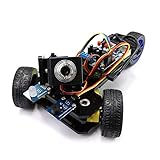
- Two Working Modes: Video mode (with camera) and Radar mode (with ultrasonic distance sensor) (Assembly required) (Raspberry Pi and Battery NOT included)
- Detailed Tutorial: Provide step-by-step assembly guide and complete Python code (The download link can be found on the product box) (No paper tutorial)
- Compatible Models: Raspberry Pi 5 / 4B / 3B+ / 3B / 3A+ (2B / B+ is also compatible but needs extra parts) (NOT included in this kit)
- Control Methods: Controlled wirelessly by your Android phone or tablet, iPhone and computer (run Windows or Raspberry Pi OS)
- Battery NOT Included: Please refer to the downloaded tutorial to buy
What happened to the company
Drive.ai was founded in 2015 by deep-learning researchers associated with Stanford’s AI laboratory. Contemporary reporting put its funding at approximately $77 million and its 2017 valuation at about $200 million. Those are historical figures, not measures of present value.
In June 2019, Apple acquired Drive.ai while the startup was preparing to close. TechCrunch, Axios, and Jones Day reported the transaction and the transfer of engineering talent or other assets. The acquisition price was not disclosed, and public reporting does not establish how much Drive.ai technology was incorporated into Apple products.
The corporate outcome matters because technical differentiation and commercial viability are different tests. Drive.ai’s later shutdown does not prove that its technical approach was unsound, nor does it prove that the company failed for one specific technical reason. It does show that a promising architecture, a working demonstration, and pilot operations were not enough to produce a sustainable independent autonomous-vehicle provider.
Do these 3 things before closing this tab:
1Fix the driver behind crashes, sound loss and screen glitches2Clear out junk files and repair common Windows errors3Scan for outdated or missing drivers - takes under a minuteHow to evaluate Drive.ai’s approach
The most useful questions are broader than whether a neural network can recognize an object:
- Generalization: Does the system handle unseen intersections, layouts, and road users?
- Data efficiency: How much human work is needed for each new capability?
- Edge-case coverage: Are rare, dangerous events deliberately mined and tested?
- Sensor robustness: What happens when cameras, lidar, or radar are blocked or unavailable?
- Interpretability: Can engineers determine why a behavior was selected?
- Validation: Are perception, prediction, planning, and control tested both separately and together?
- Operational domain: Is the vehicle limited to mapped, geofenced, repeatable routes?
- Fallback: Does it slow down, stop, request intervention, or continue when confidence drops?
- Scalability: Can the sensor suite, compute platform, and annotation pipeline support commercial deployment?
These questions expose the difference between a compelling demo and a mature autonomous-driving service. A vehicle can perform well on a known route while still lacking the data, validation, fallback behavior, or economics required for broad deployment.
The lasting lesson
Drive.ai’s most important contribution was a way of framing the problem. Autonomous driving is not merely an object-detection contest. It is a continuous learning-and-validation operation in which failures must become useful training data, labels must be trustworthy, simulation must complement road testing, and learned behavior must operate within explicit safety boundaries.
Deep learning can help a vehicle recognize patterns and handle context that is difficult to encode manually. But it does not eliminate the need for maps, rules, sensor redundancy, human oversight during development, or rigorous evidence about safety. Drive.ai’s 2017 work illustrated the promise of putting learning into more parts of the stack; its 2019 corporate outcome illustrated how far technical promise remains from a proven, scalable business.
Recommended Free Tools
Quick Recap
Sources
- IEEE Spectrum: How Drive.ai Is Mastering Autonomous Driving With Deep Learning
- IEEE Spectrum: Deep-Learning First: Drive.ai’s Path to Autonomous Driving
- IEEE Spectrum: Drive.ai Launches Robot Car Pilot in Texas With a Focus on Humans
- TechCrunch: Apple Acquires Self-Driving Startup Drive.ai on the Brink of Closure
Product prices and availability are accurate as of the date/time indicated and are subject to change. Any price and availability information displayed on Amazon at the time of purchase will apply.




