Free tools Windows power users keep installed
One-click scans. No signup required.
A battery-electric car stores energy in a rechargeable battery, uses power electronics to control that energy, and drives an electric motor that turns the wheels. Plugging in replenishes the battery; regenerative braking can return some energy during deceleration. The details vary by vehicle, and “electric car” can also refer to hybrids that use an engine.
How a battery-electric car turns stored energy into motion
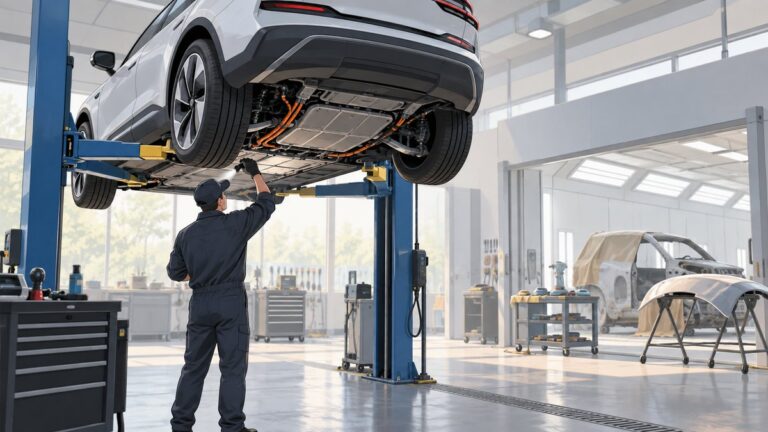
A battery-electric vehicle (BEV) has no internal-combustion engine. Its main energy source is a high-voltage traction battery made of rechargeable cells. A simplified path from energy to motion is:
- The traction battery stores energy. Its cells store energy as chemical potential. During discharge, chemical reactions allow electrical energy to flow through an external circuit. Electrons travel through that circuit; ions move within the battery’s electrolyte.
- Power electronics manage the flow. A controller regulates the power sent to the motor in response to the driver’s accelerator input. In many designs, an inverter converts the battery’s direct current (DC) into the alternating current (AC) used by the motor.
- The motor produces rotation. Electrical energy becomes rotational force, or torque, at the motor.
- Gearing carries that force to the wheels. A transmission or reduction gear connects the motor’s rotation to the wheels. Layouts differ, so this is a functional overview rather than a claim that every EV places its components in the same order or arrangement.
The U.S. Department of Energy Alternative Fuels Data Center lists the traction battery, electric traction motor, power electronics controller, transmission, charge port, onboard charger, and DC/DC converter among the core systems in an all-electric car (AFDC: How Do All-Electric Cars Work?).
The traction battery and the auxiliary battery do different jobs
The large traction battery powers the motor. A separate low-voltage auxiliary battery supplies systems such as lights and instruments. A DC/DC converter steps power down from the high-voltage system to support low-voltage equipment and can replenish the auxiliary battery. The National Highway Traffic Safety Administration describes the inverter and DC/DC converter among the components involved in electric and hybrid vehicle power systems (NHTSA: Electric and Hybrid Vehicles: Battery, Charging & Safety).
Quick wins for a faster PC:
Repair Windows errors before they cause bigger problemsFix Now →Fix the driver behind crashes, sound loss and screen glitchesFind Drivers →Clear out junk files and repair common Windows errorsFree Scan →#1 Best Overall

- SAE J1772 Standard Charger: Compatible with all North American electric vehicles and plug-in hybrids, including Ford, Chevrolet, Nissan, BMW, Volkswagen, Hyundai, Kia, Audi, Mercedes-Benz, Rivian, Porsche, Toyota, Honda, Jeep, and GMC. Tesla vehicles can be charged with a separate SAE J1772 adapter (sold separately).
- Adjustable Current: Choose from 8A, 10A, 13A, or 16A to match your vehicle’s charging needs.Dual Plug Compatibility,NEMA 6-20 Plug (220/240V): Delivers up to 3.84 kW/h, providing approximately 15.36 MPH charging speed at 16A.NEMA 5-15 Plug (110/120V): Supports 10A charging at 120V, offering 1.2 kW/h (around 4.4 MPH). Customizable Charging: Easily adjust current to suit different charging scenarios, giving you maximum flexibility at home or on the go
- Hassle-Free Installation: Forget complicated setups—just plug in and go. Equipped with NEMA 5-15 and NEMA 6-20 (220V/240V) connectors, it works with any standard 110V–240V outlet. The 25-foot cable gives you the freedom to reach vehicles parked at a distance, making charging convenient anywhere.
- Intelligent Charging: Featuring a 2.8-inch touch display, you can easily select the charging current (8A / 10A / 13A / 16A) and schedule charging with a 1–12 hour delayed start. Perfect for maximizing off-peak hours and cutting electricity costs. (Example: Set a 2-hour delay, and charging begins automatically after 2 hours.)
- Comprehensive Safety: Designed to meet CE and FCC safety standards, this charger offers multiple layers of protection, including overvoltage, overload, short-circuit, grounding, and leakage safeguards. The durable IP65-rated waterproof housing and reinforced cable ensure reliable charging in all weather conditions, keeping your vehicle safe year-round.
How charging works
When you plug in a BEV, electricity passes through the charge port and charging system. The route depends on whether the supply is AC or DC.
| Charging route | What happens in the car | What affects charging |
|---|---|---|
| AC charging | The car’s onboard charger converts incoming AC to DC for the traction battery. It also communicates with the charging equipment and monitors battery conditions. | Vehicle and equipment limits, available electrical supply, and conditions. The onboard charger sets a limit on how quickly the car can accept AC. |
| DC fast charging | The charging equipment supplies DC more directly to the battery, bypassing the car’s onboard AC-to-DC conversion. | Vehicle and charging-station limits, electrical supply, and conditions. A station’s stated capability alone does not determine the rate a particular car will receive. |
The U.S. Environmental Protection Agency describes both charging from a 120-volt outlet and DC fast charging, which supplies power more directly to the battery (EPA: Plug-In Electric Vehicle Charging: The Basics). A 120-volt outlet can be one way to charge, while residential Level 2 equipment is described as an overnight option in the U.S. Department of Energy’s federal fleet overview (DOE FEMP: Electric Vehicle Technology Overview – Federal Fleet Training). No single charge time applies to every car or installation.
Rank #2

- Flex Level 1 EV Charger - The EVDANCE Level 1 electric car charger is compatible with J1772 electric vehicles and plug-in hybrid vehicles (North American Standard). *Tesla requires a SAE J1772 adapter.
- Convenient to Use - This charger has both NEMA 6-20 plug for 16A 240V charging (3.68kW, 10-12 mi/h) and a NEMA 6-20 to 5-15 plug adapter for 12A 120V charging (1.44kW, 2-5 mi/h). The included bag makes it easier to carry on the go. It also has a 25ft cable length, you can use it flexibly from anywhere in the garage or driveway.
- Check Your Outlet Type -This charger works with standard 120V NEMA 5-15/5-20 outlets (2-5 mph charging speed) and 240V NEMA 6-20 outlets (10-12 mph) . It's not compatible with NEMA 6-15/10-30/14-30/14-50/6-50 outlets – you'll need a NEMA 14-50/14-30/10-30/6-50 to 6-20 adapter (sold separately) to connect.
- Compatible EV Models -This EV charger works with most major electric vehicles, including Ford, Chevrolet, Hyundai, Audi, Nissan Ariya, Rivian R1S, Kia, and others. However, it's not compatible with Mini Cooper Electric Hardtop,Toyota Prus Prime/Z4X/RAV4Prime, Porsche Taycan Base/4S/Turbo/Turbo S or Tesla models (Tesla requires a J1772 to Tesla Adapter, sold separately). For a full list of compatible models, check out the Full Compatibility List on our product page.
- Indication Displays - LED display that can tell you the status as well as indicate errors while charging your electric vehicle.
What to check before arranging home charging
- Confirm which connector and charging standards your vehicle supports.
- Check the car’s maximum AC charging capability and the equipment’s rating; a higher-rated charger cannot make a vehicle accept power beyond its own limit.
- Have household electrical capacity and installation requirements assessed. These vary by home and equipment.
- If considering a Level 2 home EV charger, match it to the vehicle and electrical service, and use a qualified installer where required.
What regenerative braking does
When an EV slows down, its motor can operate as a generator. It converts some of the vehicle’s kinetic energy into electricity and sends it back to the battery. That recovers energy that would otherwise be lost mainly as heat through friction braking, but recovery is partial: regenerative braking does not create energy or replace conventional brakes. Its contribution varies with the vehicle and driving conditions. The U.S. Department of Energy describes regenerative braking as a feature of electric-drive vehicles (DOE: Electric-Drive Vehicles).
BEVs, plug-in hybrids, and conventional hybrids
These vehicle types differ in whether they have an engine, whether they plug in, and how their batteries are replenished.
The Tool Desk
Outbyte Driver Updater FREEScan for outdated or missing drivers - takes under a minuteDriver Scan →Outbyte PC Repair FREERepair Windows errors before they cause bigger problemsFix Now →Rank #3

- ✅【Fast and Efficient Charging】 The eTimxon level 2 EV charger is equipped with NEMA 6-20 Plug, supports 240V, 16A, 3.84kW output current, approximately 4x faster than 8A level 1 ev chargers, shorten the electric vehicle charging time,so you can quickly get back on the road. Perfect for those early morning commutes, last-minute errands, or spontaneous weekend getaways—your car will be charged and ready to go when you are.
- ✅【Charge anywhere & anytime】Designed for maximum flexibility, eTimxon Level 1 & 2 EV charger features both NEMA 5-15 and 6-20 plug compatibility. Whether you're charging in your garage, at a friend's house, or at a roadside motel. NEMA 6-20 plug for Level 2 ev charging (240V, 16A, 3.84kW) and a NEMA 5-15 adapter for Level 1 ev charging (120V, 12A, 1.44kW) NOTE: In compliance with North American electrical safety standards, when use NEMA 5-15 Plug, you need to adjust the Current to 12A by manual to protecting both your vehicle and your home’s electrical system
- ✅【Dual-Level Charging】This portable J1772 ev charger offers true dual-level compatibility. For Level 2 fast charging (240V), it comes with a fixed NEMA 6-20 plug which must be used with a dedicated NEMA 6-20 outlet. For Level 1 charging (120V), it includes a NEMA 5-15 adapter that plugs into a standard 3-prong household outlet (NEMA 5-15 receptacle).Before You Order: Please verify you have the correct outlet
- ✅【Before Make Order】 1. This Mobile charging cable includes a fixed NEMA 6-20 plug and a NEMA 5-15 adapter. You must have access to the corresponding outlet type for the charger to work. Please confirm your outlet type before purchasing 2. You can set the current and delay time before plug in the charger into your car . 3. For an 87kWh battery pack, using the NEMA 6-20 plug (240V, Level 2) delivers a full charge in approximately 22.4 hours, while using the NEMA 5-15 adapter (120V, Level 1) takes over 60 hours for a full charge. Actual charging speed depends on your vehicle and circuit
- ✅【Multiple protection】 When the charging temperature exceeds 158°F, our EV charging station will activate the protection function and reduce the charging power. If the temperature remains too high, charging will be temporarily suspended. once the temperature back to normal, charging will automatically resume. perfect to protect your device and car at any time.
| Vehicle type | Internal-combustion engine? | Can it plug in? | How its battery is replenished |
|---|---|---|---|
| Battery-electric vehicle (BEV) | No | Yes | By plugging in; regenerative braking can also return some energy while driving. |
| Plug-in hybrid electric vehicle (PHEV) | Yes | Yes | Its larger battery can be plugged in; the vehicle also has an engine and an electric motor. |
| Conventional hybrid electric vehicle (HEV) | Yes | No | Its battery is replenished by the engine and regenerative braking. |
Because everyday use of “electric car” may include more than one of these types, BEV is the precise term for a car that runs on battery-stored electricity and has no internal-combustion engine. The U.S. Department of Energy’s federal fleet overview describes these drivetrain categories (DOE FEMP: Electric Vehicle Technology Overview – Federal Fleet Training).
Independent reader supportYour contribution helps us test, update, and keep practical guides available for everyone.Efficiency and driving range
Electric motors use energy differently from gasoline engines, but efficiency figures depend on what is counted and on the test cycle. In a September 16, 2024 fact sheet, the U.S. Department of Energy said a typical EV is 87%–91% efficient after regenerative braking, compared with about 30% for a conventional gasoline vehicle, depending on the drive cycle. The same fact sheet reports that 65%–69% of the energy stored on the vehicle goes to the wheels, with net regenerative braking recovering about 22% on the EPA combined city/highway cycle. These are cycle-specific figures, not guaranteed results for every vehicle or trip (DOE Vehicle Technologies Office: FOTW #1360, September 16, 2024).
Rank #4

- FAST CHARGING - Charge your J1772 EVs quickly and effortlessly with this Level 2 charger. up to 240V and 40 Amps of input power and 9.6 kW charging rate for fast charging at home or on the go. Ensure your outlet matches a standard NEMA 14-50 household plug
- SAFE AND RELIABLE - FCC and ETL certified (UL2594 standard) for safety with overvoltage, overcurrent, and short circuit protection; Energy Star certified for efficiency; IP65 rated for dust and water resistance
- NEMA 14-50 PLUG - Skip the hardwiring as our 40A EV charger uses a NEMA 14-50 plug to connect directly to your 240V outlet, providing high charging rates for faster EV charging
- PORTABLE EV CHARGER - Enjoy Level 2 charging anytime, anywhere with this portable EV charger. With its long 16-foot cable ( not 25 ft), you no longer need to worry about parking right up close to an outlet as it fits most driveways or garages.
- J1772 COMPATIBILITY - This J1772 charger is compatible with all electric vehicles that use the J1772 standard, including Mercedes, BMW, Ford, Honda, Hyundai, Kia, Porsche, Nissan, and Chevy. NOT natively compatible with Tesla without an adapter.
There is no single range figure that describes all BEVs. Battery size and chemistry affect potential range; vehicle efficiency, driving style, terrain, and climate affect how far a specific car travels. Extreme cold or heat can reduce range because the vehicle uses energy to manage cabin and battery temperatures, according to the U.S. Energy Information Administration (EIA: Use of energy for transportation electric vehicles). To compare advertised ranges, look at the vehicle model year, market, and test basis rather than treating one number as universal.
Quick Recap
Best Value

- LEVEL 1 CHARGING - The Lectron Level 1 Charger lets you quickly charge your EV with a standard 120V outlet; You get 15 amps and 1.65 kW of power for the standard full-charge time for your car, at home or at wor
- CONVENIENT OVERNIGHT CHARGING - The Lectron 15 Amp EV Charger is a more affordable and faster charging option compared to other Level 2 EV chargers, delivering an extra 40-50 miles of overnight charge at home — without breaking the bank
- J1772 COMPATIBILITY - This J1772 charger is compatible with all electric vehicles that use the J1772 standard, including BMW, Ford, Honda, Hyundai, Kia, Porsche, Nissan, and Chevy
- SAFE AND RELIABLE - FCC and ETL certified (UL2594 standard) for safety with overvoltage, overcurrent, and short circuit protection; Energy Star certified for efficiency; IP65 rated for dust and water resistance
- PORTABLE CONVENIENCE - Whether you're on a road trip or visiting a friend, you can easily plug in your EV and charge with our portable EV charger. Please refer to the included User Manual for complete operating instructions and compatibility requirements
Product prices and availability are accurate as of the date/time indicated and are subject to change. Any price and availability information displayed on Amazon at the time of purchase will apply.