The Tool Desk
Outbyte PC Repair FREERepair Windows errors before they cause bigger problemsFix Now →Outbyte Driver Updater FREEFix the driver behind crashes, sound loss and screen glitchesFind Drivers →BMW did not perfect the inline-six with one breakthrough engine. It kept the six-cylinder layout and repeatedly redesigned the parts around it—cylinder heads, valve timing, induction, engine management and materials—to suit different cars and changing goals. BMW traces its first car inline-six to the 1933 BMW 303; later milestones include the modern-design M06, compact and large engine families, VANOS variable valve timing, and turbocharged engines such as the N54 and N55. The through-line was the architecture’s naturally smooth operation, paired with decades of engineering changes.
Why BMW kept the inline-six
BMW’s historical account describes the inline-six as having no free inertial moments, a characteristic that helps explain its reputation for smoothness. In practical terms, the layout puts six cylinders in one row rather than dividing them between two banks. That simplicity of arrangement helped make smooth running a defining part of BMW’s case for the engine.
There is a packaging trade-off: a straight-six is long, so it needs more front-to-back space than a compact V engine. That is a general engineering observation, not a conclusion from a BMW comparative test. BMW’s history is best read as the manufacturer’s account of how it developed the format, not as independent proof that every BMW inline-six outperformed rival designs.
From the BMW 303 to a modern engine foundation
1933: the BMW 303 and M78
BMW identifies the 1933 BMW 303 as its first automobile with an inline-six. BMW’s published figures for the original M78 are 1.2 liters and 30 hp at 4,000 rpm. The company emphasizes the engine’s smooth running; a later development reached 72 hp at 4,400 rpm. Those are manufacturer historical figures, not independent test results.
Quick wins for a faster PC:
Clear out junk files and repair common Windows errorsFree Scan →Fix the driver behind crashes, sound loss and screen glitchesFind Drivers →#1 Best Overall

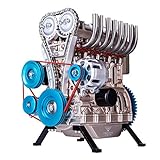
- GET HANDS ON with Inline 6 engine model kit that works for adults and kids alike. Engage young minds into STEM with a working replica of a classic 6-cylinder internal combustion car engine and 4-stroke cycke, while adults enjoy the rewarding experience of building their own small Inline 6 engine kit that runs like a dream.
- REALISTIC MODEL THAT WORKS: Following our top bestseller V8 Engine, you can now deliver the action of a classic car engine with powerful pistons and interactive cables through our new Inline 6 mini engine! Watch the motor fans turn on with real engine sounds from your visible Inline 6 engine model kit, making it a perfect STEM toy for curious minds seeking a fun blend of education and entertainment.
- FUEL THE FUN: Our complete toy Inline 6 engine assembly kit provides hours of fun as you tinker with cranks, pulleys, belts, and exhaust valves, bringing this miniature engine kit to life before your very eyes! Conquer long boring days with a mini Inline 6 engine kit that runs.
- CHALLENGE ACCEPTED: Supercharge your critical thinking skills with our mini engine build kit! Expand your creativity, think logically, and refine your motor skills as you build a model Inline 6 engine kit all while having fun. Get ready for a brain-boosting build challenge that works wonders!
- POPULAR GIFT THAT INSPIRES: Make the world of STEM amazing with our DIY engine kits for adults, teens, young boys and girls! Whether it's for birthdays, holidays, or any special occasion, Playz Inline 6 engine kit will keep them captivated as they build and operate their own engine from start to finish.
1968: the M06 establishes a new postwar design
BMW describes the M06 as its first entirely new postwar inline-six design. It was installed at a 30-degree angle and combined an overhead camshaft with a crossflow cylinder head, V-arranged valves, a combustion chamber intended to promote turbulence, and a forged crankshaft supported by seven bearings.
These details show the breadth of the redesign: BMW was addressing airflow, combustion and crankshaft support, not just increasing output. The features are BMW’s account of the engine’s construction and design aims; the available history does not establish that any one of them alone explains its subsequent success.
Two engine roles: compact sixes and larger sixes
M30: the larger-car and performance strand
BMW’s history describes large six-cylinder developments in the early 1970s. The M30 became associated with larger BMW models and, in BMW M’s retrospective, with the 3.0 CSL’s road and competition story. BMW M says the road-going CSL appeared in three production runs, with engines ranging from 180 to 206 hp, and credits the CSL with six European Touring Car Championships through 1979. These figures and the championship count are BMW M’s account.
Rank #2

- Includes museum issued collector's manual. Official BMW licensed product.
- 200 part kit. No glue or special tools necessary; build it yourself in about 3 hours
- 1:2 scale transparent working model; see all parts move through the high quality plastic casing
- Working five-speed gearbox; flip through the legendary BMW gearbox and witness the engineering
- Original engine sound; recorded from an actual r90 airhead flat six. Once built, press the button and experience the engine's sights and sounds
M20: a smaller six for the 3 Series
In 1977 BMW introduced a compact six-cylinder family in the 320i and 323i. BMW says its small cylinder spacing helped make the engine compact and that the design became the basis of a continuing evolutionary line. BMW’s historical article calls the original version M60 and notes that it was later renamed M20. Engine-code chronology can vary between period naming and later retrospective descriptions, so the designation should be checked against the specific model and market.
| Family or milestone | Role or application in BMW’s account | What changed or mattered |
|---|---|---|
| M30 | Larger six-cylinder development; associated with the 3.0 CSL | BMW M recounts road and competition applications, including three road CSL production runs and six European Touring Car Championships through 1979. |
| M20 | Compact six-cylinder family introduced in the 320i and 323i in 1977 | Small cylinder spacing supported a compact engine for the smaller 3 Series; BMW describes it as the start of an evolutionary line. |
The M20-versus-M30 distinction is therefore chiefly one of role and vehicle packaging, not a simple ranking. BMW’s cited history does not provide a single specification that applies to every variant of either family.
How BMW changed breathing and valve timing
M50: four valves per cylinder and single VANOS
The M50 arrived in the 1989–1992 period described by BMW’s history, bringing four valves per cylinder, individual ignition coils and a plastic intake manifold. In 1992, BMW says single VANOS entered large-scale production on the M50. It could adjust intake-cam timing according to operating conditions, allowing the engine to vary valve timing rather than relying on one fixed setting.
Rank #3

- ⚙【Highly Realistic Inline Twin Design】Featuring a 7.0cc inline double-cylinder layout with sporty red styling, this engine model delivers lifelike motion and structure, making it a standout high simulation mechanical model for enthusiasts.
- 🔩【 Precision CNC Metal Craftsmanship】Constructed from premium metal with CNC machining and anodized finish, ensuring durability, compact size, and a refined surface—ideal for collectors and mechanical model lovers.
- 🔥【High-Speed Stable Operation】Equipped with dual synchronous belt timing and optimized crankshaft, supporting smooth operation from 4000 to 16000RPM while reducing gear slipping risks.
- 🧠【Educational DIY Assembly Experience】Hands-on assembly reveals internal engine structure, valve mechanism, and working principles, making it a powerful STEM learning tool for mechanical understanding.
- 🎁【Collector Display & Gift Choice】Perfect as a desktop mechanical artwork, teaching aid, or gift for hobbyists. Compatible with additional ignition modules and accessories for extended functionality.a
M52: double VANOS and a focus on low-speed torque
For the M52, BMW says the system gained continuously adjustable timing for both intake and exhaust camshafts. The engine also used a resonance intake intended to improve low-speed torque. “Double” describes which camshafts receive variable timing; it does not describe a different cylinder arrangement.
M54: development for output and emissions goals
BMW describes the M54, introduced in 2000, as a comprehensive reworking of the M52. Its initial 3.0-liter form was rated by BMW at 170 kW (231 hp). BMW identifies higher power and torque and early compliance with D4 and ULEV emissions limits among the development aims. Specifications and emissions certification were not identical in every market, so this rating should not be treated as a universal figure for all M54 applications.
Across these generations, the format stayed the same while BMW changed how air entered the engine and how valve events were controlled. The sequence—from four valves per cylinder to variable timing on one camshaft and then both—shows adaptation to a wider range of engine speeds and operating conditions, rather than a change to the inline-six architecture itself.
Independent reader supportYour contribution helps us test, update, and keep practical guides available for everyone.Turbocharging and a separate motorsport branch
N52, N54 and N55
BMW’s technical training material identifies the N52, introduced in 2005, as the start of a new generation of six-cylinder engines. The N54 debuted in the 3 Series coupe in September 2006 with turbocharging and second-generation direct injection. BMW describes the N55 as the N54’s successor; it reached the US market in the 535i Gran Turismo in spring 2010. BMW says re-engineering allowed the N55 to use one exhaust turbocharger while its technical data remained virtually the same.
Those dates describe the specific launches and markets in BMW’s training material; they are not a complete guide to every model or regional application. They do show another kind of continuity: BMW retained six cylinders in a row while changing induction and fuel delivery to meet different performance and engineering requirements.
M88 and later M engines
BMW’s technical material identifies the M88 in the 1978 M1 as the first BMW Motorsport engine, and it was an inline-six. BMW M’s later chronology includes the S58 among M engines. This is a parallel performance strand, not a direct one-to-one progression from each road-engine family. Motorsport engines were developed for distinct uses, so their presence in the history should not be mistaken for proof that they shared every design feature with a particular road engine.
Best Value

- 【Complete 11-Piece Timing Overhaul Kit】 This comprehensive kit includes everything needed for a full timing system refresh on BMW M50/M52/M54 inline-6 engines. Includes timing chains, guide rails, hydraulic tensioners, and sprockets – a one-stop solution for restoring timing accuracy and engine reliability .
- 【Precision Fitment for BMW Inline-6 Engines】 Designed for M50, M50TU, M52, M52TU, M54, and M56 engines, covering a wide range of BMW models: E34 520i/525i, E36 323i/325i/328i/M3, E39 525i/528i/530i, E46 323i/325i/328i/330i, E53 X5 3.0i, and Z3/Z4 2.5i/3.0i. Replaces multiple OE numbers including 11311722651, 11311703717, 11311726480, 11311726471, and 11311432177 .
- 【Fix Common Timing Chain Wear & Guide Rail Failure】 BMW inline-6 engines of this era are known for timing chain guide rail degradation and tensioner wear, especially on high-mileage vehicles. Symptoms include rattling on cold start, timing chain noise, and potential VANOS timing faults . This kit replaces all critical wear components to restore engine reliability.
- 【System-Engineered Components – Matched for Performance】 All components—chains, tensioners, guides, and sprockets—are designed to work together as an integrated system, ensuring proper tension, smooth operation, and optimal service life . Manufactured using high-strength steel chains, glass-fiber-reinforced guide rails, and precision-machined sprockets.
- 【Professional Installation Required】 Timing chain replacement requires specialized tools (camshaft locking blocks, crank holder, VANOS tools) and precise timing alignment. Improper installation can result in valve/piston contact and catastrophic engine damage. We strongly recommend professional installation by a BMW specialist. Note: This is a 11-piece kit – verify contents against the parts list above before ordering.
What “perfected” means in BMW’s history
BMW’s case is not that one engine settled every engineering problem. The company repeatedly adapted a naturally smooth layout to different vehicle sizes and targets: compactness for smaller cars, greater output for larger and performance models, more flexible valve timing, and later turbocharging and direct injection. The M06’s cylinder-head and crankshaft design, the M20 and M30’s different roles, and the later VANOS and turbocharged generations mark stages in that process.
BMW of North America’s Ralph Mahler, then identified as Head of Product Planning and Strategy, called the inline-six “the heart and soul” of the company’s driving identity and praised successive versions’ refinement, smoothness, power delivery and efficiency. That is useful context for BMW’s brand positioning, but it is a corporate statement, not neutral engineering evidence. The historical performance figures and racing record cited here likewise come from BMW publications; no independent comparative test or reliability statistic is established by those sources.
Quick Recap
Product prices and availability are accurate as of the date/time indicated and are subject to change. Any price and availability information displayed on Amazon at the time of purchase will apply.




