Autonomous freight trucks use an automated driving system (ADS) to perform the driving task only within conditions the system is designed and permitted to handle. That does not mean a truck can drive itself anywhere, in any weather, or without oversight. Whether a commercial truck may operate without a person behind the wheel also depends on state requirements, the operator’s authorization, and procedures for failures and roadside emergencies.
What makes a freight truck autonomous?
An automated driving system is hardware and software that, when engaged, can perform the vehicle’s dynamic driving task on a sustained basis. That task includes the decisions and controls needed to move the vehicle while driving. The definition describes what the system does when it is operating; it does not promise that it can handle every road or situation.
As an Amazon Associate I earn from qualifying purchases.
This is different from driver assistance. With an assistance feature, a human remains responsible for driving and must stay attentive. NHTSA cautions that labels such as “self-driving” do not, by themselves, explain a vehicle’s actual capability or where it can be used. NHTSA says vehicles currently available for sale in the United States require the driver’s full attention, while states allow limited public-road ADS testing, research, and pilot programs under designated conditions.
Crashes, No Sound, or Screen Glitches?
Random freezes, missing sound and display glitches usually trace back to one bad driver. Find and replace yours safely.Free scan · under a minuteWindows Errors? Fix Them Before They Spread
Repair common Windows errors and clear accumulated junk for a smoother, more stable PC - no reinstall needed.Free scan · no reinstallFor freight trucks, that distinction matters because a test with a safety driver aboard is not the same operating condition as a commercial trip with no human driver. Nor does a truck’s ability to drive autonomously on one stretch of highway establish that it can do so on other roads or under different conditions.
#1 Best Overall

- for Universal Hobbies for FIAT for Centenario for Concept for New Holland Autonomous Agricultural Tractor Red 1:32 Truck Pre-built Model
- Size in INCHES: Length: 6.24, Width: 3.12
- Material: DIECAST
How does an autonomous truck drive?
The driving task, in broad terms
When an ADS is engaged, it takes responsibility for the driving task within its intended operating conditions. The system must make the driving decisions and apply the controls needed to move the truck in those conditions. The exact internal design varies: the cited public information does not establish one sensor package, software architecture, or control method used by all autonomous freight trucks.
A useful way to think about the process is not “the truck sees everything a person sees,” but “the ADS is designed to perform the driving task in a defined setting.” A system’s ability to operate is bounded by the roads, conditions, and context for which it was designed. The available Texas statutory definition expressly allows an ADS to be limited to a specific operational design domain.
The operational design domain sets the boundary
An operational design domain (ODD) is the set of conditions and context in which an ADS is designed to operate. Depending on the system, relevant limits may include route, road type, speed, weather, or other stated conditions. The sources available here do not provide a complete ODD for every deployed truck, so it would be misleading to imply that one company’s operating area defines the capability of the entire industry.
Free tools Windows power users keep installed
One-click scans. No signup required.
Outside the ODD, the truck’s autonomous capability should not be assumed. A change in weather, an unusual obstacle, a construction arrangement, or a different road can present conditions outside the system’s intended use. The precise limits are system-specific; readers should look for the operator’s stated domain rather than infer it from the word “highway” or from a demonstration.
What is not established about the hardware
A generic list of cameras, radar, lidar, or remote-control tools would suggest that every system uses the same equipment and procedures. The cited material does not support that. Aurora’s 2025 announcement says its safety report addresses its initial operating domain, cybersecurity, and remote assistance, but the announcement alone does not provide enough detail to describe the truck’s internal design or a universal remote-driving procedure.
Rank #2
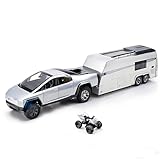
- 3-in-1 Design: Versatile toy set featuring a pickup truck with detachable RV camper trailer and bonus motorcycle, offering multiple play scenarios and combinations for extended entertainment
- Interactive Features: Equipped with realistic light effects and authentic sound effects that bring the vehicle set to life, enhancing the play experience
- Pull Back Action: Features smooth pull-back mechanism allowing the vehicles to zoom forward with ease, perfect for active play and racing fun
- Quality Construction: Made from durable alloy die-cast materials ensuring long-lasting performance and detailed finish for realistic appearance
- Age Appropriate: Specially designed for children aged 3 and above, providing safe and engaging play while developing motor skills and imagination
Are driverless trucks already operating on public highways?
There have been public-road tests, supervised operations, and commercial driverless activity, but those are distinct situations. Their differences determine what a claim about “autonomous trucks on highways” actually means.
Testing with a safety driver
In April 2024, the Associated Press reported on Aurora’s Texas freeway testing with safety drivers aboard. The article relayed company claims about accumulated miles and crashes. Those are historical, company-attributed figures reported in 2024—not present-day fleet totals, an independent safety comparison, or evidence that the truck was running without a human in the cab.
The Tool Desk
Outbyte Driver Updater FREEScan for outdated or missing drivers - takes under a minuteDriver Scan →Outbyte PC Repair FREEClear out junk files and repair common Windows errorsFree Scan →Commercial driverless operation
In May 2025, Aurora announced commercial driverless trucking in Texas and named Uber Freight and Hirschbach Motor Lines as launch customers. Aurora said it had closed its safety case before beginning driverless operations and published a report addressing its initial operating domain and safety-related topics. This is an example of a limited commercial deployment. It does not establish that every autonomous truck is ready for driverless service or that all public highways are suitable for it.
Deployment status can change. A company announcement establishes what the company said at that time; it does not substitute for checking current state authorization, operating conditions, or the scope of a particular service.
What rules apply to driverless freight trucks?
Federal oversight and commercial vehicle rules
NHTSA says manufacturers test vehicles and certify that they comply with Federal Motor Vehicle Safety Standards. The agency also describes safety oversight that includes a standing order requiring reports of certain crashes involving automated systems. This means it is inaccurate to say that federal agencies have pre-approved every autonomous truck, or that they have no oversight role.
Rank #3

- SCALE DETAILS: Precisely crafted 1:46 O scale die-cast metal model of the 2019 Dodge Ram 1500 pickup truck, measuring approximately 5 inches in length
- AUTHENTIC DESIGN: Features detailed black exterior finish, realistic wheels, and accurate body styling matching the full-size 2019 Ram 1500 truck
- CONSTRUCTION: Built with durable die-cast metal construction and high-quality plastic components for long-lasting play value
- DISPLAY QUALITY: Perfect for collectors and enthusiasts, with authentic detailing including grille, headlights, and body contours
- RECOMMENDED AGE: Suitable for ages 3 years and up, makes an ideal gift for truck enthusiasts and young collectors
Commercial trucks also operate within commercial motor vehicle requirements. The cited material does not resolve how every federal motor-carrier rule applies to every driverless configuration. A driverless system therefore should not be treated as making all human-driver requirements disappear. The rules relevant to a particular operation depend on the vehicle, the operation, and applicable federal and state requirements.
Texas: authorization for commercial driverless transportation
Texas distinguishes operating a vehicle with an ADS engaged from conducting commercial transportation without a human driver. As of May 28, 2026, a company conducting commercial operations without a human driver must hold active authorization from the Texas Department of Motor Vehicles (TxDMV). TxDMV administers the program and may restrict or revoke authorizations; the Department of Public Safety and local law enforcement enforce road rules.
Texas requirements include compliance with applicable traffic and federal motor-vehicle rules, a recording device, vehicle registration, and required liability coverage or self-insurance. The vehicle must be capable of reaching a minimal-risk condition following certain ADS failures. Operators must also provide an emergency-services interaction plan.
That plan must explain how responders can contact fleet support, remove or tow the vehicle, identify whether the ADS is engaged, and understand relevant hazards. These provisions make clear that driverless operation involves more than the ADS’s ability to steer and control a truck: the operator must also plan for failure and roadside response.
Because authorization is administered through TxDMV and program status can change, a reader evaluating a specific operator should check the current authorization and its scope rather than infer approval from a deployment announcement.
Do these 3 things before closing this tab:
1Scan for outdated or missing drivers - takes under a minute2Repair Windows errors before they cause bigger problems3Fix the driver behind crashes, sound loss and screen glitchesRank #4

- 📦 📬 AUTHENTIC DETAILS: Die-cast metal replicas featuring accurate UPS Mercedes-Benz Sprinter and USPS mail truck designs with detailed logos and markings
- 📦 📬 PREMIUM QUALITY: Constructed with durable die-cast metal and plastic parts for long-lasting play value and collectibility
- 📦 📬 PERFECT SIZE: Each vehicle measures approximately 5 inches in length, ideal for display or hands-on play
- 📦 📬 DUAL PACK VALUE: Set includes two iconic delivery vehicles - the modern UPS Sprinter van and classic USPS Grumman LLV mail truck
- 📦 📬 MOVING FEATURES: Both vehicles feature rolling wheels and opening doors for interactive play experience
Arizona: a state example, not a national rule
Arizona Department of Transportation guidance calls for a law-enforcement interaction plan and written acknowledgments addressing federal compliance where required, minimal-risk behavior after specified failures, traffic-law compliance, and applicable title, registration, licensing, and insurance requirements. ADOT says it may issue a cease-and-desist letter if required documents are missing.
Arizona illustrates why state-by-state requirements and emergency planning matter. Its guidance is not a complete survey of U.S. law, and it should not be applied as if it governs operations in other states.
Independent reader supportYour contribution helps us test, update, and keep practical guides available for everyone.What happens if the ADS fails or the truck needs help?
Minimal-risk behavior is part of the regulatory framing in both Texas and Arizona. Under the specified failure circumstances, the vehicle must be capable of reaching a minimal-risk condition. The exact behavior and triggering conditions depend on the applicable requirements and system; the cited material does not establish one universal maneuver or recovery procedure.
Emergency response planning addresses the people who may encounter a stopped or disabled truck. In Texas, the operator’s plan must cover how responders reach fleet support, identify ADS engagement, understand relevant hazards, and remove or tow the vehicle. These steps matter because an emergency responder may need to know whether automation is active and how to coordinate with the fleet before handling the vehicle.
Remote assistance should not be confused with a human continuously driving the truck from afar. Aurora’s announcement says its report covers remote assistance, but the available information does not establish what that assistance can do or how it is used in every system. Do not assume a universal remote-control capability or procedure.
Best Value
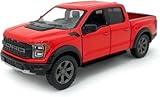
- Offical Licensed 2022 FORD F-150 Raptor
- Die Cast Metal Body w/ Plastic Parts
- 1:46 Scale, 46 Times Smaller The the Real F-150
- 5" 4 Set - Black, White, Red, Blue
- Front Doors Open - Pullback Action
How should readers judge claims that autonomous trucks are safe?
Understand what a safety case does—and does not—show
A safety case is an argument supported by evidence for why a system is acceptably safe for a stated use. Aurora said it had closed its safety case before beginning driverless operations and described its report as covering its initial operating domain and topics including cybersecurity and remote assistance. That is a company description of its assurance process, not, by itself, an independent regulator’s endorsement or proof that its trucks are safer than human-driven trucks.
Do not treat miles or crash counts as a direct comparison
The AP’s April 2024 report relayed Aurora’s historical claims about road miles and crashes while a safety driver was present. Those figures should not be presented as current driverless-fleet results. Nor can raw miles or crash counts establish a fair comparison with human-driven trucks unless exposure, operating conditions, definitions, and analysis are comparable.
The cited material does not establish a named, independently comparable statistic for the relative crash or fatality rate of driverless heavy trucks. It also does not provide an independent expert or regulator statement establishing an overall safety conclusion. A careful answer is therefore specific about what is known: distinguish the operating condition, attribute company claims, and avoid inventing a rate or claiming a general safety verdict.
Quick wins for a faster PC:
Repair Windows errors before they cause bigger problemsFix Now →Fix the driver behind crashes, sound loss and screen glitchesFind Drivers →Clear out junk files and repair common Windows errorsFree Scan →A practical comparison checklist
When assessing two deployments or a claim about a particular service, compare evidence on the same dimensions:
- Operating domain: Which routes, speeds, road types, weather conditions, and other limits are stated?
- Human presence: Is a trained safety driver aboard, or is the commercial run driverless?
- Failure response: What is required when specified ADS failures occur, and how does the vehicle reach a minimal-risk condition?
- Roadside support: How do emergency responders contact the fleet, identify ADS engagement, and arrange removal or towing?
- Legal status: Which state’s rules apply, and does the operator hold the required current authorization?
- Evidence quality: Are results independently assessed, and are miles, crashes, and operating conditions defined well enough to support the comparison?
A claim is more informative when it answers these questions than when it offers a broad label such as “self-driving” or a single unqualified mileage total.
What autonomous freight trucks could change—and what remains uncertain
Driverless commercial freight could change how carriers schedule and staff some trips, but the available evidence here does not establish the scale of those effects. In Aurora’s May 2025 announcement, Uber Freight’s founder and CEO described the launch as a step toward a more efficient supply chain. Hirschbach Motor Lines’ CEO said autonomous trucks could handle longer, less desirable routes and improve drivers’ working lives. These are partner and customer expectations, not independent findings about safety, employment, costs, or outcomes.
The clearest established point is narrower: automated freight systems can perform the driving task in a specified operating domain, and some companies have announced limited driverless commercial activity. Whether a given truck may operate on a particular public road depends on its system limits, the operating conditions, and applicable state and federal requirements. Neither a successful demonstration nor a company’s safety case establishes universal capability or a comparative safety advantage.
Quick Recap
Product prices and availability are accurate as of the date/time indicated and are subject to change. Any price and availability information displayed on Amazon at the time of purchase will apply.




