AI is changing transportation long before fully autonomous cars become ordinary. In vehicles, it already helps detect lane markings, warn about collisions, estimate traffic, plan routes, and predict when components may need attention. The next stage will connect those features with smarter roads, fleets, repair systems, and traffic networks.
That does not mean every new car is self-driving. The important distinction is between AI-assisted driving, automated driving within a limited operating area, and a vehicle capable of handling the entire trip without human supervision.
As an Amazon Associate I earn from qualifying purchases.
What AI actually does in transportation
Transportation AI is not one technology or one feature. It is a collection of systems that process large amounts of sensor and operational data. In a car, those systems may use cameras, radar, lidar, GPS, ultrasonic sensors, maps, and vehicle telemetry.
| AI function | Example in transportation |
|---|---|
| Perception | Identifying vehicles, pedestrians, lane markings, traffic signs, and obstacles |
| Prediction | Estimating whether another vehicle will change lanes or brake |
| Planning | Selecting a route, following distance, or safe maneuver |
| Optimization | Improving traffic-signal timing, delivery routes, or charging schedules |
| Anomaly detection | Spotting unusual engine, battery, brake, or fleet behavior |
| Natural-language processing | Understanding spoken navigation requests or processing logistics documents |
The quality of an AI system depends on more than its algorithm. Sensor calibration, map accuracy, software validation, connectivity, weather, and the variety of data used during training all affect its performance.
#1 Best Overall
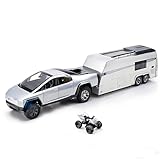
- 3-in-1 Design: Versatile toy set featuring a pickup truck with detachable RV camper trailer and bonus motorcycle, offering multiple play scenarios and combinations for extended entertainment
- Interactive Features: Equipped with realistic light effects and authentic sound effects that bring the vehicle set to life, enhancing the play experience
- Pull Back Action: Features smooth pull-back mechanism allowing the vehicles to zoom forward with ease, perfect for active play and racing fun
- Quality Construction: Made from durable alloy die-cast materials ensuring long-lasting performance and detailed finish for realistic appearance
- Age Appropriate: Specially designed for children aged 3 and above, providing safe and engaging play while developing motor skills and imagination
Cars will gain more capable driver assistance
The most visible automotive use of AI is advanced driver assistance. Automatic emergency braking can identify a potential collision and apply the brakes. Lane-centering systems interpret road markings and help maintain position. Adaptive cruise control uses surrounding traffic to adjust speed, while blind-spot and rear cross-traffic systems monitor areas a driver may not see.
These features can reduce workload and may improve safety, but they are not equivalent to self-driving. Under the SAE terminology used by regulators, Level 2 systems can control steering and speed at the same time while the driver remains responsible for the driving task. The driver must stay engaged and be ready to intervene.
The distinction matters because driver monitoring and system limitations are not minor details. A car may handle a divided highway well in clear weather but struggle with faded lane markings, construction zones, glare, heavy rain, unusual road layouts, or an object that was not represented adequately in its training data.
NHTSA states that no fully automated vehicle is currently available for purchase and use by U.S. consumers. Buyers can purchase cars with increasingly sophisticated assistance features, but those cars still require a responsible, attentive driver.
Why autonomous driving will remain limited by operating conditions
An automated driving system is designed for an operational design domain, or ODD. That domain defines where and when it is intended to work. Limits may include a particular city, mapped road type, speed range, weather condition, time of day, or requirement for a remote or onboard supervisor.
This is why a driverless shuttle operating on a mapped downtown route does not prove that an ordinary family car can drive anywhere. A system that performs reliably on a specific freeway in dry weather has not necessarily solved rural roads, snow, emergency scenes, temporary lane changes, or crowded urban intersections.
Future cars will likely combine narrower automated capabilities rather than immediately move to unrestricted autonomy. Examples include highway driving assistance, automated parking, traffic-jam assistance, and driverless operation inside controlled locations. Each can be useful without pretending that the vehicle can handle every road.
Rank #2

- Miniature Collectible: Authentic 1:64 scale die-cast model of the Tesla Model Y, a compact electric SUV.
- Detailed Design: Intricately crafted with opening doors and a removable chassis, showcasing the vehicle's distinct features.
- Limited Edition: Part of the Matchbox series, numbered 3/100 in the collection.
- Vibrant Color: Striking blue finish that captures the eye and adds a touch of vibrancy.
- Compact Size: Measuring approximately 3 inches long, perfect for display or playtime.
AI will improve traffic management, not eliminate congestion
Cars do not operate independently of the road network. Traffic agencies are using real-time information from cameras, road sensors, weather services, connected vehicles, transit systems, and incident reports to understand traffic conditions.
Adaptive signal control can adjust green and red phases when traffic patterns change. However, adaptive signals are not automatically machine-learning systems or generative AI. Established systems such as SCOOT, SCATS, RHODES, and OPAC use established traffic-control and optimization methods. Newer AI tools may help predict congestion, detect incidents, and recommend network-wide responses.
For drivers, the practical results could include better detour recommendations, faster detection of crashes, more useful travel-time estimates, and signals that respond more effectively to unusual demand. AI will not eliminate congestion by itself. Road capacity, construction, land use, crashes, travel demand, and public policy still determine how much traffic a network must handle.
Predictive maintenance could prevent more breakdowns
Modern vehicles already produce substantial diagnostic data. AI can compare sensor readings, service records, battery temperatures, vibration patterns, fault codes, and driving conditions to identify signs of a developing problem.
Recommended Free Tools
For a private car, that could mean an earlier warning about a weakening battery, abnormal transmission behavior, cooling-system trouble, or a component approaching its service limit. For a commercial fleet, the value is greater: a company can schedule a truck or bus for maintenance before a failure interrupts a delivery or strands passengers.
Predictive maintenance is an early-warning system, not a guarantee. Bad sensor data can create false alarms, while an unusual failure may be missed because the system has not seen enough comparable examples. Qualified technicians, inspection procedures, and manufacturer service requirements remain necessary.
Freight and logistics will be an important AI test case
AI can improve the less visible parts of transportation: deciding which truck carries which load, selecting delivery sequences, booking dock appointments, forecasting demand, tracking shipments, and processing bills of lading and invoices.
Rank #3

- These highly detailed kits come with everything you need to build them including the screwdriver.
- Opening parts, Rolling Wheels
- Easy assembly, Pre-painted metal body
- When finished the vehicles are fully functional
- Rolling die-cast replica
The 2026 National Freight Strategic Plan cites estimates that AI-enabled optimization could reduce logistics costs by 15% to 20% and improve inventory levels by 35% to 65% in certain supply chains. Those figures are estimates for particular applications and operating conditions, not a guaranteed result for every carrier or retailer.
What’s actually slowing this PC down?
Pick the symptom - the matching free tool is one click away.
More advanced systems may coordinate routing, facility capacity, labor, weather, and network disruptions. Still, a chatbot should not be treated as a transportation-management system. Language models can invent information, omit a restriction, mishandle a regulated document, or expose confidential data. Validated software and human review remain essential when a mistake could delay freight or create a safety problem.
AI will change how cars are designed and serviced
Manufacturers can use machine learning during design, testing, manufacturing, and warranty analysis. Engineers may analyze vehicle telemetry to find patterns associated with component failures. Factory vision systems can inspect parts for defects. Service departments can use guided diagnostic tools to connect symptoms with likely causes and repair procedures.
In electric vehicles, AI can help manage battery temperature, estimate remaining range, balance charging demand, and identify changes in battery performance. It can also support charging-station planning by predicting where demand will occur and when local electrical networks are likely to be under pressure.
These systems will make software a larger part of vehicle ownership. Updates may improve a feature after delivery, but they also make cybersecurity, software support periods, data handling, and update failures important issues for buyers.
Quick wins for a faster PC:
Clear out junk files and repair common Windows errorsFree Scan →Fix the driver behind crashes, sound loss and screen glitchesFind Drivers →Repair Windows errors before they cause bigger problemsFix Now →Safety, privacy, and accountability will determine adoption
Transportation is a safety-critical environment. An AI model may perform well in ordinary conditions and still fail in a rare situation: a pedestrian emerging from behind a truck, a sensor covered by snow, a temporary traffic pattern, a spoofed GPS signal, or an object that looks unlike anything in its training data.
Testing must therefore address edge cases, not just average performance. The FAA’s AI safety work emphasizes incremental deployment, safety assurance within existing aviation requirements, and additional scrutiny for systems that continue learning during operation. The same principle is useful for road vehicles: introduce automation in bounded situations, verify it, monitor it, and expand only when evidence supports expansion.
Rank #4

- Automotive Wiring & Electrical Systems
Privacy is another concern. Cars and infrastructure may collect camera images, precise location histories, cabin data, driving behavior, and vehicle-health information. Manufacturers and agencies need clear rules for access, retention, security, and permitted use. Connected systems also create potential attack surfaces, so protecting software and communications is part of vehicle safety.
Responsibility must remain clear as well. If a driver misunderstands a Level 2 system, the technology, vehicle maker, software supplier, and driver may all become part of a difficult investigation. NHTSA’s crash-reporting requirements for specified manufacturers, developers, and operators are one example of regulators seeking better information about automated and assisted-driving incidents.
Free tools Windows power users keep installed
One-click scans. No signup required.
What the next decade is likely to look like
- More assistance in ordinary cars: Better emergency braking, lane support, parking automation, driver monitoring, and traffic-aware cruise control will reach more models.
- Limited-domain automation: Some services will operate without a conventional driver in mapped, monitored areas or under carefully defined conditions.
- Smarter fleet operations: Commercial operators will use AI to reduce idle time, anticipate repairs, manage loads, and respond to disruptions.
- More connected infrastructure: Vehicles, signals, work zones, and traffic centers will exchange more information, although deployment will vary between communities.
- Slower progress toward universal autonomy: Weather, edge cases, liability, regulation, cost, cybersecurity, and public trust will make unrestricted self-driving a harder problem than demonstrations suggest.
The likely future is not a sudden replacement of every driver. It is a gradual shift in which cars, roads, fleets, and repair networks make more decisions with software while humans retain responsibility for many of the decisions that matter most.
FAQ
Are AI-assisted cars self-driving?
No. Most consumer vehicles with AI-based safety or driving features are Level 1 or Level 2 driver-assistance systems. The driver must remain attentive and responsible. NHTSA says fully automated vehicles are not currently available for purchase and use by U.S. consumers.
Will AI eliminate traffic jams?
No. AI can improve signal timing, routing, incident detection, and travel predictions, but congestion also depends on road capacity, crashes, construction, travel demand, land use, and public policy.
How will AI help car owners?
It can improve collision warnings, parking assistance, route planning, range estimates, vehicle diagnostics, battery management, and maintenance scheduling. These systems can still produce false warnings or miss unusual failures.
The Tool Desk
Outbyte PC Repair FREEClear out junk files and repair common Windows errorsFree Scan →Outbyte Driver Updater FREEScan for outdated or missing drivers - takes under a minuteDriver Scan →Is autonomous transportation regulated?
Yes, although the rules differ by transportation mode and location. Road-vehicle developers and operators face safety and crash-reporting requirements, while aviation authorities require safety assurance for safety-critical AI. The IMO adopted a global Maritime Autonomous Surface Ships Code in May 2026, scheduled to take effect July 1, 2026.
The Bottom Line
AI’s biggest transportation impact will probably come from better assistance, fewer preventable breakdowns, smarter traffic operations, and more efficient fleets—not from every car becoming capable of driving anywhere without a human. When evaluating an AI feature, ask what it controls, where it works, what conditions disable it, and who remains responsible. Those answers matter more than the word “autonomous” in a vehicle brochure.
Quick Recap
Product prices and availability are accurate as of the date/time indicated and are subject to change. Any price and availability information displayed on Amazon at the time of purchase will apply.




