Windows Errors? Fix Them Before They Spread
Repair common Windows errors and clear accumulated junk for a smoother, more stable PC - no reinstall needed.Free scan · no reinstallOutdated Drivers Are Slowing You Down
One free scan finds every outdated or missing driver and matches the right update for your exact hardware.Free scan · exact hardware matchAn AEB camera can help a vehicle recognize a car or pedestrian ahead, but it does not apply the brakes by itself. Automatic emergency braking (AEB) is a vehicle safety system: sensors gather information, the system assesses a possible forward crash, and the vehicle may warn the driver or automatically brake. Some AEB systems use cameras; others use radar, lidar, or a combination. What a particular car can detect, where its sensors are, and when they need service depends on its make, model, and year.
How does automatic emergency braking work?
AEB is designed to avoid or reduce the severity of an imminent forward crash. The system uses information from forward-facing sensors to assess a possible collision and, depending on the vehicle and situation, may alert the driver and apply the brakes. A forward-collision warning by itself is an alert, not automatic braking.
- Dynamic brake support (DBS): supplements a driver’s braking when the system determines the response is inadequate.
- Crash imminent braking (CIB): applies braking when a collision is imminent and the driver has not responded.
- Pedestrian AEB: uses forward-sensor information to detect a pedestrian in the vehicle’s path and may brake if the driver has not acted.
These are system functions, not guarantees that a crash will be prevented. The driver still needs to pay attention and be ready to respond. NHTSA’s driver-assistance guidance describes these functions and advises owners to consult their vehicle’s manual.
What does the camera do?
A camera can provide visual information that helps the system recognize objects or road users ahead. AEB systems can also use radar or lidar, and some combine sensors. Sensor arrangements and the way a vehicle uses their data vary by system; it is not safe to assume every AEB-equipped car has a camera or uses the same camera-and-radar combination. The camera contributes to perception, while the vehicle’s wider system makes decisions and controls braking. IIHS describes cameras, radar, and lidar as sensor options for front crash-prevention systems.
The Tool Desk
Outbyte PC Repair FREERepair Windows errors before they cause bigger problemsFix Now →Outbyte Driver Updater FREEScan for outdated or missing drivers - takes under a minuteDriver Scan →#1 Best Overall

- UPSCALED 4K FRONT + 1080P REAR DUAL DASH CAM: The ROVE R2-4K DUAL records the road ahead and behind at the same time. The front camera captures at 2.5K (QHD) and intelligently upscales to 4K (2160P) for higher-detail playback, while the rear camera records at Full HD 1080P. This is upscaled 4K, not native 4K, engineered to show sharper everyday detail than standard 1080P dash cams, so you can read license plates, signs, and surroundings in front and rear footage.
- SONY STARVIS 2 IMX675 SENSOR + SUPER NIGHT VISION: The front camera uses a Sony STARVIS 2 IMX675 5MP image sensor with a wide F1.5 aperture (F1.8 rear) and HDR to pull in more light for clearer low-light footage. This advanced sensor enhances nighttime clarity, helping capture license plates, road signs, and surrounding vehicles with greater reliability when driving after dark, through tunnels, or in dusk and dawn conditions.
- ULTRA FAST 5.8GHz WIFI/ UP TO 20MB/s DOWNLOAD SPEED: With its built-in dual-band 5.8GHz and 2.4GHz WiFi, you can use the ROVE dash cam app to view and manage dash cam recordings instantly on your iPhone and Android smartphone. Using the ROVE app, download your recorded videos directly to your smartphone at up to 20 MB/sec, then easily share them on social media with friends and family. Additionally, manage camera settings and update the latest firmware over-the-air via the ROVE App.
- CAR CAMERA WITH GPS: The new front and rear dashcam comes with built-in GPS, which enables you to view real-time live speed and compass on the 3” IPS wide camera screen. It records precise driving routes, locations, and speed stamps directly on the video so you can watch dashcam videos with GPS data using ROVE's free GPS Player on your PC or Mac & get additional evidence when you need it.
- FEATURES WITH STATE-OF-THE-ART TECHNOLOGY INCLUDED: Experience peace of mind with this front and rear car dash cam. It comes with a free 128GB microSD card and offers advanced features such as an f1.5 aperture, motion detection, G-sensor, seamless loop recording, emergency video lock, screen saver, live speed and compass direction, voice guidance, ring of threads for optional CPL filter, a built-in supercapacitor for extended product life, support for up to 1TB microSD cards, and many more.
Where is an AEB camera, and does it need calibration?
There is no universal camera location, blockage warning, cleaning method, or calibration interval established for all vehicles. For your car’s sensor locations and instructions, check the owner’s manual for its exact make, model, and year. Use the manufacturer’s service information or a qualified vehicle-specific service provider for repairs and calibration questions, including after windshield replacement. Do not rely on instructions for another make or model.
NHTSA’s consumer guidance recommends reviewing the owner’s manual for details about the vehicle’s technology and safety features. Feature names can differ among manufacturers, so match the manual to the vehicle rather than relying on a generic label.
Can a dirty camera or bad weather affect AEB?
Sensor performance can be limited by low light, poor contrast, inclement weather, operating-speed limits, and the geometry of a particular traffic situation. Depending on the system, those conditions may reduce detection or braking performance. IIHS notes that pedestrian detection can be especially challenging in darkness, although newer vehicles have improved in nighttime pedestrian testing since IIHS began that testing in 2022. No single limitation applies identically to every vehicle.
Rank #2
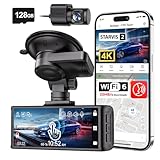
- [4K+1080P Dual Recording] REDTIGER F7N TOUCH captures your drive journey in stunning 4K UHD resolution with STARVIS 2 sensor 170° wide-angle view for the front dash cam and 1080P FHD resolution 140° wide-angle for the rear car camera. Equipped with WDR and HDR technology, the enhanced super night vision ensures better visibility even in low-light situations, providing you with reliable recordings day and night.
- [Voice Control & Touch Screen] F7NTOUCH dashcam features voice commands, allowing for hands-free control of your 4K car camera, which enhances safety by minimizing distractions. The dual camera dash cam also has smart touchscreen that can lock emergency video, turn on wifi, and capture scenery with one click. Redtiger also retains the buttons, multiple control methods are integrated.
- [Built-in GPS & 5.8GHz WiFi] Both Android and IOS users can connect to dashcam WiFi via the REDTIGER Cam app. Although the dash cam is installed wired, you can enjoy wireless control on your smartphone, faster 20MB/s download speed and share your driving experiences in real-time with friends and insurance companies. Car recorder built-in GPS provides traceable location, speed, and accurate route in the recordings.
- [Loop Recording & G-Sensor] REDTIGER F7N TOUCH dual channel dash cam automatically overwrites the oldest footage when the memory is full, ensuring endless recording with the included 128GB card. With a built-in G-sensor that detects sudden movements or impacts, it automatically locks and protects the associated footage when an event is detected on the road, ensuring it won't be overwritten during loop recording.
- [24-hour Parking Monitoring*] REDTIGER Car dashboard camera offers G-Sensor Parking Mode that automatically record when it detects any collisions or sudden motion while vehicles is parked. Time Lapse Parking Mode provides continuous surveillance by offering a condensed overview of any events that may occur during parking periods. *Please note that the parking monitoring function requires a separate hardwire kit.
A specific example comes from the Bendix Fusion operator’s manual, a commercial-vehicle system filed in NHTSA records. It warns that low light or low contrast with the roadway background can affect the camera’s ability to recognize a forward vehicle and limit system braking. That manual also describes challenging situations such as offset vehicles, curves, speed differences, and sensor interference, and cautions that alerts, warnings, or braking may not occur when expected—or may occur unexpectedly. These are Bendix Fusion-specific warnings, not universal operating rules for passenger cars. Read the Bendix Fusion operator’s manual.
What’s actually slowing this PC down?
Pick the symptom - the matching free tool is one click away.
If your vehicle displays a sensor or driver-assistance warning, follow the response in its manual. Do not assume that wiping a particular area, restarting the car, or using a generic calibration procedure will restore the system; the appropriate action is vehicle-specific.
Independent reader supportYour contribution helps us test, update, and keep practical guides available for everyone.How effective is AEB?
AEB can reduce crashes and injuries, but it cannot guarantee that a collision will be avoided. IIHS summarizes research by Cicchino (2017) finding a 50% reduction in rear-end crashes for systems that combine forward-collision warning with automatic braking, compared with a 27% reduction for warning alone. IIHS also summarizes Cicchino (2022) as finding a 27% reduction in pedestrian crashes for automatic braking systems that recognize pedestrians. These are system-level findings, not evidence about camera-only AEB.
Rank #3

- 4-Channel Dash Cam for Complete Vehicle Coverage: This dash cam is equipped with four Full HD 1080P cameras, capturing footage of the front, rear, left, and right sides of your vehicle simultaneously. The adjustable front cameras enhance visibility and offer flexible recording angles, including interior footage.
- Time-Lapse Recording & Parking Mode: With time-lapse recording, 60 minutes of footage is compressed into 1 minute, saving memory card space. Activate parking mode with the optional ACC hardwire kit (sold separately) for security when your vehicle is parked.
- Enhanced Night Vision & WDR Technology: The dash cam features advanced night vision and Wide Dynamic Range (WDR) technology for clear, balanced footage, even in low-light conditions. Eight infrared lights ensure optimal visibility, and WDR adjusts exposure to capture detailed images in varying lighting.
- Optional GPS for Real-Time Vehicle Tracking: Purchase the GPS logger (sold separately) to add location, speed, and time tracking, providing a visual representation of your vehicle's route. This feature is perfect for documenting travel details in case of incidents.
- 5GHz Wi-Fi & App Integration: Share videos easily via Wi-Fi using the mobile app for both iOS and Android devices. This feature allows for quick video downloads and sharing on your preferred platforms.
IIHS also reports that 20 automakers representing 99% of U.S. light-vehicle sales made a voluntary commitment to standardize front crash prevention. By the 2023 deadline, each affirmed that at least 95% of its vehicles weighing 8,500 pounds or less produced in the preceding year were equipped; the companies pledged to include vehicles up to 10,000 pounds by model year 2026. This voluntary commitment is distinct from the federal rule described below. IIHS provides details on the commitment and the cited safety findings.
What does the U.S. AEB rule require?
In April 2024, NHTSA finalized Federal Motor Vehicle Safety Standard (FMVSS) No. 127. The U.S. rule requires AEB, including pedestrian AEB, to be standard on covered new passenger cars and light trucks by September 2029. It is a future compliance requirement for covered new vehicles—not a statement that all vehicles already on the road have the same system or performance.
- Stop and avoid contact with a lead vehicle at speeds up to 62 mph.
- Automatically brake when a lead-vehicle collision is imminent at speeds up to 90 mph.
- Detect pedestrians in daylight and darkness and automatically brake at speeds up to 45 mph.
NHTSA projected the standard would save at least 360 lives a year and prevent at least 24,000 injuries annually. Those figures are projections for the new standard, not observed annual results after implementation. See NHTSA’s April 29, 2024 announcement and the FMVSS 127 final rule.
What should you compare when choosing a vehicle?
Do not rank AEB systems from general sensor descriptions alone. Check current vehicle-specific evaluations and official manuals, and compare the capabilities the manufacturer actually states:
Quick Recap
- Which targets the system supports, such as vehicles or pedestrians, and whether cyclists are specified.
- Its stated operating speeds and conditions.
- Whether the manufacturer identifies camera-only sensing or a combined sensor setup.
- Whether it provides a warning, automatic braking, or both.
- What the manufacturer says about daylight and darkness performance.
- How the system is enabled or disabled, what warnings it displays, and what service guidance applies.
Product prices and availability are accurate as of the date/time indicated and are subject to change. Any price and availability information displayed on Amazon at the time of purchase will apply.




