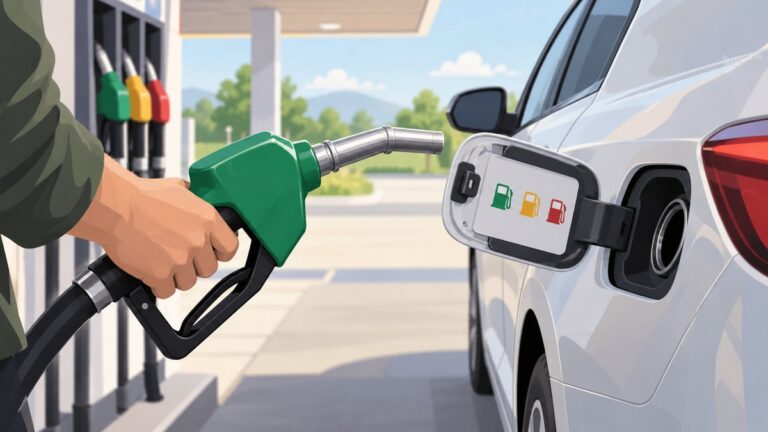
The 2026 Honda Elevate facelift is reported to have claimed fuel economy of 15.31 km/l with the six-speed manual and 16.61 km/l with the CVT. Those are certified-cycle figures, not promises of everyday mileage. The reviewed facelift road test did not measure fuel economy, so there is no facelift-specific real-world test result in the available reporting. Older Elevate tests offer context, but they cannot predict what a particular facelift owner will achieve.
What mileage does Honda claim for the Elevate facelift?
HT Auto reports claimed fuel economy of 15.31 km/l for the six-speed manual and 16.61 km/l for the CVT on the facelift. The updated model retains the naturally aspirated 1.5-litre petrol engine and offers those two transmission choices. These figures are certified-cycle claims, rather than measurements of normal commuting or a guarantee for an individual driver. HT Auto’s facelift report says the CVT claim is slightly lower than the outgoing model’s 16.92 km/l claim.
As an Amazon Associate I earn from qualifying purchases.
Honda’s September 2024 brochure listed the outgoing Elevate at 15.31 km/l for the manual and 16.92 km/l for the CVT under standard test conditions. That older CVT claim is useful historical context, not the facelift’s current reported figure. Honda cautions that mileage varies with traffic, road and climate conditions, as well as adherence to the maintenance schedule. Honda Cars India’s brochure makes clear why a certified figure should not be treated as an everyday result.
Quick wins for a faster PC:
Scan for outdated or missing drivers - takes under a minuteDriver Scan →Clear out junk files and repair common Windows errorsFree Scan →Fix the driver behind crashes, sound loss and screen glitchesFind Drivers →In short, the reported facelift claim is 15.31 km/l for the manual and 16.61 km/l for the CVT. The 16.92 km/l CVT figure belongs to the outgoing model’s 2024 brochure, so quoting it as the facelift’s claim would mix model years. HT Auto reports the newer CVT claim as slightly lower; neither number tells you exactly what you will see in city traffic or on your regular highway route.
#1 Best Overall

- 2024 Honda Civic Type R - 5472D Kinsmart Model Vehicle
- 1/36 Scale Collectible Model Compact Sports Car
- This is a 5"L x 2"W x 1.5"H Diecast Metal model with some plastic parts
- Openable Doors And Pull Back Action
- 1 car, no box
Has the facelift’s real-world mileage been tested?
Not in the reviewed road test. Autocar India states: “Given our short test drive, we didn’t subject the Elevate facelift to our real-world mileage tests.” It then gives results for the outgoing Elevate as a reference. Those are not facelift measurements, and they should not be presented as a forecast for the updated car. Autocar India’s facelift review distinguishes the two.
The distinction matters when estimating fuel bills or choosing a transmission. The facelift’s reported certified figures are the available model-specific numbers; the independent real-world results below belong to the earlier car. Neither source establishes one typical mileage that applies to every owner.
This also sets a limit on what can be concluded from early ownership comments. There is no representative owner survey or facelift-specific long-term dataset available to establish a typical figure. A single driver’s figure may be useful as an anecdote about that person’s route and usage, but it cannot establish an average for all facelift owners. The search-style question, “Are Autocar India’s Elevate CVT mileage numbers realistic? Fellow owners, what’s your experience?” captures the practical concern: published results are a comparison point, while individual experience depends on circumstances.
Recommended Free Tools
What did independent tests report for the outgoing Elevate?
Autocar India’s facelift review lists separate city and highway results for the pre-facelift Elevate. A different Autocar mileage page gives combined results from its standardized test. These are two presentations with different labels and should not be blended into a single figure.
| Source and method | Outgoing Elevate manual | Outgoing Elevate CVT |
|---|---|---|
| Autocar India facelift review: city | 8.7 km/l | 8.60 km/l |
| Autocar India facelift review: highway | 13.30 km/l | 13.10 km/l |
| Autocar India mileage page: combined standardized test | 11 km/l | 10.85 km/l |
Autocar’s mileage page describes a fixed city route and a fixed highway route, with one occupant, the air conditioning running and tyre pressures set to the manufacturer’s recommendation. The tester fills the tank to the brim before and after a run. The page lists 11 km/l for the outgoing manual and 10.85 km/l for the outgoing CVT. Those figures reflect that publication’s test method; they are not certified claims or facelift results. See Autocar India’s mileage test description and results.
The city and highway figures from the review are separately labelled observations, while the mileage page presents a combined result from its test procedure. Differences between figures can reflect how a test is conducted and reported, as well as driving conditions. They do not, by themselves, tell you what the facelift will return on your own route.
Rank #2

- 2024 Honda Civic Type R - 5472D Kinsmart Model Vehicle
- 1/36 Scale Collectible Model Compact Sports Car
- This is a 5"L x 2"W x 1.5"H Diecast Metal model with some plastic parts
- Openable Doors And Pull Back Action
- 1 car, no box
That method detail helps explain why two published real-world numbers need not match. Autocar’s combined figure comes from a described procedure that includes set routes, one occupant, air conditioning and recommended tyre pressure, with a brim-to-brim tank check. The review’s city and highway numbers have their own labels and context. They should be read as the results that each source reports, not averaged together or substituted for a facelift test that was not conducted.
Free tools Windows power users keep installed
One-click scans. No signup required.
There are therefore three distinct kinds of number in this comparison: certified claims, separate city/highway observations for the outgoing car, and combined standardized-test results for the outgoing car. The facelift claim is the only figure here specific to the updated model. The older car’s test results illustrate the gap that can exist between a claim and measured road use, but they do not establish how large that gap will be for a facelift owner.
Why can everyday mileage differ from the claim?
A certified-cycle figure is produced under standard test conditions; real driving includes varying traffic, routes and weather. Honda specifically names traffic, road and climate conditions, along with maintenance-schedule compliance, as factors that can change mileage. The test conditions Autocar describes—fixed routes, one occupant, air conditioning and specified tyre pressure—also show why a controlled result is not identical to every owner’s use.
- Route and traffic: repeated stops and congestion differ from a steady highway run.
- Weather and air conditioning: Honda includes climate among the conditions that can affect the result.
- Load: carrying unnecessary cargo adds weight; keep only what you need in the vehicle.
- Driving style: abrupt acceleration and unnecessary idling are avoidable fuel-consciousness concerns, though the reviewed sources do not quantify their effect on the Elevate.
- Vehicle condition: tyre pressure and scheduled maintenance are practical factors to check.
Because the facelift has no reported independent mileage test here and no representative owner survey or long-term dataset establishes a typical figure, individual owner reports should be treated as anecdotes. An owner’s route, traffic and car condition may differ substantially from yours.
For a useful comparison, match like with like as far as possible. A city-heavy commute with repeated stops is not directly comparable to a highway run, and a single tank is not necessarily representative of a longer pattern. If you are comparing owner comments, ask whether the car is a manual or CVT, whether the driving is mostly urban or highway, and whether the number is a single fill-up or a repeated observation. Those details help interpret an anecdote; they still do not turn it into a measured average for the facelift.
How to improve fuel-conscious driving without overpromising
Check tyre pressure correctly
Check tyres when they are cold and use the pressure specified for your vehicle. Honda’s owner manual warns that underinflation adversely affects fuel economy, tyre wear and handling. It does not support inflating tyres above the vehicle’s specified pressure as a mileage tactic. Follow the pressure specification for your exact car rather than adopting a generic number. Honda’s owner-manual information is the place to consult for vehicle-specific instructions.
Rank #3

- Brand new box. Authentic detail. Real rubber tires. True-to-scale detail. Detailed wheel design. Detailed under-chassis. Soft rubber side mirrors. Detailed interior, exterior. Comes in a blister pack. Officially licensed product. Die-cast metal body and chassis. Dimensions approximately L-3 inches long. Manufacturer's original unopened packaging.
- Material: Plastic
- Theme: Sport
- Material: Plastic
- Theme: Sport
A digital tyre-pressure gauge is a practical, small purchase if it makes checking pressure easier. Its purpose is to help you measure pressure against Honda’s specification; it is not a fuel-saving device in itself, and there is no supported percentage or km/l improvement to promise. Check pressure when the tyres are cold, and do not use a higher-than-specified setting in an attempt to improve economy.
Keep to the maintenance schedule
Follow the schedule in the owner’s manual. Honda’s brochure identifies maintenance-schedule adherence as one of the conditions that may affect mileage. If fuel use changes noticeably, note your driving conditions and have the vehicle checked by an authorised workshop instead of assuming that an additive will solve the issue.
If a drop seems sudden, first consider whether the route, traffic, weather, load or driving pattern has changed. Check tyre pressure and remove excess cargo. If there is no clear explanation, arrange an inspection at an authorised workshop. The reviewed sources do not substantiate a fuel additive as a fix, so avoid spending on an unverified product in place of checking the car.
Do these 3 things before closing this tab:
1Fix the driver behind crashes, sound loss and screen glitches2Clear out junk files and repair common Windows errors3Scan for outdated or missing drivers - takes under a minuteDrive smoothly and reduce avoidable load
Use progressive acceleration, maintain a steady legal speed when conditions permit, avoid unnecessary idling and remove cargo you do not need. These are sensible fuel-conscious habits, but the available Elevate reporting does not measure a specific saving for any one habit. Do not budget around a promised percentage or distance-per-litre improvement.
These suggestions are habits to try consistently rather than guarantees. A driver may find one relevant to their regular use, but the available evidence does not quantify how many kilometres per litre a particular change will add on an Elevate. Safe, legal driving and the vehicle’s maintenance instructions should take priority over chasing a number.
Consider pressure monitoring only as a monitoring aid
Honda material identifies TPMS as an accessory or connected feature. A pressure-monitoring system may help you notice a pressure issue, but it does not inflate the tyres or demonstrate a fuel-economy improvement. The available information does not establish current fitment or availability for every facelift variant. Confirm compatibility and availability with Honda for the exact vehicle before relying on it. Honda’s feature and accessory information can be checked for current details.
Rank #4

- Create a high-octane collection of Hot Wheels vehicles with a Hot Wheels Premium Fast & Furious 1:64 scale die-cast car.
- Each car was inspired by or featured in one of the movies from the blockbuster franchise with authentic detail and sweet decos.
- With Real Riders tires and Metal/Metal body and chassis, these elite vehicles were made with premium execution to appeal to the true collector.
- Fans of the franchise will appreciate the attention to detail, while collectors will love how each one enhances their collection with speed and style.
- Fast fans will want to collect them all. Each sold separately, subject to availability.
Do not assume that an accessory listed in Honda material is fitted to every facelift variant or available at every location. Check with Honda for the exact car and current availability. A TPMS can alert or help monitor; a tyre still needs to be checked and corrected to the specified pressure.
What’s actually slowing this PC down?
Pick the symptom - the matching free tool is one click away.
How should you compare manual and CVT mileage?
The reported facelift claims favour the CVT by 1.30 km/l: 16.61 km/l versus 15.31 km/l for the manual. That is a comparison of claimed figures only. The outgoing car’s Autocar results do not show a universal real-world advantage for either transmission: the manual is slightly higher in the review’s city and highway figures and in the separate combined test, but those are older-model results under particular reporting methods. With no facelift-specific road-test mileage, the certification difference alone is not enough to predict your running costs or choose a transmission.
For an ownership estimate, use your own expected route, annual distance and current fuel price, then treat the certified figures as reference points rather than guaranteed consumption. If you already own an Elevate, compare your fuel use over several fill-ups on a reasonably consistent route; a single tank can be distorted by traffic, weather or a change in driving pattern.
One way to structure an estimate is to divide the distance you expect to drive by a conservative fuel-economy assumption to estimate litres needed, then multiply by the petrol price you actually pay. Repeat the calculation with alternative assumptions to see how sensitive the budget is. No current fuel price or dependable real-world facelift figure is available here, so these details cannot support a rupee-per-month prediction or a claim that one transmission will cost a particular amount less to run.
When comparing the two transmissions, separate the question of the certified figure from how you drive and what you value in everyday use. The CVT has the higher reported facelift claim, while the outgoing-model independent figures are slightly higher for the manual in the cited tests. Since those results concern an older car and the facelift has not had a reviewed mileage test, neither comparison should be treated as a definitive real-world verdict. Choose based on your needs and use, not the certification difference alone.
What should owners remember?
The most defensible current answer is that the 2026 Elevate facelift is reported at 15.31 km/l manual and 16.61 km/l CVT on the certified cycle, while its reviewed road test did not measure real-world mileage. Autocar’s older-model results give context, not a prediction. Use the vehicle’s specified tyre pressure, keep up with scheduled maintenance and judge your own consumption across repeated, comparable use rather than expecting a guaranteed result from any single tip.
Best Value

- Create an elite Hot Wheels collection with a Hot Wheels Premium Car Culture vehicle.
- Each 1:64 scale die-cast car or truck has premium execution with Real Riders tires and Metal/Metal body and chassis.
- Different themed mixes are released throughout the year to appeal to collectors and to represent the most on-trend vehicles from around the world.
- The box art enhances collectability, making each one perfect for play or display.
- Each Hot Wheels Car Culture vehicle is officially licensed and designed for the true automobile enthusiast.
Frequently Asked Questions
What is the claimed mileage of the 2026 Honda Elevate facelift?
HT Auto reports claimed figures of 15.31 km/l for the six-speed manual and 16.61 km/l for the CVT. These are certified-cycle claims, not everyday mileage guarantees.
Has the Honda Elevate facelift had a real-world mileage test?
The reviewed Autocar India facelift drive did not include a mileage test. The city, highway and combined figures discussed in its reporting are for the outgoing Elevate, not the facelift.
Are Autocar India’s Elevate CVT mileage numbers realistic?
They are results from Autocar’s stated test procedures, not a promise of what every owner will get. Its review lists outgoing-model CVT results of 8.60 km/l city and 13.10 km/l highway; its separate mileage page lists 10.85 km/l in a combined standardized test. Owner use varies by route, traffic, weather, load and vehicle condition.
Why is the facelift’s CVT claim different from the older model’s?
HT Auto reports 16.61 km/l for the facelift CVT. Honda’s September 2024 brochure listed 16.92 km/l for the outgoing model. These are claims for different model-year contexts, and neither should be confused with an independent road-test result.
Should I inflate the tyres above the recommended pressure to improve mileage?
No. Honda’s manual says to check tyres when cold and use the pressure specified for the vehicle. It warns that underinflation adversely affects fuel economy, tyre wear and handling; it does not recommend overinflation as a mileage tactic.
Can TPMS or a fuel additive improve Elevate mileage?
Honda material identifies TPMS as an accessory or connected feature, but availability for a particular facelift variant should be confirmed with Honda. TPMS monitors pressure; it does not inflate tyres or prove a fuel-economy gain. The reviewed sources also do not substantiate an additive as a remedy for poor mileage.
The Bottom Line
The facelift’s reported claims are 15.31 km/l for the manual and 16.61 km/l for the CVT, but the reviewed road test did not measure its real-world mileage. Older Elevate test figures are useful context, not a forecast. Check cold tyre pressure against Honda’s specification, maintain the car on schedule and compare fuel use across repeated, similar journeys—without assuming any tip guarantees a particular saving.
Quick Recap
Product prices and availability are accurate as of the date/time indicated and are subject to change. Any price and availability information displayed on Amazon at the time of purchase will apply.