American police cars did not begin as purpose-built pursuit sedans. The first was an electric prisoner wagon, and the familiar patrol cruiser emerged only after departments combined automobiles with radio dispatch, emergency equipment, and specialized mechanical upgrades.
Over more than a century, police fleets moved from adapted civilian cars to factory police packages, then from large rear-wheel-drive sedans to all-wheel-drive SUVs, hybrids, and the first purpose-built electric pursuit vehicles.
As an Amazon Associate I earn from qualifying purchases.
Akron’s electric patrol wagon started the story in 1899
The history of American police cars begins in Akron, Ohio, where the police department introduced an electrically powered patrol wagon in 1899. Built by the Collins Buggy Company, it carried prisoners and included electric lights and a warning gong. Its reported top speed was approximately 16 to 18 mph, with a range of about 30 miles.
Do these 3 things before closing this tab:
1Fix the driver behind crashes, sound loss and screen glitches2Clear out junk files and repair common Windows errors3Scan for outdated or missing drivers - takes under a minuteIts first assignment was reportedly transporting an intoxicated man. That detail captures the vehicle’s original purpose: it was closer to an electric paddy wagon than to a modern patrol car. It transported prisoners and responded to calls, but it was not designed for continuous two-officer patrol, traffic enforcement, or radio-directed deployment.
#1 Best Overall

- SCALE: Precision-crafted 1:38 scale die-cast metal model of the 2006 Ford Mustang GT, measuring approximately 5 inches in length
- AUTHENTIC DESIGN: Detailed exterior features including realistic headlights, grille, and wheels that mirror the iconic 2006 Mustang GT styling
- FUNCTIONAL FEATURES: Working doors that open and close, plus pull-back action motor for interactive play
- CONSTRUCTION: Durable die-cast metal body with plastic components and premium paint finish
- REALISTIC DETAILS: Features accurate wheel design, distinctive Mustang grille, and authentic body styling of the GT model
Calling it the first American police car requires a small qualification. It was generally the first motorized police vehicle in the United States, and is sometimes described as the first police car in the world. But that depends on whether “police car” includes motorized prisoner wagons or refers only to a patrol automobile in the modern sense.
Automobiles gradually replaced horses and fixed posts
For much of the 1900s and 1910s, automobiles were too expensive, unreliable, and difficult to operate on poor roads to immediately replace horses and foot patrols. Departments also lacked mobile communication. An officer in a car could cover more ground, but a dispatcher could not reliably send that officer to a new incident.
That began to change as car ownership increased, roads improved, and cities expanded. During the 1910s and 1920s, departments bought ordinary commercial automobiles and modified them for police work. Ford’s history of its law-enforcement vehicles identifies Oakland, California, as an early fleet customer: the department standardized its light cars on Ford models in 1915.
Recommended Free Tools
The scale of American motoring made motorized patrol increasingly practical. By 1930, roughly 23 million cars were on U.S. roads. Police departments needed vehicles capable of covering larger territories, patrolling highways, and responding to accidents and crimes spread across growing suburbs.
The 1932 Ford Model 18, powered by the relatively affordable flathead V8, helped make faster police vehicles accessible to more departments. It would be inaccurate to say Ford invented the police car at that point. Police agencies were already using automobiles, and many early police vehicles were retail models equipped locally. Ford’s importance was its ability to supply affordable cars with useful performance in large numbers.
Radio turned the car into a mobile police office
The automobile became a much more effective police tool when departments added radio communication. Detroit developed a one-way mobile police-radio system in 1928. Headquarters could broadcast calls and information to receivers installed in patrol cars, although officers initially could not communicate back in the fully interactive way associated with modern dispatch.
San Francisco’s Police Department described its late-1920s Automotive Radio Patrol Unit as a specialized fleet with radio receivers and earphones. This created the basic patrol-cruiser system:
What’s actually slowing this PC down?
Pick the symptom - the matching free tool is one click away.
- A marked car was assigned to a geographic area.
- The officer remained available while moving through that area.
- A central dispatcher transmitted calls through the vehicle radio.
- The car carried the officer, basic equipment, and sometimes prisoners directly to the next incident.
Early radio cars did not have the equipment people now associate with police vehicles. Two-way radios, radar, mobile computers, integrated light systems, electronic sirens, and advanced safety equipment arrived separately over many decades.
Factory police packages appeared after World War II
Before manufacturers offered dedicated packages, departments or specialist suppliers adapted civilian cars. The postwar period brought a more systematic approach. Ford identifies 1950 as the introduction of its first purpose-built police package, with heavy-duty components and engine choices intended for severe service.
Rank #2

- AUTHENTIC REPLICA: Highly detailed 1:40 scale model of the iconic 1957 Chevrolet Bel Air Coupe, measuring 5 inches in length with classic finish
- WORKING FEATURES: Functioning doors that open and close, plus pull-back motor action for interactive play value
- QUALITY CONSTRUCTION: Die-cast metal body construction provides durability and authentic feel, enhanced with detailed plastic components
- REALISTIC DETAILS: Features rubber tires for enhanced realism and smooth rolling action on various surfaces
- DISPLAY WORTHY: Perfect size for collectors and enthusiasts, combining playability with showcase appeal
Ford first used the Interceptor name for a police-package engine in 1951. In 1958, Ford offered a police-exclusive 303-horsepower 361 Special V8 Police Interceptor. Ford also reported that a 1961 internal study found its vehicles represented 58 percent of police vehicles in use in the 50 largest American cities. That figure is a Ford market claim, not a complete nationwide inventory.
Chevrolet’s factory police-package history is commonly dated to the 1955 model year. The One-Fifty sedan and Two-Ten station wagon could be ordered with police equipment such as heavy-duty chassis components, improved braking hardware, and the 265-cubic-inch Super Turbo-Fire V8.
A factory police package did not necessarily mean the car arrived as a complete marked cruiser. A department or upfitter would often add the light bar, radio, siren, prisoner partition, console, weapon mounts, push bumper, decals, and computer after delivery. The package primarily described the vehicle’s mechanical and electrical preparation.
What made a police-package car different?
A police car had to tolerate conditions that could shorten the life of a normal passenger car. It might idle for hours with the air conditioning running, accelerate hard repeatedly, brake from high speed, carry heavy equipment, and operate through long shifts with little downtime.
| Police-car upgrade | Why it mattered |
|---|---|
| Cooling system | Larger radiators and improved cooling helped control temperatures during extended idling and high-load driving. |
| Alternator and battery | Additional electrical capacity supported radios, computers, warning lights, sirens, and climate-control loads. |
| Brakes | Heavy-duty components resisted fade during repeated high-speed stops. |
| Suspension and tires | Special tuning and stronger components improved control and durability under severe service. |
| Transmission and driveline | Heavy-duty parts handled frequent acceleration, idling, and high-mileage fleet use. |
| Interior | Police seating, equipment consoles, partitions, and room for body armor made the cabin usable during long shifts. |
Not every police vehicle is pursuit-rated. A pursuit vehicle is engineered and tested for emergency and high-speed driving. A special-service vehicle may instead be intended for prisoner transport, command duties, utility work, or off-road use. The U.S. Department of Justice’s summary of the 2002 Michigan State Police evaluation specifically separated special-service vehicles from pursuit vehicles and noted that special-service vehicles were not suitable for high-speed pursuit or emergency driving.
The full-size, rear-wheel-drive sedan became the standard
From roughly the 1960s through the 1990s, the typical American patrol car was a large rear-wheel-drive sedan. Full-size cars offered a roomy cabin, a large trunk, stable high-speed handling, straightforward fleet maintenance, and enough space for radios, emergency gear, and a prisoner partition.
Ford, Chevrolet, and Chrysler supplied most of the familiar platforms. Ford’s LTD and later the Crown Victoria Police Interceptor became particularly prominent. The Crown Victoria became its own Ford model in 1992, while the police version preserved the formula of a body-on-frame, rear-wheel-drive sedan with a V8 engine.
Ford reported that the Crown Victoria Police Interceptor accounted for 85 percent of police-pursuit-vehicle sales in the United States and Canada in 1998. That statistic refers to pursuit-vehicle sales, not every police vehicle in service.
The Crown Victoria’s popularity sometimes leads people to use “Crown Vic” as a synonym for any old police car. It was highly common, but American fleets also included Chevrolet Caprices and Impalas, Ford LTDs and Tauruses, Dodge Diplomats and Chargers, Plymouths, and numerous trucks, vans, and SUVs.
Rank #3

- Official Licensed (Ford and LAPD)
- 1:24 scale measuring approx 8 x 3 x 2.75 inches
- Made of diecast metal with plastic parts, rubber tires
- Openable front doors, detailed interior
- Pre-assembled Model, not a building kit, not a RC, Not Battery Operated, Lights do not turn on
Chevrolet challenged Ford with sedans, sports cars, and SUVs
Chevrolet’s Caprice became one of the most important alternatives to Ford’s full-size police sedans before civilian Caprice production ended in 1996. Chevrolet later developed police versions of the Impala, Tahoe, Camaro, and other models.
Outdated Drivers Are Slowing You Down
One free scan finds every outdated or missing driver and matches the right update for your exact hardware.Free scan · exact hardware matchWindows Errors? Fix Them Before They Spread
Repair common Windows errors and clear accumulated junk for a smoother, more stable PC - no reinstall needed.Free scan · no reinstallThe 1991 Chevrolet Camaro B4C showed that police fleets were becoming more specialized. It was a performance-oriented vehicle suited to selected highway and traffic-enforcement duties, not a practical replacement for the roomy sedan used for general patrol.
The Chevrolet Tahoe helped establish the police SUV as a mainstream fleet vehicle. Compared with a sedan, an SUV offered more cargo room, greater ground clearance, easier equipment access, and available four-wheel drive or all-wheel drive. The tradeoffs included additional weight, higher fuel consumption, and handling characteristics that could differ from a lower sedan.
Special-purpose police cars never disappeared
Although the full-size sedan dominated ordinary patrol, police fleets have always included vehicles for narrower assignments. Departments have used motorcycles, station wagons, pickups, vans, sports cars, and four-wheel-drive utility vehicles.
Ford introduced a Mustang patrol model in 1982, and the California Highway Patrol purchased 400. The Mustang was intended for a specialized traffic or highway role, not as a universal patrol replacement. Chevrolet Camaros served a similar purpose in some fleets.
Quick wins for a faster PC:
Clear out junk files and repair common Windows errorsFree Scan →Scan for outdated or missing drivers - takes under a minuteDriver Scan →Repair Windows errors before they cause bigger problemsFix Now →This is why the history is better understood as fleet segmentation rather than a simple sedan-to-SUV replacement. A department may need several vehicle types:
- Pursuit vehicles for emergency response and high-speed enforcement.
- Patrol vehicles for routine calls, transport, and general coverage.
- Special-service vehicles for utility, command, off-road, or event work.
- Prisoner-transport vehicles with additional seating and secure compartments.
- Trucks and vans for equipment, rescue, traffic control, or tactical operations.
Lights and sirens evolved separately from the car
Early police vehicles used bells, gongs, headlights, and simple lamps. Rotating beacons, sirens, roof-mounted light bars, grille lights, and electronic warning systems were added over time.
There is no single nationwide American police-car paint scheme or emergency-light configuration. State law largely controls which warning-light colors police vehicles may use, and the rules vary. Some jurisdictions favor blue, others red, and many use combinations of red, blue, amber, and white depending on the location and purpose of the light.
The familiar red-and-blue light bar is therefore a widespread convention rather than a uniform national standard. State statutes may also distinguish front-facing from rear-facing lights and reserve certain colors for law-enforcement vehicles. Federal vehicle-lighting rules exist, but they do not dictate the exact color arrangement used by every American police department.
Rank #4

- SCALE DETAILS: Precisely crafted 1:46 O scale die-cast metal model of the 2019 Dodge Ram 1500 pickup truck, measuring approximately 5 inches in length
- AUTHENTIC DESIGN: Features detailed black exterior finish, realistic wheels, and accurate body styling matching the full-size 2019 Ram 1500 truck
- CONSTRUCTION: Built with durable die-cast metal construction and high-quality plastic components for long-lasting play value
- DISPLAY QUALITY: Perfect for collectors and enthusiasts, with authentic detailing including grille, headlights, and body contours
- RECOMMENDED AGE: Suitable for ages 3 years and up, makes an ideal gift for truck enthusiasts and young collectors
Why the Crown Victoria era ended
Ford retired the Crown Victoria Police Interceptor after the 2011 model year as it moved law-enforcement customers toward newer platforms. The replacement generation used front-wheel-drive or all-wheel-drive architectures and V6 engines rather than the traditional rear-wheel-drive V8 formula.
The Crown Victoria did not disappear because of one isolated defect. The change reflected several overlapping pressures:
- More stringent emissions and fuel-economy expectations.
- Changing crash-safety requirements.
- A civilian market that had moved away from large sedans.
- Demand for all-wheel drive and additional cargo capacity.
- Improved electronic systems requiring more electrical integration.
Ford’s Taurus-based police vehicles, Police Interceptor Utility models, Chevrolet Tahoes, and Dodge Chargers and Durangos filled different parts of the market. The result was a more varied fleet rather than a single direct successor.
Modern police fleets favor SUVs and crossovers
By the 2010s and 2020s, SUVs and crossovers became central to American law-enforcement fleets. The Ford Police Interceptor Utility became one of the most important examples, offering all-wheel drive and a body better suited to equipment and officer access than many sedans.
Free tools Windows power users keep installed
One-click scans. No signup required.
A modern police SUV is not merely a civilian model with a light bar. Depending on the vehicle and agency order, it can include police-tuned suspension, heavy-duty brakes and cooling, reinforced wiring, a high-capacity alternator, police-specific seats, ballistic door panels, integrated computers, and equipment designed around police crash scenarios.
The Michigan State Police vehicle evaluations illustrate how agencies compare these vehicles. Testing has included acceleration, top speed, braking, vehicle dynamics, ergonomics, communications, and fuel economy. Top speed is only one part of the decision. Braking performance, handling, idle durability, equipment space, maintenance, and lifecycle cost can matter more for a department’s daily work.
Independent reader supportYour contribution helps us test, update, and keep practical guides available for everyone.Hybrid and electric police vehicles
Hybrid powertrains make practical sense for patrol work because police vehicles can spend long periods idling while powering radios, computers, climate control, and warning equipment. Ford’s 2025 Police Interceptor Utility uses a standard hybrid powertrain and is marketed by Ford as the only pursuit-rated hybrid police utility vehicle in its current lineup.
Battery-electric vehicles are entering the market more cautiously. Departments must plan for charging infrastructure, range, battery weight, emergency-duty energy use, repair support, and the effect of prolonged climate-control and equipment loads. A battery-electric vehicle that works well for community service or administrative duties may not be approved for high-speed pursuit.
The Tool Desk
Outbyte PC Repair FREEClear out junk files and repair common Windows errorsFree Scan →Outbyte Driver Updater FREEFix the driver behind crashes, sound loss and screen glitchesFind Drivers →General Motors describes the Chevrolet Blazer EV Police Pursuit Vehicle as the first all-electric, purpose-built, pursuit-rated police vehicle. That distinction matters: an electric SUV used by a police department is not automatically a pursuit vehicle. Its rating, equipment, and intended assignment depend on the manufacturer’s specification and the agency’s policy.
Best Value
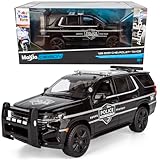
- Licensed Product through Maisto
- 1/26 Scale measuring approx 8x3x3 inches
- Opening front doors, detailed interior, made of diecast metal
- Shipped in a corrugated mailer box for better protection, not a remote control, not a builder kit
What American police cars look like in 2026
As of 2026, there is no single dominant American police-car design comparable to the Crown Victoria. Current offerings cover several categories:
| Vehicle example | Typical role or characteristic |
|---|---|
| Ford Police Interceptor Utility | All-wheel-drive pursuit and patrol utility, available with hybrid and gasoline powertrains. |
| Dodge Durango Pursuit | Three-row-style utility platform offered with a 3.6-liter V6 or 5.7-liter HEMI V8; the V8 version is listed with a 145-mph top speed. |
| Chevrolet Tahoe PPV | Full-size SUV offering cargo capacity and a long-running police-vehicle platform. |
| Chevrolet Blazer EV PPV | Purpose-built, all-electric pursuit-rated vehicle in GM’s law-enforcement lineup. |
| Ford F-150 Police Responder and Expedition/MAX SSV | Truck and large-utility applications outside ordinary sedan-style patrol. |
| Ford Transit prisoner transport | Transport-focused vehicle rather than a conventional pursuit cruiser. |
The modern American police fleet is therefore defined less by one famous model than by specialization. A vehicle is selected according to the work it must perform, the equipment it must carry, the roads it must cover, and the department’s operating budget.
The major stages in the evolution of the police car
- 1899–1910s: Motorized patrol wagons and experimental automobiles appeared alongside horse and foot patrols.
- 1910s–1920s: Departments began adopting civilian automobiles as fleet vehicles.
- 1920s–1930s: Radio-equipped cars connected patrol officers to centralized dispatch.
- 1940s–1950s: Manufacturers introduced increasingly specialized police packages.
- 1960s–1990s: Large rear-wheel-drive sedans became the standard American patrol platform.
- 1980s onward: Sports cars, pickups, vans, and utility vehicles expanded specialized fleet options.
- 2000s–2010s: The Crown Victoria era ended as SUVs, crossovers, Chargers, and newer sedans took over.
- 2020s–2026: All-wheel-drive utilities, hybrids, connected equipment, and pursuit-rated EVs define the newest phase.
The key change was not simply the replacement of one body style by another. American police cars became integrated platforms combining transportation, communication, warning systems, severe-duty hardware, officer safety equipment, and digital technology.
FAQ
What was the first American police car?
The Akron Police Department introduced an electrically powered patrol wagon in 1899. Built by the Collins Buggy Company, it carried prisoners and had electric lights and a warning gong. It is more precisely described as the first motorized American police vehicle, because it was a patrol wagon rather than a modern pursuit sedan.
When did police cars get radios?
Detroit developed a one-way mobile police-radio system in 1928. Radio receivers in patrol cars allowed headquarters to broadcast calls. Two-way communication and the more capable dispatch systems used today developed later.
Why were Crown Victorias so common as police cars?
The Crown Victoria offered a spacious cabin, large trunk, rear-wheel drive, a durable body-on-frame layout, a V8 engine, and a well-developed police package. Those traits suited high-mileage fleet use and made it a highly common pursuit and patrol vehicle through the 1990s and 2000s.
Are all police SUVs rated for pursuit?
No. Some police SUVs are pursuit-rated, while others are special-service vehicles intended for transport, utility, command, or off-road work. A department must follow the vehicle’s manufacturer rating and its own policy; a light bar does not make a vehicle suitable for high-speed pursuit.
The Bottom Line
American police cars evolved from a 16-mph electric prisoner wagon into connected, heavily engineered fleet vehicles. The biggest milestones were the spread of affordable automobiles, the arrival of mobile radio, factory police packages, the full-size rear-wheel-drive sedan era, and the current shift toward all-wheel-drive SUVs, hybrids, and electric vehicles. The modern fleet is not built around one universal cruiser: it is a collection of vehicles matched to pursuit, patrol, transport, utility, and specialized work.
Quick Recap
Product prices and availability are accurate as of the date/time indicated and are subject to change. Any price and availability information displayed on Amazon at the time of purchase will apply.




