The surviving 1968 Dodge Charger from Bullitt was not destroyed or lost forever. Two Chargers were used in the film’s famous San Francisco chase: a blue, non-R/T car performed the most dangerous stunt work and was destroyed in the gas-station explosion, while a yellow-origin Charger R/T handled close-ups and camera work. That second car survived, was found in Arizona decades later, restored, and is now described by ChromeCars as a privately held movie car.
Its identity is compelling but not documented beyond dispute. The car’s configuration, layered paint, build timing, and evidence of camera mounts all support the claim. However, the Warner Bros. vehicle records that could have provided definitive VIN confirmation were reportedly lost.
Two Chargers were used in Bullitt
The black Charger seen pursuing Steve McQueen’s Mustang GT390 was actually represented by two different 1968 Dodge Chargers.
| Car | Role in the film | What happened |
|---|---|---|
| Blue, non-R/T Charger | Stunt driving, crashes, and the climactic gas-station sequence | Destroyed in the explosion |
| Yellow-origin Charger R/T | Close-ups, controlled driving, and camera-car work | Survived, was resold, restored, and later identified as the surviving movie Charger |
Both cars were blackened for filming, which is why the distinction is easy to miss when watching the movie. The Charger destroyed during the explosion was the blue non-R/T car. The surviving candidate is generally identified as a 1968 Dodge Charger R/T with a 440-cubic-inch V8 and a four-speed manual transmission.
Do these 3 things before closing this tab:
1Clear out junk files and repair common Windows errors2Fix the driver behind crashes, sound loss and screen glitches3Repair Windows errors before they cause bigger problems#1 Best Overall

- Pullback Action: Experience realistic racing with the pullback action feature.
- Opening Doors: Explore the intricate interior details with the opening door feature.
- 1:38 Scale: Enjoy a detailed 1:38 scale die-cast model (approx. 5 inches long).
- Authentic Design: Modeled after the iconic 1967 Ford Shelby Mustang GT500.
- Display Piece: A must-have collectible for car enthusiasts and model collectors.
The surviving Charger’s specifications
ChromeCars identifies the surviving car by VIN XS29L8B259549. Its published specifications include:
- 1968 Dodge Charger R/T
- 440 CID V8
- Four-speed manual transmission
- Black exterior and black interior in its restored movie-car presentation
- Approximately 66,000 original miles
Those details matter because they match the type of Charger described in specialist accounts of the surviving Bullitt car. They do not, by themselves, prove that the VIN is the same one used by Warner Bros.; that question is limited by missing production records.
What happened after filming?
After production, the surviving Charger was reportedly returned to a Dodge dealer, refinished in yellow, and sold. That account fits the physical evidence later found on the car: investigators reportedly identified an original pale-yellow layer, a black layer associated with filming, another yellow finish, and a later gold repaint.
The reported paint sequence is significant. It is consistent with a yellow car being painted black for the movie, returned to yellow after production, and then repainted again during its later civilian life. Paint history is not a complete chain of ownership, but it is one of the reasons the car’s provenance is taken seriously.
The Charger then passed through private ownership and was not publicly recognized as a Bullitt vehicle for decades. The movie connection apparently did not follow the car through its original sale, leaving later owners to reconstruct its history from the vehicle itself and from period photographs.
Rank #2
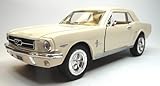
- Authentic 1:36 Scale: Meticulously crafted 1964 1/2 Ford Mustang model car with impressive 5-inch length.
- Realistic Details: Die-cast metal body with opening doors and eye-catching blue finish.
- Interactive Play: Engaging pull-back action for thrilling motion across smooth surfaces.
- Collectible Quality: Ideal for model car enthusiasts and collectors seeking miniature automotive replicas.
- Brand: KiNSMART, a trusted name in die-cast vehicle models and toys.
How Arnold Welch found the movie-car clues
In 2002, Mopar enthusiast Arnold Welch purchased the Charger in Arizona. The available accounts indicate that he did not initially buy it as a known Bullitt car. His original plan was a more conventional restoration.
During the work, however, Welch reportedly discovered unusual repaired holes in the floor and bodywork. Their locations were said to correspond with mounting points visible in production photographs—places used for cameras, sound equipment, lighting, and generator support during filming.
That discovery changed the restoration from a normal classic-car project into a provenance investigation. The car was restored in a black configuration associated with the film, preserving the visual identity that audiences recognize from the chase.
Why experts believe this is the surviving Bullitt Charger
The case rests on several pieces of circumstantial evidence that reinforce one another:
- The configuration is correct. The car is an R/T with a 440 V8 and four-speed manual transmission, matching the surviving Charger described in specialist reporting.
- The production timing fits. Hemmings has reported a January 15, 1968 build date and noted that the car was not sold to its first recorded owner until October of that year. With filming beginning in February 1968, the timing is compatible with a car being held for production use.
- The paint layers fit the story. Evidence of yellow beneath black, followed by later yellow and gold finishes, is consistent with the claimed pre-film, film-era, and post-film colors.
- The repaired mounting holes fit the production photographs. The holes reportedly align with locations where film equipment was attached to the Charger.
- The destroyed car was blue. The blue visible on the Charger used in the explosion supports the conclusion that the surviving yellow-origin R/T was the other car.
Individually, none of these details is an unbreakable identification. Together, they make the surviving-car claim persuasive to many specialists and to ChromeCars, which presents the vehicle as one of the two Chargers used in the film.
Rank #3

- SCALE: Precision-crafted 1:38 scale die-cast metal model of the 2006 Ford Mustang GT, measuring approximately 5 inches in length
- AUTHENTIC DESIGN: Detailed exterior features including realistic headlights, grille, and wheels that mirror the iconic 2006 Mustang GT styling
- FUNCTIONAL FEATURES: Working doors that open and close, plus pull-back action motor for interactive play
- CONSTRUCTION: Durable die-cast metal body with plastic components and premium paint finish
- REALISTIC DETAILS: Features accurate wheel design, distinctive Mustang grille, and authentic body styling of the GT model
Why the identification is not completely proven
The key limitation is the absence of a surviving studio VIN record. According to specialist reporting, Warner Bros. purged historical archives that included the Chargers’ identifying information. Without a studio ledger, production invoice, or other contemporaneous document tying VIN XS29L8B259549 directly to Bullitt, the public record cannot establish the connection with absolute certainty.
That distinction is important. ChromeCars presents the car as the original movie vehicle, while the available independent reporting describes the provenance as circumstantial. These statements are not necessarily contradictory: the physical evidence may be unusually strong even though the definitive paperwork is gone.
Recommended Free Tools
The most accurate description is therefore that this is the credible and widely accepted surviving Bullitt Charger, supported by physical and historical clues but not conclusively authenticated by a surviving Warner Bros. VIN record.
SEMA, the million-dollar asking price, and later ownership
Welch’s restored Charger was displayed at the 2011 SEMA show in Las Vegas, bringing the car’s suspected movie history to a large public audience. In 2013, it was advertised for approximately $1 million.
That figure should be described as an asking price, not a confirmed sale price. Reports indicate that the car later changed hands for an undisclosed amount, including a period associated with Carlyle Motors of Houston. No reliable public transaction figure establishes that the Charger sold for $1 million.
Rank #4

- AUTHENTIC REPLICA: Highly detailed 1:40 scale model of the iconic 1957 Chevrolet Bel Air Coupe, measuring 5 inches in length with classic finish
- WORKING FEATURES: Functioning doors that open and close, plus pull-back motor action for interactive play value
- QUALITY CONSTRUCTION: Die-cast metal body construction provides durability and authentic feel, enhanced with detailed plastic components
- REALISTIC DETAILS: Features rubber tires for enhanced realism and smooth rolling action on various surfaces
- DISPLAY WORTHY: Perfect size for collectors and enthusiasts, combining playability with showcase appeal
Where is the Charger now?
ChromeCars says it acquired the Charger in 2015. Its vehicle listing identifies the car as a private-collection highlight and gives the VIN, 440 engine, four-speed manual transmission, black finish, and approximately 66,000 original miles.
The Tool Desk
Outbyte PC Repair FREERepair Windows errors before they cause bigger problemsFix Now →Outbyte Driver Updater FREEScan for outdated or missing drivers - takes under a minuteDriver Scan →The Charger was displayed in the United Kingdom at the 2018 Goodwood Festival of Speed alongside the surviving Bullitt Mustang. Goodwood’s event material identified the pair as the Ford Mustang GT390 and Dodge Charger R/T 440 Magnum associated with the famous chase.
As of the latest information available for this article, ChromeCars describes the vehicle as being in a private collection. The current private owner’s name, exact storage location, and any confirmed sale price have not been publicly disclosed. It is more precise to say that the surviving Charger is held in a private collection associated with ChromeCars than to claim that ChromeCars is definitively the ultimate owner.
What happened to the Charger seen in the explosion?
The Charger that crashes into the gas station was the expendable blue non-R/T car. It was used because the stunt sequence was expected to destroy the vehicle. That car did not survive the filming.
The Charger that remains today is the other car—the R/T used for shots that required a more presentable or controllable vehicle. In other words, the famous black Charger was not a single, continuously used automobile throughout the chase. The movie’s surviving legacy comes from the second car, not from the one consumed by the explosion.
Best Value

- Boy's model toy car: The body is made of alloy material, with exquisite paint craftsmanship and good durability.
- Realistic alloy model car: The 1:32 interior decoration is realistic, with six doors that can be opened. The steering wheel and seats have simulated designs.
- Toy car with lights and music: Opening the car door can light up the lights and simulate the sound of an engine starting. It's a toy car that boys like.
- Companion to Decoration and Cake Decorations: It plays a great decorative role on display cabinets at home and is a great decoration for boys' birthday cake parties.
- Gift selection for toy cars for boys aged 3-12: This gift is suitable for children aged 3 and above and is a collectible for car enthusiasts.
What can be said with confidence?
Strongly supported
- Two 1968 Dodge Chargers were used in the chase.
- The blue non-R/T Charger was destroyed during the stunt work and gas-station explosion.
- The surviving candidate is a 1968 Charger R/T with a 440 V8 and four-speed manual transmission.
- Arnold Welch acquired the car in Arizona in 2002.
- The restoration uncovered paint layers and repaired holes reportedly associated with film equipment.
- The restored car appeared at SEMA and later at the 2018 Goodwood Festival of Speed.
- ChromeCars says it acquired the car in 2015 and lists it as a private-collection vehicle.
Claims that require qualification
- “This VIN is definitively the movie Charger.” The VIN is published by ChromeCars, but no surviving Warner Bros. VIN ledger publicly confirms the link.
- “The car sold for $1 million.” Approximately $1 million was a reported asking price, not a verified completed sale.
- “ChromeCars owns the car today.” ChromeCars says it acquired the vehicle, but the latest listing does not identify the ultimate private owner.
- “The car is on permanent public display.” The evidence supports a private-collection status, with public appearances such as Goodwood rather than continuous museum display.
The bottom line on the Bullitt Charger
The 1968 Dodge Charger from Bullitt had two fates. The blue stunt Charger was destroyed in the film’s explosion. The yellow-origin Charger R/T survived, returned briefly to ordinary civilian life, and was eventually recognized through its configuration, paint history, and unusual camera-mount repairs.
After Arnold Welch found it in Arizona and restored it, the car became a major piece of movie-car history. ChromeCars says it acquired the Charger in 2015, and the latest public information places it in a private collection. Its story is highly credible, but the missing Warner Bros. records mean the fairest conclusion is not “proven beyond all doubt.” It is the surviving Bullitt Charger supported by compelling physical evidence—and the only surviving member of the original pair described by ChromeCars.
Frequently Asked Questions
Was the Charger in the Bullitt chase a real 1968 Dodge Charger R/T?
Yes, two 1968 Chargers were used. The surviving car is generally identified as a Charger R/T with a 440-cubic-inch V8 and four-speed manual transmission. The other, a blue non-R/T car, was used for the most destructive stunt work.
Free tools Windows power users keep installed
One-click scans. No signup required.
Did the Bullitt Charger get destroyed?
One of the two Chargers was destroyed in the gas-station explosion. The surviving R/T was used for close-ups and camera work and was later found in Arizona.
Who owns the surviving Bullitt Charger?
ChromeCars says it acquired the car in 2015 and currently describes it as a private-collection vehicle. The ultimate private owner’s name and the car’s exact location have not been publicly disclosed.
Is the surviving Charger’s identity proven?
It is persuasive but not documented beyond dispute. Its R/T/440/four-speed configuration, compatible build timing, layered paint, and repaired camera-mount holes support the identification. However, the surviving public record does not include a Warner Bros. VIN ledger tying the car directly to the film.
How much did the Bullitt Charger sell for?
A price of approximately $1 million was reported as an asking price in 2013. That is not a verified completed sale price, and later reports describe any subsequent transaction amount as undisclosed.
The Bottom Line
The surviving Bullitt Charger is the 1968 Dodge Charger R/T—not the blue Charger destroyed in the explosion. Arnold Welch found it in Arizona in 2002, restored it after discovering physical clues linked to the film, and the car was later acquired by ChromeCars. It is now described as privately held. The evidence is compelling, although the loss of Warner Bros. VIN records prevents absolute documentary proof.
Quick Recap
Product prices and availability are accurate as of the date/time indicated and are subject to change. Any price and availability information displayed on Amazon at the time of purchase will apply.




