Four people died after a Tesla crashed and caught fire in Toronto, but the public evidence does not establish that failed electronic doors caused their deaths. The crash happened shortly after midnight on October 24, 2024, on Lake Shore Boulevard East near Cherry Street. Police said the Tesla was traveling at a high rate of speed, lost control, struck a guardrail and then a concrete pillar.
Five adults were inside. Four occupants, including the driver, died at the scene. A 25-year-old woman survived with serious but non-life-threatening injuries after bystanders broke a window and pulled her from the vehicle. One rescuer said the doors could not be opened from outside, raising legitimate questions about Tesla’s emergency-egress design—but not proving whether the doors had lost electrical power, had been damaged in the impact, or were otherwise mechanically jammed.
What happened in the Toronto crash?
Toronto police responded to the single-vehicle crash between approximately 12:10 and 12:13 a.m. on October 24, 2024. The vehicle was reported as a 2024 Tesla Model Y, although the public reports available after the crash did not provide a technical inspection identifying the condition of its door, latch, wiring or battery systems.
According to police accounts reported by Global News and CityNews:
What’s actually slowing this PC down?
Pick the symptom - the matching free tool is one click away.
#1 Best Overall

- 2-in-1 emergency-escape tool provides a window hammer and seat-belt cutter; 2-pack
- Tungsten double-head hammer: 1800HV hardness, 3 times stronger than common carbon steel – for instant car-door window breakage
- Sharp blade for easily cutting through a seat belt; bright-orange plastic handle provides a secure grip
- Designed to help escape from a sinking, over-turned, crashed, or burning car
- Protective bracket included for safe storage; store in center console or driver-side door pocket
- The Tesla was traveling eastbound on Lake Shore Boulevard East at a reportedly high rate of speed.
- The driver lost control.
- The vehicle struck a guardrail and then a concrete pillar.
- It caught fire and was fully engulfed by the time firefighters arrived.
- Five adults were inside: three men aged 26, 29 and 32, and two women aged 25 and 30.
- Four occupants died at the scene. The 25-year-old woman survived and was taken to hospital.
- Bystanders broke a window and pulled the survivor out. Firefighters later extricated the deceased occupants.
Initial reporting said the cause of death had not yet been determined. The available public reporting does not establish whether the four people died from collision injuries, smoke inhalation, burns, or a combination of those factors. It also does not establish whether the vehicle’s driver-assistance systems were engaged.
The crash sequence matters because it separates three different questions that are often merged together: what caused the collision, what caused the fire, and whether access through the doors affected the occupants’ chances of escape. Police identified speed and loss of control as relevant to the collision. That does not, by itself, answer the separate door or battery questions.
What does the rescuer’s account establish?
Canada Post driver Rick Harper told CityNews that he saw a woman screaming or calling for help. He said bystanders tried to open the vehicle but could not do so from outside. Harper retrieved a metal bar from his truck, and another person eventually broke a window. The surviving woman escaped through that opening.
That is important eyewitness evidence of an emergency-access problem. It is not, however, a technical finding that every electronic door mechanism failed. Harper and the other rescuers were outside a badly damaged, burning vehicle. They may have been confronting a combination of locked or unresponsive exterior handles, impact deformation, damaged latches, heat, smoke and limited time.
The Tool Desk
Outbyte Driver Updater FREEFix the driver behind crashes, sound loss and screen glitchesFind Drivers →Outbyte PC Repair FREERepair Windows errors before they cause bigger problemsFix Now →| Supported by public reporting | Not publicly established |
|---|---|
| A survivor was unable to leave through a normal door route before a window was broken. | That every door had electronically failed. |
| Bystanders could not open the doors from outside, according to Harper. | Whether the doors were electrically disabled, mechanically jammed, crash-damaged or affected by fire. |
| The survivor was removed through a broken window. | Whether the four deceased occupants were conscious and attempting to escape. |
| The vehicle burned intensely and rapidly. | Whether the traction battery initiated the fire. |
| Firefighters had to extricate the four deceased occupants. | The precise cause of each death. |
For that reason, describing the doors as having “failed” or “locked” goes beyond what the public record currently proves. More accurate wording is that the doors appeared inoperable to rescuers, or that bystanders could not open them from outside.
How Tesla Model Y doors and emergency releases work
Tesla uses electrically actuated door controls during normal operation. That differs from a conventional interior handle that directly releases a latch. Tesla also provides mechanical emergency releases, but their locations and availability vary by seat position, model and configuration.
2020–2024 Model Y front doors
Tesla’s manual for 2020–2024 Model Y vehicles says that, if the vehicle has lost power, a front occupant should:
- Locate the manual door release in front of the window switches.
- Pull the release upward.
- Push the door open.
This release is separate from the ordinary electronic door button. Tesla warns that using the manual release while the vehicle still has power can damage the window or trim because the frameless window will not automatically lower as it normally does. The warning is a vehicle-protection issue; in a genuine emergency involving loss of power or fire, escape takes priority.
Do these 3 things before closing this tab:
1Fix the driver behind crashes, sound loss and screen glitches2Repair Windows errors before they cause bigger problems3Scan for outdated or missing drivers - takes under a minute2020–2024 Model Y rear doors
The historical 2020–2024 Model Y owner’s manual says the rear manual release is available “if equipped.” On vehicles with that release, the procedure is:
Rank #2

- The original 2-in-1 lifesaving compact car safety tool: this emergency keychain hammer provides peace of mind in case of car entrapment. Can be used in various situations: rollover, electrical system failure, car fire, floods, sinking car accident.
- Jammed seatbelt cutter: the razor-sharp, stainless-steel blade allows to cut a jammed seat belt in no time. Slice the seat belt diagonally for a quick and clean cut. Can be used multiple times.
- Tempered glass window breaker: the solid, heavy-duty, stainless-steel spike easily breaks tempered glass car side windows. Hit preferably one of the corners of the window. Spring-loaded mechanism and resets after each use. Reusable multiple times.
- Made in USA. We pride ourselves in offering efficient and reliable, made in the US, safety tools for the last 20 years.
- Trusted by first responders, Law Enforcement and EMTs and carried by more than 15 million motorists worldwide. The resqme seat belt cutter and window breaker saves a life on average every 15 days. Tested and certified by TUV, a German certification.
- Remove the mat from the bottom of the rear-door pocket.
- Press the red tab to remove the access cover.
- Pull the mechanical release cable forward.
- Open the door manually.
That location is not where most passengers would instinctively search for an emergency handle. More significantly, Tesla’s wording means that a rear manual release should not automatically be assumed to exist in every 2020–2024 Model Y.
The current Model Y procedure is different
Tesla’s current online Model Y manual describes a rear mechanical release accessed through a slot at the bottom of the rear-door pocket:
- Find the slot at the bottom of the rear-door pocket.
- Slide a finger into the slot and lift off the release cover.
- Pull the mechanical cable forward.
The current instructions cannot be used to prove what was installed in the Toronto car. The crash involved a reported 2024 Model Y, and the earlier manual specifically qualified the rear release with “if equipped.” Tesla’s manuals also warn that illustrations and equipment can vary by vehicle, market and configuration.
Recommended Free Tools
Model 3, Model S, Model X and Cybertruck door-release layouts are different. A passenger who knows the procedure for one Tesla should not assume it applies to another.
Why might the doors have been inaccessible?
At least four explanations remain plausible, and the public evidence does not select among them:
- Loss of low-voltage power. The crash may have damaged, disconnected or depleted the vehicle’s low-voltage electrical system. Electrically actuated locks and handles may then become unavailable.
- Mechanical crash damage. A high-energy impact against a guardrail and concrete pillar can deform the body, door frames, latches or hinges. A mechanical emergency release cannot open a door that has been crushed or physically blocked.
- Fire and heat. Heat, flames and smoke may have damaged wiring or door structures after the collision, or made a usable release impossible to reach safely.
- Occupant condition. Serious injuries, unconsciousness, seat-belt difficulty, airbag deployment, smoke inhalation, panic or unfamiliarity with the release may prevent escape even if a mechanical mechanism remains functional.
An outside rescuer faces an additional limitation: Tesla’s manual emergency releases are interior mechanisms. A rescuer generally cannot operate one without first gaining access through a door or broken glass. This is the central practical concern raised by the Toronto account—not simply whether a hidden cable exists, but whether an injured passenger or an outside rescuer can reach it in the seconds available after a crash.
What the later NHTSA investigation does—and does not—show
In September 2025, the U.S. National Highway Traffic Safety Administration opened Preliminary Evaluation PE25010 involving inoperative electronic door handles on certain 2021 Model Y vehicles. The opening document estimated a population of approximately 174,290 vehicles in the United States.
Outdated Drivers Are Slowing You Down
One free scan finds every outdated or missing driver and matches the right update for your exact hardware.Free scan · exact hardware matchWindows Errors? Fix Them Before They Spread
Repair common Windows errors and clear accumulated junk for a smoother, more stable PC - no reinstall needed.Free scan · no reinstallThe complaints described a different situation from the Toronto crash. Owners generally reported exiting the vehicle and later being unable to reopen a door from outside, sometimes to retrieve a child. The opening summary contained no complaints involving crashes, fires, injuries or fatalities. NHTSA’s focus was outside access because an individual outside the vehicle cannot normally operate an interior manual release.
NHTSA later reported 16 complaints in an October 27, 2025 information request, up from nine in the opening material. Four complainants said they had to break a window to regain access. The agency described a possible link to insufficient voltage from the vehicle’s 12-volt low-voltage battery and noted Tesla’s multistep procedure for restoring power from outside with an external 12-volt source.
Rank #3
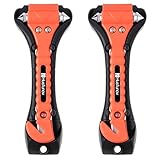
- Life-saving 2-in-1 tool:This Car Safety Hammer is a must-have for every car! It combines a window glass hammer breaker and a seat belt cutter, providing you with essential tools for emergency escape situations.Designed to break car windows in case of emergencies, our Car Safety Hammer has a sharp hammerhead that can easily shatter the glass. The built-in seat belt cutter blade ensures quick and safe seat belt release.
- Premium Material:High-grade carbon steel double-headed makes the hammer extremely sturdy, easy to break windows and save lives. The Razor-sharp blade mounted in a safe curved hook is made of high quality steel that can cut the seat belt quite easily.
- Well Designed:The bright color makes it easy to find in the dark or in a state of panic. It combines a protective bracket for safe storage. Anti-slip handle and light weight make it easy to control.
- Applicable Scenarios:Car accidents and emergencies,Be prepared for unforeseen situations on the road. Our Car Safety Hammer helps you escape from a vehicle quickly and safely in case of accidents or emergencies.In the unfortunate event of a car sinking in water, our Car Safety Hammer allows you to break the windows and swim to safety.
- Suitable for people:Whether you are a new driver or an experienced one, it is crucial to have a Car Safety Hammer within reach to ensure your own safety and the safety of others on the road.Protect your loved ones by equipping your family vehicles with this Emergency Escape Tool. Provide them with peace of mind and a reliable means of escape during emergencies.
PE25010 is not an investigation into the Toronto crash. The public NHTSA documents identify a specific U.S. model-year complaint pattern. They do not identify the Toronto vehicle or establish that its doors failed for the same reason.
NHTSA also opened Defect Petition DP25002 in December 2025 after a petition concerning the accessibility and identification of emergency egress controls in certain 2022 Model 3 vehicles. The petition alleged that a mechanical release was hidden, unlabeled and unintuitive. That proceeding involves a different Tesla model and should not be treated as a finding about the Toronto Model Y.
Low-voltage power is not the same as the high-voltage battery
Two electrical systems are relevant to this discussion:
- The high-voltage traction battery powers the electric motors. If damaged, its lithium-ion cells can enter thermal runaway and produce intense heat, gases and fire.
- The low-voltage system powers or controls many ordinary vehicle functions, including electronic locks, handles and other accessories. A low-voltage failure can create an access problem without meaning that the traction battery caused the failure.
That distinction is why a report that an electronic door handle stopped working does not, by itself, prove that the main battery was burning. Conversely, a vehicle can have a serious traction-battery fire and a separate door-access problem at the same time.
NHTSA’s external-access discussion is especially relevant to rescuers. If the low-voltage system is unavailable and there is no exterior manual release, an outside person may need to break a window or use a model-specific power-restoration procedure. Such a procedure is not a substitute for immediate emergency response and is not something a bystander should attempt around a burning or severely damaged vehicle without appropriate training.
Did the battery cause the Toronto fire?
Toronto Deputy Fire Chief Jim Jessop described an intense fire and said a battery cell was ejected by the force of the crash. He also said electric-vehicle fires can require substantial amounts of water and can reignite because of battery thermal runaway, according to CityNews’ report.
Those comments describe the hazards firefighters encountered. They do not establish:
- Whether the fire began in the traction battery or the passenger compartment.
- Whether the battery cell was ejected before or after the fire began.
- Whether the battery caused the crash.
- Whether the battery caused the deaths.
- How much water was used or how long the battery remained an ignition concern.
NHTSA says it does not believe electric vehicles generally present a greater risk of post-crash fire than gasoline-powered vehicles. That broad statement should be read alongside the more specific response hazards documented by the National Transportation Safety Board and the U.S. Fire Administration: thermal runaway, toxic or flammable gases, high-voltage shock risks, prolonged cooling and delayed reignition.
In other words, EVs have not been established as generally more likely to catch fire after a crash, but a damaged battery fire can create distinctive and difficult conditions for firefighters and rescuers.
Rank #4

- 🚔ESSENTIAL SAFETY TOOL - One end is a stainless steel seat belt cutter for cutting seatbelt, and the other end is the car window breaker tool with two hardened sharp and heavy carbon steel points, which allows you to leave the vehicle quickly in an emergency.Glass breaker and seatbelt cutter
- 🚔HIGH PERFORMANCE & DURABLE - The double-headed hammer is made of high-grade carbon steel and engineering plastics which make this car hammer very sharp and easy to break out the window for life-saving. The razor-sharp stainless steel seatbelt cutter makes cut the seatbelt in the shortest time,even underwater
- 🚔ERGONOMIC DESIGN - The anti-skid handle is long enough is approximately 5.9 inches, making it easy to control. It's compact and portable which allows it to be placed anywhere you can get in the car. The bright red for high visibility, you can find without any difficulty.
- 🚔2-PACK SAFETY HAMMERS - 2-Pack safety hammers that can be placed in different parts of your car, ready to be picked up by drivers and passengers in case of an emergency, which Increasing driving safety and can also be given to your family and friends as a surprising gift.Car window breaker tool for tesla.
- 🚔DEDICATED CUSTOMER SERVICE - We offer 90-day returns and free lifetime customer service. If you have any questions, please feel free to contact us, we will try our best to provide you with 100% satisfactory service.
Could the occupants have been incapacitated before door access mattered?
Yes. That possibility cannot be excluded from the public information.
Quick wins for a faster PC:
Fix the driver behind crashes, sound loss and screen glitchesFind Drivers →Repair Windows errors before they cause bigger problemsFix Now →The collision involved a high-speed impact with fixed objects. Such an event can cause fatal or incapacitating blunt-force injuries, loss of consciousness, seat-belt or airbag complications, and damage that makes a door impossible to open. Smoke and heat can also overwhelm occupants before they can identify an unfamiliar emergency release.
The survivor’s rescue demonstrates that at least one occupant remained able to respond or escape through a broken window. It does not show that the other four occupants were conscious, physically capable of reaching a release, uninjured enough to move, or alive at the point when rescuers began trying to open the vehicle.
There is no public basis in the supplied reporting for describing the victims as having been “burned alive,” for saying they were trapped alive, or for claiming that all four tried and failed to operate the doors. Those conclusions would require medical, coroner, emergency-call, vehicle-inspection or reliable direct-witness evidence.
Earlier and later Tesla cases are not the same incident
Reports of other Tesla crashes provide context, but they cannot be used to fill gaps in the Toronto investigation. The vehicles, model years, damage patterns and legal records differ.
Free tools Windows power users keep installed
One-click scans. No signup required.
| Incident | What was reported | Why it must remain separate |
|---|---|---|
| Florida Model S, 2019 | A lawsuit alleged that a man died in a burning Model S after retractable exterior handles failed to deploy. | This was a lawsuit allegation, not a final judicial or engineering finding. The vehicle was a Model S, not a Model Y. See ABC News. |
| Spring, Texas Model S crash | An NTSB factual report examined Tesla door operation during a 2019 crash. It noted manual operation for the front doors during total power loss and a mechanical cable for rear access, while warning responders that doors might not unlock from outside after a crash. | The report concerns a Model S and is useful historical evidence, not proof of what happened in the Toronto Model Y. See the NTSB report. |
| Toronto Model Y, October 2024 | Four occupants died after the crash and fire; a survivor was removed through a broken window after a witness said the doors could not be opened from outside. | This is the incident at issue. No public technical report has established the exact door failure, fire origin or cause of death. |
| Piedmont, California Cybertruck, November 2024 | Three college students died after a Cybertruck crash and fire. A fourth occupant survived after a rescuer broke a window. Families later alleged the door design trapped occupants. | This involved a Cybertruck, a different door design, a different crash and a separate legal record. See The Associated Press. |
| Wisconsin Model S, November 1, 2024 | All five occupants died in a crash. A later lawsuit alleged that low-voltage power loss left the Model S doors unusable. | The allegation concerns a separate Model S case and has not established what happened in Toronto. See the reported lawsuit coverage. |
| Virginia Model Y rescue | Bloomberg later reported that a state trooper broke the window of a burning Model Y when the doors would not open and rescued the driver. | That incident illustrates a potential rescue problem but is not evidence about the Toronto car. See Bloomberg’s report. |
Bloomberg’s broader investigation reported at least 15 deaths in 12 U.S. crash incidents in which occupants or rescuers allegedly encountered Tesla doors that would not open. That is an investigative-media tally, not a comprehensive government statistic, and it does not prove Tesla doors caused all 15 deaths. Car and Driver’s summary also describes the tally and its limitations.
What is the regulatory status?
The known U.S. regulatory actions concern broader or separate door-access questions:
- PE25010: NHTSA’s September 2025 Preliminary Evaluation of certain 2021 Model Y vehicles focuses on inoperative electronic door handles and outside access after low-voltage problems.
- DP25002: NHTSA’s December 2025 defect petition proceeding concerns the accessibility and identification of emergency egress controls in certain 2022 Model 3 vehicles.
- Potential Tesla redesign: Tesla design chief Franz von Holzhausen reportedly said in 2025 that the company was looking at combining electronic and manual door-release mechanisms. The scope, production timing and retrofit availability have not been established by the materials reviewed. See Bloomberg’s report.
The public materials reviewed do not show a recall or official finding attributing the four Toronto deaths to a defective Tesla door system. They also do not show that NHTSA opened a case specifically into the Toronto crash.
Independent reader supportYour contribution helps us test, update, and keep practical guides available for everyone.What Tesla owners and passengers should know
Every Tesla occupant should learn the emergency release location before an emergency, especially anyone who regularly sits in the rear. The correct procedure depends on the model, model year and configuration.
Best Value

- 🚔ESSENTIAL SAFETY TOOL - One end is a stainless steel seat belt cutter for cutting seatbelt, and the other end is the window breaker tool with two hardened sharp and heavy carbon steel points, which allows you to leave the vehicle quickly in an emergency.
- 🚔HIGH PERFORMANCE & DURABLE - The double-headed hammer is made of high-grade carbon steel and engineering plastics which make this car hammer very sharp and easy to break out the window for life-saving. The razor-sharp stainless steel seat belt cutter makes cut the seatbelt in the shortest time.
- 🚔ERGONOMIC DESIGN - The anti-skid handle is long enough is approximately 5.9 inches, making it easy to control. It's compact and portable which allows it to be placed anywhere you can get in the car. The bright red for high visibility, you can find without any difficulty.
- 🚔4-PACK SAFETY HAMMERS - 4-Pack safety hammers that can be placed in different parts of your car, ready to be picked up by drivers and passengers in case of an emergency, which Increasing driving safety and can also be given to your family and friends as a surprising gift.
- 🚔DEDICATED CUSTOMER SERVICE - We offer 90-day returns and free lifetime customer service. If you have any questions, please feel free to contact us, we will try our best to provide you with 100% satisfactory service.
Before an emergency
- Read the owner’s manual for the exact vehicle rather than relying on a generic Tesla video.
- Locate the front manual releases and, if present, the rear mechanical releases.
- Make sure regular passengers and older children know that the emergency mechanism may not be located where a conventional handle would be.
- Do not assume that a 2020–2024 Model Y has a rear manual release; Tesla’s manual says it is available only if equipped.
- Consider keeping a purpose-built window-breaking tool accessible to occupants, not buried in a trunk or inaccessible storage area. A breaker is not a guarantee of escape, and the type and location of vehicle glass can affect its usefulness.
After a serious crash or fire
- Call 911 or the local emergency number immediately and provide the vehicle location and model if known.
- Do not touch exposed orange high-voltage wiring, battery components or an ejected battery cell.
- Do not assume that a quiet, powered-down EV is electrically safe.
- Do not approach a burning vehicle unless a rescue can be attempted without creating an unacceptable risk to the rescuer.
- Firefighters and other trained responders should use Tesla’s model-specific First Responders guidance and Model Y Emergency Response Guide.
Tesla’s first-responder materials emphasize that damaged vehicles may retain dangerous energy and that responders may need to de-energize the high-voltage system during extraction. Those instructions are for trained emergency personnel, not a recommendation for bystanders to investigate a damaged battery.
What a complete investigation would need to establish
A reliable conclusion about the Toronto doors would require more than a witness seeing that they would not open. Investigators would need to determine:
- The exact Model Y trim, production date and door-release configuration.
- Whether the rear manual releases were installed in that particular vehicle.
- The condition of the 12-volt low-voltage battery, wiring, fuses, control modules and electronic latches after the crash.
- Whether the doors, hinges, latches or body structure were mechanically deformed.
- Whether fire or heat damaged the access mechanisms after impact.
- Whether any occupant attempted an interior manual release and had the physical ability to use it.
- The timing of the crash, fire growth, 911 calls, bystander rescue and firefighter arrival.
- The official cause of death for each occupant and the fire’s point of origin.
None of those questions is answered by the fact that a window was broken successfully. The broken window shows that it provided a viable rescue route for the survivor. It does not identify why the doors were inaccessible or establish that a different door design would have saved the other occupants.
What remains unknown about Toronto
The public record does not establish:
- Whether the Toronto Tesla lost low-voltage power.
- Whether its doors were electronically disabled, mechanically jammed, or both.
- Whether the rear doors had the manual-release hardware described as “if equipped” in Tesla’s older Model Y manual.
- Whether any of the four deceased occupants tried to use an emergency release.
- Whether the occupants were conscious or physically capable of escaping after the impact.
- Whether the traction battery initiated the fire.
- Whether the four victims died from trauma, smoke, burns or a combination of causes.
- Whether vehicle software or driver-assistance features played any role in the crash.
Those gaps are not minor details. They determine whether the Toronto incident was primarily a high-energy collision followed by a fire, an emergency-egress failure, a battery event, or several of those events occurring together.
Frequently Asked Questions
Did Tesla’s electronic doors cause the four deaths in Toronto?
That has not been established. The strongest public evidence is a rescuer’s account that bystanders could not open the doors from outside and had to break a window to remove the surviving woman. The public record does not identify whether the problem resulted from low-voltage power loss, crash damage, fire, a missing or inaccessible rear release, or a combination of factors.
How does a Tesla Model Y open if it loses power?
For 2020–2024 Model Y vehicles, the front manual releases are in front of the window switches. A rear mechanical release may be present under the rear-door-pocket mat and behind an access cover, but Tesla’s manual says it is available only if equipped. Tesla’s current online Model Y manual describes a revised rear release accessed through a slot in the door pocket. Owners should check the manual for their exact vehicle.
Are electric vehicles more likely than gasoline cars to catch fire after a crash?
NHTSA says it does not believe EVs generally present a greater risk of post-crash fire than gasoline vehicles. However, a damaged lithium-ion battery can create distinctive hazards, including thermal runaway, high-voltage shock, toxic or flammable gases and delayed reignition. General fire frequency and emergency-response difficulty are separate questions.
Is NHTSA investigating the Toronto Tesla crash?
The NHTSA proceedings cited here do not identify the Toronto crash. PE25010 concerns complaints involving certain U.S. 2021 Model Y vehicles, mainly outside access after low-voltage problems. DP25002 concerns emergency-release accessibility in certain 2022 Model 3 vehicles.
What’s actually slowing this PC down?
Pick the symptom - the matching free tool is one click away.
What should Tesla passengers do before an emergency?
Learn the manual-release location for the exact Tesla model and model year, and show regular passengers how to use it. Keep a window-breaking tool within reach if you choose to carry one, but call emergency services immediately after a serious crash or fire and do not approach exposed high-voltage components or a burning vehicle unnecessarily.
The Bottom Line
The Toronto crash raises a serious emergency-egress question, but it is not a completed technical finding that Tesla’s doors caused four deaths. What is established is that a high-speed Model Y crash caused a severe fire, four occupants died, and a survivor was rescued through a broken window after a witness said the doors could not be opened from outside. The unresolved issues—low-voltage power, door configuration, crash deformation, fire timing, occupant condition and official causes of death—must be answered before assigning responsibility to the electronic door design.
Quick Recap
Product prices and availability are accurate as of the date/time indicated and are subject to change. Any price and availability information displayed on Amazon at the time of purchase will apply.