Ford does not publish an official catalog of exactly 14 Mustang body styles. This guide uses an editorial count: it separates recognizable production body and roof configurations across Mustang history, including selected era-specific forms, while excluding trims and performance editions. The count is a way to organize the visual history—not Ford’s own taxonomy.
How this guide counts Mustang body styles
A body style is identified here by the shape of the body and roof, especially the profile from the windshield to the rear deck. A fastback’s sloping roof, a notchback’s distinct rear window and trunk, and a convertible’s folding top are meaningful configuration differences. Names have shifted across generations, so each entry is tied to its era rather than treated as a universal label.
The fourteen entries below include production configurations and selected roof variants. A T-top counts as a separate roof configuration for this visual guide, but it remains an option on a fastback rather than a separate base body. GT, Mach 1, Boss, Shelby, and Dark Horse are performance or appearance models, not body styles. The electric Mustang Mach-E is an SUV and is not included in this list of Mustang cars.
The 14 Mustang body and roof configurations
1. First-generation hardtop (1965–1973)
Ford’s original fixed-roof Mustang was a two-door hardtop, with a roof that meets a separate rear window and trunk rather than flowing continuously into the tail. Ford dates the Mustang debut to April 17, 1964, at the New York World’s Fair and describes the launch body as a hardtop or convertible. For the 1965 model year, the hardtop became part of a range that also included the new fastback.
Windows Errors? Fix Them Before They Spread
Repair common Windows errors and clear accumulated junk for a smoother, more stable PC - no reinstall needed.Free scan · no reinstallCrashes, No Sound, or Screen Glitches?
Random freezes, missing sound and display glitches usually trace back to one bad driver. Find and replace yours safely.Free scan · under a minute#1 Best Overall

- Pullback Action: Experience realistic racing with the pullback action feature.
- Opening Doors: Explore the intricate interior details with the opening door feature.
- 1:38 Scale: Enjoy a detailed 1:38 scale die-cast model (approx. 5 inches long).
- Authentic Design: Modeled after the iconic 1967 Ford Shelby Mustang GT500.
- Display Piece: A must-have collectible for car enthusiasts and model collectors.
2. First-generation convertible (1965–1973)
The convertible has a folding fabric top and an open cabin when the top is lowered. It was available at launch alongside the hardtop, making open-top motoring one of the Mustang’s original configurations. The body’s profile with the top raised differs from the fixed-roof car, while lowering it removes the roof altogether.
3. First-generation 2+2 fastback (1965–1966)
Ford added the 2+2 fastback for 1965. Its roofline sweeps toward the rear, blending more continuously into the tail than the hardtop’s more distinct rear-window-and-trunk profile. Ford’s launch-era history calls out hardtop and convertible availability at debut, then identifies the 2+2 fastback as a 1965 addition.
4. First-generation SportsRoof (1967–1973)
For the redesigned 1967 model year, Ford marketed the fastback as the SportsRoof. The long sloping roof and integrated rear profile remained the defining visual feature, while the later body was wider and more substantial than the original 1965–1966 fastback. “SportsRoof” is an era-specific name for this fastback form, not a trim level.
Rank #2

- Authentic Ford Design: Each model kit accurately captures the signature style and details of iconic Ford vehicles.
- Precision-Molded Parts: High-quality, finely molded components ensure a realistic and detailed build.
- Customizable Features: Includes decals and optional parts for a personalized, unique build.
- Ideal for Hobbyists: Perfect for model builders of all skill levels, from beginners to experienced collectors.
- Display-Ready Models: Create a stunning Ford model that’s ready to showcase in your collection or as a standout display piece.
5. Mustang II notchback (1974–1978)
The Mustang II returned to a separate-roof-and-trunk silhouette. Ford’s chronology identifies the 1974 car as a notchback, including the luxury Ghia model. The Ghia designation describes a model version; the notchback describes the body profile.
Quick wins for a faster PC:
Repair Windows errors before they cause bigger problemsFix Now →Scan for outdated or missing drivers - takes under a minuteDriver Scan →6. Mustang II 2+2 fastback (1974–1978)
The Mustang II was also offered as a 2+2 fastback. Its sloping rear roof contrasted with the notchback’s more upright rear window and distinct trunk. Ford’s chronology identifies both shapes for 1974, making this an especially clear period example of two body profiles sold in the same generation.
7. Mustang II fastback with T-top panels (1977–1978)
Ford notes that 1977 fastbacks could be ordered with T-top removable glass roof panels. The panels opened the cabin to the sky while retaining fixed roof sections along the sides and center; this was not a full convertible. This guide counts it as a distinct roof configuration, not as a separate base body shape.
Rank #3
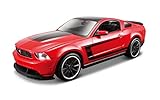
- These highly detailed kits come with everything you need to build them including the screwdriver
- Opening parts, Rolling Wheels
- Easy assembly, Pre-painted metal body
- When finished the vehicles are fully functional
- Rolling die-cast replica
8. Fox-body coupe/notchback (1979–1993)
The third-generation Fox-body Mustang offered a coupe whose rear window and trunk formed a more defined notchback profile. “Fox-body” names the generation/platform, while “coupe” and “notchback” describe its fixed-roof form. The two terms are often used together by owners, but the roof and rear-deck shape is the useful visual distinction.
9. Fox-body hatchback (1979–1993)
The Fox-body hatchback has a sloping rear window integrated with a lift-up rear hatch, rather than a separate trunk lid. Its roofline and rear opening make it visibly different from the coupe/notchback even though both are fixed-roof two-door cars.
10. Fox-body convertible (1983–1993)
Ford returned a convertible to the Fox-body lineup for 1983. Its folding top gives it an open-roof configuration distinct from the coupe and hatchback. The model-year start matters: the convertible was not part of the first Fox-body offerings.
Rank #4

- 1:25 scale, skill level 2, paint & glue required 169 parts Molded in white, clear and transparent red, with chrome-plated parts. Black vinyl tires Metal axle Built size: 7.125 inches long Ages 10+
11. SN-95 coupe (1994–2004)
The fourth-generation SN-95 coupe used a fixed roof and separate rear deck. “SN-95” is the generation/platform label; coupe is the body category. The generation’s reshaped proportions distinguish it from the earlier Fox-body coupe, though both have a distinct trunk rather than a liftback-style rear opening.
12. SN-95 convertible (1994–2004)
The SN-95 convertible kept the generation’s basic front and side design while replacing the fixed roof with a folding top. It is a separate body configuration from the coupe, not a separate performance model.
13. S197 fastback (2005–2014)
The fifth-generation S197 returned to a strongly defined fastback silhouette, with a roof that slopes toward the rear rather than ending above a separate upright rear window and trunk. This entry refers to the standard fixed-roof shape, not to a GT, Shelby, or other trim fitted with that body.
Best Value
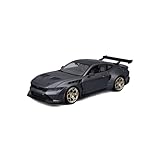
- Detailed Die-cast metal body with plastic parts
- Large Apx 9-1/2" replica
- Opening doors and engine compartment
- Full functioning steering
- Four-wheel suspension
14. S197 convertible (2005–2014)
The S197 convertible paired the generation’s styling with a folding roof. Ford’s current model presentation continues to distinguish fastback and convertible forms, but that modern naming should not be projected backward onto every historical generation.
Independent reader supportYour contribution helps us test, update, and keep practical guides available for everyone.How to tell a fastback, coupe, notchback, and convertible apart
| Configuration | Roof and rear profile | What opens or changes |
|---|---|---|
| Hardtop or coupe | Fixed roof, with a distinct rear window and trunk profile; details vary by generation. | The roof does not fold or lift as a hatch. |
| Fastback | Fixed roof slopes toward the rear and flows into a longer rear profile. | The roof is fixed; “fastback” describes its silhouette. |
| Notchback | More upright rear window meets a distinct trunk area. | The roof is fixed; “notchback” describes the rear profile. |
| Hatchback | Sloping rear glass is part of a lift-up hatch. | The rear opening lifts with the glass, unlike a separate trunk lid. |
| Convertible | Folding roof; with the top lowered, the passenger compartment is open. | The roof folds away rather than remaining fixed. |
| T-top | Removable roof panels within a roof structure, offered on Mustang II fastbacks for 1977. | Panels come out; it is not a full convertible. |
These terms are easiest to apply when anchored to a particular generation. In casual conversation, owners may call a fixed-roof Mustang a coupe even when enthusiasts also use “notchback” for its rear profile. A photograph or silhouette resolves more than the label alone.
What the body-style count leaves out
Ford’s 2026 Mustang page presents fastback and convertible configurations alongside multiple trims and editions. That is a current-year description, not a promise that the same names or lineup will apply to later model years. GT, Mach 1, Boss, Shelby, and Dark Horse refer to model, performance, or appearance identities; none creates a new roof or body shape by itself.
Ford’s family page also presents the Mustang Mach-E separately as an electric SUV. Its shared Mustang name does not make it another body style of the Mustang car described here.
What’s actually slowing this PC down?
Pick the symptom - the matching free tool is one click away.
What Ford’s early sales history says—and does not say
Ford Motor Company’s corporate history reports 103,000 fastback tops sold in the Mustang’s first two years. The same page renders the hardtop and convertible figures as “755,00” and “142,00,” respectively, so those two figures should not be silently corrected or treated as verified exact totals. The first-two-year sales figures also do not define an official body-style taxonomy.
Quick Recap
Product prices and availability are accurate as of the date/time indicated and are subject to change. Any price and availability information displayed on Amazon at the time of purchase will apply.