What’s actually slowing this PC down?
Pick the symptom - the matching free tool is one click away.
Ford’s 4.6-liter Modular V8 reached the Mustang GT and SVT Cobra for the 1996 model year, replacing the 5.0-liter engine in those applications. The 5.0 badge returned to the Mustang GT in 2011 with the 5.0-liter Coyote V8. That is the Mustang lineage—not evidence that every 4.6-liter engine in every Ford vehicle was replaced, or that every Coyote is a direct swap for a 4.6.
What is a Ford Modular engine?
“Modular” refers to a Ford engine family, not one specific displacement or a single Mustang engine. In the Mustang story, its key point of entry was the 4.6-liter V8. Ford’s Mustang timeline describes the engine as using overhead cams to operate the intake and exhaust valves. Ford’s chronology places its arrival in Mustang GTs and SVT Cobras in 1996, replacing the 5.0-liter engine in those Mustang applications. Ford’s 50 Years of Mustang Milestones and Ford de México’s Mustang chronology document that transition.
When did the Mustang move from the 4.6 to the Coyote?
The change happened in stages. The 4.6-liter Modular arrived in the Mustang GT and SVT Cobra for 1996; the 5.0-liter Coyote appeared in the Mustang GT for 2011. Ford’s milestone page describes that year as when “The 5.0 badge returns to Mustang.” For the 2011 Mustang GT, Ford listed 412 horsepower and 390 lb-ft of torque. Those figures apply to that model year and application, not every later Coyote. Ford’s Mustang milestones
Key Mustang milestones
| Model year or application | Engine milestone | What the evidence establishes |
|---|---|---|
| 1996 Mustang GT and SVT Cobra | 4.6-liter Modular V8 | Ford says it replaced the 5.0-liter engine in these Mustang applications; its timeline notes overhead cams. Ford Motor Company |
| 2011 Mustang GT | 5.0-liter Coyote V8 | The 5.0 badge returned; Ford listed 412 hp and 390 lb-ft for this GT. Ford Motor Company |
| 2018 Mustang GT | Third-generation 5.0-liter Coyote | Ford described an aluminum block, plasma-treated cylinder bores, Ti-VCT, a variable-pressure oil pump, and 12:1 compression. Ford South America |
| Later Mustang applications | Fourth-generation 5.0-liter Coyote in Dark Horse; 5.4-liter Coyote-based V8 in Mustang GT3 | Ford identifies these applications, but the shared family name does not establish parts interchange. Ford of Canada |
Is the Coyote a Modular engine?
The Coyote belongs to the broader Ford V8 story, but “Modular” and “Coyote” are not interchangeable labels. Modular identifies an engine family; Coyote identifies the 5.0-liter V8 introduced in the 2011 Mustang GT and developed through later generations. A Coyote’s family name or displacement alone does not tell you that its components fit a particular 4.6-liter installation.
Do these 3 things before closing this tab:
1Fix the driver behind crashes, sound loss and screen glitches2Clear out junk files and repair common Windows errors3Scan for outdated or missing drivers - takes under a minute#1 Best Overall
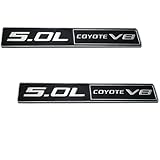
- 5.0L Coyote v8 Emblem is made of High-quality Metal Materials to ensure that it will not fade or fall off during long-term use.
- 5.0L Coyote V8 Emblem Fit for F150 for Mustang for Other 5.0L Engine Trunk Car
- Size:5.2inch*0.7inch*0.4inch;Weight:0.05Kg
- 5.0L Coyote V8 Emblem Adopting 3D design, after electroplating process, the surface is smooth and metal style.
- Easy to install,Please keep the car body dry and clean before installation
How do the 4.6-liter Mustang V8 and Coyote differ?
The clearest comparison is historical and application-specific: the 4.6-liter was the Mustang GT and SVT Cobra V8 beginning in 1996, while the Coyote became the Mustang GT’s 5.0-liter V8 for 2011. The available official specifications below describe particular model years, rather than every engine sold under either family name.
2011 Coyote output
Ford listed 412 horsepower and 390 lb-ft for the 2011 Mustang GT’s 5.0-liter Coyote. That is a dated factory figure for that model, not a blanket specification for all Coyote engines. Ford Motor Company
Rank #2

- Camshaft Alignment Holding Tool: Compatible with Ford 5.0 Coyote engine 2010-2017; Just used for the Gen 1 & Gen 2 5.0 Coyote engine (2010 2011 2012 2013 2014 2015 2016 2017)
- Crankshaft Positioning Tool: Compatible with Ford 1993-newer 4.2L V6; 4.6L 2 valve, 4.6L 4-valve V8, 5.4L V8, and 6.8L V10 engines. Replace 303-448, T93P-6303-A, 6024 & 525219
- Function: Camshaft alignment holding tool is used for locking the camshaft in right position when replace timing chain, and crankshaft positioning tool is used to make the crankshaft align and hold on Top Dead Center( TDC ) for correct timing chain installation
- High Quality Material: Made of high quality steel and has been forged and heat-treated multiple times, it is very sturdy and durable, and also has the characteristics of anti-corrosion, which is not easy to damage
- Tips for Use: These engines are not freewheel engines. Do not rotate the crankshaft and/or camshaft when removing the timing chain and installing the cylinder head. If “timing jump” occurs, it will cause damage to the valves and/or pistons, requiring the cylinder head to be removed.
2018 third-generation Coyote details
For the 2018 Mustang GT, Ford described a third-generation 5.0-liter Coyote with an aluminum block, plasma-treated cylinder bores, Ti-VCT, a variable-pressure oil pump, and a 12:1 compression ratio. Ford South America reported 466 CV at 7,000 rpm and 556 Nm at 4,625 rpm for the Brazil-market 2018 Mustang GT. CV and Nm are the units in that regional release; do not treat those figures as universal Coyote output. Ford South America’s 2018 technical release
Later Coyote applications
Ford identifies a fourth-generation 5.0-liter Coyote in the Mustang Dark Horse. Ford de México announced 500 horsepower and 418 lb-ft for that Dark Horse application. Separately, Ford describes the Mustang GT3 as using a 5.4-liter Coyote-based V8. The GT3 engine’s race-car application and larger displacement are important distinctions; neither fact supplies a general interchange specification for road cars. Ford de México and Ford of Canada
Rank #3

- 1:4 SCALE MODL WITH MOVING PARTS; Clear Engine Casing So You Can See All the Parts Move, LED Lights Simulate Spark Plugs Firing; Fan Spins, Crank Turns, Just like Original
- 100 PAGE COLLECTOR'S BOOK; Full Color Photos, History and Facts about the Ford Mustang, Clear Instructions for Building
- NO GLUE REQUIRED; Builds in a Couple Hours with the Included Tools.
- ELECTRONIC SOUND MODULE: Electric Display Base Plays Sounds Recorded From Actual 1965 Ford Mustang
Can you swap a Coyote into a car that had a 4.6?
There is no universal yes-or-no answer established by the Mustang history and specifications above. A swap depends on the exact recipient vehicle and model year, the Coyote generation and donor vehicle, and the supporting parts and systems. Do not assume that a Coyote bolts in because both engines are Ford V8s or because the recipient once used a Modular 4.6.
Quick Recap
Rank #4

- Application: This timing tool set is compatible with Ford Mustang F150 5.0L Coyote engine 2018-2023, and only used for third generation engines. Partial accessory are compatible with Ford 4.6L 5.4L 5.2L 5.8L 6.2L 6.8L engine(Please see details below)
- Function: Used to hold the cams ensure camshaft alignment when replace timing chain; Designed to compress valve springs and replace valves, springs, and retainers, etc; and used to hold crankshaft for correct timing chain installation
- OEM Equivalent Part Number: 303-448, T93P-6303-A, 6024, 525219
- High Quality Material: Made of high quality steel and has been forged and heat-treated multiple times, it is very sturdy and durable, and also has the characteristics of anti-corrosion, which is not easy to damage
- A Complete Set: This kit includes camshaft alignment holding tool, flywheel flexplate holding locking tool, crankshaft positioning tool, valve spring compressor tool,magnetic screwdriver, 4pcs bolts, 1pc 3/8" long bolt and 1pc portable case
What to verify before buying an engine
- Identify the exact engines: record the recipient’s year, model, and original 4.6 configuration, then identify the donor engine’s generation, year, and application.
- Check packaging: confirm engine-bay clearance, mounts, oil-pan clearance, and any chassis-specific constraints for the exact vehicles.
- Plan controls and wiring: verify the engine-management system, wiring, sensors, and any required integration with the recipient’s systems.
- Match the drivetrain and accessories: confirm transmission compatibility and account for accessory layout and related supporting components.
- Define intended use: a street build and a competition build may call for different supporting equipment and compliance checks.
- Confirm parts fitment for the exact combination: get application-specific documentation or guidance before purchase; the engine family name is not an interchange chart.
Product prices and availability are accurate as of the date/time indicated and are subject to change. Any price and availability information displayed on Amazon at the time of purchase will apply.




