Quick wins for a faster PC:
Scan for outdated or missing drivers - takes under a minuteDriver Scan →Repair Windows errors before they cause bigger problemsFix Now →Ford and Mazda’s relationship grew from an early vehicle-supply arrangement into a broad alliance involving ownership, management, product development, manufacturing, procurement, and distribution. Ford’s stake peaked at 33.4%, but the companies did not merge, and not every Ford-era Mazda was a rebadged Ford. Ford later sold down its stake; today, their clearest continuing tie is the 50:50 AutoAlliance Thailand manufacturing joint venture.
How the Ford–Mazda relationship began
Cooperation began before the formal equity alliance. Mazda’s corporate history records that Mazda began supplying Ford’s Courier/Proceed small pickup in 1971. Ford and Mazda also participated with Nissan in an agreement to establish Japan Automatic Transmission Company in 1969.
In November 1979, Ford acquired a 25% shareholding in Toyo Kogyo, Mazda’s parent company. Mazda’s historical account describes the arrangement as both a capital tie-up and an operational relationship: commissioned manufacturing for Ford expanded from small commercial vehicles to transmission units and small passenger vehicles.
From investment to strategic alliance
In December 1993, Ford and Mazda agreed to build a global strategic alliance. Mazda’s histories describe cooperation in areas including product development, manufacturing, and distribution. The relationship therefore went beyond occasional rebadging, though the degree of sharing varied by program.
Do these 3 things before closing this tab:
1Scan for outdated or missing drivers - takes under a minute2Clear out junk files and repair common Windows errors3Fix the driver behind crashes, sound loss and screen glitches#1 Best Overall

- 1:18 Special Edition. Detailed die-cast precision model. Large - approx 9.5" replica.
- Die-cast metal body. Opening doors and engine compartment.
- Full functioning steering. Four-wheel suspension.
- Detailed chassis with separate exhaust system.
- Mounted on plastic stand.
Ford increased its Mazda holding to 33.4% in 1996. Mazda says Ford appointed Henry D. G. Wallace as its first non-Japanese president and CEO, while Mazda pursued restructuring under its Millennium Plan. Ford had significant influence and management involvement, but did not own Mazda outright or replace its separate brand.
Mazda’s account links this period to business streamlining and a clearer brand position. Mazda continued to launch its own products, including the Atenza/Mazda6, Demio/Mazda2, and Axela/Mazda3, under its Zoom-Zoom strategy.
What Ford and Mazda shared
The alliance included capital and governance, product development, manufacturing, technology information, procurement, and distribution. Mazda’s historical and investor materials describe cooperation involving engines, transmissions, and global vehicle programs, but they do not justify treating every model or component as shared.
| Area | What the evidence supports |
|---|---|
| Ownership and management | Ford held a 25% stake from 1979 and raised it to 33.4% in 1996; Ford supplied senior management during the management period that ended in 2008. |
| Vehicles and technology | The companies coordinated on product development and technology, with the extent of sharing differing by program and market. |
| Manufacturing | They operated joint manufacturing ventures in the United States and Thailand. |
| Business operations | Mazda described benefits from coordination in procurement and distribution as well as product programs. |
A shared plant, component, or development program does not make two vehicles mechanically identical. Styling, tuning, equipment, software, and brand positioning could differ. It is more accurate to identify a particular program than to call an entire generation of cars a rebadge.
Notable shared vehicle and manufacturing programs
Courier and Proceed
Mazda’s history records that it supplied Ford’s Courier/Proceed small pickup beginning in 1971, before the formal 1979 equity tie-up. This early program illustrates that practical cooperation preceded common ownership.
Rank #2
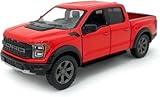
- Offical Licensed 2022 FORD F-150 Raptor
- Die Cast Metal Body w/ Plastic Parts
- 1:46 Scale, 46 Times Smaller The the Real F-150
- 5" 4 Set - Black, White, Red, Blue
- Front Doors Open - Pullback Action
Ranger and Mazda pickups in Thailand
AutoAlliance Thailand began producing Ford Ranger and Mazda Fighter/B-Series pickup trucks in 1998. Mazda later began BT-50 production at the plant in February 2006. These programs connected the brands through manufacturing and related pickup programs; details should be understood in their specific market and production context.
Mazda2 and Ford Fiesta
AutoAlliance Thailand’s passenger-car plant opened in 2009 and was designed to produce the Mazda2 and Ford Fiesta for Thailand and Asia-Pacific export markets. This is an example of shared production infrastructure, not proof that the two models were identical.
AutoAlliance International in Michigan
AutoAlliance International became a 50:50 Ford–Mazda joint venture in June 1992. Mazda later described the facility as producing the Mazda6 alongside Ford-related products. This U.S. venture is a historical chapter, not a current Mazda production facility according to Mazda’s current facilities information.
Why Ford reduced its ownership
Ford began reducing its Mazda stake after the 2008 financial crisis. Mazda’s history says Ford gradually sold its shares, ending Ford’s 12-year management of Mazda. In November 2008, the companies agreed to continue their strategic relationship even as Ford reduced its holding.
In November 2010, Ford announced it would transfer most of its remaining Mazda shares to Mazda business partners. Mazda said Ford was expected to retain 3.5% after the transaction, with the companies intending to keep cooperating where mutually beneficial. Mazda’s fiscal-2015 materials later reported that Ford’s holding had fallen to 2.1% following further Ford sales and Mazda capital increases, while describing continuing cooperation through joint ventures, projects, and technology-information exchange.
Rank #3

- Pullback Action: Experience realistic racing with the pullback action feature.
- Opening Doors: Explore the intricate interior details with the opening door feature.
- 1:38 Scale: Enjoy a detailed 1:38 scale die-cast model (approx. 5 inches long).
- Authentic Design: Modeled after the iconic 1967 Ford Shelby Mustang GT500.
- Display Piece: A must-have collectible for car enthusiasts and model collectors.
Mazda’s shareholder disclosure for March 31, 2026 lists Toyota Motor Corporation at 5.1% among major shareholders and does not list Ford. The evidence supports the conclusion that Ford no longer has a material disclosed ownership position in Mazda.
What remains today
The former broad relationship under common ownership has ended, but a specific manufacturing partnership remains. AutoAlliance Thailand says it was established in 1995 as a Ford–Mazda joint venture. Mazda’s Integrated Report 2024 identifies the Rayong facility as a current production site, with Mazda and Ford each holding a 50% investment ratio. Mazda lists the Mazda2, Mazda3, CX-3, and CX-30 among its primary products there.
AutoAlliance Thailand reported reaching four million cumulative units in 2024. In February 2025, Mazda announced plans to invest 5 billion Thai baht to strengthen the facility as a manufacturing hub for new compact SUVs, with planned annual capacity of 100,000 units and an export focus on Japan and ASEAN markets. These are figures and plans reported by Mazda and AutoAlliance Thailand, not evidence that Ford regained its former corporate control.
Independent reader supportYour contribution helps us test, update, and keep practical guides available for everyone.What the alliance meant for both companies
For Mazda, the relationship brought capital, management support, manufacturing opportunities, procurement advantages, and access to Ford’s scale during a period of restructuring. For Ford, it provided access to Mazda vehicles, engineering, manufacturing capacity, and regional products.
The result was neither a single shared lineup nor a simple takeover. Some programs involved shared production or development; others remained Mazda-specific. The alliance’s history is best understood as an evolving business relationship whose scope changed over time.
Rank #4

- These highly detailed kits come with everything you need to build them including the screwdriver
- Opening parts, Rolling Wheels
- Easy assembly, Pre-painted metal body
- When finished the vehicles are fully functional
- Rolling die-cast replica
FAQ
Did Ford own Mazda?
Ford never owned Mazda outright. Mazda’s corporate history records a 25% Ford stake from 1979 and a peak holding of 33.4% after Ford increased its stake in 1996. Ford had substantial influence and management involvement, but Mazda remained a distinct company and brand.
Did Ford and Mazda end their relationship in 2008?
No. Ford’s ownership and management role contracted, but the companies continued strategic cooperation. Mazda’s later materials describe ongoing projects and joint ventures, and AutoAlliance Thailand remains a 50:50 Ford–Mazda venture.
Are Ford and Mazda cars the same?
Not generally. The companies shared some manufacturing, development, technology, or vehicle programs, but the level of commonality varied. A specific model’s generation, market, and production period matter when assessing what was shared.
Are Ford and Mazda still partners?
They are no longer under common ownership, and Ford is not listed among Mazda’s major shareholders in Mazda’s disclosure dated March 31, 2026. They do continue to share ownership of AutoAlliance Thailand, a manufacturing joint venture.
Quick Recap
Product prices and availability are accurate as of the date/time indicated and are subject to change. Any price and availability information displayed on Amazon at the time of purchase will apply.
What’s actually slowing this PC down?
Pick the symptom - the matching free tool is one click away.