Free tools Windows power users keep installed
One-click scans. No signup required.
Short answer: The Ford Barra is Australia’s closest cultural equivalent to Toyota’s 2JZ: a smooth, factory-produced inline-six with turbocharged versions, a strong enthusiast following, and enormous tuning potential. The comparison is useful as shorthand, but it does not mean the engines are mechanically identical. The Barra is Ford Australia’s larger 4.0-liter, long-stroke six-cylinder family, while the famous 2JZ-GTE is Toyota’s 3.0-liter JZ-series engine.
What makes the Barra special is the combination of displacement, factory turbo variants, a cast-iron block, modern engine control, and a large Australian performance aftermarket. What makes Barra ownership difficult is its size, age, variant complexity, electronics, and the fact that a used engine’s condition matters far more than its reputation.

As an Amazon Associate I earn from qualifying purchases.
What is the Ford Barra engine?
“Barra” is the common name for Ford Australia’s modern 4.0-liter straight-six family introduced with the BA Falcon program in 2002. It was not an entirely unrelated clean-sheet engine; it evolved from Ford Australia’s earlier locally developed inline-six engines into a dual-overhead-camshaft, four-valves-per-cylinder design with variable cam timing.
The name is generally associated with “Barramundi,” the development codename connected with the BA Falcon program. The result was a family of naturally aspirated, turbocharged, LPG, and later EcoLPi engines used across Falcon sedans, utes, and performance models.
#1 Best Overall

- LS Engine Swap Mount: There is slotted for adjustment with engine placement in the engine compartment.These mounts allows the installation of 4L60E,4L65E,TH350,TH400,TH700R4,4L80 and any other combination of standard or automatic transmissions
- Fit for: ALL Chevrolet LS Series Engines:LS1, LS2, LS3, LS6, LS7, LS9, GM 4.8L 5.3L 5.7L 6.0L 6.2L(1997-2014),also 1999-2013 4.8L,5.3L,6.0L,6.2L Vortec Truck Engines.The details under the description
- Compatible with: 1973-1998 OBS and Square Body Chevy/GMC 2WD 4WD,full Size C/K Trucks,Jimmy, Sierra, Scottsdale, Silverado, Cheyenne, C10, C20, C1500, C2500, C3500.The details under the description
- Stable: High Carbon cold rolled steel and accurate accessory size,easier installation and more stable
- Attention: We sincerely appreciate the purchase of our ls swap motor mounts.If product has any quality issues, you can request to send a new product, we value your shopping experience
The core architecture is approximately 4.0 liters, with a bore of about 92.3 mm and a stroke of about 99.3 mm. That makes the Barra relatively long-stroke or undersquare. It uses an inline-six layout, a cast-iron block, and an aluminum cylinder head. Ford’s later documentation identifies naturally aspirated, EcoLPi, and turbocharged 4.0-liter DOHC DI-VCT configurations, showing why “the Barra” should be understood as a family of related engines rather than one fixed specification. The FG-X owner documentation is particularly useful for seeing those configurations together.
The important distinction: A Barra 190, a Barra 245T, an E-Gas engine, and an FG 270T share family DNA, but they do not necessarily share compression ratio, pistons, rods, intake and exhaust hardware, fuel system, sump, accessories, ECU, wiring, or calibration.
Factory Barra variants and representative specifications
Factory output changed with model year, emissions calibration, fuel type, transmission, turbocharger, and vehicle application. The figures below are representative ratings, not universal specifications for every engine carrying the Barra name.
Do these 3 things before closing this tab:
1Scan for outdated or missing drivers - takes under a minute2Repair Windows errors before they cause bigger problems3Fix the driver behind crashes, sound loss and screen glitches| Variant or family | Typical application | Representative factory output | What matters when buying or swapping |
|---|---|---|---|
| Barra 182 | Early BA naturally aspirated Falcon | 182 kW-class | Early DOHC/VCT naturally aspirated specification |
| Barra 190 | BF Falcon and ute | 190 kW at 5,250 rpm; 383 Nm at 2,500 rpm | Representative naturally aspirated BF specification |
| Barra 240T/245T | BA and BF turbo Falcons, including XR6 Turbo applications | Approximately 240–245 kW; up to about 480 Nm in BF specification | Turbo-specific compression ratio, hardware, fuel system, and calibration |
| Barra 270T | FG-era turbo Falcon | 270 kW-class | Later intake, turbocharger, electronics, and vehicle-integration revisions |
| FPV F6 variants | FPV performance Falcon applications | Higher output than standard XR6 Turbo versions | Specific turbo, intercooler, calibration, and internal-equipment combinations |
| E-Gas and EcoLPi | LPG-fuelled Falcon applications | Separate LPG-focused ratings | Distinct fuel-system hardware and calibration; not a simple gasoline conversion |
The BFII specification sheet lists the Barra 190 at 190 kW and 383 Nm, and the Barra 245T at 245 kW and 480 Nm. It also lists compression ratios of 10.3:1 for the naturally aspirated engine and 8.7:1 for the turbo engine, while retaining the same 92.3 mm bore and 99.3 mm stroke dimensions. Those figures illustrate the key point: two engines with the same displacement and basic family identity can be configured very differently. See the BFII factory specification sheet for the published comparison.
Barra generations: BA, BF, FG, and FG-X
BA Barra
The BA Falcon introduced the modern Barra family in 2002. It established the basic 4.0-liter DOHC and variable-cam-timing architecture in naturally aspirated and turbocharged forms.
BA engines can be attractive to swap builders because they are older and may be less electronically integrated than later Falcons. That is not the same as saying they are simple. Age-related wiring faults, immobilizer systems, donor-specific ECUs, sensor differences, and the condition of the engine and accessories can be more important than the BA badge itself. The original BA Falcon specification material provides useful baseline information.
BF and BF Mark II
BF revisions brought changes to output, calibration, and components. The BFII specification sheet is valuable because it presents naturally aspirated, E-Gas, and turbocharged six-cylinder data together.
What’s actually slowing this PC down?
Pick the symptom - the matching free tool is one click away.
A BF engine should still be identified by its actual donor configuration, engine markings, attached hardware, and documentation. A seller’s description such as “BF Barra turbo” is not enough to establish which ECU, fuel system, sump, accessories, sensors, or transmission interfaces are included.
FG and FG-X
The FG generation introduced further revisions to the intake system, cylinder head, turbocharger, electronic controls, and vehicle integration. The FG-X continued with naturally aspirated gasoline, EcoLPi, and turbocharged 4.0-liter DOHC DI-VCT configurations.
FG engines can offer a more modern factory package, but they can also bring more integration work when transplanted into an unrelated chassis. The engine, ECU, body-control systems, immobilizer, instruments, transmission, and CAN communication may all be part of the swap problem.
Rank #2
Haltech’s compatibility documentation covers Barra 182, 190, 240T, 245T, and 270T applications across BA, BF, and FG variants. Its warning is important: the model and variant must be selected correctly, because an incorrect configuration can cause malfunctions. This is one reason the complete donor package is often more valuable than a bare long-block.
Why the Barra became known as Australia’s 2JZ
The nickname is fair in a cultural and enthusiast sense. Both engines:
- use a smooth, naturally balanced inline-six layout;
- have factory turbocharged versions associated with substantial aftermarket power;
- can be developed in stages instead of requiring an exotic racing engine from the outset;
- have become symbols of the performance scenes in their home markets; and
- have inspired swaps, drag builds, street cars, and extensive tuning communities.
The nickname is misleading if it suggests identical engineering. The 2JZ-GTE is Toyota’s 3.0-liter cast-iron inline-six, most famously associated with the Supra, and used Toyota-specific sequential turbocharging and engine-management systems. The Barra is a larger 4.0-liter Ford Australia engine with its own turbocharger, cylinder-head, cam-control, fuel, ECU, and vehicle-integration variations. A useful cultural comparison is discussed in Speedhunters’ coverage of the Barra and 2JZ comparison.
| Question | Barra | 2JZ |
|---|---|---|
| Basic layout | Ford Australia 4.0-liter inline-six | Toyota JZ-family 3.0-liter inline-six in 2JZ form |
| Why enthusiasts value it | Large displacement, turbo factory variants, local Australian support, and tunability | Strong turbo reputation, global recognition, and a mature international swap ecosystem |
| Turbo system | Varies by BA, BF, FG, FPV, and specific calibration | 2JZ-GTE used Toyota-specific sequential turbocharging |
| Swap character | Physically large and heavily dependent on donor electronics and chassis packaging | Also requires substantial integration, but may have broader availability outside Australia |
| Which is better? | Neither universally. The best choice depends on the chassis, market, budget, parts access, power target, and electronics strategy. | |
The Barra’s larger displacement gives it a different torque and packaging character from the 2JZ. Australian builders may also have better access to Falcon donors and specialist Barra parts, while builders elsewhere may find the 2JZ ecosystem easier to source. That is a project-planning conclusion, not a claim that one engine has a universally higher limit or better design.
Naturally aspirated, turbo, LPG, and EcoLPi Barra engines
Naturally aspirated Barra
Naturally aspirated engines are often less expensive to buy and can be suitable for a period-correct Falcon restoration, a mild street project, or a swap where turbo power is not required. They should not automatically be treated as turbo engines waiting for a turbocharger.
Compression ratio, piston and connecting-rod specification, exhaust and intake hardware, fuel delivery, oil-pan configuration, ECU calibration, and accessories can differ. Converting a naturally aspirated engine may require considerably more than adding a turbo, intercooler, and exhaust. The exact donor and the intended power level determine whether the conversion makes technical and financial sense.
Factory turbo Barra
A turbo Barra provides the most straightforward factory starting point for a turbo-focused build because the donor already has turbo-oriented compression, hardware, engine management, and supporting systems. Even then, “turbo engine” is not a sufficient specification. A BA 240T, BF 245T, FG 270T, and FPV F6 engine are not interchangeable descriptions.
When comparing two turbo engines, identify the complete configuration: engine generation, turbocharger, intake manifold, exhaust manifold, injectors, fuel rail, throttle body, coils, sensors, ECU, wiring, sump, accessories, flexplate or flywheel, and transmission.
E-Gas and EcoLPi
LPG versions require particular caution. E-Gas and EcoLPi engines use LPG-focused fuel-system hardware and calibration. Ford’s FG-X documentation identifies EcoLPi as a distinct 4.0-liter DOHC DI-VCT configuration, rather than simply a gasoline engine with a different fuel in the tank.
Quick wins for a faster PC:
Fix the driver behind crashes, sound loss and screen glitchesFind Drivers →Clear out junk files and repair common Windows errorsFree Scan →Before buying one for a conversion, establish exactly which long-block, injectors, rails, sensors, ECU, wiring, fuel tank and delivery system are included. A gasoline swap plan cannot be assumed to work with an LPG donor without substantial fuel-system and control changes.
Rank #3
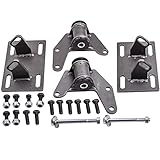
- LS Engine Swap Mount: For 1978-1988 G-body LS Engine adapter Set, for Chevrolet Monte Carlo LS, for LS1 LS2 LS3 LS6 LS LQ4 LQ9 4.8L 5.3L 6.0L 6.2L
- Upgrade Design: Adjustable conversion mounts are slotted for adjustment with engine placement in the engine compartment, to eliminates clearance and fitment issues when installing your LS engine
- Feature: These mounts will offer you to move the engine from the original bell housing position up to 1/2 inches forward, and up to 1 inch rearward
- Package Contents: 2 x mount plates, 2 x frame mounts, 8 x mount bolts, 2 x motor mount bolts & Washers, 6 x Hex nuts
- Premium Materials: The bracket is made of high-strength steel, precision-cut with 1/4-inch laser for durability. The polyurethane bushing offers excellent wear and corrosion resistance, effectively reducing vibration during use
Why turbo Barra engines have such a strong reputation
The formula is straightforward: six cylinders in line, four liters of displacement, factory turbocharging, modern engine control, and a production-car foundation that can be modified in stages. The large displacement can produce strong torque without relying on the same operating conditions as a smaller engine, while the inline-six layout provides smoothness and an orderly exhaust arrangement.
However, the cast-iron block is not an “unlimited horsepower” guarantee. Reliable high-output performance depends on the particular engine’s condition, piston and rod specification, turbocharger, intercooling, fuel delivery, ignition, cooling system, oil control, drivetrain, and calibration.
Garrett lists a turbocharger application for the FG Falcon XR6/G6E with the Barra 270T. Garrett has also documented a Barra-powered FG F6 project producing more than 1,000 horsepower with a larger G-Series turbocharger. That is evidence of what a specific, extensively modified project achieved—not a safe stock-engine limit, a warranty, or a result every used Barra can reproduce. The project coverage describes a purpose-built combination with substantial turbo and supporting-hardware work.
For an FG 270T owner investigating an exact replacement application, the Garrett 770596-5002S turbocharger is an example of why fitment must be checked by application, not merely by the word “Barra.” A turbocharger that is correct for an FG Falcon XR6/G6E is not automatically correct for a BA, BF, FPV, or custom swap.
Reliability: capable platform, not indestructible engine
Barra reliability discussions often become too absolute. A well-maintained, standard or lightly modified engine with a suitable tune, adequate fuel delivery, and a healthy cooling system is very different from a high-mileage engine with unknown boost history and repeated detonation.
For a used engine, the main risks are condition-related:
- poor oiling history, low oil pressure, sludge, or bearing wear;
- overheating or evidence of cooling-system contamination;
- worn piston rings, cylinder walls, or valves;
- timing-component wear and cam-control faults;
- turbocharger shaft, bearing, or seal problems;
- detonation damage from an earlier tune;
- crankcase-ventilation problems;
- damaged sensors, coils, injectors, or wiring; and
- fuel-delivery, intercooling, boost-control, and calibration failures on turbo builds.
An iron block helps explain the engine’s reputation, but it does not remove heat, lubrication, cylinder-pressure, or tuning limits. A reliable high-output build also needs appropriate machining, fasteners, fuel-system capacity, engine protection, and professional calibration where the power target and duty cycle justify them.
Recommended Free Tools
How to inspect and buy a used Barra
Do not buy a used engine based only on “4.0 turbo,” “low kilometer,” or a claimed horsepower figure. The engine’s identity and included parts are as important as the long-block itself.
1. Confirm the exact engine and donor
- Record the BA, BF, FG, or FG-X donor generation.
- Confirm naturally aspirated, turbo, E-Gas, or EcoLPi status.
- Verify the engine markings and available donor documentation.
- Identify the original transmission and whether the engine was paired with a manual or automatic.
- Ask what modifications and tune the engine previously ran.
2. Request meaningful condition evidence
Compression and leak-down results are more useful than a seller’s general assurance that the engine “ran perfectly.” If you are inspecting an engine yourself, an automotive compression tester and a leak-down tester can help establish whether the cylinders are broadly consistent and whether leakage points toward the rings, valves, or head gasket. The test procedure, engine temperature, throttle position, battery condition, and interpretation all matter, so unexplained numbers should not be treated as proof of health.
- Inspect the oil and coolant for signs of contamination.
- Look for evidence of overheating, repaired head-gasket problems, or neglected cooling maintenance.
- Check turbocharger shaft movement, compressor damage, oil leakage, and exhaust-side condition.
- Inspect crankcase ventilation, hoses, connectors, coils, sensors, and damaged wiring.
- Ask for oil-pressure information where available.
3. Establish what is actually included
A “complete engine” is often incomplete from a swap perspective. Confirm whether the sale includes the correct:
- sump and pickup;
- intake and exhaust manifolds;
- turbocharger and wastegate or boost-control hardware;
- intercooler plumbing;
- injectors, fuel rail, and throttle body;
- coils and sensors;
- alternator, starter, power-steering and air-conditioning accessories;
- engine harness and ECU;
- immobilizer-related components and keys;
- flywheel or flexplate; and
- transmission interface and mounting hardware.
A generation-specific Ford Falcon workshop manual is also a useful companion for identification, wiring, torque procedures, servicing, and troubleshooting—but match its coverage to the actual BA, BF, FG, or FG-X vehicle. A manual for the wrong generation can create as much confusion as it resolves.
Crashes, No Sound, or Screen Glitches?
Random freezes, missing sound and display glitches usually trace back to one bad driver. Find and replace yours safely.Free scan · under a minutePC Slower Than It Used to Be?
A free scan shows the junk files, broken settings and background clutter dragging Windows down - then fixes them in one click.Free scan · Windows 10 & 114. Price the entire project
The purchase price is only one line in a Barra swap budget. Include mounts, sump modifications, exhaust, radiator, fans, intercooler, piping, fuel delivery, ECU and tuning, driveshaft, differential, transmission control, wiring, gauges, brakes, and certification or inspection work.
Rank #4

- FUNCTION: Our LS engine brackets allow you to easily bolt an LS series engine into your vehicle, even if it originally had a small block Chevy engine.
- GREAT DESIGN: Our brackets are designed to fit your vehicle perfectly, with OEM specifications that ensure the best possible fitment. Plus, they'll move the crankshaft centerline up .17 inches in your vehicle for improved performance.
- PREMIUM QUALITY: Our adapter plates are CNC milled from aluminum, making them the most accurate and durable option available.
- EASY INSTALLATION: Our swap motor mounts for LS require no grinding for a flush fit. We've milled out the necessary opening in the center of the plate to clear the hump on the backside of your SBC/BBC motor mounts.
- COMPLETE PACKAGE: You'll receive everything you need to install our brackets, including 2 adapter plates, 8 flat head bolts, and 6 flange M10-1.5 bolts. The plates are M10 threaded, so you can use the hardware included.Plus, with a 180-day warranty, you can buy with confidence.
Swapping a Barra into another chassis
The Barra is physically large for an inline-six. A factory Falcon installation does not guarantee that the same engine will fit or function in a different vehicle. Before buying the engine, measure and plan for:
- engine-bay length, width, and height;
- sump position and crossmember clearance;
- steering shaft, steering box, brake-booster, and master-cylinder clearance;
- exhaust-side space and turbocharger location;
- radiator, fan, intercooler, and intake placement;
- transmission tunnel and shifter position;
- engine mounts and transmission crossmember;
- driveshaft length and differential strength;
- fuel tank, pump, return or returnless system, and fuel lines;
- ECU, immobilizer, dashboard, body-control, and CAN requirements; and
- local emissions, noise, engineering, registration, and inspection rules.
The electrical plan should be decided before the engine is installed. A builder may retain a suitably matched factory ECU and donor electronics, or use a supported aftermarket management system. Neither route is automatically easier.
Haltech’s Barra documentation lists BA, BF, and FG compatibility, manual-transmission applications, and the ZF 6HP26 automatic in supported configurations. It also states that the ECU requires correct configuration before the vehicle will start and warns that selecting the wrong model or variant can cause malfunctions. The Haltech Barra ECU overview should therefore be treated as a compatibility reference, not as permission to assume every Barra and transmission combination is plug-and-play.
The Tool Desk
Outbyte PC Repair FREEClear out junk files and repair common Windows errorsFree Scan →Outbyte Driver Updater FREEFix the driver behind crashes, sound loss and screen glitchesFind Drivers →For a supported BA, BF, or FG Falcon application, the Haltech Elite PRO Plug-in ECU HT-154000 is a relevant engine-management option to investigate. The official Haltech product information identifies the unit for those Falcon I6 Barra applications, including naturally aspirated and turbo configurations and selected automatic-transmission support. A custom-chassis swap still requires careful wiring, configuration, sensor selection, immobilizer planning, and tuning.
Independent reader supportYour contribution helps us test, update, and keep practical guides available for everyone.Supporting systems matter as much as the long-block
A sensible Barra project is a system, not an engine purchase. The following areas deserve attention before increasing boost or chasing a dyno number.
Fuel system
Injectors, pump capacity, wiring, fuel pressure control, filters, lines, and fuel quality must match the target power and fuel type. A turbo engine that runs out of fuel can suffer damage quickly, even if the long-block is otherwise healthy. LPG hardware should not be mixed into a gasoline plan without confirming compatibility.
Cooling and intercooling
More power creates more heat. Radiator capacity, fan control, thermostat and hose condition, intercooler efficiency, charge-air plumbing, and airflow through the front of the vehicle all matter. An intercooler kit must match both the chassis generation and the intended turbocharger and piping arrangement.
For builders comparing chassis-specific options, a Plazmaman BA/BF or FG Barra intercooler kit is an example of a fitment-sensitive product category. BA/BF and FG kits are not interchangeable by name alone; verify the chassis, bumper, radiator support, turbo outlet, throttle-body position, and intended power range before ordering.
Engine management and calibration
The ECU must correctly control fuel, ignition, throttle, cam timing, boost, and engine protection strategies. A calibration that is safe on one turbo, injector set, fuel, and intercooler arrangement may be unsafe on another. Wideband oxygen feedback, fuel-pressure monitoring, knock control, intake-air-temperature management, and sensible protection limits are more valuable than a headline dyno number.
Drivetrain and chassis
Torque is transmitted through the clutch or torque converter, transmission, driveshaft, differential, axles, mounts, and tires. Brakes, suspension, cooling airflow, and structural mounting points also need to suit the new power and weight distribution. The factory Falcon drivetrain provides useful reference points, but it does not make an unrelated chassis automatically safe.
Best Value

- 【Application】Fits drive-by-cable(DBC) applications with LS1 Throttle Body LS1 Engines!The Engine Wiring Harness Compatible with Chevy GMC Cadillac Hummer Trucks Vortec 4.8L 5.3L & 6.0L 1997 1998 1999 2000 2001 2002 2003 2004 2005 2006 Drive By Cable LS1 Engines , 4L60E Transmission
- 【Included Connectors】Alternator, ECT Sensor, MAF Sensor, Spare Sensor, IAT Sensor, TPS Sensor IAC Sensor, #1 to #8 Fuel Injector, LH Coil, LH02 Sensor, Ground(Cyl Head), Knock Sensor, Cam Sensor, Trans Connector, VVS Sensor, RH Coil, MAP Sensor, RH 02 Coil, Crank Sensor, Starter(Battery), Underdast Wires, Classis Ground, lgnition Power (Key on & Cranking), DLC Connector, PCM Connectors, Grommet Seal.
- 【Specification】Fits for 8 cylinders using 4L60E transmission. Equipped with 8PCS EV1 to EV6 Adapters.Plug and play with switched power, constant power and ground connections required. Allow for installing the PCM underneath the dash of your vehicle with a sliding grommet seal for that professional leak proof installation.All LS1 engines require VATS (security) to be removed from the PCM.
- 【Stable Conductivity】The internal contact terminals of the wire harness are made of crimped copper, which have good conductivity, fast transmission speed, and are not easy to rust.
- 【Ensure Safety Use】The surface of the standalone wiring harness is mainly made of rubber and PP, which have good insulation, flame retardancy, and corrosion resistance.
A practical Barra build-planning sequence
- Define the use: restoration, daily road car, occasional track use, drag racing, or a high-power project.
- Choose the donor: document generation, fuel type, turbo status, transmission, ECU, and included accessories.
- Verify the engine: inspect oil and coolant, obtain compression and leak-down evidence, and check turbo and cooling condition.
- Mock up the installation: solve sump, mounts, steering, exhaust, radiator, intercooler, and transmission clearance before final assembly.
- Choose the electronics strategy: retain a matched donor system or select an ECU with documented compatibility for the exact variant.
- Build the fuel and cooling systems: size them for the intended power, fuel, climate, and duty cycle rather than the engine’s stock rating alone.
- Calibrate conservatively: verify fuel pressure, air-fuel behavior, ignition, temperatures, boost control, and engine-protection functions.
- Validate the complete vehicle: test drivability, heat management, braking, drivetrain behavior, emissions compliance, and inspection requirements.
This sequence prevents a common mistake: buying the cheapest available long-block and discovering later that the missing ECU, sump, accessories, transmission controller, or fuel hardware costs more than the original engine.
What’s actually slowing this PC down?
Pick the symptom - the matching free tool is one click away.
Common Barra mistakes to avoid
- Assuming all 4.0-liter engines are the same: naturally aspirated, turbo, LPG, EcoLPi, and FPV engines have important differences.
- Using a horsepower story as a durability specification: a documented 1,000-plus-horsepower project is not a universal safe limit.
- Ignoring the sump and steering clearance: the Barra’s physical size can determine whether a swap is practical.
- Buying a bare engine for an electronics-heavy project: missing harnesses, ECUs, keys, sensors, and accessories can stop the project before tuning begins.
- Mixing generations without a parts plan: intake, turbo, sensors, wiring, ECU, transmission, and accessories may not match.
- Treating LPG hardware as a gasoline conversion: E-Gas and EcoLPi require separate fuel-system and calibration planning.
- Installing an ECU with the wrong variant selected: incorrect configuration can cause malfunctions or a no-start condition.
- Spending on a turbo before budgeting for fuel and cooling: those systems protect the engine and determine whether the power is usable.
Barra versus 2JZ: which should you choose?
Choose the Barra when its displacement, local availability, factory turbo options, and Australian specialist support suit the project. It can be a particularly rational choice for a Falcon restoration, an Australian-market build, or a swap where a complete turbo donor is easier to source than a comparable 2JZ package.
Choose a 2JZ when the project already has strong Toyota support, the chassis is designed around the 2JZ ecosystem, or parts availability in your market makes the Toyota engine easier to build and integrate. Outside Australia, the 2JZ may have a broader international swap and parts network; inside Australia, Barra donors and specialist knowledge may be more accessible.
Neither engine’s reputation replaces inspection of the specific used unit. The right question is not whether the Barra “beats” the 2JZ. It is whether the engine, donor parts, transmission, electronics, fuel system, and support network match the vehicle and the intended use.
Frequently Asked Questions
Is the Ford Barra really Australia’s 2JZ?
Yes as a cultural comparison, not as an engineering equivalence. Both are enthusiast-favorite inline-sixes with factory turbocharged versions and substantial aftermarket support. The Barra is a larger 4.0-liter Ford Australia engine; the 2JZ is Toyota’s 3.0-liter JZ-family engine with different turbo, cylinder-head, fuel, and electronics systems.
Recommended Free Tools
Which Barra engine is the best one to buy?
There is no universal best variant. A complete turbo donor is usually the most logical starting point for a turbo build, while a naturally aspirated engine may suit a lower-cost or restoration project. BA, BF, FG, FPV, E-Gas, and EcoLPi engines have different hardware and electronics, so the best choice is the one that matches the chassis, power target, fuel type, transmission, and available parts.
Can a naturally aspirated Barra simply be converted to turbo?
Not necessarily. Naturally aspirated and turbo engines can differ in compression ratio, pistons, rods, manifolds, fuel system, ECU calibration, oil-pan arrangement, accessories, and other hardware. A conversion may be possible, but the complete parts list and target power should be established before assuming that adding a turbo is sufficient.
Will a Barra fit any rear-wheel-drive car with enough space?
No. The Barra is physically large, and a swap must address sump, crossmember, steering, brake-booster, exhaust, radiator, intercooler, transmission tunnel, driveshaft, differential, fuel system, ECU, immobilizer, wiring, and legal requirements. A factory Falcon installation does not guarantee compatibility with another chassis.
How much power can a Barra make safely?
There is no single safe number for every Barra. Safe output depends on the exact variant, engine condition, fuel system, turbocharger, intercooling, ignition, cooling, oil control, drivetrain, intended duty cycle, and calibration. Documented high-power builds show what carefully developed combinations have achieved, not what every stock or used engine can safely deliver.
The Bottom Line
Bottom line: The Barra deserves its Australian 2JZ reputation because it combines a smooth inline-six layout, four liters of displacement, factory turbocharging, a robust production foundation, and a mature performance scene. Its limitations are equally real: it is large, increasingly old, electronically variant-specific, and often sold with incomplete or uncertain parts. Buy the exact engine rather than the badge, plan the complete drivetrain and control system, and treat tuning, fuel, cooling, and engine condition as part of the engine—not optional extras.
Quick Recap
Product prices and availability are accurate as of the date/time indicated and are subject to change. Any price and availability information displayed on Amazon at the time of purchase will apply.




